FeedHive Review (2026): Social Media Scheduling Pricing, Limits & Alternatives
Bottom line
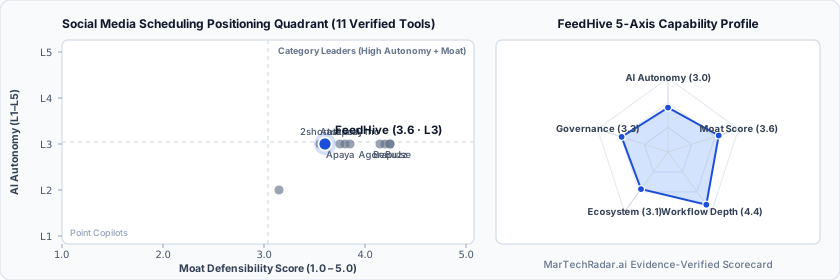
FeedHive is a Web SaaS tool for Social Media Scheduling (Social Media Scheduling & Auto-Publishing) in Social & Influencer. Pricing: From $15/mo. Best suited to B2B SaaS and Creators / Solo. Editor ratings: AI autonomy L3 (conditional automation); moat score 3.6/5.0 (Proprietary moat). Fact-checked by Anthony Hay on Oct 14, 2026.
AI-powered social media scheduling, automation, and analytics platform helping marketing teams scale multi-channel social workflows.
FeedHive buyer fit verdict: when to choose vs. when to walk away
Choose FeedHive if (Best Fit)
- Target ICP & Stack Fit: You operate as B2B SaaS and Creators / Solo requiring a Web SaaS deployment for Social Media Scheduling.
- L3 Architecture & Defensibility: Algorithmic recycling queues, AI assistant generation integrated with native scheduling pipelines, and programmatic agent orchestration across platforms.
- Commercial Model Fit: Your procurement budget aligns with From $15/mo.
Walk away from FeedHive if (Deal-Breakers)
- Walk away if your workflow requires uncapped enterprise volume on the From $15/mo entry plan without upgrading tiers.
- Walk away if your workflow cannot tolerate API rate limits and platform policy gaps: Third-party social network API token expirations and dynamic endpoint throttling can disrupt scheduled publishing queues, requiring manual re-authentication.
- Walk away if consumption-bound AI credit overhead is a deal-breaker for your team: High-volume generative drafting exhausts fixed monthly AI credit pools, restricting autonomous content experimentation during active campaign cycles.
FeedHive key facts & scorecard
| Pricing | From $15/moVendor pricing page |
|---|---|
| Free plan | No / not disclosed |
| Delivery | Web SaaS |
| Audience | B2B SaaS, Creators / Solo |
| AI autonomy level | L3 · Conditional automationEditor-verified |
| Moat tier & score | 3.6 / 5.0 · Proprietary moatEditor-verified |
| Funding | Venture-backed |
| Company size | 2-10 employees |
| Governance & docs | API & Docs ↗ · Terms ↗ · Privacy ↗ |
| Headquarters | Zurich, CH |
| Founded | 2021 |
| Last verified |
FeedHive pros & cons: strengths vs. operational limitations
Pros: core strengths & capabilities
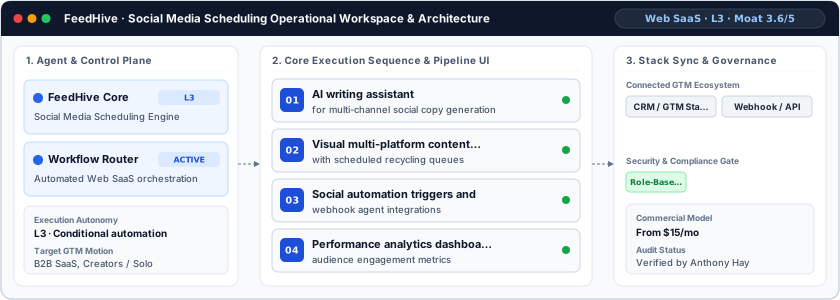
- AI writing assistant: for multi-channel social copy generation
- Visual multi-platform content calendar: with scheduled recycling queues
- Social automation triggers and: webhook agent integrations
- Performance analytics dashboards tracking: audience engagement metrics
Cons: operational limitations & risks
- API Rate Limits and Platform Policy Gaps: Third-party social network API token expirations and dynamic endpoint throttling can disrupt scheduled publishing queues, requiring manual re-authentication.
- Consumption-Bound AI Credit Overhead: High-volume generative drafting exhausts fixed monthly AI credit pools, restricting autonomous content experimentation during active campaign cycles.
- Governance and Deep CRM Attribution Deficits: The system lacks bi-directional multi-touch attribution syncing with enterprise data warehouses, requiring manual exports to reconcile pipeline impact.
FeedHive TCO & deal-breaker stress test
Simulate 12-month stepped TCO, hidden cost multipliers, contract lock-in exposure, and stack failure modes using only facts verified by Anthony Hay on · Capture SHA ae4f743b.
FeedHive aligns with your 5-seat / $800/mo profile. Review the walk-away triggers and contract levers below before deployment.
| Plan / Tier | Verified Rate | Scale Fit | Scope & Quota Notes |
|---|---|---|---|
| Entry / Starter | $15/mo | 1–2 seats | Verified $15/mo published rate on vendor pricing schedule. |
| Growth / Professional | $180/mo | 5 seats | Verified $180/mo published rate on vendor pricing schedule. |
- Moat Score
- 3.6 / 5.0
- AI Autonomy
- L3
- Free Tier / Trial
- None disclosed
Triggered audit signals & failure modes
- Published Self-Serve Entry FloorVerified Pricing Ledger
FeedHive publishes a transparent entry point (From $15/mo) for initial validation before committing.
- Tier Fit for 5-Seat Scale: Growth / Professional ($180/mo)Verified Tier Schedule
Verified $180/mo published rate on vendor pricing schedule.
- Primary Operational Bottleneck: Consumption-Bound AI Credit OverheadAudit by Anthony Hay
High-volume generative drafting exhausts fixed monthly AI credit pools, restricting autonomous content experimentation during active campaign cycles.
Hidden TCO Multipliers & Quota Gates
- Annual Billing Headline vs. Monthly Premium: Headline entry rates reflect annual billing commitments (Save up to 30%); month-to-month flexibility carries a higher effective monthly rate or requires annual prepayment.
- Credit & Usage Burn Multiplier: Automated workflows consume metered credits/usage quotas; multi-step enrichment, voice minutes, or high-frequency agent runs can trigger mid-cycle top-up packs.
When to Walk Away & Negotiation Levers
- Walk away if your workflow requires uncapped enterprise volume on the From $15/mo entry plan without upgrading tiers.
- Walk away if your workflow cannot tolerate API rate limits and platform policy gaps: Third-party social network API token expirations and dynamic endpoint throttling can disrupt scheduled publishing queues, requiring manual re-authentication.
- Walk away if consumption-bound AI credit overhead is a deal-breaker for your team: High-volume generative drafting exhausts fixed monthly AI credit pools, restricting autonomous content experimentation during active campaign cycles.
- Validate exact quota thresholds (seats, credits, or API calls) included in FeedHive's From $15/mo tier before converting from monthly to annual billing.
- Require a sandbox proof-of-concept testing API rate limits and platform policy gaps against your live CRM/data schema before annual sign-off.
Ask a custom procurement or TCO stress-test question about FeedHive
Lower 5-seat floor (~$7/mo vs. $180 / mo)
Lower 5-seat floor (~$10/mo vs. $180 / mo)
FeedHive moat & subtrack positioning
Algorithmic recycling queues, AI assistant generation integrated with native scheduling pipelines, and programmatic agent orchestration across platforms.
Editorial review
Fact-checked by Anthony Hay (Senior SEO, Search Intelligence & Content Operations Editor) on .
Background
Modern social distribution requires operational cadence across fragmented networks without compounding manual production overhead. Founded in 2021 and headquartered in Zurich, CH, FeedHive addresses this operational bottleneck by delivering an algorithmic social publishing and workflow automation engine. Designed primarily for agency leads, social media managers, and mid-market growth teams, the platform consolidates campaign scheduling, programmatic post recycling, and generative drafting into a synchronized operational calendar across major social networks.
How FeedHive works
At Level 3 autonomy, FeedHive functions through a multi-tier publishing pipeline coupled with an integrated language model orchestration layer. Inbound creative prompts and campaign outlines trigger the AI Assistant, which evaluates platform-specific character limits, formatting constraints, and past engagement data to generate post variants. The scheduling engine indexes scheduled assets into dynamic content queues, routing approved payloads via direct network APIs while managing rate-limited webhook responses and engagement tracking metrics in real time.
Limitations
Operational considerations and platform boundaries include:
- API Rate Limits and Platform Policy Gaps: Third-party social network API token expirations and dynamic endpoint throttling can disrupt scheduled publishing queues, requiring manual re-authentication.
- Consumption-Bound AI Credit Overhead: High-volume generative drafting exhausts fixed monthly AI credit pools, restricting autonomous content experimentation during active campaign cycles.
- Governance and Deep CRM Attribution Deficits: The system lacks bi-directional multi-touch attribution syncing with enterprise data warehouses, requiring manual exports to reconcile pipeline impact.
FeedHive pricing
Commercial access operates on a tiered SaaS subscription starting from $15 per month on entry-level plans, with annual billing options available at $180 per year. Upper tiers scale according to connected social accounts, team collaboration seats, approval workflow governance, and allocated monthly AI generation credits.
How FeedHive compares
Relative to unified social listening suites like Agorapulse, FeedHive emphasizes generative copywriting automation and recurring queue recycling over deep community management ticketing. Compared to emerging automated engines like Antela.ai, Inc. and Apaya, FeedHive provides a more mature editorial UI for team approvals, making it suitable for content-heavy operational teams seeking reliable cross-platform publishing without enterprise-grade listening overhead.
Frequently asked questions about FeedHive
How much does FeedHive cost and what pricing tiers are available?
Published pricing summary for FeedHive: From $15/mo. A permanent free plan is not disclosed for FeedHive. Verified tier schedule: Entry / Starter ($15/mo for 1–2 seats); Growth / Professional ($180/mo for 5 seats). Commercial access operates on a tiered SaaS subscription starting from $15 per month on entry-level plans, with annual billing options available at $180 per year.
How does FeedHive work and how autonomous is its AI architecture?
AI-powered social media scheduling, automation, and analytics platform helping marketing teams scale multi-channel social workflows. Within Social Media Scheduling (Social Media Scheduling & Auto-Publishing), MarTechRadar rates its execution architecture at L3 · Conditional automation with a verified Moat Score of 3.6 / 5.0 (Proprietary moat). Algorithmic recycling queues, AI assistant generation integrated with native scheduling pipelines, and programmatic agent orchestration across platforms. Corporate profile: operating at 2-10 employees scale.
What are the main limitations of FeedHive and when should buyers walk away?
Based on our editorial technical audit, key operational considerations and boundaries for FeedHive include: (1) API Rate Limits and Platform Policy Gaps: Third-party social network API token expirations and dynamic endpoint throttling can disrupt scheduled publishing queues, requiring manual re-authentication. (2) Consumption-Bound AI Credit Overhead: High-volume generative drafting exhausts fixed monthly AI credit pools, restricting autonomous content experimentation during active campaign cycles. (3) Governance and Deep CRM Attribution Deficits: The system lacks bi-directional multi-touch attribution syncing with enterprise data warehouses, requiring manual exports to reconcile pipeline impact. Primary procurement walk-away rule: Walk away if your workflow requires uncapped enterprise volume on the From $15/mo entry plan without upgrading tiers.
What integrations, compliance certifications, and contract terms apply to FeedHive?
First-party governance and developer endpoints verified on domain include: API Docs (https://docs.feedhive.com). Key TCO multiplier to watch: Annual Billing Headline vs. Monthly Premium (Headline entry rates reflect annual billing commitments (Save up to 30%); month-to-month flexibility carries a higher effective monthly rate or requires annual prepayment.) Before signing a contract, procurement teams should validate exact quota thresholds (seats, credits, or API calls) included in FeedHive's From $15/mo tier before converting from monthly to annual billing.
What are the best FeedHive alternatives and head-to-head competitors in 2026?
Top fact-checked alternatives to FeedHive in Social Media Scheduling (Social Media Scheduling & Auto-Publishing) include Publer (From $4/mo), Vidyo.ai ($7–$49/mo), Vizard.ai (Free plan · $0/mo · Enterprise plan), askpolly (Custom / enterprise pricing). Relative to unified social listening suites like Agorapulse, FeedHive emphasizes generative copywriting automation and recurring queue recycling over deep community management ticketing.
Verified sources & evidence trail
- Official product domain: https://feedhive.com
- Commercial pricing verification: https://www.feedhive.com/pricing
- Verified corporate entity profiles (
sameAs): LinkedIn Company Profile · Crunchbase Entity Record · Crunchbase Entity Record - First-party governance & documentation links: API & Docs · Terms · Privacy
- Editorial audit sign-off: Fact-checked by Anthony Hay on under the MarTechRadar Evidence-Ledger Protocol.