Hour One Review (2026): AI Avatar Pricing, Limits & Alternatives
Bottom line
Hour One is a Web SaaS tool for AI Avatar (Digital Avatars & Presenters) in Visual & Creative Media. Pricing: Custom / enterprise pricing. Best suited to DTC / eCommerce and Enterprise Brands. Editor ratings: AI autonomy L2 (workflow copilot); moat score 4.2/5.0 (Proprietary moat). Fact-checked by Julie Brot on Oct 16, 2026.
Enterprise generative AI video platform transforming text scripts into photorealistic presenter-led studio videos using licensed human avatars.
Hour One buyer fit verdict: when to choose vs. when to walk away
Choose Hour One if (Best Fit)
- Target ICP & Stack Fit: You operate as DTC / eCommerce and Enterprise Brands requiring a Web SaaS deployment for AI Avatar.
- L2 Architecture & Defensibility: Proprietary photorealistic avatar rendering pipeline coupled with a commercial marketplace of licensed human presenters and dynamic 3D studio environments.
- Commercial Model Fit: Your procurement budget aligns with Custom / enterprise pricing.
Walk away from Hour One if (Deal-Breakers)
- Walk away if you require transparent self-serve monthly billing or your budget ceiling is under $1,000/mo (Hour One requires sales-gated custom quoting).
- Walk away if your workflow cannot tolerate non-verbal animation latency: Avatars exhibit mechanical upper-body gestures and rigid micro-expressions when handling fast technical dialogue, limiting dynamic audience engagement.
- Walk away if batch rendering throughput is a deal-breaker for your team: High-definition multi-scene generation incurs noticeable queue times during peak rendering loads, constraining rapid localized production turnarounds.
Hour One key facts & scorecard
| Pricing | Custom / enterprise pricing |
|---|---|
| Free plan | No / not disclosed |
| Delivery | Web SaaS |
| Audience | DTC / eCommerce, Enterprise Brands |
| AI autonomy level | L2 · Workflow copilotEditor-verified |
| Moat tier & score | 4.2 / 5.0 · Proprietary moatEditor-verified |
| Funding | AcquiredAcquired by Wix |
| Total funding | $25M |
| Founders | Arnon Kahani, Lior Hakim, Natalie Monbiot, Oren Aharon |
| Company size | 11-50 employees |
| Headquarters | Tel Aviv, Israel |
| Founded | 2019 |
| Last verified |
Hour One pros & cons: strengths vs. operational limitations
Pros: core strengths & capabilities
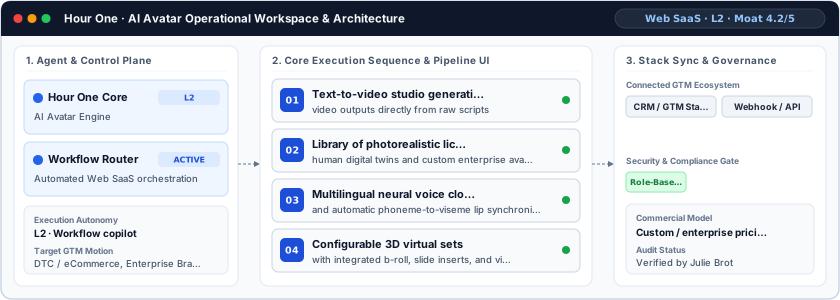
- Text-to-video studio generating presenter-led: video outputs directly from raw scripts
- Library of photorealistic licensed: human digital twins and custom enterprise avatar synthesis
- Multilingual neural voice cloning: and automatic phoneme-to-viseme lip synchronization
- Configurable 3D virtual sets: with integrated b-roll, slide inserts, and visual layouts
Cons: operational limitations & risks
- Non-verbal animation latency: Avatars exhibit mechanical upper-body gestures and rigid micro-expressions when handling fast technical dialogue, limiting dynamic audience engagement.
- Batch rendering throughput: High-definition multi-scene generation incurs noticeable queue times during peak rendering loads, constraining rapid localized production turnarounds.
- Contextual pacing calibration: Text-to-speech cadence often requires manual SSML tagging to prevent uninflected delivery across complex enterprise terminology and legal scripts.
Hour One TCO & deal-breaker stress test
Simulate 12-month stepped TCO, hidden cost multipliers, contract lock-in exposure, and stack failure modes using only facts verified by Julie Brot on · Capture SHA 98f237d3.
Hour One triggers high-severity friction under your 5-seat / $800/mo constraints. Benchmark the verified subtrack alternatives below before committing.
| Plan / Tier | Verified Rate | Scale Fit | Scope & Quota Notes |
|---|---|---|---|
| Enterprise / Custom | Custom quote | 15–50+ seats (Enterprise SLA) | Sales-negotiated annual contract for custom volume, SSO/RBAC governance, and dedicated SLA. |
- Moat Score
- 4.2 / 5.0
- AI Autonomy
- L2
- Free Tier / Trial
- None disclosed
Triggered audit signals & failure modes
- Opaque Enterprise Quoting vs. SMB/Mid-Market BudgetVerified Pricing Ledger
Hour One does not disclose a public self-serve floor (Custom / enterprise pricing). Buyers with a $800/mo cap face high sales-qualification friction.
- Sales-Gated Contract TermsFact-checked by Julie Brot
Commercial procurement operates on an enterprise model where pricing is available on request through tailored enterprise sales quotes based on organizational scale and seats.
- Primary Operational Bottleneck: Non-verbal animation latencyAudit by Julie Brot
Avatars exhibit mechanical upper-body gestures and rigid micro-expressions when handling fast technical dialogue, limiting dynamic audience engagement.
Hidden TCO Multipliers & Quota Gates
- Non-verbal animation latency: Avatars exhibit mechanical upper-body gestures and rigid micro-expressions when handling fast technical dialogue, limiting dynamic audience engagement.
- Batch rendering throughput: High-definition multi-scene generation incurs noticeable queue times during peak rendering loads, constraining rapid localized production turnarounds.
When to Walk Away & Negotiation Levers
- Walk away if you require transparent self-serve monthly billing or your budget ceiling is under $1,000/mo (Hour One requires sales-gated custom quoting).
- Walk away if your workflow cannot tolerate non-verbal animation latency: Avatars exhibit mechanical upper-body gestures and rigid micro-expressions when handling fast technical dialogue, limiting dynamic audience engagement.
- Walk away if batch rendering throughput is a deal-breaker for your team: High-definition multi-scene generation incurs noticeable queue times during peak rendering loads, constraining rapid localized production turnarounds.
- Demand a 30- to 60-day paid pilot opt-out clause in the Hour One order form before signing a 12-month enterprise commitment.
- Require a sandbox proof-of-concept testing non-verbal animation latency against your live CRM/data schema before annual sign-off.
Ask a custom procurement or TCO stress-test question about Hour One
Lower 5-seat floor (~$24/mo vs. Custom Quote) · Transparent self-serve entry without mandatory annual lock-in
Lower 5-seat floor (~$39/mo vs. Custom Quote) · Transparent self-serve entry without mandatory annual lock-in
Hour One moat & subtrack positioning
Proprietary photorealistic avatar rendering pipeline coupled with a commercial marketplace of licensed human presenters and dynamic 3D studio environments.
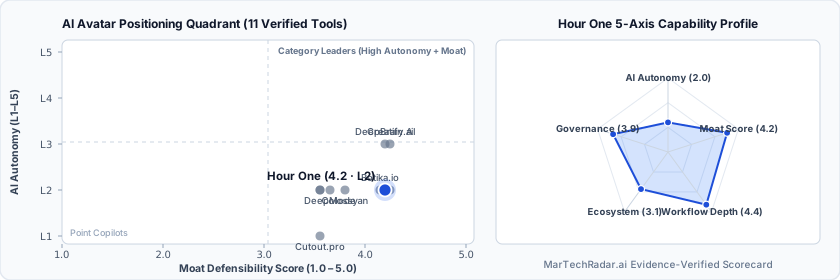
Editorial review
Fact-checked by Julie Brot (Enterprise SaaS Governance & Procurement Editor) on .
Background
Hour One was established in 2019 in Tel Aviv, Israel, to decouple corporate visual communications from the cost and operational overhead of physical studio production. Having secured $25M in venture funding before being acquired by Wix, the company targets enterprise learning and development heads, corporate communications leads, and product marketing teams. The software provides an automated pipeline for generating presenter-led instructional and promotional video assets directly from structured text inputs.
How Hour One works
At the architectural layer, the system autonomy, the platform centers on a cloud-based neural synthesis engine. Users input written transcripts, select from a catalog of licensed human avatars, and configure cinematic virtual environments. The ingestion pipeline processes text inputs through neural text-to-speech models, which drive phoneme-to-viseme alignment models to animate synthetic presenter facial mechanics. The rendering engine composites the resulting synthetic presenter into 3D virtual studio sets alongside slide graphics and b-roll assets.
Limitations
Operational considerations and platform boundaries include:
- Non-verbal animation latency: Avatars exhibit mechanical upper-body gestures and rigid micro-expressions when handling fast technical dialogue, limiting dynamic audience engagement.
- Batch rendering throughput: High-definition multi-scene generation incurs noticeable queue times during peak rendering loads, constraining rapid localized production turnarounds.
- Contextual pacing calibration: Text-to-speech cadence often requires manual SSML tagging to prevent uninflected delivery across complex enterprise terminology and legal scripts.
Hour One pricing
Commercial procurement operates on an enterprise model where pricing is available on request through tailored enterprise sales quotes based on organizational scale and seats. Contracts typically accommodate structured commitments governed by render-minute allocations, seat licenses, custom avatar creation services, and enterprise compliance requirements.
How Hour One compares
Hour One competes directly against Synthesia, HeyGen, and Colossyan within the synthetic video subtrack. Synthesia provides broader ecosystem integrations and corporate compliance controls, while HeyGen delivers rapid mobile-optimized video workflows and dynamic script adaptation. Colossyan maintains focus on workplace training features like interactive branching. Hour One differentiates through its pre-rendered 3D studio environments, serving corporate operations seeking standardized, broadcast-style training modules. It is best suited for enterprise marketing teams and growth practitioners seeking disciplined workflow orchestration.
Frequently asked questions about Hour One
How much does Hour One cost and does it require a custom enterprise quote?
Published pricing summary for Hour One: Custom / enterprise pricing. A permanent free plan is not disclosed for Hour One. Commercial procurement operates on an enterprise model where pricing is available on request through tailored enterprise sales quotes based on organizational scale and seats.
How does Hour One work and how autonomous is its AI architecture?
Enterprise generative AI video platform transforming text scripts into photorealistic presenter-led studio videos using licensed human avatars. Within AI Avatar (Digital Avatars & Presenters), MarTechRadar rates its execution architecture at L2 · Workflow copilot with a verified Moat Score of 4.2 / 5.0 (Proprietary moat). Proprietary photorealistic avatar rendering pipeline coupled with a commercial marketplace of licensed human presenters and dynamic 3D studio environments. Corporate profile: Founded by Arnon Kahani, Lior Hakim, Natalie Monbiot, Oren Aharon, operating at 11-50 employees scale, acquired by Wix.
What are the main limitations of Hour One and when should buyers walk away?
Based on our editorial technical audit, key operational considerations and boundaries for Hour One include: (1) Non-verbal animation latency: Avatars exhibit mechanical upper-body gestures and rigid micro-expressions when handling fast technical dialogue, limiting dynamic audience engagement. (2) Batch rendering throughput: High-definition multi-scene generation incurs noticeable queue times during peak rendering loads, constraining rapid localized production turnarounds. (3) Contextual pacing calibration: Text-to-speech cadence often requires manual SSML tagging to prevent uninflected delivery across complex enterprise terminology and legal scripts. Primary procurement walk-away rule: Walk away if you require transparent self-serve monthly billing or your budget ceiling is under $1,000/mo (Hour One requires sales-gated custom quoting).
What integrations, compliance certifications, and contract terms apply to Hour One?
Key TCO multiplier to watch: Non-verbal animation latency (Avatars exhibit mechanical upper-body gestures and rigid micro-expressions when handling fast technical dialogue, limiting dynamic audience engagement.) Before signing a contract, procurement teams should demand a 30- to 60-day paid pilot opt-out clause in the Hour One order form before signing a 12-month enterprise commitment.
What are the best Hour One alternatives and head-to-head competitors in 2026?
Top fact-checked alternatives to Hour One in AI Avatar (Digital Avatars & Presenters) include Wondershare Virbo (Custom / enterprise pricing), Cutout.pro (Custom / enterprise pricing), OnModel (Custom / enterprise pricing), Synthesia (Free plan · $29–$89/mo). Hour One competes directly against Synthesia, HeyGen, and Colossyan within the synthetic video subtrack. Synthesia provides broader ecosystem integrations and corporate compliance controls, while HeyGen delivers rapid mobile-optimized video workflows and dynamic script adaptation.
Verified sources & evidence trail
- Official product domain: https://hourone.ai
- Commercial pricing verification: Verified against official vendor pricing policy (Custom / enterprise pricing)
- Verified corporate entity profiles (
sameAs): LinkedIn Company Profile · Crunchbase Entity Record - Editorial audit sign-off: Fact-checked by Julie Brot on under the MarTechRadar Evidence-Ledger Protocol.