INRŌ Review (2026): Social Media Scheduling Pricing, Limits & Alternatives
Bottom line
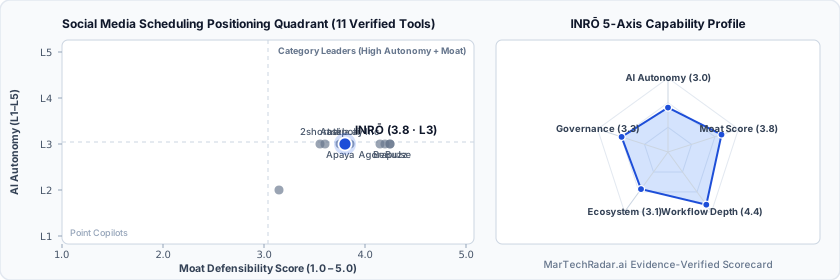
INRŌ is a Web SaaS tool for Social Media Scheduling (Social Media Scheduling & Auto-Publishing) in Social & Influencer. Pricing: Free plan · $0/mo · Enterprise plan. Best suited to Social Media Managers, Creator & Influencer Agencies and Brand Community Ops. Editor ratings: AI autonomy L3 (conditional automation); moat score 3.8/5.0 (Proprietary moat). Fact-checked by Anthony Hay on Oct 11, 2026.
AI-driven Instagram DM automation and conversational sales platform converting social comments, mentions, and inbound messages into qualified leads.
INRŌ buyer fit verdict: when to choose vs. when to walk away
Choose INRŌ if (Best Fit)
- Target ICP & Stack Fit: You operate as Social Media Managers, Creator & Influencer Agencies and Brand Community Ops requiring a Web SaaS deployment for Social Media Scheduling.
- L3 Architecture & Defensibility: Native Meta Graph API messaging integration combined with proprietary intent parsing and conversational commerce automation tailored for direct-to-consumer funnels.
- Commercial Model Fit: Your procurement budget aligns with Free plan · $0/mo · Enterprise plan and want a self-serve free tier for zero-cost initial validation.
Walk away from INRŌ if (Deal-Breakers)
- Walk away if your workflow requires uncapped enterprise volume on the Free plan · $0/mo · Enterprise plan entry plan without upgrading tiers.
- Walk away if your workflow cannot tolerate platform monoculture & rate limits: The architecture remains heavily dependent on Meta's developer ecosystem, exposing workflows to Meta Graph API rate limits, schema updates, and rigid messaging window restrictions.
- Walk away if conversational hallucination risk is a deal-breaker for your team: Autonomous generative replies require stringent prompt boundaries, as unconstrained interactions risk generating inaccurate product specifications or unapproved discount codes.
INRŌ key facts & scorecard
| Pricing | Free plan · $0/mo · Enterprise planVendor pricing page |
|---|---|
| Free plan | Yes |
| Delivery | Web SaaS |
| Audience | Social Media Managers, Creator & Influencer Agencies, Brand Community Ops |
| AI autonomy level | L3 · Conditional automationEditor-verified |
| Moat tier & score | 3.8 / 5.0 · Proprietary moatEditor-verified |
| Funding | Undisclosed |
| Total funding | UndisclosedBacked by Icehouse Ventures, Enterprise Angels |
| Company size | 2-10 employees |
| Governance & docs | DPA ↗ · Terms ↗ · Privacy ↗ |
| Headquarters | Pontpoint, Hauts-de-France |
| Founded | 2023 |
| Last verified |
INRŌ pros & cons: strengths vs. operational limitations
Pros: core strengths & capabilities
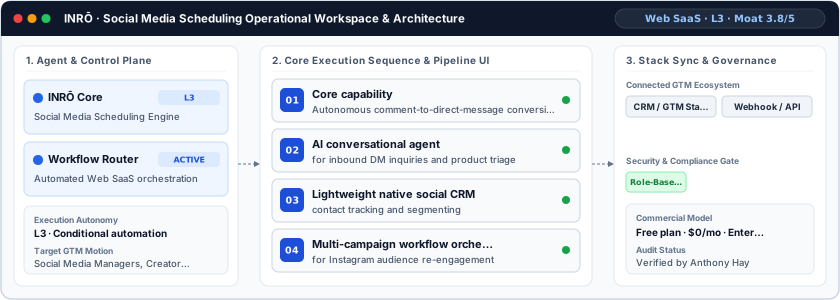
- Core capability: Autonomous comment-to-direct-message conversion triggers
- AI conversational agent: for inbound DM inquiries and product triage
- Lightweight native social CRM: contact tracking and segmenting
- Multi-campaign workflow orchestration: for Instagram audience re-engagement
Cons: operational limitations & risks
- Platform Monoculture & Rate Limits: The architecture remains heavily dependent on Meta's developer ecosystem, exposing workflows to Meta Graph API rate limits, schema updates, and rigid messaging window restrictions.
- Conversational Hallucination Risk: Autonomous generative replies require stringent prompt boundaries, as unconstrained interactions risk generating inaccurate product specifications or unapproved discount codes.
- Attribution & Enterprise Integration Lag: Data synchronization with external enterprise data warehouses or headless CRM environments lacks bi-directional webhooks, necessitating manual export routines for complex multi-touch attribution.
INRŌ TCO & deal-breaker stress test
Simulate 12-month stepped TCO, hidden cost multipliers, contract lock-in exposure, and stack failure modes using only facts verified by Anthony Hay on · Capture SHA 725654a3.
INRŌ is viable for 5 seats, but requires commercial or technical verification on the flagged items below.
| Plan / Tier | Verified Rate | Scale Fit | Scope & Quota Notes |
|---|---|---|---|
| Free / Sandbox | $0 | 1–2 seats (Evaluation) | Entry free tier with capped usage or feature quotas for initial workflow testing. |
| Entry / Starter | $12.99/mo | 1–2 seats | Verified $12.99/mo published rate on vendor pricing schedule. |
| Growth / Professional | $299/mo | 5 seats | Verified $299/mo published rate on vendor pricing schedule. |
| Scale / Advanced | $1249/mo | 15 seats | Verified $1249/mo published rate on vendor pricing schedule. |
- Moat Score
- 3.8 / 5.0
- AI Autonomy
- L3
- Free Tier / Trial
- Free plan
Triggered audit signals & failure modes
- Opaque Enterprise Quoting vs. SMB/Mid-Market BudgetVerified Pricing Ledger
INRŌ does not disclose a public self-serve floor (Free plan · $0/mo · Enterprise plan). Buyers with a $800/mo cap face high sales-qualification friction.
- Published Self-Serve Entry FloorVerified Pricing Ledger
INRŌ publishes a transparent entry point (Free plan · $0/mo · Enterprise plan) with a free tier for initial validation before committing.
- Tier Fit for 5-Seat Scale: Entry / Starter ($12.99/mo)Verified Tier Schedule
Verified $12.99/mo published rate on vendor pricing schedule.
- Primary Operational Bottleneck: Platform Monoculture & Rate LimitsAudit by Anthony Hay
The architecture remains heavily dependent on Meta's developer ecosystem, exposing workflows to Meta Graph API rate limits, schema updates, and rigid messaging window restrictions.
Hidden TCO Multipliers & Quota Gates
- Annual Billing Headline vs. Monthly Premium: Headline entry rates reflect annual billing commitments (save 30%); month-to-month flexibility carries a higher effective monthly rate or requires annual prepayment.
- Credit & Usage Burn Multiplier: Automated workflows consume metered credits/usage quotas; multi-step enrichment, voice minutes, or high-frequency agent runs can trigger mid-cycle top-up packs.
When to Walk Away & Negotiation Levers
- Walk away if your workflow requires uncapped enterprise volume on the Free plan · $0/mo · Enterprise plan entry plan without upgrading tiers.
- Walk away if your workflow cannot tolerate platform monoculture & rate limits: The architecture remains heavily dependent on Meta's developer ecosystem, exposing workflows to Meta Graph API rate limits, schema updates, and rigid messaging window restrictions.
- Walk away if conversational hallucination risk is a deal-breaker for your team: Autonomous generative replies require stringent prompt boundaries, as unconstrained interactions risk generating inaccurate product specifications or unapproved discount codes.
- Validate exact quota thresholds (seats, credits, or API calls) included in INRŌ's Free plan · $0/mo · Enterprise plan tier before converting from monthly to annual billing.
- Require a sandbox proof-of-concept testing platform monoculture & rate limits against your live CRM/data schema before annual sign-off.
Ask a custom procurement or TCO stress-test question about INRŌ
Lower 5-seat floor (~$60/mo vs. Custom Quote)
Lower 5-seat floor (~$19/mo vs. Custom Quote)
INRŌ moat & subtrack positioning
Native Meta Graph API messaging integration combined with proprietary intent parsing and conversational commerce automation tailored for direct-to-consumer funnels.
Editorial review
Fact-checked by Anthony Hay (Senior SEO, Search Intelligence & Content Operations Editor) on .
Background
Established in 2023 and headquartered in Pontpoint, Hauts-de-France, INRŌ addresses the critical conversion bottleneck between social engagement and transactional commerce. Engineered specifically for direct-to-consumer e-commerce brands, digital creators, and growth marketing teams, the platform replaces manual community moderation with automated conversational sales funnels. Rather than treating social channels merely as broadcasting endpoints, INRŌ captures audience interest at the point of interaction, deploying automated agents directly inside Instagram direct messaging to drive qualified lead acquisition and catalog discovery.
How INRŌ works
At its technical core, INRŌ operates as an L3 semi-autonomous interaction engine integrated via the official Meta Graph API webhooks. The system continuously listens for incoming events, including public post comments, story mentions, and inbound direct messages. Upon event detection, INRŌ parses user intent using conversational natural language processing agents, triggering deterministic message flows or context-aware generative replies. The platform synchronizes contact records into an internal social CRM, maintaining thread state, qualification tags, and active interaction sequences without human intervention.
Limitations
Operational considerations and platform boundaries include:
- Platform Monoculture & Rate Limits: The architecture remains heavily dependent on Meta's developer ecosystem, exposing workflows to Meta Graph API rate limits, schema updates, and rigid messaging window restrictions.
- Conversational Hallucination Risk: Autonomous generative replies require stringent prompt boundaries, as unconstrained interactions risk generating inaccurate product specifications or unapproved discount codes.
- Attribution & Enterprise Integration Lag: Data synchronization with external enterprise data warehouses or headless CRM environments lacks bi-directional webhooks, necessitating manual export routines for complex multi-touch attribution.
INRŌ pricing
INRŌ structures its commercial packaging around contact volume, workflow capacity, and AI agent token allocations. The entry tier is available at $0 per month, supporting up to 100 active monthly contacts, three concurrent automations, and baseline AI credits. Scaling organizations transition to tiered plans starting at $12.99 per month for expanded contact quotas, with custom enterprise pricing deployed for high-volume brand deployments requiring bespoke infrastructure parameters.
How INRŌ compares
Within the social automation spectrum, INRŌ differentiates itself from multi-channel publishers like Agorapulse by focusing strictly on inbound conversational conversions over scheduled publishing calendars. Against competitors such as Antela.ai, Inc. and Apaya, INRŌ prioritizes deep native Instagram API event handling rather than broad, shallow cross-network scheduling. The ideal enterprise buyer is a mid-market DTC merchant or high-velocity brand handling heavy inbound Instagram comment volumes seeking automated lead capture without heavy multi-channel overhead.
Direct competitors & market radar
Top algorithmic competitors based on category positioning, capability overlap, and ICP alignment.
Frequently asked questions about INRŌ
How much does INRŌ cost and what pricing tiers are available?
Published pricing summary for INRŌ: Free plan · $0/mo · Enterprise plan. INRŌ includes a free tier or sandbox entry point. Verified tier schedule: Free / Sandbox ($0 for 1–2 seats (Evaluation)); Entry / Starter ($12.99/mo for 1–2 seats); Growth / Professional ($299/mo for 5 seats); Scale / Advanced ($1249/mo for 15 seats). INRŌ structures its commercial packaging around contact volume, workflow capacity, and AI agent token allocations. The entry tier is available at $0 per month, supporting up to 100 active monthly contacts, three concurrent automations, and baseline AI credits.
How does INRŌ work and how autonomous is its AI architecture?
AI-driven Instagram DM automation and conversational sales platform converting social comments, mentions, and inbound messages into qualified leads. Within Social Media Scheduling (Social Media Scheduling & Auto-Publishing), MarTechRadar rates its execution architecture at L3 · Conditional automation with a verified Moat Score of 3.8 / 5.0 (Proprietary moat). Native Meta Graph API messaging integration combined with proprietary intent parsing and conversational commerce automation tailored for direct-to-consumer funnels. Corporate profile: operating at 2-10 employees scale.
What are the main limitations of INRŌ and when should buyers walk away?
Based on our editorial technical audit, key operational considerations and boundaries for INRŌ include: (1) Platform Monoculture & Rate Limits: The architecture remains heavily dependent on Meta's developer ecosystem, exposing workflows to Meta Graph API rate limits, schema updates, and rigid messaging window restrictions. (2) Conversational Hallucination Risk: Autonomous generative replies require stringent prompt boundaries, as unconstrained interactions risk generating inaccurate product specifications or unapproved discount codes. (3) Attribution & Enterprise Integration Lag: Data synchronization with external enterprise data warehouses or headless CRM environments lacks bi-directional webhooks, necessitating manual export routines for complex multi-touch attribution. Primary procurement walk-away rule: Walk away if your workflow requires uncapped enterprise volume on the Free plan · $0/mo · Enterprise plan entry plan without upgrading tiers.
What integrations, compliance certifications, and contract terms apply to INRŌ?
First-party governance and developer endpoints verified on domain include: DPA (https://www.inro.social/legal/dpa). Key TCO multiplier to watch: Annual Billing Headline vs. Monthly Premium (Headline entry rates reflect annual billing commitments (save 30%); month-to-month flexibility carries a higher effective monthly rate or requires annual prepayment.) Before signing a contract, procurement teams should validate exact quota thresholds (seats, credits, or API calls) included in INRŌ's Free plan · $0/mo · Enterprise plan tier before converting from monthly to annual billing.
What are the best INRŌ alternatives and head-to-head competitors in 2026?
Top fact-checked alternatives to INRŌ in Social Media Scheduling (Social Media Scheduling & Auto-Publishing) include Metricool (Free plan · $10–$45/mo), Flmlnk (From $60/mo), Castmagic (From $19/mo), Loomly (From $49/mo). Within the social automation spectrum, INRŌ differentiates itself from multi-channel publishers like Agorapulse by focusing strictly on inbound conversational conversions over scheduled publishing calendars.
Verified sources & evidence trail
- Official product domain: https://www.inro.social
- Commercial pricing verification: https://www.inro.social/pricing
- Verified corporate entity profiles (
sameAs): LinkedIn Company Profile · Crunchbase Entity Record - First-party governance & documentation links: DPA · Terms · Privacy
- Editorial audit sign-off: Fact-checked by Anthony Hay on under the MarTechRadar Evidence-Ledger Protocol.