Kochava Review (2026): Marketing Attribution Pricing, Limits & Alternatives
Bottom line
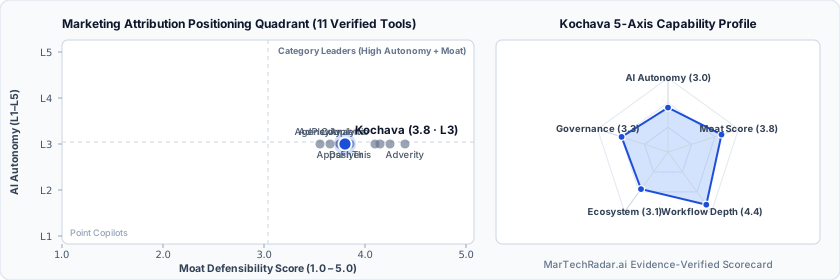
Kochava is a API / SDK tool for Marketing Attribution (Multi-Touch Attribution & eCommerce Dashboards) in Analytics & Attribution. Pricing: Custom / enterprise pricing. Best suited to DTC / eCommerce and Enterprise Brands. Editor ratings: AI autonomy L3 (conditional automation); moat score 3.8/5.0 (Proprietary moat). Fact-checked by Tim Fenolz on Oct 11, 2026.
Omnichannel attribution engine and mobile measurement platform providing real-time deterministic and probabilistic tracking across mobile, web, and CTV.
Kochava buyer fit verdict: when to choose vs. when to walk away
Choose Kochava if (Best Fit)
- Target ICP & Stack Fit: You operate as DTC / eCommerce and Enterprise Brands requiring a API / SDK deployment for Marketing Attribution.
- L3 Architecture & Defensibility: Kochava maintains defensibility via its proprietary real-time event processing architecture, deep direct network integrations across mobile and connected TV ecosystems, integrated anti-fraud engines, and a unified enterprise data marketplace.
- Commercial Model Fit: Your procurement budget aligns with Custom / enterprise pricing.
Walk away from Kochava if (Deal-Breakers)
- Walk away if you require transparent self-serve monthly billing or your budget ceiling is under $1,000/mo (Kochava requires sales-gated custom quoting).
- Walk away if your workflow cannot tolerate signal latency and skadnetwork timers: Aggregated conversion windows enforced by Apple SKAdNetwork generate delayed reporting cycles, restricting immediate algorithmic campaign reallocations.
- Walk away if SDK footprint and implementation overhead is a deal-breaker for your team: Embedding client-side tracking requires deep code-level integration, rigorous testing across target operating system releases, and ongoing maintenance to prevent binary bloat.
Kochava key facts & scorecard
| Pricing | Custom / enterprise pricing |
|---|---|
| Free plan | No / not disclosed |
| Delivery | API / SDK |
| Audience | DTC / eCommerce, Enterprise Brands |
| AI autonomy level | L3 · Conditional automationEditor-verified |
| Moat tier & score | 3.8 / 5.0 · Proprietary moatEditor-verified |
| Funding | Venture-backed |
| Total funding | Venture-backedBacked by Private Equity |
| Founders | Charles Manning |
| Company size | 51-200 employees |
| Headquarters | Sandpoint, ID |
| Founded | 2011 |
| Last verified |
Kochava pros & cons: strengths vs. operational limitations
Pros: core strengths & capabilities
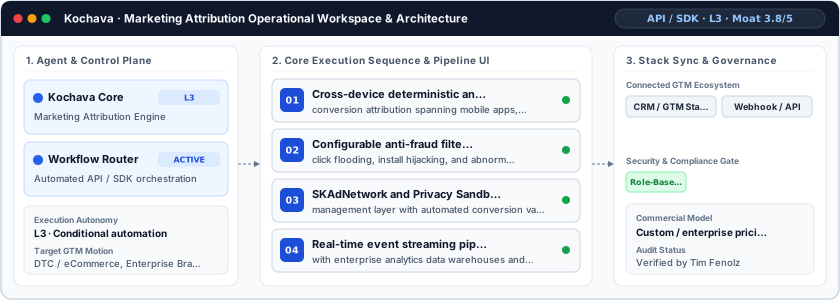
- Cross-device deterministic and probabilistic: conversion attribution spanning mobile apps, web surfaces, and CTV platforms
- Configurable anti-fraud filter monitoring: click flooding, install hijacking, and abnormal conversion telemetry
- SKAdNetwork and Privacy Sandbox: management layer with automated conversion value schema configuration
- Real-time event streaming pipeline integrating: with enterprise analytics data warehouses and downstream ad networks
Cons: operational limitations & risks
- Signal Latency and SKAdNetwork Timers: Aggregated conversion windows enforced by Apple SKAdNetwork generate delayed reporting cycles, restricting immediate algorithmic campaign reallocations.
- SDK Footprint and Implementation Overhead: Embedding client-side tracking requires deep code-level integration, rigorous testing across target operating system releases, and ongoing maintenance to prevent binary bloat.
- Data Pipeline Ingestion Limits: High-volume server-to-server webhook configurations occasionally experience downstream throttling when syncing high-frequency impression logs into external cloud warehouses.
Kochava TCO & deal-breaker stress test
Simulate 12-month stepped TCO, hidden cost multipliers, contract lock-in exposure, and stack failure modes using only facts verified by Tim Fenolz on · Capture SHA 90368c51.
Kochava triggers high-severity friction under your 5-seat / $800/mo constraints. Benchmark the verified subtrack alternatives below before committing.
| Plan / Tier | Verified Rate | Scale Fit | Scope & Quota Notes |
|---|---|---|---|
| Free | $500/mo | 1–2 seats | Includes 33K conversions/month |
| Enterprise / Custom | Custom quote | 15–50+ seats (Enterprise SLA) | Sales-negotiated annual contract for custom volume, SSO/RBAC governance, and dedicated SLA. |
- Moat Score
- 3.8 / 5.0
- AI Autonomy
- L3
- Free Tier / Trial
- None disclosed
Triggered audit signals & failure modes
- Opaque Enterprise Quoting vs. SMB/Mid-Market BudgetVerified Pricing Ledger
Kochava does not disclose a public self-serve floor (Custom / enterprise pricing). Buyers with a $800/mo cap face high sales-qualification friction.
- Sales-Gated Contract TermsFact-checked by Tim Fenolz
Kochava provisions its platform under a usage-based enterprise subscription model. Commercial pricing is available on request through tailored enterprise sales quotes based on organizational scale and seats.
- Usage / Credit Burn VolatilityCommercial Model Audit
Kochava uses credit or usage-metered billing (Custom / enterprise pricing). High-volume automated workflows across 5 seats can trigger mid-cycle overage charges.
- Primary Operational Bottleneck: Signal Latency and SKAdNetwork TimersAudit by Tim Fenolz
Aggregated conversion windows enforced by Apple SKAdNetwork generate delayed reporting cycles, restricting immediate algorithmic campaign reallocations.
Hidden TCO Multipliers & Quota Gates
- Per-Seat Linear Scaling: Kochava prices licenses on a per-user/seat basis (Custom / enterprise pricing); expanding from 2 to 15+ operators multiplies base recurring spend linearly.
- Credit & Usage Burn Multiplier: Automated workflows consume metered credits/usage quotas; multi-step enrichment, voice minutes, or high-frequency agent runs can trigger mid-cycle top-up packs.
- Enterprise Governance & Add-On Gating: Advanced capabilities such as Single Sign-On (SSO), custom role permissions, or specialized analytics modules are gated behind upper tiers or paid add-ons.
When to Walk Away & Negotiation Levers
- Walk away if you require transparent self-serve monthly billing or your budget ceiling is under $1,000/mo (Kochava requires sales-gated custom quoting).
- Walk away if your workflow cannot tolerate signal latency and skadnetwork timers: Aggregated conversion windows enforced by Apple SKAdNetwork generate delayed reporting cycles, restricting immediate algorithmic campaign reallocations.
- Walk away if SDK footprint and implementation overhead is a deal-breaker for your team: Embedding client-side tracking requires deep code-level integration, rigorous testing across target operating system releases, and ongoing maintenance to prevent binary bloat.
- Demand a 30- to 60-day paid pilot opt-out clause in the Kochava order form before signing a 12-month enterprise commitment.
- Require a sandbox proof-of-concept testing signal latency and skadnetwork timers against your live CRM/data schema before annual sign-off.
Ask a custom procurement or TCO stress-test question about Kochava
Lower 5-seat floor (~$79/mo vs. Custom Quote) · Transparent self-serve entry without mandatory annual lock-in
Lower 5-seat floor (~$20/mo vs. Custom Quote)
Kochava moat & subtrack positioning
Kochava maintains defensibility via its proprietary real-time event processing architecture, deep direct network integrations across mobile and connected TV ecosystems, integrated anti-fraud engines, and a unified enterprise data marketplace.
Editorial review
Fact-checked by Tim Fenolz (Lead AdTech, Programmatic & Attribution Analyst) on .
Background
Architected around cross-platform telemetry and deterministic device resolution, Kochava delivers an omnichannel attribution platform and mobile measurement partner (MMP) infrastructure. Headquartered in Sandpoint, ID, and founded in 2011, the company engineered its platform to unbundle ad measurement from walled-garden self-reporting. Kochava serves growth marketers, user acquisition directors, and enterprise data engineers who require unified conversion verification across mobile apps, web properties, and connected TV (CTV) networks. Rather than relying on sampled aggregates, the platform ingests raw, high-throughput event logs directly from publisher endpoints to establish auditable attribution records across complex acquisition funnels.
How Kochava works
At its operational foundation, Kochava runs a real-time event pipeline ingesting ad impressions, click redirects, and downstream in-app telemetry via client-side SDKs and server-to-server APIs. The system operates at an L3 autonomy profile, automating deterministic matching via persistent device graphs while falling back to privacy-safe probabilistic models when identifiers are constrained. For iOS and Android environments, Kochava provisions configurable schema management for Apple SKAdNetwork and Google Privacy Sandbox, decoding postback payloads into distinct conversion buckets. Simultaneously, heuristic anomaly detection engines inspect incoming telemetry to suppress click injection, install hijacking, and spoofed IPs prior to conversion finalization.
Limitations
Operational considerations and platform boundaries include:
- Signal Latency and SKAdNetwork Timers: Aggregated conversion windows enforced by Apple SKAdNetwork generate delayed reporting cycles, restricting immediate algorithmic campaign reallocations.
- SDK Footprint and Implementation Overhead: Embedding client-side tracking requires deep code-level integration, rigorous testing across target operating system releases, and ongoing maintenance to prevent binary bloat.
- Data Pipeline Ingestion Limits: High-volume server-to-server webhook configurations occasionally experience downstream throttling when syncing high-frequency impression logs into external cloud warehouses.
Kochava pricing
Kochava provisions its platform under a usage-based enterprise subscription model. Commercial pricing is available on request through tailored enterprise sales quotes based on organizational scale and seats. Contracts scale according to tracked Monthly Active Users, aggregate monthly attribution volumes, data retention thresholds, and premium feature add-ons such as advanced fraud prevention modules and real-time raw data pipeline feeds.
How Kochava compares
Kochava competes primarily against specialized mobile measurement partners including AppsFlyer and Adjust, as well as cross-channel data pipeline aggregators like Adverity. While AppsFlyer and Adjust maintain dense footprints in pure-play mobile app attribution, Kochava differentiates through extensive connected TV measurement capabilities and configurable raw-data feeds. Conversely, Adverity focuses strictly on marketing middleware and ETL transformations without native SDK-level deterministic attribution engines. Kochava remains well matched for mid-market to enterprise consumer apps and omnichannel brands that require cross-device mobile and CTV conversion accounting.
Direct competitors & market radar
Top algorithmic competitors based on category positioning, capability overlap, and ICP alignment.
Frequently asked questions about Kochava
How much does Kochava cost and does it require a custom enterprise quote?
Published pricing summary for Kochava: Custom / enterprise pricing. A permanent free plan is not disclosed for Kochava. Verified tier schedule: Free ($500/mo for 1–2 seats); Enterprise / Custom (Custom quote for 15–50+ seats (Enterprise SLA)). Kochava provisions its platform under a usage-based enterprise subscription model. Commercial pricing is available on request through tailored enterprise sales quotes based on organizational scale and seats.
How does Kochava work and how autonomous is its AI architecture?
Omnichannel attribution engine and mobile measurement platform providing real-time deterministic and probabilistic tracking across mobile, web, and CTV. Within Marketing Attribution (Multi-Touch Attribution & eCommerce Dashboards), MarTechRadar rates its execution architecture at L3 · Conditional automation with a verified Moat Score of 3.8 / 5.0 (Proprietary moat). Kochava maintains defensibility via its proprietary real-time event processing architecture, deep direct network integrations across mobile and connected TV ecosystems, integrated anti-fraud engines, and a unified enterprise data marketplace. Corporate profile: Founded by Charles Manning, operating at 51-200 employees scale.
What are the main limitations of Kochava and when should buyers walk away?
Based on our editorial technical audit, key operational considerations and boundaries for Kochava include: (1) Signal Latency and SKAdNetwork Timers: Aggregated conversion windows enforced by Apple SKAdNetwork generate delayed reporting cycles, restricting immediate algorithmic campaign reallocations. (2) SDK Footprint and Implementation Overhead: Embedding client-side tracking requires deep code-level integration, rigorous testing across target operating system releases, and ongoing maintenance to prevent binary bloat. (3) Data Pipeline Ingestion Limits: High-volume server-to-server webhook configurations occasionally experience downstream throttling when syncing high-frequency impression logs into external cloud warehouses. Primary procurement walk-away rule: Walk away if you require transparent self-serve monthly billing or your budget ceiling is under $1,000/mo (Kochava requires sales-gated custom quoting).
What integrations, compliance certifications, and contract terms apply to Kochava?
Key TCO multiplier to watch: Per-Seat Linear Scaling (Kochava prices licenses on a per-user/seat basis (Custom / enterprise pricing); expanding from 2 to 15+ operators multiplies base recurring spend linearly.) Before signing a contract, procurement teams should demand a 30- to 60-day paid pilot opt-out clause in the Kochava order form before signing a 12-month enterprise commitment.
What are the best Kochava alternatives and head-to-head competitors in 2026?
Top fact-checked alternatives to Kochava in Marketing Attribution (Multi-Touch Attribution & eCommerce Dashboards) include AppsFlyer (From $0.07/mo), Adjust (Custom / enterprise pricing), Podscribe (From $1.05/mo), AdPlexity (From $79/mo). Kochava competes primarily against specialized mobile measurement partners including AppsFlyer and Adjust, as well as cross-channel data pipeline aggregators like Adverity.
Verified sources & evidence trail
- Official product domain: https://kochava.com
- Commercial pricing verification: Verified against official vendor pricing policy (Custom / enterprise pricing)
- Verified corporate entity profiles (
sameAs): LinkedIn Company Profile · Crunchbase Entity Record - Editorial audit sign-off: Fact-checked by Tim Fenolz on under the MarTechRadar Evidence-Ledger Protocol.