Lapis Review (2026): DCO Pricing, Limits & Alternatives
Bottom line
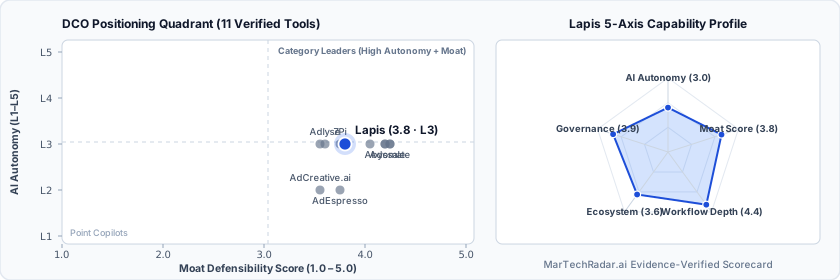
Lapis is a Web SaaS tool for DCO (Dynamic Creative Optimization / DCO) in AdTech & Paid Media. Pricing: From $99/mo. Best suited to Performance Marketing Directors, Ad Agencies and Retail Media Advertisers. Editor ratings: AI autonomy L3 (conditional automation); moat score 3.8/5.0 (Proprietary moat). Fact-checked by Anthony Hay on Oct 12, 2026.
Autonomous ad creative engine that generates, deploys, and optimizes multi-platform paid campaigns using closed-loop performance feedback.
Lapis buyer fit verdict: when to choose vs. when to walk away
Choose Lapis if (Best Fit)
- Target ICP & Stack Fit: You operate as Performance Marketing Directors, Ad Agencies and Retail Media Advertisers requiring a Web SaaS deployment for DCO, with verified ecosystem connectivity for LinkedIn.
- L3 Architecture & Defensibility: Lapis couples multimodal asset generation with cross-platform campaign deployment and telemetry feedback, orchestrating automated creative iteration across Meta, Google, and LinkedIn ad networks.
- Commercial Model Fit: Your procurement budget aligns with From $99/mo.
Walk away from Lapis if (Deal-Breakers)
- Walk away if your workflow requires uncapped enterprise volume on the From $99/mo entry plan without upgrading tiers.
- Walk away if your workflow cannot tolerate API rate limits and ad network governance: Automated campaign generation and frequent variant updates are bound by external network API rate limits and downstream creative review latencies across Meta and Google, which can delay real-time flighting.
- Walk away if credit consumption caps is a deal-breaker for your team: Creative generation workflows are strictly governed by monthly credit allowances, meaning high-velocity multivariate experiments can stall mid-cycle without incremental credit allocation.
Lapis key facts & scorecard
| Pricing | From $99/moVendor pricing page |
|---|---|
| Free plan | No / not disclosed |
| Delivery | Web SaaS |
| Audience | Performance Marketing Directors, Ad Agencies, Retail Media Advertisers |
| AI autonomy level | L3 · Conditional automationEditor-verified |
| Moat tier & score | 3.8 / 5.0 · Proprietary moatEditor-verified |
| Funding | Venture-backed |
| Total funding | $500KBacked by Y Combinator |
| Company size | 2-10 employees |
| Ecosystem integrations | |
| Governance & docs | System Status ↗ · API & Docs ↗ · Terms ↗ · Privacy ↗ |
| Headquarters | San Francisco, California |
| Founded | 2025 |
| Last verified |
Lapis pros & cons: strengths vs. operational limitations
Pros: core strengths & capabilities
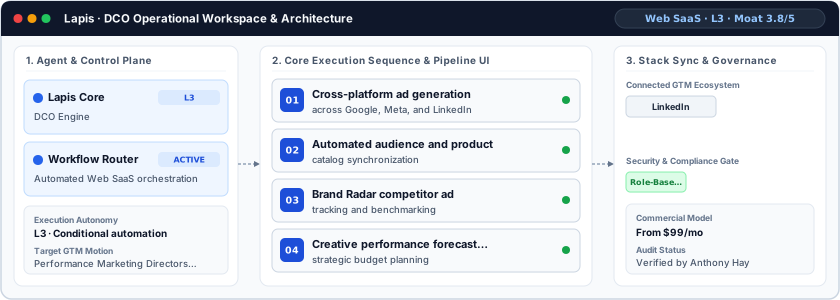
- Cross-platform ad generation: across Google, Meta, and LinkedIn
- Automated audience and product: catalog synchronization
- Brand Radar competitor ad: tracking and benchmarking
- Creative performance forecasting and: strategic budget planning
Cons: operational limitations & risks
- API Rate Limits and Ad Network Governance: Automated campaign generation and frequent variant updates are bound by external network API rate limits and downstream creative review latencies across Meta and Google, which can delay real-time flighting.
- Credit Consumption Caps: Creative generation workflows are strictly governed by monthly credit allowances, meaning high-velocity multivariate experiments can stall mid-cycle without incremental credit allocation.
- Schema and Feed Dependency: Asset generation quality degrades when ingesting non-standard e-commerce product catalogs or dynamic web pages lacking structured Open Graph metadata and clear product specifications.
Lapis TCO & deal-breaker stress test
Simulate 12-month stepped TCO, hidden cost multipliers, contract lock-in exposure, and stack failure modes using only facts verified by Anthony Hay on · Capture SHA 8f741aa2.
Lapis aligns with your 5-seat / $800/mo profile. Review the walk-away triggers and contract levers below before deployment.
| Plan / Tier | Verified Rate | Scale Fit | Scope & Quota Notes |
|---|---|---|---|
| Basic | $99/mo | 1–2 seats | Google, Meta, and LinkedIn |
- Moat Score
- 3.8 / 5.0
- AI Autonomy
- L3
- Free Tier / Trial
- None disclosed
Triggered audit signals & failure modes
- Published Self-Serve Entry FloorVerified Pricing Ledger
Lapis publishes a transparent entry point (From $99/mo) for initial validation before committing.
- Primary Operational Bottleneck: Credit Consumption CapsAudit by Anthony Hay
Creative generation workflows are strictly governed by monthly credit allowances, meaning high-velocity multivariate experiments can stall mid-cycle without incremental credit allocation.
Hidden TCO Multipliers & Quota Gates
- Credit & Usage Burn Multiplier: Automated workflows consume metered credits/usage quotas; multi-step enrichment, voice minutes, or high-frequency agent runs can trigger mid-cycle top-up packs.
- API Rate Limits and Ad Network Governance: Automated campaign generation and frequent variant updates are bound by external network API rate limits and downstream creative review latencies across Meta and Google, which can delay real-time flighting.
- Credit Consumption Caps: Creative generation workflows are strictly governed by monthly credit allowances, meaning high-velocity multivariate experiments can stall mid-cycle without incremental credit allocation.
When to Walk Away & Negotiation Levers
- Walk away if your workflow requires uncapped enterprise volume on the From $99/mo entry plan without upgrading tiers.
- Walk away if your workflow cannot tolerate API rate limits and ad network governance: Automated campaign generation and frequent variant updates are bound by external network API rate limits and downstream creative review latencies across Meta and Google, which can delay real-time flighting.
- Walk away if credit consumption caps is a deal-breaker for your team: Creative generation workflows are strictly governed by monthly credit allowances, meaning high-velocity multivariate experiments can stall mid-cycle without incremental credit allocation.
- Validate exact quota thresholds (seats, credits, or API calls) included in Lapis's From $99/mo tier before converting from monthly to annual billing.
- Require a sandbox proof-of-concept testing API rate limits and ad network governance against your live CRM/data schema before annual sign-off.
Ask a custom procurement or TCO stress-test question about Lapis
Lower 5-seat floor (~$24/mo vs. From $99 / mo)
Lower 5-seat floor (~$36/mo vs. From $99 / mo)
Lapis key entities, modules & ecosystem stack
Lapis moat & subtrack positioning
Lapis couples multimodal asset generation with cross-platform campaign deployment and telemetry feedback, orchestrating automated creative iteration across Meta, Google, and LinkedIn ad networks.
Editorial review
Fact-checked by Anthony Hay (Senior SEO, Search Intelligence & Content Operations Editor) on .
Background
To counteract rapid creative fatigue and slow asset iteration across digital advertising networks, growth marketing teams require autonomous production pipelines that tie asset generation directly into live campaign execution. Founded in 2025 in San Francisco, California, Lapis emerged with $500K in early venture capital funding to build an autonomous advertising platform for modern growth teams and e-commerce operators. Operating within dynamic creative optimization, the platform abstracts the manual workflow of creative conception, variant rendering, and deployment across major programmatic channels.
How Lapis works
Lapis operates through an L3 autonomous closed-loop generation engine. The ingestion layer processes product catalog feeds, target landing page URLs, and brand design guidelines to seed multimodal models. These models assemble multi-format creatives, including display banners and kinetic text video units, while generating paired copywriting in over 100 languages. Once generated, assets are pushed directly via APIs into Google, Meta, and LinkedIn campaign hierarchies. The system continuously polls downstream campaign performance metrics to forecast creative decay and dynamically iterate underperforming creative variants.
Limitations
Operational considerations and platform boundaries include:
- API Rate Limits and Ad Network Governance: Automated campaign generation and frequent variant updates are bound by external network API rate limits and downstream creative review latencies across Meta and Google, which can delay real-time flighting.
- Credit Consumption Caps: Creative generation workflows are strictly governed by monthly credit allowances, meaning high-velocity multivariate experiments can stall mid-cycle without incremental credit allocation.
- Schema and Feed Dependency: Asset generation quality degrades when ingesting non-standard e-commerce product catalogs or dynamic web pages lacking structured Open Graph metadata and clear product specifications.
Lapis pricing
Commercial access to Lapis follows a hybrid SaaS and managed subscription model. The self-serve Basic tier begins at $99 per month and provides 25 monthly generation credits, access to multi-network publishing across Google, Meta, and LinkedIn, competitor tracking via Brand Radar, and performance forecasting. Higher operational requirements and autonomous managed campaigns across traditional digital ad channels are provisioned via custom enterprise agreements.
How Lapis compares
Within the creative optimization market, Lapis competes alongside solutions like 7Pi, Abyssale, and AdCreative.ai. While Abyssale specializes in template-driven image generation APIs and 7Pi focuses on modular feed automation, Lapis provides a more autonomous campaign loop that connects generation with deployment. Conversely, AdCreative.ai emphasizes conversion-scoring models for static assets, whereas Lapis targets growth marketing teams seeking continuous, multi-network campaign iteration with integrated competitor intelligence.
Direct competitors & market radar
Top algorithmic competitors based on category positioning, capability overlap, and ICP alignment.
Frequently asked questions about Lapis
How much does Lapis cost and what pricing tiers are available?
Published pricing summary for Lapis: From $99/mo. A permanent free plan is not disclosed for Lapis. Commercial access to Lapis follows a hybrid SaaS and managed subscription model. The self-serve Basic tier begins at $99 per month and provides 25 monthly generation credits, access to multi-network publishing across Google, Meta, and LinkedIn, competitor tracking via Brand Radar, and performance forecasting.
How does Lapis work and how autonomous is its AI architecture?
Autonomous ad creative engine that generates, deploys, and optimizes multi-platform paid campaigns using closed-loop performance feedback. Within DCO (Dynamic Creative Optimization / DCO), MarTechRadar rates its execution architecture at L3 · Conditional automation with a verified Moat Score of 3.8 / 5.0 (Proprietary moat). Lapis couples multimodal asset generation with cross-platform campaign deployment and telemetry feedback, orchestrating automated creative iteration across Meta, Google, and LinkedIn ad networks. Corporate profile: operating at 2-10 employees scale.
What are the main limitations of Lapis and when should buyers walk away?
Based on our editorial technical audit, key operational considerations and boundaries for Lapis include: (1) API Rate Limits and Ad Network Governance: Automated campaign generation and frequent variant updates are bound by external network API rate limits and downstream creative review latencies across Meta and Google, which can delay real-time flighting. (2) Credit Consumption Caps: Creative generation workflows are strictly governed by monthly credit allowances, meaning high-velocity multivariate experiments can stall mid-cycle without incremental credit allocation. (3) Schema and Feed Dependency: Asset generation quality degrades when ingesting non-standard e-commerce product catalogs or dynamic web pages lacking structured Open Graph metadata and clear product specifications. Primary procurement walk-away rule: Walk away if your workflow requires uncapped enterprise volume on the From $99/mo entry plan without upgrading tiers.
What integrations, compliance certifications, and contract terms apply to Lapis?
Verified ecosystem and stack integrations include LinkedIn. First-party governance and developer endpoints verified on domain include: Status (https://www.trylapis.com/status), API Docs (https://docs.trylapis.com). Key TCO multiplier to watch: Credit & Usage Burn Multiplier (Automated workflows consume metered credits/usage quotas; multi-step enrichment, voice minutes, or high-frequency agent runs can trigger mid-cycle top-up packs.) Before signing a contract, procurement teams should validate exact quota thresholds (seats, credits, or API calls) included in Lapis's From $99/mo tier before converting from monthly to annual billing.
What are the best Lapis alternatives and head-to-head competitors in 2026?
Top fact-checked alternatives to Lapis in DCO (Dynamic Creative Optimization / DCO) include NativeAds (Custom / enterprise pricing), Kuaizi.ai (Custom / enterprise pricing), Protaigé (Free plan · $0/mo · Enterprise plan), WordStream (Custom / enterprise pricing). Within the creative optimization market, Lapis competes alongside solutions like 7Pi, Abyssale, and AdCreative.ai. While Abyssale specializes in template-driven image generation APIs and 7Pi focuses on modular feed automation, Lapis provides a more autonomous campaign loop that connects generation with deployment.
Verified sources & evidence trail
- Official product domain: https://www.trylapis.com/
- Commercial pricing verification: https://www.trylapis.com/pricing
- Verified corporate entity profiles (
sameAs): LinkedIn Company Profile · Crunchbase Entity Record - First-party governance & documentation links: System Status · API & Docs · Terms · Privacy
- Editorial audit sign-off: Fact-checked by Anthony Hay on under the MarTechRadar Evidence-Ledger Protocol.