Mention.com Review (2026): Social Listening Pricing, Limits & Alternatives
Bottom line
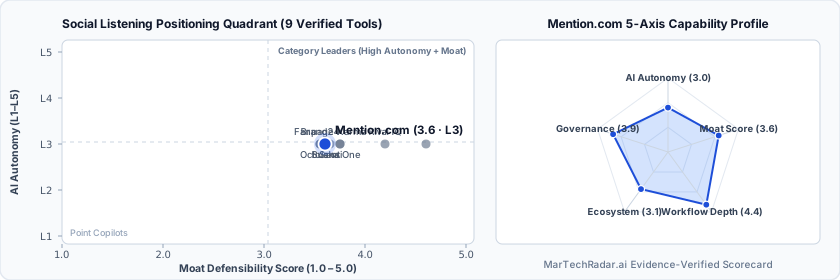
Mention.com is a Web SaaS tool for Social Listening (Social Listening & Sentiment Analysis) in Social & Influencer. Pricing: Custom / enterprise pricing. Best suited to DTC / eCommerce and Enterprise Brands. Editor ratings: AI autonomy L3 (conditional automation); moat score 3.6/5.0 (Proprietary moat). Fact-checked by Julie Brot on Oct 14, 2026.
Web and social media monitoring platform offering real-time brand tracking, competitive analysis, and automated sentiment classification across digital.
Mention.com buyer fit verdict: when to choose vs. when to walk away
Choose Mention.com if (Best Fit)
- Target ICP & Stack Fit: You operate as DTC / eCommerce and Enterprise Brands requiring a Web SaaS deployment for Social Listening.
- L3 Architecture & Defensibility: Broad ingestion footprint spanning over one billion online sources, aggregated historical archives up to two years, and native workflow integration under MyNewsdesk for corporate communications teams.
- Commercial Model Fit: Your procurement budget aligns with Custom / enterprise pricing.
Walk away from Mention.com if (Deal-Breakers)
- Walk away if you require transparent self-serve monthly billing or your budget ceiling is under $1,000/mo (Mention.com requires sales-gated custom quoting).
- Walk away if your workflow cannot tolerate social network API restrictions: Third-party platform API constraints can restrict ingestion depth, rate limits, and historical data access on walled-garden networks like Meta and X.
- Walk away if semantic sentiment polarity drift is a deal-breaker for your team: Automated sentiment scoring algorithms struggle with vernacular nuances, industry jargon, and sarcasm, necessitating manual tag overrides during brand crises.
Mention.com key facts & scorecard
| Pricing | Custom / enterprise pricing |
|---|---|
| Free plan | No / not disclosed |
| Delivery | Web SaaS |
| Audience | DTC / eCommerce, Enterprise Brands |
| AI autonomy level | L3 · Conditional automationEditor-verified |
| Moat tier & score | 3.6 / 5.0 · Proprietary moatEditor-verified |
| Funding | AcquiredAcquired by MyNewsdesk |
| Total funding | $800K |
| Founders | Arnaud le Blanc, Didier Forest, Edouard de la Jonquiere, Matthieu Vaxelaire |
| Company size | 51-200 employees |
| Headquarters | Paris, Ile-de-France, France |
| Founded | 2012 |
| Last verified |
Mention.com pros & cons: strengths vs. operational limitations
Pros: core strengths & capabilities
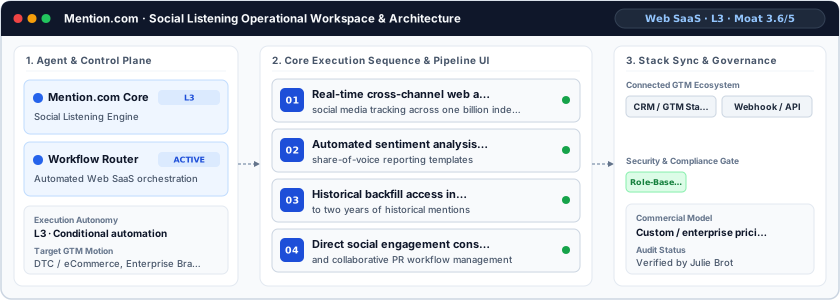
- Real-time cross-channel web and: social media tracking across one billion indexed sources
- Automated sentiment analysis and: share-of-voice reporting templates
- Historical backfill access indexing up: to two years of historical mentions
- Direct social engagement console: and collaborative PR workflow management
Cons: operational limitations & risks
- Social Network API Restrictions: Third-party platform API constraints can restrict ingestion depth, rate limits, and historical data access on walled-garden networks like Meta and X.
- Semantic Sentiment Polarity Drift: Automated sentiment scoring algorithms struggle with vernacular nuances, industry jargon, and sarcasm, necessitating manual tag overrides during brand crises.
- Query Noise and Entity Ambiguity: Tracking generic or multi-meaning brand names produces volume spikes containing irrelevant mentions, requiring continuous boolean maintenance and negative keyword filtering.
Mention.com TCO & deal-breaker stress test
Simulate 12-month stepped TCO, hidden cost multipliers, contract lock-in exposure, and stack failure modes using only facts verified by Julie Brot on · Capture SHA edf89d29.
Mention.com triggers high-severity friction under your 5-seat / $800/mo constraints. Benchmark the verified subtrack alternatives below before committing.
| Plan / Tier | Verified Rate | Scale Fit | Scope & Quota Notes |
|---|---|---|---|
| Enterprise / Custom | Custom quote | 15–50+ seats (Enterprise SLA) | Sales-negotiated annual contract for custom volume, SSO/RBAC governance, and dedicated SLA. |
- Moat Score
- 3.6 / 5.0
- AI Autonomy
- L3
- Free Tier / Trial
- None disclosed
Triggered audit signals & failure modes
- Opaque Enterprise Quoting vs. SMB/Mid-Market BudgetVerified Pricing Ledger
Mention.com does not disclose a public self-serve floor (Custom / enterprise pricing). Buyers with a $800/mo cap face high sales-qualification friction.
- Sales-Gated Contract TermsFact-checked by Julie Brot
Commercial procurement operates outside self-serve transactional tiers, with licensing delivered via tailored enterprise sales quotes based on organizational scale, monitoring volume, seat count, and tracked keyword limits.
- Primary Operational Bottleneck: Social Network API RestrictionsAudit by Julie Brot
Third-party platform API constraints can restrict ingestion depth, rate limits, and historical data access on walled-garden networks like Meta and X.
Hidden TCO Multipliers & Quota Gates
- Enterprise Governance & Add-On Gating: Advanced capabilities such as Single Sign-On (SSO), custom role permissions, or specialized analytics modules are gated behind upper tiers or paid add-ons.
- Social Network API Restrictions: Third-party platform API constraints can restrict ingestion depth, rate limits, and historical data access on walled-garden networks like Meta and X.
- Semantic Sentiment Polarity Drift: Automated sentiment scoring algorithms struggle with vernacular nuances, industry jargon, and sarcasm, necessitating manual tag overrides during brand crises.
When to Walk Away & Negotiation Levers
- Walk away if you require transparent self-serve monthly billing or your budget ceiling is under $1,000/mo (Mention.com requires sales-gated custom quoting).
- Walk away if your workflow cannot tolerate social network API restrictions: Third-party platform API constraints can restrict ingestion depth, rate limits, and historical data access on walled-garden networks like Meta and X.
- Walk away if semantic sentiment polarity drift is a deal-breaker for your team: Automated sentiment scoring algorithms struggle with vernacular nuances, industry jargon, and sarcasm, necessitating manual tag overrides during brand crises.
- Demand a 30- to 60-day paid pilot opt-out clause in the Mention.com order form before signing a 12-month enterprise commitment.
- Require a sandbox proof-of-concept testing social network API restrictions against your live CRM/data schema before annual sign-off.
Ask a custom procurement or TCO stress-test question about Mention.com
Lower 5-seat floor (~$159/mo vs. Custom Quote) · Transparent self-serve entry without mandatory annual lock-in
Lower 5-seat floor (~$199/mo vs. Custom Quote)
Mention.com moat & subtrack positioning
Broad ingestion footprint spanning over one billion online sources, aggregated historical archives up to two years, and native workflow integration under MyNewsdesk for corporate communications teams.
Editorial review
Fact-checked by Julie Brot (Enterprise SaaS Governance & Procurement Editor) on .
Background
Backed by an initial $800K in venture capital before its acquisition by MyNewsdesk, Mention.com was founded in 2012 in Paris, Ile-de-France, France, to capture fragmented online discourse into structured intelligence. The platform targets corporate communications leaders, brand managers, and PR practitioners who require continuous visibility over digital brand equity without deploying bespoke scraping infrastructure. Operating within the social listening and sentiment analysis category, Mention.com converts unstructured conversational streams into operational metrics for cross-functional marketing teams.
How Mention.com works
Mention.com executes continuous indexing against a catalog of roughly one billion sources, covering major social networks, forum boards, blogs, and news wires. Inbound text payloads flow through an ingestion pipeline that normalizes data schemas before executing natural language processing for polarity scoring, topic extraction, and share-of-voice calculations. The system maintains an index granting users up to two years of retrospective query access. At an L3 autonomy profile, it automates alert routing and sentiment tagging while relying on human operators for nuanced contextual interpretation and triage.
Limitations
Operational considerations and platform boundaries include:
- Social Network API Restrictions: Third-party platform API constraints can restrict ingestion depth, rate limits, and historical data access on walled-garden networks like Meta and X.
- Semantic Sentiment Polarity Drift: Automated sentiment scoring algorithms struggle with vernacular nuances, industry jargon, and sarcasm, necessitating manual tag overrides during brand crises.
- Query Noise and Entity Ambiguity: Tracking generic or multi-meaning brand names produces volume spikes containing irrelevant mentions, requiring continuous boolean maintenance and negative keyword filtering.
Mention.com pricing
Commercial procurement operates outside self-serve transactional tiers, with licensing delivered via tailored enterprise sales quotes based on organizational scale, monitoring volume, seat count, and tracked keyword limits. Contracts typically structure access on annual agreements covering ingestion quotas and dedicated account management, with commercial terms available on request directly from the sales team.
How Mention.com compares
Mention.com positions itself against Brand24 and Meltwater Radarly by balancing operational agility against broad listening coverage. While Brand24 targets mid-market teams seeking rapid setup, Mention.com offers deeper news coverage through MyNewsdesk alignment. Conversely, Meltwater Radarly delivers more advanced deep-listening data science for global enterprises, though Mention.com provides a more accessible interface for PR and communications workflows.
Direct competitors & market radar
Top algorithmic competitors based on category positioning, capability overlap, and ICP alignment.
Frequently asked questions about Mention.com
How much does Mention.com cost and does it require a custom enterprise quote?
Published pricing summary for Mention.com: Custom / enterprise pricing. A permanent free plan is not disclosed for Mention.com. Commercial procurement operates outside self-serve transactional tiers, with licensing delivered via tailored enterprise sales quotes based on organizational scale, monitoring volume, seat count, and tracked keyword limits.
How does Mention.com work and how autonomous is its AI architecture?
Web and social media monitoring platform offering real-time brand tracking, competitive analysis, and automated sentiment classification across digital. Within Social Listening (Social Listening & Sentiment Analysis), MarTechRadar rates its execution architecture at L3 · Conditional automation with a verified Moat Score of 3.6 / 5.0 (Proprietary moat). Broad ingestion footprint spanning over one billion online sources, aggregated historical archives up to two years, and native workflow integration under MyNewsdesk for corporate communications teams. Corporate profile: Founded by Arnaud le Blanc, Didier Forest, Edouard de la Jonquiere, Matthieu Vaxelaire, operating at 51-200 employees scale, acquired by MyNewsdesk.
What are the main limitations of Mention.com and when should buyers walk away?
Based on our editorial technical audit, key operational considerations and boundaries for Mention.com include: (1) Social Network API Restrictions: Third-party platform API constraints can restrict ingestion depth, rate limits, and historical data access on walled-garden networks like Meta and X. (2) Semantic Sentiment Polarity Drift: Automated sentiment scoring algorithms struggle with vernacular nuances, industry jargon, and sarcasm, necessitating manual tag overrides during brand crises. (3) Query Noise and Entity Ambiguity: Tracking generic or multi-meaning brand names produces volume spikes containing irrelevant mentions, requiring continuous boolean maintenance and negative keyword filtering. Primary procurement walk-away rule: Walk away if you require transparent self-serve monthly billing or your budget ceiling is under $1,000/mo (Mention.com requires sales-gated custom quoting).
What integrations, compliance certifications, and contract terms apply to Mention.com?
Key TCO multiplier to watch: Enterprise Governance & Add-On Gating (Advanced capabilities such as Single Sign-On (SSO), custom role permissions, or specialized analytics modules are gated behind upper tiers or paid add-ons.) Before signing a contract, procurement teams should demand a 30- to 60-day paid pilot opt-out clause in the Mention.com order form before signing a 12-month enterprise commitment.
What are the best Mention.com alternatives and head-to-head competitors in 2026?
Top fact-checked alternatives to Mention.com in Social Listening (Social Listening & Sentiment Analysis) include Brand24 ($199–$599/mo · Enterprise plan), Meltwater Radarly (Custom / enterprise pricing), Octolens ($159/mo), Drift (Custom / enterprise pricing). Mention.com positions itself against Brand24 and Meltwater Radarly by balancing operational agility against broad listening coverage. While Brand24 targets mid-market teams seeking rapid setup, Mention.com offers deeper news coverage through MyNewsdesk alignment.
Verified sources & evidence trail
- Official product domain: https://mention.com
- Commercial pricing verification: Verified against official vendor pricing policy (Custom / enterprise pricing)
- Verified corporate entity profiles (
sameAs): LinkedIn Company Profile · Crunchbase Entity Record - Editorial audit sign-off: Fact-checked by Julie Brot on under the MarTechRadar Evidence-Ledger Protocol.