Omi Review (2026): Social Media Scheduling Pricing, Limits & Alternatives
Bottom line
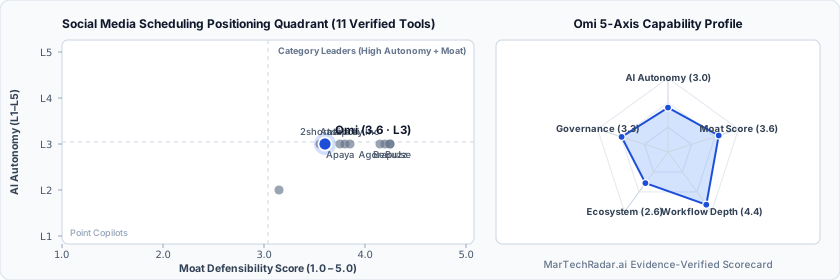
Omi is a Web SaaS tool for Social Media Scheduling (Social Media Scheduling & Auto-Publishing) in Social & Influencer. Pricing: Custom / enterprise pricing. Best suited to Social Media Managers, Creator & Influencer Agencies and Brand Community Ops. Editor ratings: AI autonomy L3 (conditional automation); moat score 3.6/5.0 (Proprietary moat). Fact-checked by Jagmeet Sine on Oct 15, 2026.
Enterprise social media scheduling and publishing platform centralizing multi-brand content delivery and distributed campaign workflows.
Omi buyer fit verdict: when to choose vs. when to walk away
Choose Omi if (Best Fit)
- Target ICP & Stack Fit: You operate as Social Media Managers, Creator & Influencer Agencies and Brand Community Ops requiring a Web SaaS deployment for Social Media Scheduling.
- L3 Architecture & Defensibility: Omi builds defensibility through enterprise-grade multi-brand governance, workflow routing logic, and centralized digital asset transformation tailored for distributed marketing organizations.
- Commercial Model Fit: Your procurement budget aligns with Custom / enterprise pricing.
Walk away from Omi if (Deal-Breakers)
- Walk away if you require transparent self-serve monthly billing or your budget ceiling is under $1,000/mo (Omi requires sales-gated custom quoting).
- Walk away if your workflow cannot tolerate API rate limit vulnerability: Unplanned structural changes or sudden token revocation events across third-party social networks disrupt publishing queues, requiring manual credential refreshes.
- Walk away if dynamic content parsing is a deal-breaker for your team: Complex interactive formats, native polls, and transient channel features often lag in automated staging queues compared to first-party network interfaces.
Omi key facts & scorecard
| Pricing | Custom / enterprise pricing |
|---|---|
| Free plan | No / not disclosed |
| Delivery | Web SaaS |
| Audience | Social Media Managers, Creator & Influencer Agencies, Brand Community Ops |
| AI autonomy level | L3 · Conditional automationEditor-verified |
| Moat tier & score | 3.6 / 5.0 · Proprietary moatEditor-verified |
| Funding | Series A |
| Headquarters | France |
| Founded | 2020 |
| Last verified |
Omi pros & cons: strengths vs. operational limitations
Pros: core strengths & capabilities
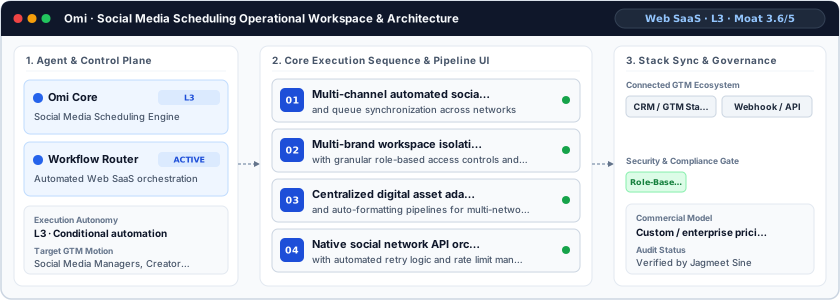
- Multi-channel automated social scheduling: and queue synchronization across networks
- Multi-brand workspace isolation: with granular role-based access controls and approval workflows
- Centralized digital asset adaptation: and auto-formatting pipelines for multi-network compliance
- Native social network API orchestration: with automated retry logic and rate limit management
Cons: operational limitations & risks
- API Rate Limit Vulnerability: Unplanned structural changes or sudden token revocation events across third-party social networks disrupt publishing queues, requiring manual credential refreshes.
- Dynamic Content Parsing: Complex interactive formats, native polls, and transient channel features often lag in automated staging queues compared to first-party network interfaces.
- Asset Ingestion Overhead: High-resolution video encoding pipelines enforce strict file boundary checks, occasionally bottlenecking rapid multi-channel batch deployments during peak campaign periods.
Omi TCO & deal-breaker stress test
Simulate 12-month stepped TCO, hidden cost multipliers, contract lock-in exposure, and stack failure modes using only facts verified by Jagmeet Sine on .
Omi triggers high-severity friction under your 5-seat / $800/mo constraints. Benchmark the verified subtrack alternatives below before committing.
| Plan / Tier | Verified Rate | Scale Fit | Scope & Quota Notes |
|---|---|---|---|
| Enterprise / Custom | Custom quote | 15–50+ seats (Enterprise SLA) | Sales-negotiated annual contract for custom volume, SSO/RBAC governance, and dedicated SLA. |
- Moat Score
- 3.6 / 5.0
- AI Autonomy
- L3
- Free Tier / Trial
- None disclosed
Triggered audit signals & failure modes
- Opaque Enterprise Quoting vs. SMB/Mid-Market BudgetVerified Pricing Ledger
Omi does not disclose a public self-serve floor (Custom / enterprise pricing). Buyers with a $800/mo cap face high sales-qualification friction.
- Sales-Gated Contract TermsFact-checked by Jagmeet Sine
Commercial access to the platform follows a direct enterprise licensing framework. Pricing is available on request through tailored enterprise sales quotes based on organizational scale, user seat counts, connected social channel volumes, and managed brand workspaces.
- Primary Operational Bottleneck: API Rate Limit VulnerabilityAudit by Jagmeet Sine
Unplanned structural changes or sudden token revocation events across third-party social networks disrupt publishing queues, requiring manual credential refreshes.
Hidden TCO Multipliers & Quota Gates
- Credit & Usage Burn Multiplier: Automated workflows consume metered credits/usage quotas; multi-step enrichment, voice minutes, or high-frequency agent runs can trigger mid-cycle top-up packs.
- API Rate Limit Vulnerability: Unplanned structural changes or sudden token revocation events across third-party social networks disrupt publishing queues, requiring manual credential refreshes.
- Dynamic Content Parsing: Complex interactive formats, native polls, and transient channel features often lag in automated staging queues compared to first-party network interfaces.
When to Walk Away & Negotiation Levers
- Walk away if you require transparent self-serve monthly billing or your budget ceiling is under $1,000/mo (Omi requires sales-gated custom quoting).
- Walk away if your workflow cannot tolerate API rate limit vulnerability: Unplanned structural changes or sudden token revocation events across third-party social networks disrupt publishing queues, requiring manual credential refreshes.
- Walk away if dynamic content parsing is a deal-breaker for your team: Complex interactive formats, native polls, and transient channel features often lag in automated staging queues compared to first-party network interfaces.
- Demand a 30- to 60-day paid pilot opt-out clause in the Omi order form before signing a 12-month enterprise commitment.
- Require a sandbox proof-of-concept testing API rate limit vulnerability against your live CRM/data schema before annual sign-off.
Ask a custom procurement or TCO stress-test question about Omi
Lower 5-seat floor (~$395/mo vs. Custom Quote) · Transparent self-serve entry without mandatory annual lock-in
Lower 5-seat floor (~$10/mo vs. Custom Quote) · Transparent self-serve entry without mandatory annual lock-in
Omi moat & subtrack positioning
Omi builds defensibility through enterprise-grade multi-brand governance, workflow routing logic, and centralized digital asset transformation tailored for distributed marketing organizations.
Editorial review
Fact-checked by Jagmeet Sine (Senior MarTech Infrastructure & Agentic Workflow Architect) on .
Background
Digital marketing teams managing complex multi-brand portfolios often encounter operational gridlock when synchronizing cross-network distribution schedules. Headquartered in France, Omi serves brand communications leaders, community directors, and multi-entity agencies requiring coordinated social distribution infrastructure. Positioned within the social media scheduling and auto-publishing track, the software centralizes programmatic content scheduling, asset organization, and publishing controls into unified operational environments. Instead of handling disconnected network dispatching across fragmented regional teams, marketing departments deploy Omi to enforce schedule synchronicity, content governance, and editorial review standards across diverse enterprise social touchpoints.
How Omi works
Omi relies on a centralized scheduling engine connected to major social networks via direct REST integrations and webhooks. The platform ingests localized creative assets, normalizes rich-media payloads against specific platform dimension rules, and assigns them to distributed time queues. Autonomous scheduling routines continuously monitor network-specific rate caps, executing queued dispatches through managed API handshakes without manual intervention. Editorial permission trees ensure that multi-brand assets transition through drafting, compliance review, and automated queue staging. Bidirectional webhook ingestion streams publishing confirmation receipt metadata back into unified status dashboards, tracking post verification and delivery states across all connected profiles.
Limitations
Operational considerations and platform boundaries include:
- API Rate Limit Vulnerability: Unplanned structural changes or sudden token revocation events across third-party social networks disrupt publishing queues, requiring manual credential refreshes.
- Dynamic Content Parsing: Complex interactive formats, native polls, and transient channel features often lag in automated staging queues compared to first-party network interfaces.
- Asset Ingestion Overhead: High-resolution video encoding pipelines enforce strict file boundary checks, occasionally bottlenecking rapid multi-channel batch deployments during peak campaign periods.
Omi pricing
Commercial access to the platform follows a direct enterprise licensing framework. Pricing is available on request through tailored enterprise sales quotes based on organizational scale, user seat counts, connected social channel volumes, and managed brand workspaces. Deployments include provisioning tiers adjusted for technical support levels, dedicated workspace isolation, and custom onboarding resources. Prospective enterprise buyers must coordinate directly with the vendor's commercial team to evaluate specific profile counts, integration requirements, and security compliance stipulations prior to contracting.
How Omi compares
Omi operates alongside established social platforms like Agorapulse, Antela.ai, Inc., and Apaya. While Agorapulse delivers expansive community listening combined with social support inboxes, Omi emphasizes dedicated content staging queues and multi-brand asset governance. Antela.ai, Inc. concentrates primarily on algorithmic copy creation, whereas Omi maintains operational depth in pipeline orchestration and scheduling reliability. Compared to lightweight transactional dispatchers like Apaya, Omi provides structured permission hierarchies and enterprise review chains. The software suits mid-market to enterprise consumer goods brands and agencies that prioritize strict compliance controls over broad, reactive listening suites. It is best suited for enterprise marketing teams and growth practitioners seeking disciplined workflow orchestration.
Direct competitors & market radar
Top algorithmic competitors based on category positioning, capability overlap, and ICP alignment.
Frequently asked questions about Omi
How much does Omi cost and does it require a custom enterprise quote?
Published pricing summary for Omi: Custom / enterprise pricing. A permanent free plan is not disclosed for Omi. Commercial access to the platform follows a direct enterprise licensing framework. Pricing is available on request through tailored enterprise sales quotes based on organizational scale, user seat counts, connected social channel volumes, and managed brand workspaces.
How does Omi work and how autonomous is its AI architecture?
Enterprise social media scheduling and publishing platform centralizing multi-brand content delivery and distributed campaign workflows. Within Social Media Scheduling (Social Media Scheduling & Auto-Publishing), MarTechRadar rates its execution architecture at L3 · Conditional automation with a verified Moat Score of 3.6 / 5.0 (Proprietary moat). Omi builds defensibility through enterprise-grade multi-brand governance, workflow routing logic, and centralized digital asset transformation tailored for distributed marketing organizations.
What are the main limitations of Omi and when should buyers walk away?
Based on our editorial technical audit, key operational considerations and boundaries for Omi include: (1) API Rate Limit Vulnerability: Unplanned structural changes or sudden token revocation events across third-party social networks disrupt publishing queues, requiring manual credential refreshes. (2) Dynamic Content Parsing: Complex interactive formats, native polls, and transient channel features often lag in automated staging queues compared to first-party network interfaces. (3) Asset Ingestion Overhead: High-resolution video encoding pipelines enforce strict file boundary checks, occasionally bottlenecking rapid multi-channel batch deployments during peak campaign periods. Primary procurement walk-away rule: Walk away if you require transparent self-serve monthly billing or your budget ceiling is under $1,000/mo (Omi requires sales-gated custom quoting).
What integrations, compliance certifications, and contract terms apply to Omi?
Key TCO multiplier to watch: Credit & Usage Burn Multiplier (Automated workflows consume metered credits/usage quotas; multi-step enrichment, voice minutes, or high-frequency agent runs can trigger mid-cycle top-up packs.) Before signing a contract, procurement teams should demand a 30- to 60-day paid pilot opt-out clause in the Omi order form before signing a 12-month enterprise commitment.
What are the best Omi alternatives and head-to-head competitors in 2026?
Top fact-checked alternatives to Omi in Social Media Scheduling (Social Media Scheduling & Auto-Publishing) include Aomni (Custom / enterprise pricing), GlossAi (Custom / enterprise pricing), Passionfroot (Custom / enterprise pricing), Saywise (Custom / enterprise pricing). Omi operates alongside established social platforms like Agorapulse, Antela.ai, Inc., and Apaya. While Agorapulse delivers expansive community listening combined with social support inboxes, Omi emphasizes dedicated content staging queues and multi-brand asset governance.
Verified sources & evidence trail
- Official product domain: https://www.omi.so
- Commercial pricing verification: Verified against official vendor pricing policy (Custom / enterprise pricing)
- Editorial audit sign-off: Fact-checked by Jagmeet Sine on under the MarTechRadar Evidence-Ledger Protocol.