Pencil Review (2026): DCO Pricing, Limits & Alternatives
Bottom line
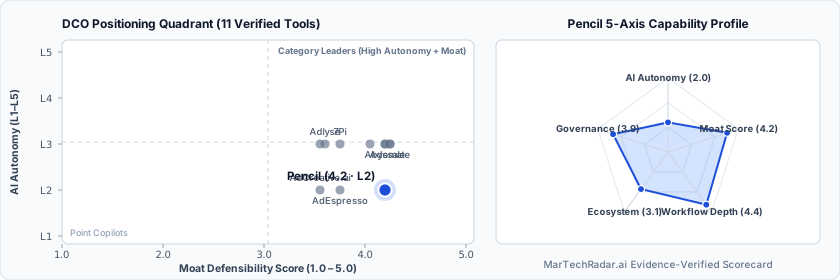
Pencil is a Web SaaS tool for DCO (Dynamic Creative Optimization / DCO) in AdTech & Paid Media. Pricing: From $14/mo. Best suited to DTC / eCommerce and Enterprise Brands. Editor ratings: AI autonomy L2 (workflow copilot); moat score 4.2/5.0 (Proprietary moat). Fact-checked by Anna Xia on Oct 15, 2026.
Generative AI creative platform producing dynamic static and video ad variants with built-in predictive performance scoring and multi-network ad deployment.
Pencil buyer fit verdict: when to choose vs. when to walk away
Choose Pencil if (Best Fit)
- Target ICP & Stack Fit: You operate as DTC / eCommerce and Enterprise Brands requiring a Web SaaS deployment for DCO.
- L2 Architecture & Defensibility: Proprietary predictive scoring models trained on historical performance ad spend, backed by enterprise distribution via The Brandtech Group.
- Commercial Model Fit: Your procurement budget aligns with From $14/mo.
Walk away from Pencil if (Deal-Breakers)
- Walk away if your workflow requires uncapped enterprise volume on the From $14/mo entry plan without upgrading tiers.
- Walk away if your workflow cannot tolerate predictive drift: Users encounter operational friction and integration bottlenecks, as the pipeline struggles with Predictive performance scores rely on historical conversion correlations that degrade when platform auction dynamics or consumer trends shift unpredictably.
- Walk away if asset rendering artifacts is a deal-breaker for your team: Users encounter operational friction and integration bottlenecks, as the pipeline struggles with Automated video reformatting frequently clips complex branding elements, requiring manual timeline micro-adjustments inside the canvas editor.
Pencil key facts & scorecard
| Pricing | From $14/moVendor pricing page |
|---|---|
| Free plan | No / not disclosed |
| Delivery | Web SaaS |
| Audience | DTC / eCommerce, Enterprise Brands |
| AI autonomy level | L2 · Workflow copilotEditor-verified |
| Moat tier & score | 4.2 / 5.0 · Proprietary moatEditor-verified |
| Funding | AcquiredAcquired by The Brandtech Group |
| Total funding | $3.9M |
| Founders | James Chadwick, Sumukh Avadhani, Will Hanschell |
| Company size | 201-500 employees |
| Governance & docs | Trust & Security ↗ · System Status ↗ · Changelog ↗ · DPA ↗ · Privacy ↗ |
| Headquarters | London, England |
| Founded | 2018 |
| Last verified |
Pencil pros & cons: strengths vs. operational limitations
Pros: core strengths & capabilities
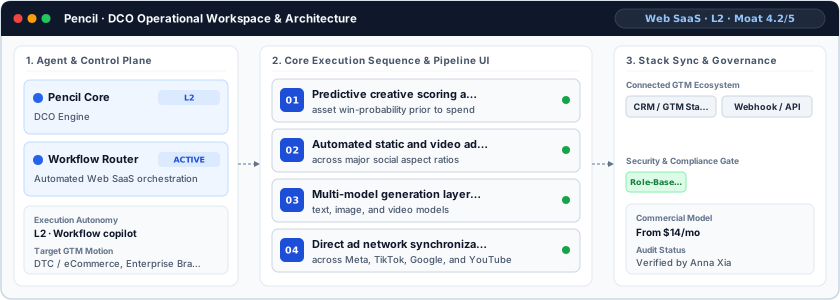
- Predictive creative scoring assessing: asset win-probability prior to spend
- Automated static and video ad generation: across major social aspect ratios
- Multi-model generation layer orchestrating: text, image, and video models
- Direct ad network synchronization: across Meta, TikTok, Google, and YouTube
Cons: operational limitations & risks
- Predictive Drift: Users encounter operational friction and integration bottlenecks, as the pipeline struggles with Predictive performance scores rely on historical conversion correlations that degrade when platform auction dynamics or consumer trends shift unpredictably.
- Asset Rendering Artifacts: Users encounter operational friction and integration bottlenecks, as the pipeline struggles with Automated video reformatting frequently clips complex branding elements, requiring manual timeline micro-adjustments inside the canvas editor.
- API Rate Constrictions: Users encounter operational friction and integration bottlenecks, as the pipeline struggles with Bulk multi-channel variant deployment faces upstream API rate limits across ad networks during high-cadence seasonal campaign pushes.
Pencil TCO & deal-breaker stress test
Simulate 12-month stepped TCO, hidden cost multipliers, contract lock-in exposure, and stack failure modes using only facts verified by Anna Xia on · Capture SHA 5ce12e32.
Pencil aligns with your 5-seat / $800/mo profile. Review the walk-away triggers and contract levers below before deployment.
| Plan / Tier | Verified Rate | Scale Fit | Scope & Quota Notes |
|---|---|---|---|
| Entry / Starter | $14/mo | Unlimited seats (Entry credits) | Verified $14/mo published rate on vendor pricing schedule. |
| Growth / Professional | $55/mo | Unlimited seats (Growth credits) | Verified $55/mo published rate on vendor pricing schedule. |
- Moat Score
- 4.2 / 5.0
- AI Autonomy
- L2
- Free Tier / Trial
- None disclosed
Triggered audit signals & failure modes
- Published Self-Serve Entry FloorVerified Pricing Ledger
Pencil publishes a transparent entry point (From $14/mo) for initial validation before committing.
- Tier Fit for 5-Seat Scale: Growth / Professional ($55/mo)Verified Tier Schedule
Verified $55/mo published rate on vendor pricing schedule.
- Primary Operational Bottleneck: Predictive DriftAudit by Anna Xia
Users encounter operational friction and integration bottlenecks, as the pipeline struggles with Predictive performance scores rely on historical conversion correlations that degrade when platform auction dynamics or consumer trends shift unpredictably.
Hidden TCO Multipliers & Quota Gates
- Annual Billing Headline vs. Monthly Premium: Headline entry rates reflect annual billing commitments (save 20%); month-to-month flexibility carries a higher effective monthly rate or requires annual prepayment.
- Profile / Workspace Quota Ceilings: Base tiers cap the number of connected profiles, workspaces, or contact records, forcing tier upgrades before seat limits are reached.
- Enterprise Governance & Add-On Gating: Advanced capabilities such as Single Sign-On (SSO), custom role permissions, or specialized analytics modules are gated behind upper tiers or paid add-ons.
When to Walk Away & Negotiation Levers
- Walk away if your workflow requires uncapped enterprise volume on the From $14/mo entry plan without upgrading tiers.
- Walk away if your workflow cannot tolerate predictive drift: Users encounter operational friction and integration bottlenecks, as the pipeline struggles with Predictive performance scores rely on historical conversion correlations that degrade when platform auction dynamics or consumer trends shift unpredictably.
- Walk away if asset rendering artifacts is a deal-breaker for your team: Users encounter operational friction and integration bottlenecks, as the pipeline struggles with Automated video reformatting frequently clips complex branding elements, requiring manual timeline micro-adjustments inside the canvas editor.
- Validate exact quota thresholds (seats, credits, or API calls) included in Pencil's From $14/mo tier before converting from monthly to annual billing.
- Require a sandbox proof-of-concept testing predictive drift against your live CRM/data schema before annual sign-off.
Ask a custom procurement or TCO stress-test question about Pencil
Lower 5-seat floor (~$39/mo vs. $55 / mo)
Fits within $800/mo budget (From $499/mo · Enterprise plan)
Pencil moat & subtrack positioning
Proprietary predictive scoring models trained on historical performance ad spend, backed by enterprise distribution via The Brandtech Group.
Editorial review
Fact-checked by Anna Xia (Senior B2B GTM & Revenue Systems Analyst) on .
Background
Established in 2018 in London, England, Pencil raised $3.9M in venture funding before being acquired by The Brandtech Group to scale its machine learning creative infrastructure. Tailored for growth marketing teams, performance agencies, and consumer brands, the platform automates the production of paid social and video advertisements. Operating within the dynamic creative optimization space, Pencil ingests source creative assets, catalog data, and brand parameters to generate high-volume variations engineered to combat creative fatigue across paid channels.
How Pencil works
At its technical core, Pencil pairs generative layout orchestration with a predictive scoring engine evaluated against historic ad spend telemetry. The data ingestion pipeline ingests product imagery, brand palettes, and copywriting copy banks, routing them through fine-tuned generative models for scriptwriting, image rendering, and video composition. Generated variants receive an algorithmic performance score before deployment, predicting conversion propensity. Operating at an L2 autonomy level, human operators retain approval control before pushing rendered creative variants directly to Meta, TikTok, and Google ad accounts.
Limitations
Operational considerations and platform boundaries include:
- Predictive Drift: Users encounter operational friction and integration bottlenecks, as the pipeline struggles with Predictive performance scores rely on historical conversion correlations that degrade when platform auction dynamics or consumer trends shift unpredictably.
- Asset Rendering Artifacts: Users encounter operational friction and integration bottlenecks, as the pipeline struggles with Automated video reformatting frequently clips complex branding elements, requiring manual timeline micro-adjustments inside the canvas editor.
- API Rate Constrictions: Users encounter operational friction and integration bottlenecks, as the pipeline struggles with Bulk multi-channel variant deployment faces upstream API rate limits across ad networks during high-cadence seasonal campaign pushes.
Pencil pricing
Pencil operates a tier-based SaaS commercial model starting from $14 per month for entry-level access billed monthly, covering fifty generation units. Scaling teams expand into upper tiers priced at $55 per month or custom enterprise licensing governed by The Brandtech Group, which introduces custom workspaces, dedicated compute capacity, and governance controls.
How Pencil compares
Compared to templated rendering engines like Abyssale or performance-focused generators like AdCreative.ai and 7Pi, Pencil differentiates through predictive scoring and ad network sync. While Abyssale focuses on deterministic API-driven layout automation, Pencil emphasizes probabilistic generative assembly. It best serves data-driven performance teams requiring continuous variation testing without maintaining manual design production pipelines. It is best suited for enterprise marketing teams and growth practitioners seeking disciplined workflow orchestration.
Direct competitors & market radar
Top algorithmic competitors based on category positioning, capability overlap, and ICP alignment.
Frequently asked questions about Pencil
How much does Pencil cost and what pricing tiers are available?
Published pricing summary for Pencil: From $14/mo. A permanent free plan is not disclosed for Pencil. Verified tier schedule: Entry / Starter ($14/mo for Unlimited seats (Entry credits)); Growth / Professional ($55/mo for Unlimited seats (Growth credits)). Pencil operates a tier-based SaaS commercial model starting from $14 per month for entry-level access billed monthly, covering fifty generation units.
How does Pencil work and how autonomous is its AI architecture?
Generative AI creative platform producing dynamic static and video ad variants with built-in predictive performance scoring and multi-network ad deployment. Within DCO (Dynamic Creative Optimization / DCO), MarTechRadar rates its execution architecture at L2 · Workflow copilot with a verified Moat Score of 4.2 / 5.0 (Proprietary moat). Proprietary predictive scoring models trained on historical performance ad spend, backed by enterprise distribution via The Brandtech Group. Corporate profile: Founded by James Chadwick, Sumukh Avadhani, Will Hanschell, operating at 201-500 employees scale, acquired by The Brandtech Group.
What are the main limitations of Pencil and when should buyers walk away?
Based on our editorial technical audit, key operational considerations and boundaries for Pencil include: (1) Predictive Drift: Users encounter operational friction and integration bottlenecks, as the pipeline struggles with Predictive performance scores rely on historical conversion correlations that degrade when platform auction dynamics or consumer trends shift unpredictably. (2) Asset Rendering Artifacts: Users encounter operational friction and integration bottlenecks, as the pipeline struggles with Automated video reformatting frequently clips complex branding elements, requiring manual timeline micro-adjustments inside the canvas editor. (3) API Rate Constrictions: Users encounter operational friction and integration bottlenecks, as the pipeline struggles with Bulk multi-channel variant deployment faces upstream API rate limits across ad networks during high-cadence seasonal campaign pushes. Primary procurement walk-away rule: Walk away if your workflow requires uncapped enterprise volume on the From $14/mo entry plan without upgrading tiers.
What integrations, compliance certifications, and contract terms apply to Pencil?
First-party governance and developer endpoints verified on domain include: Trust/Security (https://trust.trypencil.com), Status (https://status.trypencil.com), DPA (https://trypencil.com/legals/sub-processors). Key TCO multiplier to watch: Annual Billing Headline vs. Monthly Premium (Headline entry rates reflect annual billing commitments (save 20%); month-to-month flexibility carries a higher effective monthly rate or requires annual prepayment.) Before signing a contract, procurement teams should validate exact quota thresholds (seats, credits, or API calls) included in Pencil's From $14/mo tier before converting from monthly to annual billing.
What are the best Pencil alternatives and head-to-head competitors in 2026?
Top fact-checked alternatives to Pencil in DCO (Dynamic Creative Optimization / DCO) include Playad.ai (From $39/mo), Springboards (Custom / enterprise pricing), Omneky (Custom / enterprise pricing), Bluma (Custom / enterprise pricing). Compared to templated rendering engines like Abyssale or performance-focused generators like AdCreative.ai and 7Pi, Pencil differentiates through predictive scoring and ad network sync. While Abyssale focuses on deterministic API-driven layout automation, Pencil emphasizes probabilistic generative assembly.
Verified sources & evidence trail
- Official product domain: https://trypencil.com
- Commercial pricing verification: https://trypencil.com/pricing
- Verified corporate entity profiles (
sameAs): LinkedIn Company Profile · Crunchbase Entity Record - First-party governance & documentation links: Trust & Security · System Status · Changelog · DPA · Privacy
- Editorial audit sign-off: Fact-checked by Anna Xia on under the MarTechRadar Evidence-Ledger Protocol.