Perplexity Tracker Review (2026): GEO Pricing, Limits & Alternatives
Bottom line
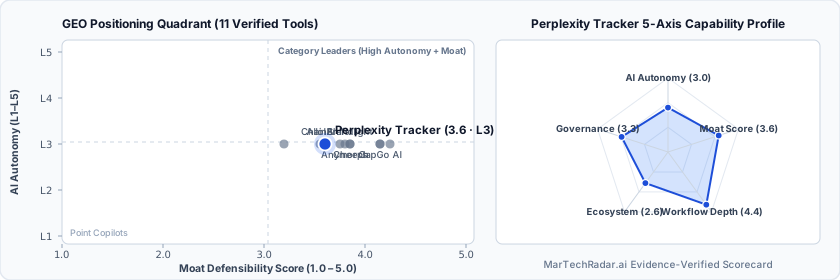
Perplexity Tracker is a Web SaaS tool for GEO (GEO Brand Tracking & LLM Rank Tracking) in GEO & AI SEO. Pricing: Custom / enterprise pricing. Best suited to B2B SaaS. Editor ratings: AI autonomy L3 (conditional automation); moat score 3.6/5.0 (Proprietary moat). Fact-checked by Jiacky Lee on Oct 15, 2026.
Specialized generative engine optimization tool monitoring brand citations, mentions, and source indexing across Perplexity conversational answer outputs.
Perplexity Tracker buyer fit verdict: when to choose vs. when to walk away
Choose Perplexity Tracker if (Best Fit)
- Target ICP & Stack Fit: You operate as B2B SaaS requiring a Web SaaS deployment for GEO.
- L3 Architecture & Defensibility: Provides purpose-built citation analysis specifically calibrated for Perplexity's citation graphs and retrieval pipelines, though vulnerable to ongoing API changes and broader multi-model tracking competitors.
- Commercial Model Fit: Your procurement budget aligns with Custom / enterprise pricing.
Walk away from Perplexity Tracker if (Deal-Breakers)
- Walk away if you require transparent self-serve monthly billing or your budget ceiling is under $1,000/mo (Perplexity Tracker requires sales-gated custom quoting).
- Walk away if your workflow cannot tolerate platform monoculture: Users encounter operational friction and integration bottlenecks, as the pipeline struggles with The tracker focuses primarily on Perplexity outputs, omitting native cross-engine tracking for OpenAI ChatGPT Search, Google Gemini, or Claude without secondary workflows.
- Walk away if dynamic rag variance is a deal-breaker for your team: Users encounter operational friction and integration bottlenecks, as the pipeline struggles with Perplexity's live web retrieval and frequent search index updates generate natural output non-determinism, requiring higher sampling volumes to distinguish genuine ranking shifts from transient model noise.
Perplexity Tracker key facts & scorecard
| Pricing | Custom / enterprise pricing |
|---|---|
| Free plan | No / not disclosed |
| Delivery | Web SaaS |
| Audience | B2B SaaS |
| AI autonomy level | L3 · Conditional automationEditor-verified |
| Moat tier & score | 3.6 / 5.0 · Proprietary moatEditor-verified |
| Funding | Bootstrapped |
| Headquarters | United Kingdom |
| Founded | 2024 |
| Last verified |
Perplexity Tracker pros & cons: strengths vs. operational limitations
Pros: core strengths & capabilities
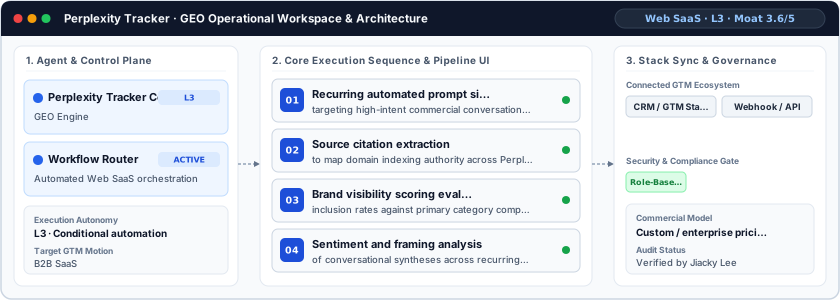
- Recurring automated prompt simulations: targeting high-intent commercial conversational queries
- Source citation extraction: to map domain indexing authority across Perplexity answer cards
- Brand visibility scoring evaluating: inclusion rates against primary category competitors
- Sentiment and framing analysis: of conversational syntheses across recurring tracking runs
Cons: operational limitations & risks
- Platform Monoculture: Users encounter operational friction and integration bottlenecks, as the pipeline struggles with The tracker focuses primarily on Perplexity outputs, omitting native cross-engine tracking for OpenAI ChatGPT Search, Google Gemini, or Claude without secondary workflows.
- Dynamic RAG Variance: Users encounter operational friction and integration bottlenecks, as the pipeline struggles with Perplexity's live web retrieval and frequent search index updates generate natural output non-determinism, requiring higher sampling volumes to distinguish genuine ranking shifts from transient model noise.
- Site Availability Instability: Users encounter operational friction and integration bottlenecks, as the pipeline struggles with Observed infrastructure connectivity drops on public endpoints pose operational risks for data ingestion pipelines requiring unbroken historical longitudinal tracking.
Perplexity Tracker TCO & deal-breaker stress test
Simulate 12-month stepped TCO, hidden cost multipliers, contract lock-in exposure, and stack failure modes using only facts verified by Jiacky Lee on · Capture SHA 97335aa3.
Perplexity Tracker triggers high-severity friction under your 5-seat / $800/mo constraints. Benchmark the verified subtrack alternatives below before committing.
| Plan / Tier | Verified Rate | Scale Fit | Scope & Quota Notes |
|---|---|---|---|
| Enterprise / Custom | Custom quote | 15–50+ seats (Enterprise SLA) | Sales-negotiated annual contract for custom volume, SSO/RBAC governance, and dedicated SLA. |
- Moat Score
- 3.6 / 5.0
- AI Autonomy
- L3
- Free Tier / Trial
- None disclosed
Triggered audit signals & failure modes
- Opaque Enterprise Quoting vs. SMB/Mid-Market BudgetVerified Pricing Ledger
Perplexity Tracker does not disclose a public self-serve floor (Custom / enterprise pricing). Buyers with a $800/mo cap face high sales-qualification friction.
- Sales-Gated Contract TermsFact-checked by Jiacky Lee
Commercial procurement operates through custom enterprise pricing available on request via sales engagements. Subscription contracts are structured around customized terms determined by query simulation frequency, tracked prompt volume, and dedicated analytical seat requirements.
- Primary Operational Bottleneck: Platform MonocultureAudit by Jiacky Lee
Users encounter operational friction and integration bottlenecks, as the pipeline struggles with The tracker focuses primarily on Perplexity outputs, omitting native cross-engine tracking for OpenAI ChatGPT Search, Google Gemini, or Claude without secondary workflows.
Hidden TCO Multipliers & Quota Gates
- Platform Monoculture: Users encounter operational friction and integration bottlenecks, as the pipeline struggles with The tracker focuses primarily on Perplexity outputs, omitting native cross-engine tracking for OpenAI ChatGPT Search, Google Gemini, or Claude without secondary workflows.
- Dynamic RAG Variance: Users encounter operational friction and integration bottlenecks, as the pipeline struggles with Perplexity's live web retrieval and frequent search index updates generate natural output non-determinism, requiring higher sampling volumes to distinguish genuine ranking shifts from transient model noise.
When to Walk Away & Negotiation Levers
- Walk away if you require transparent self-serve monthly billing or your budget ceiling is under $1,000/mo (Perplexity Tracker requires sales-gated custom quoting).
- Walk away if your workflow cannot tolerate platform monoculture: Users encounter operational friction and integration bottlenecks, as the pipeline struggles with The tracker focuses primarily on Perplexity outputs, omitting native cross-engine tracking for OpenAI ChatGPT Search, Google Gemini, or Claude without secondary workflows.
- Walk away if dynamic rag variance is a deal-breaker for your team: Users encounter operational friction and integration bottlenecks, as the pipeline struggles with Perplexity's live web retrieval and frequent search index updates generate natural output non-determinism, requiring higher sampling volumes to distinguish genuine ranking shifts from transient model noise.
- Demand a 30- to 60-day paid pilot opt-out clause in the Perplexity Tracker order form before signing a 12-month enterprise commitment.
- Require a sandbox proof-of-concept testing platform monoculture against your live CRM/data schema before annual sign-off.
Ask a custom procurement or TCO stress-test question about Perplexity Tracker
Lower 5-seat floor (~$24/mo vs. Custom Quote) · Transparent self-serve entry without mandatory annual lock-in
Lower 5-seat floor (~$499/mo vs. Custom Quote) · Transparent self-serve entry without mandatory annual lock-in
Perplexity Tracker moat & subtrack positioning
Provides purpose-built citation analysis specifically calibrated for Perplexity's citation graphs and retrieval pipelines, though vulnerable to ongoing API changes and broader multi-model tracking competitors.
Editorial review
Fact-checked by Jiacky Lee (Managing Editor, AI Autonomy & Moat Methodology) on .
Background
Modern digital discovery requires visibility into conversational answer engines where generative models synthesize purchase recommendations rather than listing blue links. Headquartered in the United Kingdom, Perplexity Tracker addresses this operational shift for organic search directors, brand strategists, and enterprise marketing analysts. The platform concentrates exclusively on monitoring brand performance, citation frequency, and algorithmic recommendations within Perplexity's conversational environment.
How Perplexity Tracker works
Operating with conditional automation, the system executes scheduled prompt simulations across target commercial keyword clusters and industry prompts. The ingest pipeline systematically deconstructs Perplexity's generated responses, parsing raw output text into structured semantic metrics. It extracts domain references from answer footnotes, identifies brand sentiment, and logs source indexation paths to uncover which authoritative web resources inform the underlying retrieval-augmented generation engine during prompt execution.
Limitations
Operational considerations and platform boundaries include:
- Platform Monoculture: Users encounter operational friction and integration bottlenecks, as the pipeline struggles with The tracker focuses primarily on Perplexity outputs, omitting native cross-engine tracking for OpenAI ChatGPT Search, Google Gemini, or Claude without secondary workflows.
- Dynamic RAG Variance: Users encounter operational friction and integration bottlenecks, as the pipeline struggles with Perplexity's live web retrieval and frequent search index updates generate natural output non-determinism, requiring higher sampling volumes to distinguish genuine ranking shifts from transient model noise.
- Site Availability Instability: Users encounter operational friction and integration bottlenecks, as the pipeline struggles with Observed infrastructure connectivity drops on public endpoints pose operational risks for data ingestion pipelines requiring unbroken historical longitudinal tracking.
Perplexity Tracker pricing
Commercial procurement operates through custom enterprise pricing available on request via sales engagements. Subscription contracts are structured around customized terms determined by query simulation frequency, tracked prompt volume, and dedicated analytical seat requirements. Prospective enterprise clients must coordinate directly with the vendor's commercial team to obtain tailored quotes tailored to organizational scale.
How Perplexity Tracker compares
While horizontal platforms like AthenaHQ and Anymorph track broad multi-LLM brand visibility across diverse proprietary model APIs, Perplexity Tracker isolates its analytical tooling specifically on Perplexity's citation graphs and indexation behaviors. Competitors like Brandlight emphasize broad cross-engine digital footprint audits. Perplexity Tracker serves enterprise search teams seeking granular citation attribution within Perplexity's specific conversational search audience. It is best suited for enterprise marketing teams and growth practitioners seeking disciplined workflow orchestration.
Frequently asked questions about Perplexity Tracker
How much does Perplexity Tracker cost and does it require a custom enterprise quote?
Published pricing summary for Perplexity Tracker: Custom / enterprise pricing. A permanent free plan is not disclosed for Perplexity Tracker. Commercial procurement operates through custom enterprise pricing available on request via sales engagements. Subscription contracts are structured around customized terms determined by query simulation frequency, tracked prompt volume, and dedicated analytical seat requirements.
How does Perplexity Tracker work and how autonomous is its AI architecture?
Specialized generative engine optimization tool monitoring brand citations, mentions, and source indexing across Perplexity conversational answer outputs. Within GEO (GEO Brand Tracking & LLM Rank Tracking), MarTechRadar rates its execution architecture at L3 · Conditional automation with a verified Moat Score of 3.6 / 5.0 (Proprietary moat). Provides purpose-built citation analysis specifically calibrated for Perplexity's citation graphs and retrieval pipelines, though vulnerable to ongoing API changes and broader multi-model tracking competitors.
What are the main limitations of Perplexity Tracker and when should buyers walk away?
Based on our editorial technical audit, key operational considerations and boundaries for Perplexity Tracker include: (1) Platform Monoculture: Users encounter operational friction and integration bottlenecks, as the pipeline struggles with The tracker focuses primarily on Perplexity outputs, omitting native cross-engine tracking for OpenAI ChatGPT Search, Google Gemini, or Claude without secondary workflows. (2) Dynamic RAG Variance: Users encounter operational friction and integration bottlenecks, as the pipeline struggles with Perplexity's live web retrieval and frequent search index updates generate natural output non-determinism, requiring higher sampling volumes to distinguish genuine ranking shifts from transient model noise. (3) Site Availability Instability: Users encounter operational friction and integration bottlenecks, as the pipeline struggles with Observed infrastructure connectivity drops on public endpoints pose operational risks for data ingestion pipelines requiring unbroken historical longitudinal tracking. Primary procurement walk-away rule: Walk away if you require transparent self-serve monthly billing or your budget ceiling is under $1,000/mo (Perplexity Tracker requires sales-gated custom quoting).
What integrations, compliance certifications, and contract terms apply to Perplexity Tracker?
Key TCO multiplier to watch: Platform Monoculture (Users encounter operational friction and integration bottlenecks, as the pipeline struggles with The tracker focuses primarily on Perplexity outputs, omitting native cross-engine tracking for OpenAI ChatGPT Search, Google Gemini, or Claude without secondary workflows.) Before signing a contract, procurement teams should demand a 30- to 60-day paid pilot opt-out clause in the Perplexity Tracker order form before signing a 12-month enterprise commitment.
What are the best Perplexity Tracker alternatives and head-to-head competitors in 2026?
Top fact-checked alternatives to Perplexity Tracker in GEO (GEO Brand Tracking & LLM Rank Tracking) include EntityMap (Custom / enterprise pricing), GenerativeRank (Custom / enterprise pricing), GeoRank (Custom / enterprise pricing), AthenaHQ (Free plan · $295/mo · Enterprise plan). While horizontal platforms like AthenaHQ and Anymorph track broad multi-LLM brand visibility across diverse proprietary model APIs, Perplexity Tracker isolates its analytical tooling specifically on Perplexity's citation graphs and indexation behaviors.
Verified sources & evidence trail
- Official product domain: https://perplexitytracker.com
- Commercial pricing verification: Verified against official vendor pricing policy (Custom / enterprise pricing)
- Editorial audit sign-off: Fact-checked by Jiacky Lee on under the MarTechRadar Evidence-Ledger Protocol.