Planoly Review (2026): Social Media Scheduling Pricing, Limits & Alternatives
Bottom line
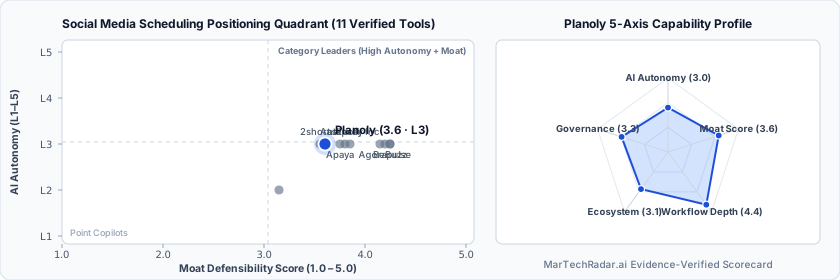
Planoly is a Web SaaS tool for Social Media Scheduling (Social Media Scheduling & Auto-Publishing) in Social & Influencer. Pricing: From $3/mo. Best suited to DTC / eCommerce and Creators / Solo. Editor ratings: AI autonomy L3 (conditional automation); moat score 3.6/5.0 (Proprietary moat). Fact-checked by Anthony Hay on Oct 14, 2026.
Visual social media planning and scheduling platform optimizing multi-channel content workflows, visual grid layouts, and automated publishing pipelines.
Planoly buyer fit verdict: when to choose vs. when to walk away
Choose Planoly if (Best Fit)
- Target ICP & Stack Fit: You operate as DTC / eCommerce and Creators / Solo requiring a Web SaaS deployment for Social Media Scheduling.
- L3 Architecture & Defensibility: Planoly maintains defensibility through deep historical visual planning workflows, dedicated visual-first grid composition tools, and broad platform integrations tailored for creators and mid-market retail brands.
- Commercial Model Fit: Your procurement budget aligns with From $3/mo.
Walk away from Planoly if (Deal-Breakers)
- Walk away if your workflow requires uncapped enterprise volume on the From $3/mo entry plan without upgrading tiers.
- Walk away if your workflow cannot tolerate API rate limiting and token degradation: Automated publishing pipelines remain constrained by native network API rate limits and periodic OAuth token expirations, resulting in silent post-delivery drops during large multi-account publishing spikes.
- Walk away if media format transcoding bottlenecks is a deal-breaker for your team: High-resolution video payloads require external re-encoding before queuing to satisfy disparate network aspect ratio guidelines, occasionally delaying short-form video releases across non-Meta channels.
Planoly key facts & scorecard
| Pricing | From $3/moVendor pricing page |
|---|---|
| Free plan | No / not disclosed |
| Delivery | Web SaaS |
| Audience | DTC / eCommerce, Creators / Solo |
| AI autonomy level | L3 · Conditional automationEditor-verified |
| Moat tier & score | 3.6 / 5.0 · Proprietary moatEditor-verified |
| Funding | AcquiredAcquired by Traject |
| Founders | Andy Hoang, Brandy Pham, Kenny Teng, Thai Huynh |
| Company size | 11-50 employees |
| Governance & docs | Terms ↗ · Privacy ↗ |
| Headquarters | Austin, TX |
| Founded | 2015 |
| Last verified |
Planoly pros & cons: strengths vs. operational limitations
Pros: core strengths & capabilities
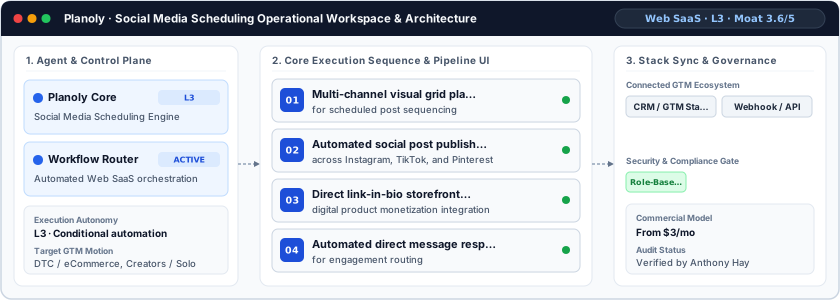
- Multi-channel visual grid planner: for scheduled post sequencing
- Automated social post publishing: across Instagram, TikTok, and Pinterest
- Direct link-in-bio storefront and: digital product monetization integration
- Automated direct message response workflows: for engagement routing
Cons: operational limitations & risks
- API Rate Limiting and Token Degradation: Automated publishing pipelines remain constrained by native network API rate limits and periodic OAuth token expirations, resulting in silent post-delivery drops during large multi-account publishing spikes.
- Media Format Transcoding Bottlenecks: High-resolution video payloads require external re-encoding before queuing to satisfy disparate network aspect ratio guidelines, occasionally delaying short-form video releases across non-Meta channels.
- Enterprise Asset Governance Controls: The system lacks enterprise-grade hierarchical role-based access control (RBAC), limiting its operational viability for multi-brand conglomerates requiring strict multi-stage legal and regulatory approval steps.
Planoly TCO & deal-breaker stress test
Simulate 12-month stepped TCO, hidden cost multipliers, contract lock-in exposure, and stack failure modes using only facts verified by Anthony Hay on · Capture SHA e7742f53.
Planoly is viable for 5 seats, but requires commercial or technical verification on the flagged items below.
| Plan / Tier | Verified Rate | Scale Fit | Scope & Quota Notes |
|---|---|---|---|
| Entry / Starter | $3/mo | 1–2 seats | Features included in every plan |
| Growth / Professional | $14/mo | 5 seats | Pick the plan that fits where you are right now and grow from there. |
- Moat Score
- 3.6 / 5.0
- AI Autonomy
- L3
- Free Tier / Trial
- None disclosed
Triggered audit signals & failure modes
- Published Self-Serve Entry FloorVerified Pricing Ledger
Planoly publishes a transparent entry point (From $3/mo) for initial validation before committing.
- Usage / Credit Burn VolatilityCommercial Model Audit
Planoly uses credit or usage-metered billing (From $3/mo). High-volume automated workflows across 5 seats can trigger mid-cycle overage charges.
- Tier Fit for 5-Seat Scale: Entry / Starter ($3/mo)Verified Tier Schedule
Features included in every plan
- Primary Operational Bottleneck: API Rate Limiting and Token DegradationAudit by Anthony Hay
Automated publishing pipelines remain constrained by native network API rate limits and periodic OAuth token expirations, resulting in silent post-delivery drops during large multi-account publishing spikes.
Hidden TCO Multipliers & Quota Gates
- Annual Billing Headline vs. Monthly Premium: Headline entry rates reflect annual billing commitments (Save up to 15%); month-to-month flexibility carries a higher effective monthly rate or requires annual prepayment.
- Credit & Usage Burn Multiplier: Automated workflows consume metered credits/usage quotas; multi-step enrichment, voice minutes, or high-frequency agent runs can trigger mid-cycle top-up packs.
- Enterprise Governance & Add-On Gating: Advanced capabilities such as Single Sign-On (SSO), custom role permissions, or specialized analytics modules are gated behind upper tiers or paid add-ons.
When to Walk Away & Negotiation Levers
- Walk away if your workflow requires uncapped enterprise volume on the From $3/mo entry plan without upgrading tiers.
- Walk away if your workflow cannot tolerate API rate limiting and token degradation: Automated publishing pipelines remain constrained by native network API rate limits and periodic OAuth token expirations, resulting in silent post-delivery drops during large multi-account publishing spikes.
- Walk away if media format transcoding bottlenecks is a deal-breaker for your team: High-resolution video payloads require external re-encoding before queuing to satisfy disparate network aspect ratio guidelines, occasionally delaying short-form video releases across non-Meta channels.
- Validate exact quota thresholds (seats, credits, or API calls) included in Planoly's From $3/mo tier before converting from monthly to annual billing.
- Require a sandbox proof-of-concept testing API rate limiting and token degradation against your live CRM/data schema before annual sign-off.
Ask a custom procurement or TCO stress-test question about Planoly
Lower 5-seat floor (~$13/mo vs. Usage-Metered)
Lower 5-seat floor (~$29/mo vs. Usage-Metered)
Planoly moat & subtrack positioning
Planoly maintains defensibility through deep historical visual planning workflows, dedicated visual-first grid composition tools, and broad platform integrations tailored for creators and mid-market retail brands.
Editorial review
Fact-checked by Anthony Hay (Senior SEO, Search Intelligence & Content Operations Editor) on .
Background
For distributed marketing teams and creator-led brands tasked with maintaining unified brand aesthetics across decentralized networks, Planoly delivers visual content planning and automated distribution. Headquartered in Austin, TX, and founded in 2015, the platform was later acquired by Traject to serve as its flagship social publishing engine. Designed primarily for social media directors and visual content strategists, the software structures asset preparation, channel scheduling, and cross-network delivery into an integrated visual operations pipeline.
How Planoly works
At its architectural core, Planoly operates as an L3 automated publishing engine connecting into official developer endpoints across Meta, Pinterest, and TikTok. Assets uploaded to the media repository undergo automated transcoding, aspect-ratio validation, and metadata normalization before entering the visual planning grid. Scheduled assets are staged within a timed queuing worker that polls platform-specific rate limits, triggers programmatic publishing calls via secure OAuth tokens, and captures real-time downstream engagement payloads without requiring manual execution.
Limitations
Operational considerations and platform boundaries include:
- API Rate Limiting and Token Degradation: Automated publishing pipelines remain constrained by native network API rate limits and periodic OAuth token expirations, resulting in silent post-delivery drops during large multi-account publishing spikes.
- Media Format Transcoding Bottlenecks: High-resolution video payloads require external re-encoding before queuing to satisfy disparate network aspect ratio guidelines, occasionally delaying short-form video releases across non-Meta channels.
- Enterprise Asset Governance Controls: The system lacks enterprise-grade hierarchical role-based access control (RBAC), limiting its operational viability for multi-brand conglomerates requiring strict multi-stage legal and regulatory approval steps.
Planoly pricing
Planoly operates a tiered subscription commercial model. Entry-level pricing options begin with lightweight plans starting from $3 per month for basic tooling, scaling up to standard functional tiers such as the Starter plan at $14 per month for solo operators managing a single social profile set. Commercial upgrades unlock additional team seats, expanded profile sets, digital product sales tooling, and automated messaging add-ons.
How Planoly compares
Within the publishing domain, Planoly contends with competitors like Agorapulse, Antela.ai, Inc., and Apaya. While Agorapulse emphasizes centralized social inbox triage, unified CRM tracking, and complex enterprise governance, Planoly targets visual planning workflows and grid curation. Platforms like Antela.ai, Inc. focus on programmatic content generation, whereas Planoly remains centered on human-curated visual timelines. Consequently, the solution is optimized for visual commerce brands and boutique marketing teams rather than complex enterprise compliance departments.
Frequently asked questions about Planoly
How much does Planoly cost and what pricing tiers are available?
Published pricing summary for Planoly: From $3/mo. A permanent free plan is not disclosed for Planoly. Verified tier schedule: Entry / Starter ($3/mo for 1–2 seats); Growth / Professional ($14/mo for 5 seats). Planoly operates a tiered subscription commercial model. Entry-level pricing options begin with lightweight plans starting from $3 per month for basic tooling, scaling up to standard functional tiers such as the Starter plan at $14 per month for solo operators managing a single social profile set.
How does Planoly work and how autonomous is its AI architecture?
Visual social media planning and scheduling platform optimizing multi-channel content workflows, visual grid layouts, and automated publishing pipelines. Within Social Media Scheduling (Social Media Scheduling & Auto-Publishing), MarTechRadar rates its execution architecture at L3 · Conditional automation with a verified Moat Score of 3.6 / 5.0 (Proprietary moat). Planoly maintains defensibility through deep historical visual planning workflows, dedicated visual-first grid composition tools, and broad platform integrations tailored for creators and mid-market retail brands. Corporate profile: Founded by Andy Hoang, Brandy Pham, Kenny Teng, Thai Huynh, operating at 11-50 employees scale, acquired by Traject.
What are the main limitations of Planoly and when should buyers walk away?
Based on our editorial technical audit, key operational considerations and boundaries for Planoly include: (1) API Rate Limiting and Token Degradation: Automated publishing pipelines remain constrained by native network API rate limits and periodic OAuth token expirations, resulting in silent post-delivery drops during large multi-account publishing spikes. (2) Media Format Transcoding Bottlenecks: High-resolution video payloads require external re-encoding before queuing to satisfy disparate network aspect ratio guidelines, occasionally delaying short-form video releases across non-Meta channels. (3) Enterprise Asset Governance Controls: The system lacks enterprise-grade hierarchical role-based access control (RBAC), limiting its operational viability for multi-brand conglomerates requiring strict multi-stage legal and regulatory approval steps. Primary procurement walk-away rule: Walk away if your workflow requires uncapped enterprise volume on the From $3/mo entry plan without upgrading tiers.
What integrations, compliance certifications, and contract terms apply to Planoly?
Key TCO multiplier to watch: Annual Billing Headline vs. Monthly Premium (Headline entry rates reflect annual billing commitments (Save up to 15%); month-to-month flexibility carries a higher effective monthly rate or requires annual prepayment.) Before signing a contract, procurement teams should validate exact quota thresholds (seats, credits, or API calls) included in Planoly's From $3/mo tier before converting from monthly to annual billing.
What are the best Planoly alternatives and head-to-head competitors in 2026?
Top fact-checked alternatives to Planoly in Social Media Scheduling (Social Media Scheduling & Auto-Publishing) include Blink AI (Custom / enterprise pricing), Plann (From $12.50/mo), Postwise (From $37/mo), Sked Social (Free plan · $0/mo · Enterprise plan). Within the publishing domain, Planoly contends with competitors like Agorapulse, Antela.ai, Inc., and Apaya. While Agorapulse emphasizes centralized social inbox triage, unified CRM tracking, and complex enterprise governance, Planoly targets visual planning workflows and grid curation.
Verified sources & evidence trail
- Official product domain: https://planoly.com
- Commercial pricing verification: https://www.planoly.com/pricing
- Verified corporate entity profiles (
sameAs): LinkedIn Company Profile · Crunchbase Entity Record - First-party governance & documentation links: Terms · Privacy
- Editorial audit sign-off: Fact-checked by Anthony Hay on under the MarTechRadar Evidence-Ledger Protocol.