Prescient AI Review (2026): Marketing Mix Modeling Pricing, Limits & Alternatives
Bottom line
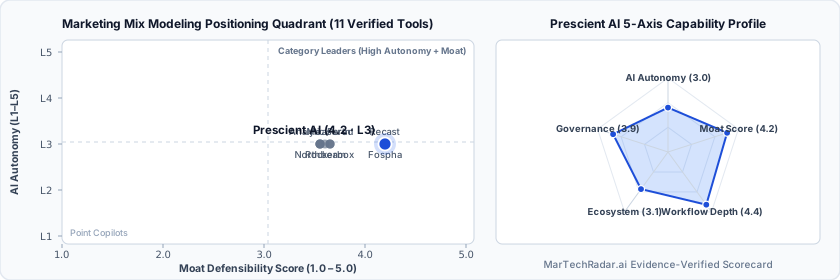
Prescient AI is a Web SaaS tool for Marketing Mix Modeling (Marketing Mix Modeling & Incremental Lift) in Analytics & Attribution. Pricing: Custom / enterprise pricing. Best suited to DTC / eCommerce and Enterprise Brands. Editor ratings: AI autonomy L3 (conditional automation); moat score 4.2/5.0 (Proprietary moat). Fact-checked by Julie Brot on Oct 12, 2026.
Marketing mix modeling and forecasting engine delivering cookieless incremental revenue attribution and media budget optimization for multi-channel.
Prescient AI buyer fit verdict: when to choose vs. when to walk away
Choose Prescient AI if (Best Fit)
- Target ICP & Stack Fit: You operate as DTC / eCommerce and Enterprise Brands requiring a Web SaaS deployment for Marketing Mix Modeling.
- L3 Architecture & Defensibility: Proprietary Bayesian econometric pipelines trained specifically on high-velocity direct-to-consumer transaction signals, bypassing user-level tracking identifiers entirely while providing granular ad-set level attribution and scenario forecasting.
- Commercial Model Fit: Your procurement budget aligns with Custom / enterprise pricing.
Walk away from Prescient AI if (Deal-Breakers)
- Walk away if you require transparent self-serve monthly billing or your budget ceiling is under $1,000/mo (Prescient AI requires sales-gated custom quoting).
- Walk away if your workflow cannot tolerate historical data cold start: The statistical regression framework requires extended historical daily order and ad spend records to stabilize parameters, restricting measurement efficacy for newly launched brands or unseasoned sales channels.
- Walk away if high ad spend floor is a deal-breaker for your team: Econometric models require significant variance and scale in media investments, rendering statistical outputs noisy or inconclusive for marketing operations allocating under six figures in aggregate monthly ad spend.
Prescient AI key facts & scorecard
| Pricing | Custom / enterprise pricing |
|---|---|
| Free plan | No / not disclosed |
| Delivery | Web SaaS |
| Audience | DTC / eCommerce, Enterprise Brands |
| AI autonomy level | L3 · Conditional automationEditor-verified |
| Moat tier & score | 4.2 / 5.0 · Proprietary moatEditor-verified |
| Funding | Series A |
| Total funding | $16.7MBacked by Headline, Blumberg Capital |
| Founders | Cody Greco, Michael True |
| Company size | 51-200 employees |
| Governance & docs | API & Docs ↗ · Terms ↗ · Privacy ↗ |
| Headquarters | San Francisco, California |
| Founded | 2020 |
| Last verified |
Prescient AI pros & cons: strengths vs. operational limitations
Pros: core strengths & capabilities
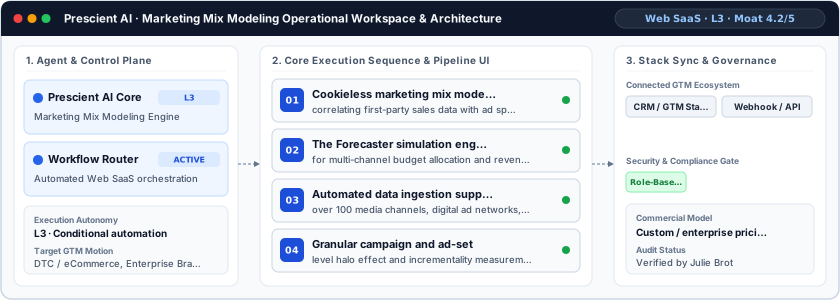
- Cookieless marketing mix modeling: correlating first-party sales data with ad spend
- The Forecaster simulation engine: for multi-channel budget allocation and revenue projection
- Automated data ingestion supporting: over 100 media channels, digital ad networks, and commerce platforms
- Granular campaign and ad-set: level halo effect and incrementality measurement
Cons: operational limitations & risks
- Historical Data Cold Start: The statistical regression framework requires extended historical daily order and ad spend records to stabilize parameters, restricting measurement efficacy for newly launched brands or unseasoned sales channels.
- High Ad Spend Floor: Econometric models require significant variance and scale in media investments, rendering statistical outputs noisy or inconclusive for marketing operations allocating under six figures in aggregate monthly ad spend.
- Granular Click-Level Latency: Because the system computes macro econometric relationships rather than deterministic user clickpaths, it cannot provide instantaneous real-time session tracking or intra-day attribution updates for rapid programmatic bid adjustments.
Prescient AI TCO & deal-breaker stress test
Simulate 12-month stepped TCO, hidden cost multipliers, contract lock-in exposure, and stack failure modes using only facts verified by Julie Brot on · Capture SHA 34ec39b4.
Prescient AI triggers high-severity friction under your 5-seat / $800/mo constraints. Benchmark the verified subtrack alternatives below before committing.
| Plan / Tier | Verified Rate | Scale Fit | Scope & Quota Notes |
|---|---|---|---|
| Enterprise / Custom | Custom quote | Unlimited seats (Enterprise SLA) | Sales-negotiated annual contract for custom volume, SSO/RBAC governance, and dedicated SLA. |
- Moat Score
- 4.2 / 5.0
- AI Autonomy
- L3
- Free Tier / Trial
- None disclosed
Triggered audit signals & failure modes
- Opaque Enterprise Quoting vs. SMB/Mid-Market BudgetVerified Pricing Ledger
Prescient AI does not disclose a public self-serve floor (Custom / enterprise pricing). Buyers with a $800/mo cap face high sales-qualification friction.
- Sales-Gated Contract TermsFact-checked by Julie Brot
Prescient AI delivers its measurement engine through a closed subscription commercial structure, with exact terms available on request through tailored enterprise sales quotes based on organizational scale and seats.
- Primary Operational Bottleneck: Historical Data Cold StartAudit by Julie Brot
The statistical regression framework requires extended historical daily order and ad spend records to stabilize parameters, restricting measurement efficacy for newly launched brands or unseasoned sales channels.
Hidden TCO Multipliers & Quota Gates
- Historical Data Cold Start: The statistical regression framework requires extended historical daily order and ad spend records to stabilize parameters, restricting measurement efficacy for newly launched brands or unseasoned sales channels.
- High Ad Spend Floor: Econometric models require significant variance and scale in media investments, rendering statistical outputs noisy or inconclusive for marketing operations allocating under six figures in aggregate monthly ad spend.
When to Walk Away & Negotiation Levers
- Walk away if you require transparent self-serve monthly billing or your budget ceiling is under $1,000/mo (Prescient AI requires sales-gated custom quoting).
- Walk away if your workflow cannot tolerate historical data cold start: The statistical regression framework requires extended historical daily order and ad spend records to stabilize parameters, restricting measurement efficacy for newly launched brands or unseasoned sales channels.
- Walk away if high ad spend floor is a deal-breaker for your team: Econometric models require significant variance and scale in media investments, rendering statistical outputs noisy or inconclusive for marketing operations allocating under six figures in aggregate monthly ad spend.
- Demand a 30- to 60-day paid pilot opt-out clause in the Prescient AI order form before signing a 12-month enterprise commitment.
- Require a sandbox proof-of-concept testing historical data cold start against your live CRM/data schema before annual sign-off.
Ask a custom procurement or TCO stress-test question about Prescient AI
Lower 5-seat floor (~$125/mo vs. Custom Quote)
Verified Marketing Mix Modeling peer (Custom / enterprise pricing · Moat 4.2/5.0)
Prescient AI moat & subtrack positioning
Proprietary Bayesian econometric pipelines trained specifically on high-velocity direct-to-consumer transaction signals, bypassing user-level tracking identifiers entirely while providing granular ad-set level attribution and scenario forecasting.
Editorial review
Fact-checked by Julie Brot (Enterprise SaaS Governance & Procurement Editor) on .
Background
Established in 2020 in San Francisco, California, Prescient AI secured $16.7M in venture capital funding to build modern econometrics for enterprise growth leaders and performance marketing executives. The company develops algorithmic media measurement designed to quantify revenue drivers across complex consumer channels without relying on client-side tracking pixels. By shifting attribution away from deprecated device identifiers and towards macroscopic economic modeling, Prescient AI targets brands seeking defensible incrementality reporting across fragmented digital ad ecosystems.
How Prescient AI works
At its architectural core, the platform operates at Level 3 autonomy by ingesting first-party transaction ledgers alongside daily platform spend, impressions, and creative metadata through automated API connectors. Prescient AI processes these time-series feeds through Bayesian marketing mix modeling algorithms that isolate baseline organic demand, external seasonal variables, and ad channel decay rates. The platform continuously updates these media response curves, feeding results into its Forecaster engine to output predictive budget simulations and marginal return recommendations across paid networks.
Limitations
Operational considerations and platform boundaries include:
- Historical Data Cold Start: The statistical regression framework requires extended historical daily order and ad spend records to stabilize parameters, restricting measurement efficacy for newly launched brands or unseasoned sales channels.
- High Ad Spend Floor: Econometric models require significant variance and scale in media investments, rendering statistical outputs noisy or inconclusive for marketing operations allocating under six figures in aggregate monthly ad spend.
- Granular Click-Level Latency: Because the system computes macro econometric relationships rather than deterministic user clickpaths, it cannot provide instantaneous real-time session tracking or intra-day attribution updates for rapid programmatic bid adjustments.
Prescient AI pricing
Prescient AI delivers its measurement engine through a closed subscription commercial structure, with exact terms available on request through tailored enterprise sales quotes based on organizational scale and seats. Contracts scale across tiered customer bands reflecting operational volume, gross merchandise value, and active media integrations. Every commercial deployment bundles full algorithmic forecasting capabilities, platform connectors, and guided analytical onboarding without consumption-based overage fees.
How Prescient AI compares
Within the marketing mix modeling category, Prescient AI contends directly with Recast, Fospha, and Northbeam. Recast emphasizes pure open Bayesian time-series methods that necessitate dedicated internal econometricians, while Northbeam leans heavily on blended multi-touch clickstream identity graphs. Fospha targets European direct-to-consumer operations via digital platform integrations. Prescient AI differentiates by providing automated operationalization through its Forecaster interface, making it ideal for multi-channel commerce enterprises allocating substantial digital ad budgets across paid social and search.
Direct competitors & market radar
Top algorithmic competitors based on category positioning, capability overlap, and ICP alignment.
Frequently asked questions about Prescient AI
How much does Prescient AI cost and does it require a custom enterprise quote?
Published pricing summary for Prescient AI: Custom / enterprise pricing. A permanent free plan is not disclosed for Prescient AI. Prescient AI delivers its measurement engine through a closed subscription commercial structure, with exact terms available on request through tailored enterprise sales quotes based on organizational scale and seats.
How does Prescient AI work and how autonomous is its AI architecture?
Marketing mix modeling and forecasting engine delivering cookieless incremental revenue attribution and media budget optimization for multi-channel. Within Marketing Mix Modeling (Marketing Mix Modeling & Incremental Lift), MarTechRadar rates its execution architecture at L3 · Conditional automation with a verified Moat Score of 4.2 / 5.0 (Proprietary moat). Proprietary Bayesian econometric pipelines trained specifically on high-velocity direct-to-consumer transaction signals, bypassing user-level tracking identifiers entirely while providing granular ad-set level attribution and scenario forecasting. Corporate profile: Founded by Cody Greco, Michael True, operating at 51-200 employees scale.
What are the main limitations of Prescient AI and when should buyers walk away?
Based on our editorial technical audit, key operational considerations and boundaries for Prescient AI include: (1) Historical Data Cold Start: The statistical regression framework requires extended historical daily order and ad spend records to stabilize parameters, restricting measurement efficacy for newly launched brands or unseasoned sales channels. (2) High Ad Spend Floor: Econometric models require significant variance and scale in media investments, rendering statistical outputs noisy or inconclusive for marketing operations allocating under six figures in aggregate monthly ad spend. (3) Granular Click-Level Latency: Because the system computes macro econometric relationships rather than deterministic user clickpaths, it cannot provide instantaneous real-time session tracking or intra-day attribution updates for rapid programmatic bid adjustments. Primary procurement walk-away rule: Walk away if you require transparent self-serve monthly billing or your budget ceiling is under $1,000/mo (Prescient AI requires sales-gated custom quoting).
What integrations, compliance certifications, and contract terms apply to Prescient AI?
First-party governance and developer endpoints verified on domain include: API Docs (https://help.prescientai.com/docs/features-core-concepts). Key TCO multiplier to watch: Historical Data Cold Start (The statistical regression framework requires extended historical daily order and ad spend records to stabilize parameters, restricting measurement efficacy for newly launched brands or unseasoned sales channels.) Before signing a contract, procurement teams should demand a 30- to 60-day paid pilot opt-out clause in the Prescient AI order form before signing a 12-month enterprise commitment.
What are the best Prescient AI alternatives and head-to-head competitors in 2026?
Top fact-checked alternatives to Prescient AI in Marketing Mix Modeling (Marketing Mix Modeling & Incremental Lift) include Recast (Custom / enterprise pricing), Fospha (From $1,500/yr), Northbeam (Custom / enterprise pricing), Rockerbox (Custom / enterprise pricing). Within the marketing mix modeling category, Prescient AI contends directly with Recast, Fospha, and Northbeam. Recast emphasizes pure open Bayesian time-series methods that necessitate dedicated internal econometricians, while Northbeam leans heavily on blended multi-touch clickstream identity graphs.
Verified sources & evidence trail
- Official product domain: https://prescient-ai.io
- Commercial pricing verification: Verified against official vendor pricing policy (Custom / enterprise pricing)
- Verified corporate entity profiles (
sameAs): LinkedIn Company Profile · Crunchbase Entity Record - First-party governance & documentation links: API & Docs · Terms · Privacy
- Editorial audit sign-off: Fact-checked by Julie Brot on under the MarTechRadar Evidence-Ledger Protocol.