Recast Review (2026): Marketing Mix Modeling Pricing, Limits & Alternatives
Bottom line
Recast is a Web SaaS tool for Marketing Mix Modeling (Marketing Mix Modeling & Incremental Lift) in Analytics & Attribution. Pricing: Custom / enterprise pricing. Best suited to B2B SaaS. Editor ratings: AI autonomy L3 (conditional automation); moat score 4.2/5.0 (Proprietary moat). Fact-checked by Sarah Per on Oct 6, 2026.
Modern econometrics platform combining continuous Bayesian marketing mix modeling with GeoLift incrementality experimentation to optimize cross-channel.
Recast buyer fit verdict: when to choose vs. when to walk away
Choose Recast if (Best Fit)
- Target ICP & Stack Fit: You operate as B2B SaaS requiring a Web SaaS deployment for Marketing Mix Modeling, with verified ecosystem connectivity for Slack, Notion.
- L3 Architecture & Defensibility: Defensibility stems from proprietary Bayesian Markov Chain Monte Carlo optimization engines configured for continuous weekly updates rather than static semi-annual snapshots, combined with unified GeoLift experiment design calibration.
- Commercial Model Fit: Your procurement budget aligns with Custom / enterprise pricing.
Walk away from Recast if (Deal-Breakers)
- Walk away if you require transparent self-serve monthly billing or your budget ceiling is under $1,000/mo (Recast requires sales-gated custom quoting).
- Walk away if your workflow cannot tolerate data granularity and lag: The econometric engine requires aggregated historical time-series data, meaning campaigns need sustained spend volume across multiple weeks before the model identifies incremental signal.
- Walk away if geo-testing execution constraints is a deal-breaker for your team: Executing matched-market GeoLift experiments requires isolated regional media delivery, creating operational friction for digital platforms lacking precise regional budget gating.
Recast key facts & scorecard
| Pricing | Custom / enterprise pricing |
|---|---|
| Free plan | No / not disclosed |
| Delivery | Web SaaS |
| Audience | B2B SaaS |
| AI autonomy level | L3 · Conditional automationEditor-verified |
| Moat tier & score | 4.2 / 5.0 · Proprietary moatEditor-verified |
| Funding | Seed |
| Total funding | $4.5MBacked by Lerer Hippeau, Allbirds, Data Tech Fund, Good Friends, Jonah Goodhart |
| Ecosystem integrations | Slack, Notion |
| Governance & docs | API & Docs ↗ · Privacy ↗ |
| Headquarters | New York, United States |
| Founded | 2021 |
| Last verified |
Recast pros & cons: strengths vs. operational limitations
Pros: core strengths & capabilities
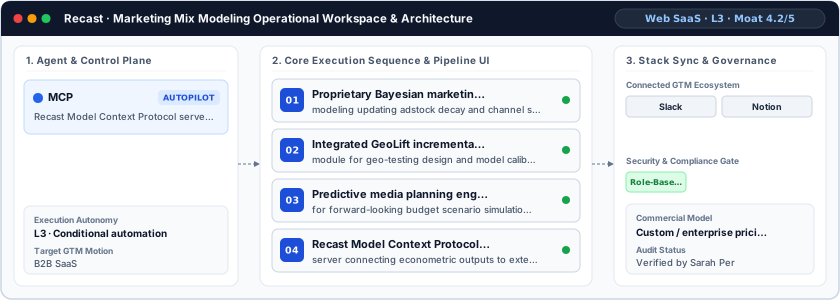
- Proprietary Bayesian marketing mix: modeling updating adstock decay and channel saturation curves continuously
- Integrated GeoLift incrementality experimentation: module for geo-testing design and model calibration
- Predictive media planning engine: for forward-looking budget scenario simulation and spend optimization
- Recast Model Context Protocol (MCP): server connecting econometric outputs to external developer tools, Slack, and Notion
Cons: operational limitations & risks
- Data Granularity and Lag: The econometric engine requires aggregated historical time-series data, meaning campaigns need sustained spend volume across multiple weeks before the model identifies incremental signal.
- Geo-Testing Execution Constraints: Executing matched-market GeoLift experiments requires isolated regional media delivery, creating operational friction for digital platforms lacking precise regional budget gating.
- Exogenous Variable Maintenance: Accurate model stability demands ongoing manual inputs for promotions, distribution shifts, pricing variations, and supply chain disruptions to prevent econometric misattribution.
Recast TCO & deal-breaker stress test
Simulate 12-month stepped TCO, hidden cost multipliers, contract lock-in exposure, and stack failure modes using only facts verified by Sarah Per on · Capture SHA e4b1b558.
Recast triggers high-severity friction under your 5-seat / $800/mo constraints. Benchmark the verified subtrack alternatives below before committing.
| Plan / Tier | Verified Rate | Scale Fit | Scope & Quota Notes |
|---|---|---|---|
| Enterprise / Custom | Custom quote | 15–50+ seats (Enterprise SLA) | Sales-negotiated annual contract for custom volume, SSO/RBAC governance, and dedicated SLA. |
- Moat Score
- 4.2 / 5.0
- AI Autonomy
- L3
- Free Tier / Trial
- None disclosed
Triggered audit signals & failure modes
- Opaque Enterprise Quoting vs. SMB/Mid-Market BudgetVerified Pricing Ledger
Recast does not disclose a public self-serve floor (Custom / enterprise pricing). Buyers with a $800/mo cap face high sales-qualification friction.
- Sales-Gated Contract TermsFact-checked by Sarah Per
Commercial pricing is available on request through tailored enterprise sales quotes based on organizational scale and seats.
- Primary Operational Bottleneck: Geo-Testing Execution ConstraintsAudit by Sarah Per
Executing matched-market GeoLift experiments requires isolated regional media delivery, creating operational friction for digital platforms lacking precise regional budget gating.
Hidden TCO Multipliers & Quota Gates
- Data Granularity and Lag: The econometric engine requires aggregated historical time-series data, meaning campaigns need sustained spend volume across multiple weeks before the model identifies incremental signal.
- Geo-Testing Execution Constraints: Executing matched-market GeoLift experiments requires isolated regional media delivery, creating operational friction for digital platforms lacking precise regional budget gating.
When to Walk Away & Negotiation Levers
- Walk away if you require transparent self-serve monthly billing or your budget ceiling is under $1,000/mo (Recast requires sales-gated custom quoting).
- Walk away if your workflow cannot tolerate data granularity and lag: The econometric engine requires aggregated historical time-series data, meaning campaigns need sustained spend volume across multiple weeks before the model identifies incremental signal.
- Walk away if geo-testing execution constraints is a deal-breaker for your team: Executing matched-market GeoLift experiments requires isolated regional media delivery, creating operational friction for digital platforms lacking precise regional budget gating.
- Demand a 30- to 60-day paid pilot opt-out clause in the Recast order form before signing a 12-month enterprise commitment.
- Require a sandbox proof-of-concept testing data granularity and lag against your live CRM/data schema before annual sign-off.
Ask a custom procurement or TCO stress-test question about Recast
Lower 5-seat floor (~$125/mo vs. Custom Quote)
Verified Marketing Mix Modeling peer (Custom / enterprise pricing · Moat 4.2/5.0)
Recast key entities, modules & ecosystem stack
Recast Model Context Protocol server connecting econometric outputs to external developer tools, Slack, and Notion
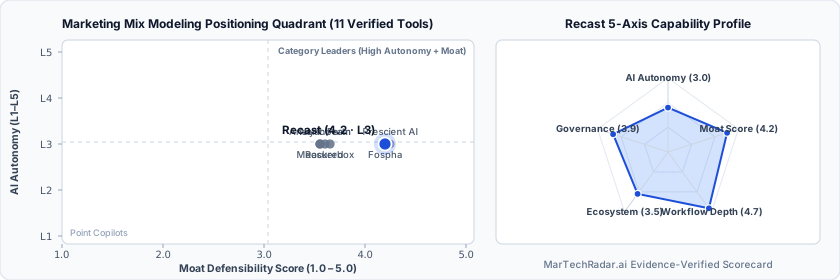
Recast moat & subtrack positioning
Defensibility stems from proprietary Bayesian Markov Chain Monte Carlo optimization engines configured for continuous weekly updates rather than static semi-annual snapshots, combined with unified GeoLift experiment design calibration.
Editorial review
Fact-checked by Sarah Per (Principal Content Systems & Generative Media Editor) on .
Background
Architected around statistical time-series econometrics rather than client-side deterministic cookies, Recast was founded in 2021 in New York, United States, securing $4.5M in venture funding. Built by econometricians to counter signal degradation across modern privacy frameworks, the platform serves heads of performance marketing, chief financial officers, and revenue analytics leaders. Recast repositions marketing mix modeling from an intermittent consulting engagement into continuous operational planning infrastructure.
How Recast works
At the architectural layer, the system conditional autonomy, Recast executes continuous marketing mix modeling through a proprietary Bayesian regression engine. Instead of relying on user-level click trackers or pixel tags, the system ingests aggregated channel spend data, revenue transactions, and exogenous macro variables across weekly cadences. Algorithmic pipelines estimate dynamic adstock decay rates and non-linear channel saturation curves, continuously refreshing posterior distributions via Bayesian computation. The platform calibrates these statistical priors against real-world incrementality benchmarks by embedding native GeoLift experimentation workflows, allowing marketers to simulate budget shifts across diverse spend scenarios.
Limitations
Operational considerations and platform boundaries include:
- Data Granularity and Lag: The econometric engine requires aggregated historical time-series data, meaning campaigns need sustained spend volume across multiple weeks before the model identifies incremental signal.
- Geo-Testing Execution Constraints: Executing matched-market GeoLift experiments requires isolated regional media delivery, creating operational friction for digital platforms lacking precise regional budget gating.
- Exogenous Variable Maintenance: Accurate model stability demands ongoing manual inputs for promotions, distribution shifts, pricing variations, and supply chain disruptions to prevent econometric misattribution.
Recast pricing
Commercial pricing is available on request through tailored enterprise sales quotes based on organizational scale and seats. Contracts operate on annual subscription structures tied to gross measured media spend, historical data ingestion volume, and dedicated econometric calibration support.
How Recast compares
Within the measurement category, Recast competes directly with Prescient AI, Northbeam, and Fospha. While Northbeam and Fospha deploy click-path tracking, first-party pixel graphs, and deterministic multi-touch attribution, Recast relies strictly on aggregated econometric lift that remains immune to browser tracking changes. Against Prescient AI, which emphasizes rapid attribution for direct-to-consumer digital channels, Recast provides mathematically rigorous Bayesian calibration through integrated GeoLift experiments. The platform suits omnichannel brands managing diversified budgets across digital and offline channels.
Direct competitors & market radar
Top algorithmic competitors based on category positioning, capability overlap, and ICP alignment.
Frequently asked questions about Recast
How much does Recast cost and does it require a custom enterprise quote?
Published pricing summary for Recast: Custom / enterprise pricing. A permanent free plan is not disclosed for Recast. Commercial pricing is available on request through tailored enterprise sales quotes based on organizational scale and seats. Contracts operate on annual subscription structures tied to gross measured media spend, historical data ingestion volume, and dedicated econometric calibration support.
How does Recast work and how autonomous is its AI architecture?
Modern econometrics platform combining continuous Bayesian marketing mix modeling with GeoLift incrementality experimentation to optimize cross-channel. Within Marketing Mix Modeling (Marketing Mix Modeling & Incremental Lift), MarTechRadar rates its execution architecture at L3 · Conditional automation with a verified Moat Score of 4.2 / 5.0 (Proprietary moat). Defensibility stems from proprietary Bayesian Markov Chain Monte Carlo optimization engines configured for continuous weekly updates rather than static semi-annual snapshots, combined with unified GeoLift experiment design calibration.
What are the main limitations of Recast and when should buyers walk away?
Based on our editorial technical audit, key operational considerations and boundaries for Recast include: (1) Data Granularity and Lag: The econometric engine requires aggregated historical time-series data, meaning campaigns need sustained spend volume across multiple weeks before the model identifies incremental signal. (2) Geo-Testing Execution Constraints: Executing matched-market GeoLift experiments requires isolated regional media delivery, creating operational friction for digital platforms lacking precise regional budget gating. (3) Exogenous Variable Maintenance: Accurate model stability demands ongoing manual inputs for promotions, distribution shifts, pricing variations, and supply chain disruptions to prevent econometric misattribution. Primary procurement walk-away rule: Walk away if you require transparent self-serve monthly billing or your budget ceiling is under $1,000/mo (Recast requires sales-gated custom quoting).
What integrations, compliance certifications, and contract terms apply to Recast?
Verified ecosystem and stack integrations include Slack, Notion. First-party governance and developer endpoints verified on domain include: API Docs (https://docs.getrecast.com/docs). Key TCO multiplier to watch: Data Granularity and Lag (The econometric engine requires aggregated historical time-series data, meaning campaigns need sustained spend volume across multiple weeks before the model identifies incremental signal.) Before signing a contract, procurement teams should demand a 30- to 60-day paid pilot opt-out clause in the Recast order form before signing a 12-month enterprise commitment.
What are the best Recast alternatives and head-to-head competitors in 2026?
Top fact-checked alternatives to Recast in Marketing Mix Modeling (Marketing Mix Modeling & Incremental Lift) include Prescient AI (Custom / enterprise pricing), Fospha (From $1,500/yr), Measured (Custom / enterprise pricing), Odins.ai (Custom / enterprise pricing). Within the measurement category, Recast competes directly with Prescient AI, Northbeam, and Fospha.
Verified sources & evidence trail
- Official product domain: https://getrecast.com
- Commercial pricing verification: Verified against official vendor pricing policy (Custom / enterprise pricing)
- First-party governance & documentation links: API & Docs · Privacy
- Editorial audit sign-off: Fact-checked by Sarah Per on under the MarTechRadar Evidence-Ledger Protocol.