Sellforte Review (2026): Marketing Mix Modeling Pricing, Limits & Alternatives
Bottom line
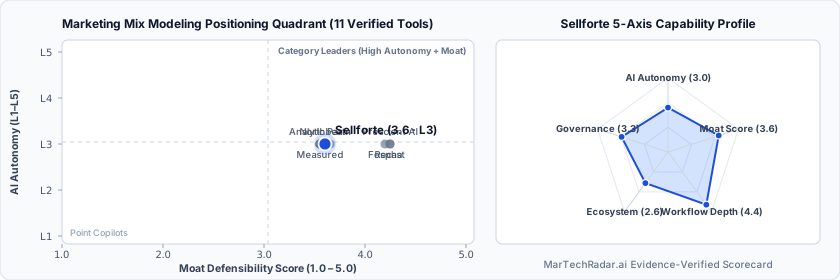
Sellforte is a Web SaaS tool for Marketing Mix Modeling (Marketing Mix Modeling & Incremental Lift) in Analytics & Attribution. Pricing: Custom / enterprise pricing. Best suited to DTC / eCommerce and Enterprise Brands. Editor ratings: AI autonomy L3 (conditional automation); moat score 3.6/5.0 (Proprietary moat). Fact-checked by Jagmeet Sine on Oct 15, 2026.
Continuous econometric marketing mix modeling platform calculating cross-channel incremental lift and budget allocations without user-level tracking.
Sellforte buyer fit verdict: when to choose vs. when to walk away
Choose Sellforte if (Best Fit)
- Target ICP & Stack Fit: You operate as DTC / eCommerce and Enterprise Brands requiring a Web SaaS deployment for Marketing Mix Modeling.
- L3 Architecture & Defensibility: Proprietary continuous Bayesian regression engines integrated directly into enterprise retail point-of-sale and digital ad data pipelines, delivering automated weekly parameter recalibration.
- Commercial Model Fit: Your procurement budget aligns with Custom / enterprise pricing.
Walk away from Sellforte if (Deal-Breakers)
- Walk away if you require transparent self-serve monthly billing or your budget ceiling is under $1,000/mo (Sellforte requires sales-gated custom quoting).
- Walk away if your workflow cannot tolerate historical data cold start: The statistical validity of the state-space models requires at least two full years of continuous, granular historical expenditure and sales data, preventing newly launched brands or pivot-stage businesses from deriving statistically significant elasticity curves.
- Walk away if rapid creative granularity deficit is a deal-breaker for your team: Because the engine models aggregate time-series movements to bypass identity tracking, it cannot reliably isolate intra-week creative fatigue, specific asset performance variations, or tactical micro-audiences within ad sets.
Sellforte key facts & scorecard
| Pricing | Custom / enterprise pricing |
|---|---|
| Free plan | No / not disclosed |
| Delivery | Web SaaS |
| Audience | DTC / eCommerce, Enterprise Brands |
| AI autonomy level | L3 · Conditional automationEditor-verified |
| Moat tier & score | 3.6 / 5.0 · Proprietary moatEditor-verified |
| Funding | Seed |
| Headquarters | United States |
| Last verified |
Sellforte pros & cons: strengths vs. operational limitations
Pros: core strengths & capabilities
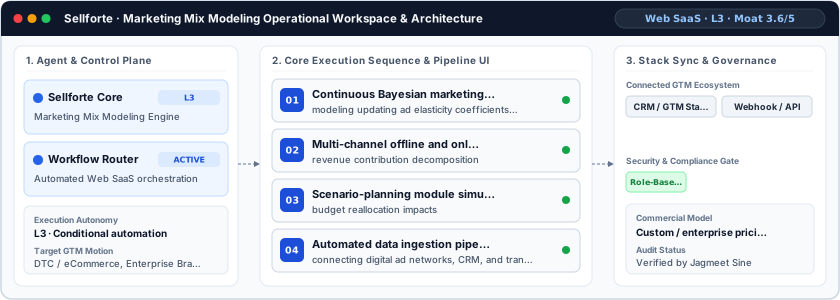
- Continuous Bayesian marketing mix: modeling updating ad elasticity coefficients weekly
- Multi-channel offline and online: revenue contribution decomposition
- Scenario-planning module simulating cross-channel: budget reallocation impacts
- Automated data ingestion pipelines: connecting digital ad networks, CRM, and transaction logs
Cons: operational limitations & risks
- Historical Data Cold Start: The statistical validity of the state-space models requires at least two full years of continuous, granular historical expenditure and sales data, preventing newly launched brands or pivot-stage businesses from deriving statistically significant elasticity curves.
- Rapid Creative Granularity Deficit: Because the engine models aggregate time-series movements to bypass identity tracking, it cannot reliably isolate intra-week creative fatigue, specific asset performance variations, or tactical micro-audiences within ad sets.
- Schema and Exogenous Volatility: Abrupt shifts in distribution channels, localized promo disruptions, or unmodeled external shocks introduce severe collinearity that necessitates manual econometrician intervention to adjust prior parameters and prevent false attribution skew.
Sellforte TCO & deal-breaker stress test
Simulate 12-month stepped TCO, hidden cost multipliers, contract lock-in exposure, and stack failure modes using only facts verified by Jagmeet Sine on .
Sellforte triggers high-severity friction under your 5-seat / $800/mo constraints. Benchmark the verified subtrack alternatives below before committing.
| Plan / Tier | Verified Rate | Scale Fit | Scope & Quota Notes |
|---|---|---|---|
| Enterprise / Custom | Custom quote | 15–50+ seats (Enterprise SLA) | Sales-negotiated annual contract for custom volume, SSO/RBAC governance, and dedicated SLA. |
- Moat Score
- 3.6 / 5.0
- AI Autonomy
- L3
- Free Tier / Trial
- None disclosed
Triggered audit signals & failure modes
- Opaque Enterprise Quoting vs. SMB/Mid-Market BudgetVerified Pricing Ledger
Sellforte does not disclose a public self-serve floor (Custom / enterprise pricing). Buyers with a $800/mo cap face high sales-qualification friction.
- Sales-Gated Contract TermsFact-checked by Jagmeet Sine
Sellforte delivers its software under an annual enterprise subscription structure. Commercial pricing is available on request through tailored enterprise sales quotes based on organizational scale, total advertising spend ingested, and seat deployment requirements.
- Primary Operational Bottleneck: Historical Data Cold StartAudit by Jagmeet Sine
The statistical validity of the state-space models requires at least two full years of continuous, granular historical expenditure and sales data, preventing newly launched brands or pivot-stage businesses from deriving statistically significant elasticity curves.
Hidden TCO Multipliers & Quota Gates
- Historical Data Cold Start: The statistical validity of the state-space models requires at least two full years of continuous, granular historical expenditure and sales data, preventing newly launched brands or pivot-stage businesses from deriving statistically significant elasticity curves.
- Rapid Creative Granularity Deficit: Because the engine models aggregate time-series movements to bypass identity tracking, it cannot reliably isolate intra-week creative fatigue, specific asset performance variations, or tactical micro-audiences within ad sets.
When to Walk Away & Negotiation Levers
- Walk away if you require transparent self-serve monthly billing or your budget ceiling is under $1,000/mo (Sellforte requires sales-gated custom quoting).
- Walk away if your workflow cannot tolerate historical data cold start: The statistical validity of the state-space models requires at least two full years of continuous, granular historical expenditure and sales data, preventing newly launched brands or pivot-stage businesses from deriving statistically significant elasticity curves.
- Walk away if rapid creative granularity deficit is a deal-breaker for your team: Because the engine models aggregate time-series movements to bypass identity tracking, it cannot reliably isolate intra-week creative fatigue, specific asset performance variations, or tactical micro-audiences within ad sets.
- Demand a 30- to 60-day paid pilot opt-out clause in the Sellforte order form before signing a 12-month enterprise commitment.
- Require a sandbox proof-of-concept testing historical data cold start against your live CRM/data schema before annual sign-off.
Ask a custom procurement or TCO stress-test question about Sellforte
Lower 5-seat floor (~$125/mo vs. Custom Quote)
Verified Marketing Mix Modeling peer (Pricing not disclosed · Moat 3.6/5.0)
Sellforte moat & subtrack positioning
Proprietary continuous Bayesian regression engines integrated directly into enterprise retail point-of-sale and digital ad data pipelines, delivering automated weekly parameter recalibration.
Editorial review
Fact-checked by Jagmeet Sine (Senior MarTech Infrastructure & Agentic Workflow Architect) on .
Background
Architected to solve cross-channel capital misallocation caused by signal loss and cookie deprecation, Sellforte provides continuous econometric analysis for enterprise performance and finance executives. Headquartered in the United States, the platform automates marketing mix modeling to evaluate online and offline commercial investments without relying on user-level tracking identifiers. Built for chief marketing officers and data science practitioners, the infrastructure translates aggregated sales data and advertising spend into statistical incrementality measurements. Within analytics stacks, Sellforte functions as an econometric measurement layer bridging commercial revenue reporting with media mix optimization.
How Sellforte works
Sellforte operates through an automated Bayesian time-series regression pipeline that ingests aggregated transaction records, media spend, pricing fluctuations, and macroeconomic variables via scheduled connectors into analytical warehouses. The platform applies state-space econometric algorithms to isolate baseline sales from paid marketing lift, factoring in ad carryover effects via adstock transformations and diminishing marginal returns via saturation curves. Executing with conditional autonomy, the model continuously updates prior distributions as fresh data enters the pipeline, automatically adjusting elasticity coefficients weekly. Optimization heuristics then generate media budget reallocations based on calculated marginal return on ad spend.
Limitations
Operational considerations and platform boundaries include:
- Historical Data Cold Start: The statistical validity of the state-space models requires at least two full years of continuous, granular historical expenditure and sales data, preventing newly launched brands or pivot-stage businesses from deriving statistically significant elasticity curves.
- Rapid Creative Granularity Deficit: Because the engine models aggregate time-series movements to bypass identity tracking, it cannot reliably isolate intra-week creative fatigue, specific asset performance variations, or tactical micro-audiences within ad sets.
- Schema and Exogenous Volatility: Abrupt shifts in distribution channels, localized promo disruptions, or unmodeled external shocks introduce severe collinearity that necessitates manual econometrician intervention to adjust prior parameters and prevent false attribution skew.
Sellforte pricing
Sellforte delivers its software under an annual enterprise subscription structure. Commercial pricing is available on request through tailored enterprise sales quotes based on organizational scale, total advertising spend ingested, and seat deployment requirements. The commercial package includes continuous automated data pipeline maintenance, baseline model calibration, and recurring econometric health checks, with tiering dictated by transaction processing volume and custom connector engineering requirements.
How Sellforte compares
Sellforte competes in the algorithmic marketing mix modeling space alongside Recast, Prescient AI, and Fospha. While Recast emphasizes Markov Chain Monte Carlo Bayesian modeling tailored for high-growth direct-to-consumer businesses and Prescient AI focuses on digital-first multi-touch regression, Sellforte targets large enterprises managing hybrid omnichannel retail footprints. Unlike Fospha, which leans heavily on first-party clickstream data pipelines, Sellforte relies purely on top-down aggregated econometrics. This approach makes Sellforte ideal for multi-channel retailers and consumer packaged goods enterprises requiring unified incrementality measurement across physical retail, digital media, and television networks.
Direct competitors & market radar
Top algorithmic competitors based on category positioning, capability overlap, and ICP alignment.
Frequently asked questions about Sellforte
How much does Sellforte cost and does it require a custom enterprise quote?
Published pricing summary for Sellforte: Custom / enterprise pricing. A permanent free plan is not disclosed for Sellforte. Sellforte delivers its software under an annual enterprise subscription structure. Commercial pricing is available on request through tailored enterprise sales quotes based on organizational scale, total advertising spend ingested, and seat deployment requirements.
How does Sellforte work and how autonomous is its AI architecture?
Continuous econometric marketing mix modeling platform calculating cross-channel incremental lift and budget allocations without user-level tracking. Within Marketing Mix Modeling (Marketing Mix Modeling & Incremental Lift), MarTechRadar rates its execution architecture at L3 · Conditional automation with a verified Moat Score of 3.6 / 5.0 (Proprietary moat). Proprietary continuous Bayesian regression engines integrated directly into enterprise retail point-of-sale and digital ad data pipelines, delivering automated weekly parameter recalibration.
What are the main limitations of Sellforte and when should buyers walk away?
Based on our editorial technical audit, key operational considerations and boundaries for Sellforte include: (1) Historical Data Cold Start: The statistical validity of the state-space models requires at least two full years of continuous, granular historical expenditure and sales data, preventing newly launched brands or pivot-stage businesses from deriving statistically significant elasticity curves. (2) Rapid Creative Granularity Deficit: Because the engine models aggregate time-series movements to bypass identity tracking, it cannot reliably isolate intra-week creative fatigue, specific asset performance variations, or tactical micro-audiences within ad sets. (3) Schema and Exogenous Volatility: Abrupt shifts in distribution channels, localized promo disruptions, or unmodeled external shocks introduce severe collinearity that necessitates manual econometrician intervention to adjust prior parameters and prevent false attribution skew. Primary procurement walk-away rule: Walk away if you require transparent self-serve monthly billing or your budget ceiling is under $1,000/mo (Sellforte requires sales-gated custom quoting).
What integrations, compliance certifications, and contract terms apply to Sellforte?
Key TCO multiplier to watch: Historical Data Cold Start (The statistical validity of the state-space models requires at least two full years of continuous, granular historical expenditure and sales data, preventing newly launched brands or pivot-stage businesses from deriving statistically significant elasticity curves.) Before signing a contract, procurement teams should demand a 30- to 60-day paid pilot opt-out clause in the Sellforte order form before signing a 12-month enterprise commitment.
What are the best Sellforte alternatives and head-to-head competitors in 2026?
Top fact-checked alternatives to Sellforte in Marketing Mix Modeling (Marketing Mix Modeling & Incremental Lift) include Haus (Pricing not disclosed), Scout (Pricing not disclosed), Voyantis (Custom / enterprise pricing), Windsor.ai (Custom / enterprise pricing). Sellforte competes in the algorithmic marketing mix modeling space alongside Recast, Prescient AI, and Fospha.
Verified sources & evidence trail
- Official product domain: https://sellforte.com
- Commercial pricing verification: Verified against official vendor pricing policy (Custom / enterprise pricing)
- Editorial audit sign-off: Fact-checked by Jagmeet Sine on under the MarTechRadar Evidence-Ledger Protocol.