PubMatic Convert Review (2026): AI Programmatic Advertising Pricing, Limits & Alternatives
Bottom line
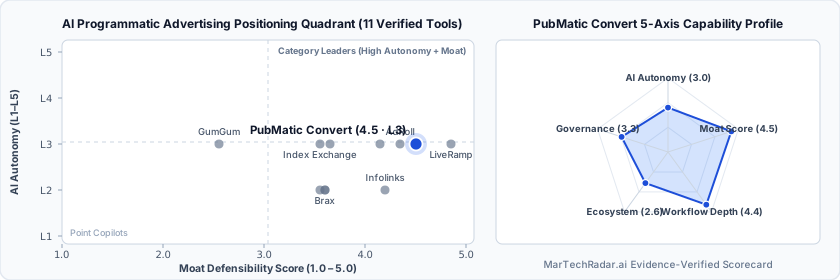
PubMatic Convert is a Web SaaS tool for AI Programmatic Advertising (Programmatic DSP/SSP & Contextual AdTech) in AdTech & Paid Media. Pricing: Custom / enterprise pricing. Best suited to DTC / eCommerce and Enterprise Brands. Editor ratings: AI autonomy L3 (conditional automation); moat score 4.5/5.0 (Proprietary moat (category leader)). Fact-checked by Anna Xia on Oct 12, 2026.
Enterprise commerce media platform unifying sponsored listings, off-site programmatic monetization, and cross-channel retail yield management.
PubMatic Convert buyer fit verdict: when to choose vs. when to walk away
Choose PubMatic Convert if (Best Fit)
- Target ICP & Stack Fit: You operate as DTC / eCommerce and Enterprise Brands requiring a Web SaaS deployment for AI Programmatic Advertising.
- L3 Architecture & Defensibility: PubMatic Convert establishes a defensible moat through its established global publisher and supply-side infrastructure, deep low-latency auction processing pipelines, and proprietary commerce media yield optimization algorithms.
- Commercial Model Fit: Your procurement budget aligns with Custom / enterprise pricing.
Walk away from PubMatic Convert if (Deal-Breakers)
- Walk away if you require transparent self-serve monthly billing or your budget ceiling is under $1,000/mo (PubMatic Convert requires sales-gated custom quoting).
- Walk away if your workflow cannot tolerate catalog synchronization latency: High-velocity stock level fluctuations and rapid SKU price updates can experience caching delays, occasionally causing ad delivery against out-of-stock inventory.
- Walk away if audience identity match degradation is a deal-breaker for your team: Cross-domain audience activation depends heavily on third-party cookie alternatives and authenticated traffic solutions, leading to variable scale across non-authenticated publisher inventory.
PubMatic Convert key facts & scorecard
| Pricing | Custom / enterprise pricing |
|---|---|
| Free plan | No / not disclosed |
| Delivery | Web SaaS |
| Audience | DTC / eCommerce, Enterprise Brands |
| AI autonomy level | L3 · Conditional automationEditor-verified |
| Moat tier & score | 4.5 / 5.0 · Proprietary moat (category leader)Editor-verified |
| Funding | Public company |
| Governance & docs | Privacy ↗ |
| Headquarters | Redwood City, United States |
| Founded | 2006 |
| Last verified |
PubMatic Convert pros & cons: strengths vs. operational limitations
Pros: core strengths & capabilities
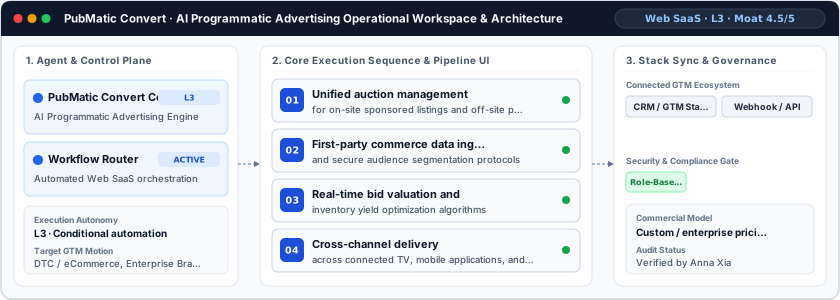
- Unified auction management: for on-site sponsored listings and off-site programmatic display
- First-party commerce data ingestion: and secure audience segmentation protocols
- Real-time bid valuation and: inventory yield optimization algorithms
- Cross-channel delivery: across connected TV, mobile applications, and web environments
Cons: operational limitations & risks
- Catalog Synchronization Latency: High-velocity stock level fluctuations and rapid SKU price updates can experience caching delays, occasionally causing ad delivery against out-of-stock inventory.
- Audience Identity Match Degradation: Cross-domain audience activation depends heavily on third-party cookie alternatives and authenticated traffic solutions, leading to variable scale across non-authenticated publisher inventory.
- Integration Engineering Overhead: Embedding custom auction hooks into bespoke merchant commerce platforms requires substantial initial developer resources and ongoing schema maintenance across product feeds.
PubMatic Convert TCO & deal-breaker stress test
Simulate 12-month stepped TCO, hidden cost multipliers, contract lock-in exposure, and stack failure modes using only facts verified by Anna Xia on · Capture SHA fb761238.
PubMatic Convert triggers high-severity friction under your 5-seat / $800/mo constraints. Benchmark the verified subtrack alternatives below before committing.
| Plan / Tier | Verified Rate | Scale Fit | Scope & Quota Notes |
|---|---|---|---|
| Enterprise / Custom | Custom quote | 15–50+ seats (Enterprise SLA) | Sales-negotiated annual contract for custom volume, SSO/RBAC governance, and dedicated SLA. |
- Moat Score
- 4.5 / 5.0
- AI Autonomy
- L3
- Free Tier / Trial
- None disclosed
Triggered audit signals & failure modes
- Opaque Enterprise Quoting vs. SMB/Mid-Market BudgetVerified Pricing Ledger
PubMatic Convert does not disclose a public self-serve floor (Custom / enterprise pricing). Buyers with a $800/mo cap face high sales-qualification friction.
- Sales-Gated Contract TermsFact-checked by Anna Xia
PubMatic Convert delivers enterprise licensing governed strictly by direct transaction terms. Commercial pricing is available on request through tailored enterprise sales quotes based on organizational scale, transaction throughput, and seat access.
- Primary Operational Bottleneck: Catalog Synchronization LatencyAudit by Anna Xia
High-velocity stock level fluctuations and rapid SKU price updates can experience caching delays, occasionally causing ad delivery against out-of-stock inventory.
Hidden TCO Multipliers & Quota Gates
- Catalog Synchronization Latency: High-velocity stock level fluctuations and rapid SKU price updates can experience caching delays, occasionally causing ad delivery against out-of-stock inventory.
- Audience Identity Match Degradation: Cross-domain audience activation depends heavily on third-party cookie alternatives and authenticated traffic solutions, leading to variable scale across non-authenticated publisher inventory.
When to Walk Away & Negotiation Levers
- Walk away if you require transparent self-serve monthly billing or your budget ceiling is under $1,000/mo (PubMatic Convert requires sales-gated custom quoting).
- Walk away if your workflow cannot tolerate catalog synchronization latency: High-velocity stock level fluctuations and rapid SKU price updates can experience caching delays, occasionally causing ad delivery against out-of-stock inventory.
- Walk away if audience identity match degradation is a deal-breaker for your team: Cross-domain audience activation depends heavily on third-party cookie alternatives and authenticated traffic solutions, leading to variable scale across non-authenticated publisher inventory.
- Demand a 30- to 60-day paid pilot opt-out clause in the PubMatic Convert order form before signing a 12-month enterprise commitment.
- Require a sandbox proof-of-concept testing catalog synchronization latency against your live CRM/data schema before annual sign-off.
Ask a custom procurement or TCO stress-test question about PubMatic Convert
Lower 5-seat floor (~$36/mo vs. Custom Quote) · Transparent self-serve entry without mandatory annual lock-in
Verified AI Programmatic Advertising peer (From $20,000/yr · Moat 4.8/5.0)
PubMatic Convert moat & subtrack positioning
PubMatic Convert establishes a defensible moat through its established global publisher and supply-side infrastructure, deep low-latency auction processing pipelines, and proprietary commerce media yield optimization algorithms.
Editorial review
Fact-checked by Anna Xia (Senior B2B GTM & Revenue Systems Analyst) on .
Background
Within the programmatic advertising supply chain, retail media networks require unified monetization frameworks to bridge on-site merchant inventory with broader demand channels. Launched by parent organization PubMatic, which was established in 2006 and is headquartered in Redwood City, United States, PubMatic Convert functions as a specialized commerce media infrastructure suite. Engineered for enterprise retailers, commerce networks, and digital publishers, the platform standardizes transaction mechanics across native storefront real estate and distributed web environments.
How PubMatic Convert works
At the architectural layer, the system autonomy, Convert coordinates programmatic auctions through direct integration with e-commerce storefronts and publisher digital assets using low-latency server-to-server APIs and prebid wrappers. The architecture ingests first-party SKU catalog data, user purchase intent, and audience segments into an algorithmic pricing engine. Machine learning models continuously compute floor prices, evaluate real-time bidding parameters, and dynamically balance sponsored search listings with programmatic display units to maximize publisher yield without degrading page performance.
Limitations
Operational considerations and platform boundaries include:
- Catalog Synchronization Latency: High-velocity stock level fluctuations and rapid SKU price updates can experience caching delays, occasionally causing ad delivery against out-of-stock inventory.
- Audience Identity Match Degradation: Cross-domain audience activation depends heavily on third-party cookie alternatives and authenticated traffic solutions, leading to variable scale across non-authenticated publisher inventory.
- Integration Engineering Overhead: Embedding custom auction hooks into bespoke merchant commerce platforms requires substantial initial developer resources and ongoing schema maintenance across product feeds.
PubMatic Convert pricing
PubMatic Convert delivers enterprise licensing governed strictly by direct transaction terms. Commercial pricing is available on request through tailored enterprise sales quotes based on organizational scale, transaction throughput, and seat access. Contracts typically take the form of revenue-sharing agreements on managed media spend or fixed technology fees calculated against gross merchandise value and auction volume.
How PubMatic Convert compares
While GumGum targets contextual placements via visual content analysis and LiveRamp focuses on deterministic data onboarding and clean-room identity graphs, PubMatic Convert addresses end-to-end supply-side commerce monetization. Unlike AdRoll, which functions primarily as a self-serve demand-side platform for direct-to-consumer growth teams, Convert serves enterprise marketplaces that require granular supply control, unified yield management, and direct integration into global programmatic pipelines.
Direct competitors & market radar
Top algorithmic competitors based on category positioning, capability overlap, and ICP alignment.
Frequently asked questions about PubMatic Convert
How much does PubMatic Convert cost and does it require a custom enterprise quote?
Published pricing summary for PubMatic Convert: Custom / enterprise pricing. A permanent free plan is not disclosed for PubMatic Convert. PubMatic Convert delivers enterprise licensing governed strictly by direct transaction terms. Commercial pricing is available on request through tailored enterprise sales quotes based on organizational scale, transaction throughput, and seat access.
How does PubMatic Convert work and how autonomous is its AI architecture?
Enterprise commerce media platform unifying sponsored listings, off-site programmatic monetization, and cross-channel retail yield management. Within AI Programmatic Advertising (Programmatic DSP/SSP & Contextual AdTech), MarTechRadar rates its execution architecture at L3 · Conditional automation with a verified Moat Score of 4.5 / 5.0 (Proprietary moat (category leader)). PubMatic Convert establishes a defensible moat through its established global publisher and supply-side infrastructure, deep low-latency auction processing pipelines, and proprietary commerce media yield optimization algorithms.
What are the main limitations of PubMatic Convert and when should buyers walk away?
Based on our editorial technical audit, key operational considerations and boundaries for PubMatic Convert include: (1) Catalog Synchronization Latency: High-velocity stock level fluctuations and rapid SKU price updates can experience caching delays, occasionally causing ad delivery against out-of-stock inventory. (2) Audience Identity Match Degradation: Cross-domain audience activation depends heavily on third-party cookie alternatives and authenticated traffic solutions, leading to variable scale across non-authenticated publisher inventory. (3) Integration Engineering Overhead: Embedding custom auction hooks into bespoke merchant commerce platforms requires substantial initial developer resources and ongoing schema maintenance across product feeds. Primary procurement walk-away rule: Walk away if you require transparent self-serve monthly billing or your budget ceiling is under $1,000/mo (PubMatic Convert requires sales-gated custom quoting).
What integrations, compliance certifications, and contract terms apply to PubMatic Convert?
Key TCO multiplier to watch: Catalog Synchronization Latency (High-velocity stock level fluctuations and rapid SKU price updates can experience caching delays, occasionally causing ad delivery against out-of-stock inventory.) Before signing a contract, procurement teams should demand a 30- to 60-day paid pilot opt-out clause in the PubMatic Convert order form before signing a 12-month enterprise commitment.
What are the best PubMatic Convert alternatives and head-to-head competitors in 2026?
Top fact-checked alternatives to PubMatic Convert in AI Programmatic Advertising (Programmatic DSP/SSP & Contextual AdTech) include LiveRamp (From $20,000/yr), Nodals AI (Custom / enterprise pricing), AdRoll (Free plan · $36/mo), Taboola (Custom / enterprise pricing). While GumGum targets contextual placements via visual content analysis and LiveRamp focuses on deterministic data onboarding and clean-room identity graphs, PubMatic Convert addresses end-to-end supply-side commerce monetization.
Verified sources & evidence trail
- Official product domain: https://pubmatic.com
- Commercial pricing verification: Verified against official vendor pricing policy (Custom / enterprise pricing)
- First-party governance & documentation links: Privacy
- Editorial audit sign-off: Fact-checked by Anna Xia on under the MarTechRadar Evidence-Ledger Protocol.