AdRoll Review (2026): AI Programmatic Advertising Pricing, Limits & Alternatives
Bottom line
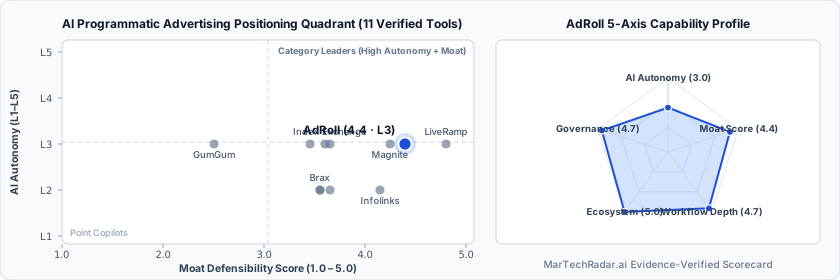
AdRoll is a Web SaaS tool for AI Programmatic Advertising (Programmatic DSP/SSP & Contextual AdTech) in AdTech & Paid Media. Pricing: Free plan · $36/mo. Best suited to DTC / eCommerce. Editor ratings: AI autonomy L3 (conditional automation); moat score 4.4/5.0 (Proprietary moat (category leader)). Fact-checked by Anna Xia on Oct 4, 2026.
Multichannel programmatic demand-side platform and retargeting engine unifying web display, native, social, connected TV, and digital out-of-home.
AdRoll buyer fit verdict: when to choose vs. when to walk away
Choose AdRoll if (Best Fit)
- Target ICP & Stack Fit: You operate as DTC / eCommerce requiring a Web SaaS deployment for AI Programmatic Advertising, with verified ecosystem connectivity for Salesforce, HubSpot, Snowflake, Shopify.
- L3 Architecture & Defensibility: Proprietary BidIQ machine learning bidding engine paired with NextRoll's extensive cooperative identity graph, enabling cross-device audience matching and automated dynamic creative optimization across independent web ad exchanges.
- Commercial Model Fit: Your procurement budget aligns with Free plan · $36/mo and want a self-serve free tier for zero-cost initial validation.
Walk away from AdRoll if (Deal-Breakers)
- Walk away if your workflow requires uncapped enterprise volume on the Free plan · $36/mo entry plan without upgrading tiers.
- Walk away if your workflow cannot tolerate browser tracking deprecation: Safari ITP and evolving third-party cookie restrictions diminish conversion attribution fidelity and shrink retargeting pool durations unless server-side identity tracking is manually deployed.
- Walk away if ecosystem margin stacking is a deal-breaker for your team: Operating as a managed wrapper on top of external ad exchanges and social networks introduces compounding take-rates compared to procuring raw inventory directly through enterprise DSPs.
AdRoll key facts & scorecard
| Pricing | Free plan · $36/moVendor pricing page |
|---|---|
| Free plan | Yes |
| Delivery | Web SaaS |
| Audience | DTC / eCommerce |
| AI autonomy level | L3 · Conditional automationEditor-verified |
| Moat tier & score | 4.4 / 5.0 · Proprietary moat (category leader)Editor-verified |
| Funding | Acquired |
| Total funding | $89.0MBacked by Foundation Capital, Meritech Capital Partners |
| Founders | Aaron Bell |
| Company size | 201-500 employees |
| Ecosystem integrations | Salesforce, HubSpot, Snowflake, Shopify, WooCommerce |
| Compliance & governance | CCPA |
| Headquarters | San Francisco, United States |
| Founded | 2007 |
| Last verified |
AdRoll pros & cons: strengths vs. operational limitations
Pros: core strengths & capabilities
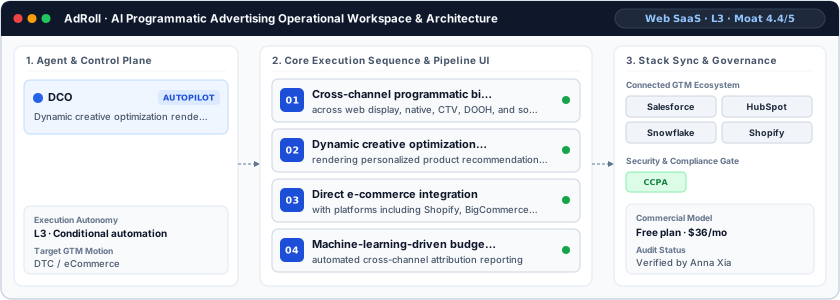
- Cross-channel programmatic bidding: across web display, native, CTV, DOOH, and social networks
- Dynamic creative optimization (DCO): rendering personalized product recommendations from catalog feeds
- Direct e-commerce integration: with platforms including Shopify, BigCommerce, and WooCommerce
- Machine-learning-driven budget allocation and: automated cross-channel attribution reporting
Cons: operational limitations & risks
- Browser Tracking Deprecation: Safari ITP and evolving third-party cookie restrictions diminish conversion attribution fidelity and shrink retargeting pool durations unless server-side identity tracking is manually deployed.
- Ecosystem Margin Stacking: Operating as a managed wrapper on top of external ad exchanges and social networks introduces compounding take-rates compared to procuring raw inventory directly through enterprise DSPs.
- Bid Customization Constraints: Algorithmic decision-making exposes limited granular supply-path optimization, preventing engineering teams from adjusting custom multi-variable real-time bid pricing parameters directly.
AdRoll TCO & deal-breaker stress test
Simulate 12-month stepped TCO, hidden cost multipliers, contract lock-in exposure, and stack failure modes using only facts verified by Anna Xia on · Capture SHA 8f02ba28.
AdRoll aligns with your 5-seat / $800/mo profile. Review the walk-away triggers and contract levers below before deployment.
| Plan / Tier | Verified Rate | Scale Fit | Scope & Quota Notes |
|---|---|---|---|
| Free / Sandbox | $0 | 1–2 seats (Evaluation) | Entry free tier with capped usage or feature quotas for initial workflow testing. |
| Entry / Starter | $36/mo | 1–2 seats | Verified $36/mo published rate on vendor pricing schedule. |
- Moat Score
- 4.4 / 5.0
- AI Autonomy
- L3
- Free Tier / Trial
- Free plan
Triggered audit signals & failure modes
- Published Self-Serve Entry FloorVerified Pricing Ledger
AdRoll publishes a transparent entry point (Free plan · $36/mo) with a free tier for initial validation before committing.
- Primary Operational Bottleneck: Browser Tracking DeprecationAudit by Anna Xia
Safari ITP and evolving third-party cookie restrictions diminish conversion attribution fidelity and shrink retargeting pool durations unless server-side identity tracking is manually deployed.
Hidden TCO Multipliers & Quota Gates
- Credit & Usage Burn Multiplier: Automated workflows consume metered credits/usage quotas; multi-step enrichment, voice minutes, or high-frequency agent runs can trigger mid-cycle top-up packs.
- Enterprise Governance & Add-On Gating: Advanced capabilities such as Single Sign-On (SSO), custom role permissions, or specialized analytics modules are gated behind upper tiers or paid add-ons.
When to Walk Away & Negotiation Levers
- Walk away if your workflow requires uncapped enterprise volume on the Free plan · $36/mo entry plan without upgrading tiers.
- Walk away if your workflow cannot tolerate browser tracking deprecation: Safari ITP and evolving third-party cookie restrictions diminish conversion attribution fidelity and shrink retargeting pool durations unless server-side identity tracking is manually deployed.
- Walk away if ecosystem margin stacking is a deal-breaker for your team: Operating as a managed wrapper on top of external ad exchanges and social networks introduces compounding take-rates compared to procuring raw inventory directly through enterprise DSPs.
- Validate exact quota thresholds (seats, credits, or API calls) included in AdRoll's Free plan · $36/mo tier before converting from monthly to annual billing.
- Require a sandbox proof-of-concept testing browser tracking deprecation against your live CRM/data schema before annual sign-off.
Ask a custom procurement or TCO stress-test question about AdRoll
Fits within $800/mo budget (From $49/mo)
Verified AI Programmatic Advertising peer (Custom / enterprise pricing · Moat 4.9/5.0)
AdRoll key entities, modules & ecosystem stack
Dynamic creative optimization rendering personalized product recommendations from catalog feeds
AdRoll moat & subtrack positioning
Proprietary BidIQ machine learning bidding engine paired with NextRoll's extensive cooperative identity graph, enabling cross-device audience matching and automated dynamic creative optimization across independent web ad exchanges.
Editorial review
Fact-checked by Anna Xia (Senior B2B GTM & Revenue Systems Analyst) on .
Background
Operating within the Programmatic DSP/SSP & Contextual AdTech sector, AdRoll functions as a cross-channel demand-side platform designed to bridge programmatic ad exchanges and direct-response marketing channels. Established in 2007 in San Francisco, United States, the platform secured $89.0M in total funding prior to operating as the flagship direct-to-consumer division of NextRoll. Engineered primarily for growth-stage e-commerce brands, performance marketing teams, and mid-market agencies, AdRoll provides a consolidated media-buying layer that circumvents the operational complexity of enterprise-tier programmatic trading desks.
How AdRoll works
AdRoll operates as an L3 conditional-autonomy programmatic engine driven by its BidIQ machine learning algorithm. The technical architecture ingests first-party behavioral telemetry through site pixels, client-side event listeners, and catalog APIs across e-commerce platforms. Incoming user touchpoints are resolved against NextRoll's identity graph, linking anonymous browser sessions to persistent consumer profiles. When a target user triggers an impression opportunity across ad exchanges, BidIQ evaluates real-time bid requests via OpenRTB protocols, executing automated bid valuations based on historical conversion probabilities and target return-on-ad-spend parameters. The pipeline dynamically constructs personalized display and native creatives by querying product catalog feeds, rendering customized pricing and assets in real time without manual creative re-assembly, alongside native workflow integrations for Salesforce, HubSpot, and Snowflake under verified CCPA governance controls.
Limitations
Operational considerations and platform boundaries include:
- Browser Tracking Deprecation: Safari ITP and evolving third-party cookie restrictions diminish conversion attribution fidelity and shrink retargeting pool durations unless server-side identity tracking is manually deployed.
- Ecosystem Margin Stacking: Operating as a managed wrapper on top of external ad exchanges and social networks introduces compounding take-rates compared to procuring raw inventory directly through enterprise DSPs.
- Bid Customization Constraints: Algorithmic decision-making exposes limited granular supply-path optimization, preventing engineering teams from adjusting custom multi-variable real-time bid pricing parameters directly.
AdRoll pricing
AdRoll operates a hybrid commercial model combining subscription software access with variable media fees. Entry-level usage is supported via a pay-as-you-go Free Ads tier where organizations pay only for gross media inventory consumed. Advanced functional capabilities, including multi-touch cross-channel attribution and expanded reporting modules, are commercialized under the Marketing & Ads Plus subscription starting at $36 per month, with high-volume advertisers routed to annual managed-services contracts.
How AdRoll compares
In the AI Programmatic Advertising landscape, within programmatic ad delivery, AdRoll competes against infrastructure and contextual specialists such as LiveRamp, GumGum, and Outbrain Smartlogic. While LiveRamp focuses primarily on neutral identity resolution and enterprise data clean rooms, AdRoll functions directly as an execution-oriented media DSP. Conversely, GumGum and Outbrain Smartlogic specialize in contextual computer vision and native recommendation widgets, whereas AdRoll emphasizes cross-network conversion retargeting across display, native, CTV, and social. AdRoll remains optimal for resource-constrained growth brands that require unified multichannel retargeting without maintaining dedicated programmatic media trading desks.
Direct competitors & market radar
Top algorithmic competitors based on category positioning, capability overlap, and ICP alignment.
Frequently asked questions about AdRoll
How much does AdRoll cost and what pricing tiers are available?
Published pricing summary for AdRoll: Free plan · $36/mo. AdRoll includes a free tier or sandbox entry point. Verified tier schedule: Free / Sandbox ($0 for 1–2 seats (Evaluation)); Entry / Starter ($36/mo for 1–2 seats). AdRoll operates a hybrid commercial model combining subscription software access with variable media fees. Entry-level usage is supported via a pay-as-you-go Free Ads tier where organizations pay only for gross media inventory consumed.
How does AdRoll work and how autonomous is its AI architecture?
Multichannel programmatic demand-side platform and retargeting engine unifying web display, native, social, connected TV, and digital out-of-home. Within AI Programmatic Advertising (Programmatic DSP/SSP & Contextual AdTech), MarTechRadar rates its execution architecture at L3 · Conditional automation with a verified Moat Score of 4.4 / 5.0 (Proprietary moat (category leader)). Proprietary BidIQ machine learning bidding engine paired with NextRoll's extensive cooperative identity graph, enabling cross-device audience matching and automated dynamic creative optimization across independent web ad exchanges. Corporate profile: Founded by Aaron Bell, operating at 201-500 employees scale.
What are the main limitations of AdRoll and when should buyers walk away?
Based on our editorial technical audit, key operational considerations and boundaries for AdRoll include: (1) Browser Tracking Deprecation: Safari ITP and evolving third-party cookie restrictions diminish conversion attribution fidelity and shrink retargeting pool durations unless server-side identity tracking is manually deployed. (2) Ecosystem Margin Stacking: Operating as a managed wrapper on top of external ad exchanges and social networks introduces compounding take-rates compared to procuring raw inventory directly through enterprise DSPs. (3) Bid Customization Constraints: Algorithmic decision-making exposes limited granular supply-path optimization, preventing engineering teams from adjusting custom multi-variable real-time bid pricing parameters directly. Primary procurement walk-away rule: Walk away if your workflow requires uncapped enterprise volume on the Free plan · $36/mo entry plan without upgrading tiers.
What integrations, compliance certifications, and contract terms apply to AdRoll?
Verified ecosystem and stack integrations include Salesforce, HubSpot, Snowflake, Shopify, WooCommerce. Documented security and governance attestations include CCPA. Key TCO multiplier to watch: Credit & Usage Burn Multiplier (Automated workflows consume metered credits/usage quotas; multi-step enrichment, voice minutes, or high-frequency agent runs can trigger mid-cycle top-up packs.) Before signing a contract, procurement teams should validate exact quota thresholds (seats, credits, or API calls) included in AdRoll's Free plan · $36/mo tier before converting from monthly to annual billing.
What are the best AdRoll alternatives and head-to-head competitors in 2026?
Top fact-checked alternatives to AdRoll in AI Programmatic Advertising (Programmatic DSP/SSP & Contextual AdTech) include LiveRamp (From $20,000/yr), Outbrain Smartlogic (Custom / enterprise pricing), GumGum (Custom / enterprise pricing), Madgicx (From $49/mo). In the AI Programmatic Advertising landscape, within programmatic ad delivery, AdRoll competes against infrastructure and contextual specialists such as LiveRamp, GumGum, and Outbrain Smartlogic.
Verified sources & evidence trail
- Official product domain: https://adroll.com
- Commercial pricing verification: https://www.adroll.com/pricing
- Verified corporate entity profiles (
sameAs): LinkedIn Company Profile · Crunchbase Entity Record - Editorial audit sign-off: Fact-checked by Anna Xia on under the MarTechRadar Evidence-Ledger Protocol.