The Trade Desk Kokai Review (2026): AI Programmatic Advertising Pricing, Limits & Alternatives
Bottom line
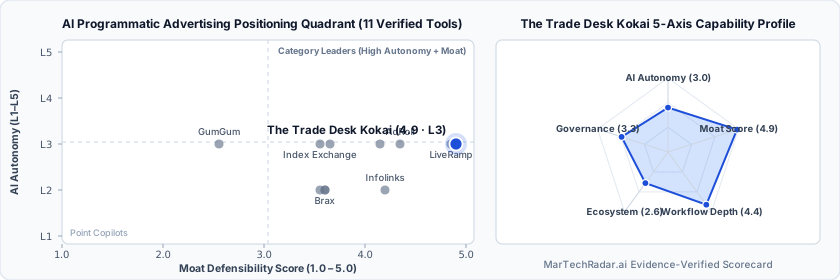
The Trade Desk Kokai is a Web SaaS tool for AI Programmatic Advertising (Programmatic DSP/SSP & Contextual AdTech) in AdTech & Paid Media. Pricing: Custom / enterprise pricing. Best suited to DTC / eCommerce and Enterprise Brands. Editor ratings: AI autonomy L3 (conditional automation); moat score 4.9/5.0 (Proprietary moat (category leader)). Fact-checked by Jagmeet Sine on Oct 7, 2026.
Algorithmic omnichannel demand-side platform upgrading programmatic bidstream valuation, identity resolution via UID2, and cross-channel supply-path.
The Trade Desk Kokai buyer fit verdict: when to choose vs. when to walk away
Choose The Trade Desk Kokai if (Best Fit)
- Target ICP & Stack Fit: You operate as DTC / eCommerce and Enterprise Brands requiring a Web SaaS deployment for AI Programmatic Advertising.
- L3 Architecture & Defensibility: Proprietary high-throughput bid evaluation processing millions of queries per second, deep supply-chain direct integrations, and custody of the open-source Unified ID 2.0 ecosystem.
- Commercial Model Fit: Your procurement budget aligns with Custom / enterprise pricing.
Walk away from The Trade Desk Kokai if (Deal-Breakers)
- Walk away if you require transparent self-serve monthly billing or your budget ceiling is under $1,000/mo (The Trade Desk Kokai requires sales-gated custom quoting).
- Walk away if your workflow cannot tolerate audience graph density: Identity resolution degrades outside authenticated publisher networks when third-party cookie restrictions apply and UID2 token adoption is absent.
- Walk away if supply path latency is a deal-breaker for your team: Complex multi-hop SSP routing occasionally exceeds 100-millisecond real-time bidding timeouts, forcing dropped bid opportunities on edge nodes.
The Trade Desk Kokai key facts & scorecard
| Pricing | Custom / enterprise pricing |
|---|---|
| Free plan | No / not disclosed |
| Delivery | Web SaaS |
| Audience | DTC / eCommerce, Enterprise Brands |
| AI autonomy level | L3 · Conditional automationEditor-verified |
| Moat tier & score | 4.9 / 5.0 · Proprietary moat (category leader)Editor-verified |
| Funding | Public company |
| Governance & docs | Trust & Security ↗ · Privacy ↗ |
| Headquarters | Ventura, United States |
| Founded | 2009 |
| Last verified |
The Trade Desk Kokai pros & cons: strengths vs. operational limitations
Pros: core strengths & capabilities
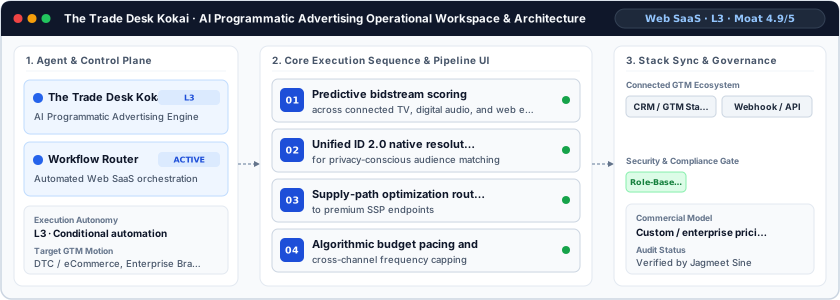
- Predictive bidstream scoring: across connected TV, digital audio, and web environments
- Unified ID 2.0 native resolution: for privacy-conscious audience matching
- Supply-path optimization routing bids directly: to premium SSP endpoints
- Algorithmic budget pacing and: cross-channel frequency capping
Cons: operational limitations & risks
- Audience Graph Density: Identity resolution degrades outside authenticated publisher networks when third-party cookie restrictions apply and UID2 token adoption is absent.
- Supply Path Latency: Complex multi-hop SSP routing occasionally exceeds 100-millisecond real-time bidding timeouts, forcing dropped bid opportunities on edge nodes.
- First-Party Data Onboarding Overhead: Configuring CRM mappings and enterprise data clean room syncs requires substantial data engineering preparation before programmatic models reach steady-state accuracy.
The Trade Desk Kokai TCO & deal-breaker stress test
Simulate 12-month stepped TCO, hidden cost multipliers, contract lock-in exposure, and stack failure modes using only facts verified by Jagmeet Sine on · Capture SHA c0e7252b.
The Trade Desk Kokai triggers high-severity friction under your 5-seat / $800/mo constraints. Benchmark the verified subtrack alternatives below before committing.
| Plan / Tier | Verified Rate | Scale Fit | Scope & Quota Notes |
|---|---|---|---|
| Enterprise / Custom | Custom quote | 15–50+ seats (Enterprise SLA) | Sales-negotiated annual contract for custom volume, SSO/RBAC governance, and dedicated SLA. |
- Moat Score
- 4.9 / 5.0
- AI Autonomy
- L3
- Free Tier / Trial
- None disclosed
Triggered audit signals & failure modes
- Opaque Enterprise Quoting vs. SMB/Mid-Market BudgetVerified Pricing Ledger
The Trade Desk Kokai does not disclose a public self-serve floor (Custom / enterprise pricing). Buyers with a $800/mo cap face high sales-qualification friction.
- Sales-Gated Contract TermsFact-checked by Jagmeet Sine
Commercial access is provisioned through enterprise Master Services Agreements rather than self-serve subscription tiers.
- Primary Operational Bottleneck: Audience Graph DensityAudit by Jagmeet Sine
Identity resolution degrades outside authenticated publisher networks when third-party cookie restrictions apply and UID2 token adoption is absent.
Hidden TCO Multipliers & Quota Gates
- Credit & Usage Burn Multiplier: Automated workflows consume metered credits/usage quotas; multi-step enrichment, voice minutes, or high-frequency agent runs can trigger mid-cycle top-up packs.
- Audience Graph Density: Identity resolution degrades outside authenticated publisher networks when third-party cookie restrictions apply and UID2 token adoption is absent.
- Supply Path Latency: Complex multi-hop SSP routing occasionally exceeds 100-millisecond real-time bidding timeouts, forcing dropped bid opportunities on edge nodes.
When to Walk Away & Negotiation Levers
- Walk away if you require transparent self-serve monthly billing or your budget ceiling is under $1,000/mo (The Trade Desk Kokai requires sales-gated custom quoting).
- Walk away if your workflow cannot tolerate audience graph density: Identity resolution degrades outside authenticated publisher networks when third-party cookie restrictions apply and UID2 token adoption is absent.
- Walk away if supply path latency is a deal-breaker for your team: Complex multi-hop SSP routing occasionally exceeds 100-millisecond real-time bidding timeouts, forcing dropped bid opportunities on edge nodes.
- Demand a 30- to 60-day paid pilot opt-out clause in the The Trade Desk Kokai order form before signing a 12-month enterprise commitment.
- Require a sandbox proof-of-concept testing audience graph density against your live CRM/data schema before annual sign-off.
Ask a custom procurement or TCO stress-test question about The Trade Desk Kokai
Lower 5-seat floor (~$36/mo vs. Custom Quote) · Transparent self-serve entry without mandatory annual lock-in
Transparent self-serve entry without mandatory annual lock-in
The Trade Desk Kokai moat & subtrack positioning
Proprietary high-throughput bid evaluation processing millions of queries per second, deep supply-chain direct integrations, and custody of the open-source Unified ID 2.0 ecosystem.
Editorial review
Fact-checked by Jagmeet Sine (Senior MarTech Infrastructure & Agentic Workflow Architect) on .
Background
Within the fragmented omnichannel programmatic ecosystem, The Trade Desk Kokai operates as an independent media buying platform engineered to bypass walled-garden limitations. Established in 2009 in Ventura, United States, the parent organization developed Kokai as an algorithmic evolution of its core demand-side engine. Built for global media agency trading desks and enterprise brand marketers, the platform provides direct access to open-web inventory across connected TV, mobile, display, and digital audio channels.
How The Trade Desk Kokai works
At the architectural layer, the system autonomy, Kokai evaluates millions of inbound ad queries per second using real-time machine learning pipelines. The system ingests multi-source data signals—including publisher context, device parameters, and first-party identity tokens via Unified ID 2.0—to score impression utility before generating a bid response. Its pricing engine automatically adjusts valuation thresholds based on historical win rates, supply-path optimization rules, and real-time conversion probability, executing automated media allocations without manual line-item intervention.
Limitations
Operational considerations and platform boundaries include:
- Audience Graph Density: Identity resolution degrades outside authenticated publisher networks when third-party cookie restrictions apply and UID2 token adoption is absent.
- Supply Path Latency: Complex multi-hop SSP routing occasionally exceeds 100-millisecond real-time bidding timeouts, forcing dropped bid opportunities on edge nodes.
- First-Party Data Onboarding Overhead: Configuring CRM mappings and enterprise data clean room syncs requires substantial data engineering preparation before programmatic models reach steady-state accuracy.
The Trade Desk Kokai pricing
Commercial access is provisioned through enterprise Master Services Agreements rather than self-serve subscription tiers. Platform pricing is available on request through tailored enterprise sales quotes based on organizational scale and seats, typically calculated as a tech fee percentage of gross media spend combined with contractual monthly minimums. Additional costs apply for third-party audience data segments and clean room governance modules.
How The Trade Desk Kokai compares
While AdRoll targets mid-market direct-to-consumer e-commerce brands with self-serve retargeting, Kokai focuses on global enterprise-scale programmatic buying. GumGum specializes in deep computer-vision contextual analysis, whereas Kokai treats contextual signals as one variable within an omnichannel predictive model. Compared to LiveRamp's pure-play identity resolution infrastructure, Kokai executes programmatic activation directly. Kokai fits high-budget media operations requiring cross-channel supply control and independent identity alignment outside closed publisher networks.
Direct competitors & market radar
Top algorithmic competitors based on category positioning, capability overlap, and ICP alignment.
Frequently asked questions about The Trade Desk Kokai
How much does The Trade Desk Kokai cost and does it require a custom enterprise quote?
Published pricing summary for The Trade Desk Kokai: Custom / enterprise pricing. A permanent free plan is not disclosed for The Trade Desk Kokai. Commercial access is provisioned through enterprise Master Services Agreements rather than self-serve subscription tiers.
How does The Trade Desk Kokai work and how autonomous is its AI architecture?
Algorithmic omnichannel demand-side platform upgrading programmatic bidstream valuation, identity resolution via UID2, and cross-channel supply-path. Within AI Programmatic Advertising (Programmatic DSP/SSP & Contextual AdTech), MarTechRadar rates its execution architecture at L3 · Conditional automation with a verified Moat Score of 4.9 / 5.0 (Proprietary moat (category leader)). Proprietary high-throughput bid evaluation processing millions of queries per second, deep supply-chain direct integrations, and custody of the open-source Unified ID 2.0 ecosystem.
What are the main limitations of The Trade Desk Kokai and when should buyers walk away?
Based on our editorial technical audit, key operational considerations and boundaries for The Trade Desk Kokai include: (1) Audience Graph Density: Identity resolution degrades outside authenticated publisher networks when third-party cookie restrictions apply and UID2 token adoption is absent. (2) Supply Path Latency: Complex multi-hop SSP routing occasionally exceeds 100-millisecond real-time bidding timeouts, forcing dropped bid opportunities on edge nodes. (3) First-Party Data Onboarding Overhead: Configuring CRM mappings and enterprise data clean room syncs requires substantial data engineering preparation before programmatic models reach steady-state accuracy. Primary procurement walk-away rule: Walk away if you require transparent self-serve monthly billing or your budget ceiling is under $1,000/mo (The Trade Desk Kokai requires sales-gated custom quoting).
What integrations, compliance certifications, and contract terms apply to The Trade Desk Kokai?
First-party governance and developer endpoints verified on domain include: Trust/Security (https://www.thetradedesk.com/trust). Key TCO multiplier to watch: Credit & Usage Burn Multiplier (Automated workflows consume metered credits/usage quotas; multi-step enrichment, voice minutes, or high-frequency agent runs can trigger mid-cycle top-up packs.) Before signing a contract, procurement teams should demand a 30- to 60-day paid pilot opt-out clause in the The Trade Desk Kokai order form before signing a 12-month enterprise commitment.
What are the best The Trade Desk Kokai alternatives and head-to-head competitors in 2026?
Top fact-checked alternatives to The Trade Desk Kokai in AI Programmatic Advertising (Programmatic DSP/SSP & Contextual AdTech) include AdRoll (Free plan · $36/mo), Taboola (Custom / enterprise pricing), SWYM.ai (Custom / enterprise pricing), TripleLift (Custom / enterprise pricing). While AdRoll targets mid-market direct-to-consumer e-commerce brands with self-serve retargeting, Kokai focuses on global enterprise-scale programmatic buying. GumGum specializes in deep computer-vision contextual analysis, whereas Kokai treats contextual signals as one variable within an omnichannel predictive model.
Verified sources & evidence trail
- Official product domain: https://thetradedesk.com
- Commercial pricing verification: Verified against official vendor pricing policy (Custom / enterprise pricing)
- First-party governance & documentation links: Trust & Security · Privacy
- Editorial audit sign-off: Fact-checked by Jagmeet Sine on under the MarTechRadar Evidence-Ledger Protocol.