SalesForge Review (2026): Cold Email Pricing, Limits & Alternatives
Bottom line
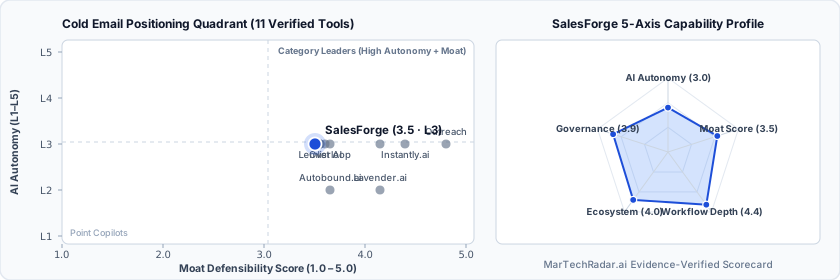
SalesForge is a Web SaaS tool for Cold Email (Cold Email Sequences & Mailbox Infra) in AI SDR & Outbound. Pricing: $10–$49/mo. Best suited to B2B SaaS. Editor ratings: AI autonomy L3 (conditional automation); moat score 3.5/5.0 (Proprietary moat). Fact-checked by Jiacky Lee on Oct 7, 2026.
Multi-mailbox cold email and LinkedIn outreach automation platform powered by autonomous AI SDR agents to maximize deliverability and outbound pipeline.
SalesForge buyer fit verdict: when to choose vs. when to walk away
Choose SalesForge if (Best Fit)
- Target ICP & Stack Fit: You operate as B2B SaaS requiring a Web SaaS deployment for Cold Email, with verified ecosystem connectivity for Outreach, LinkedIn.
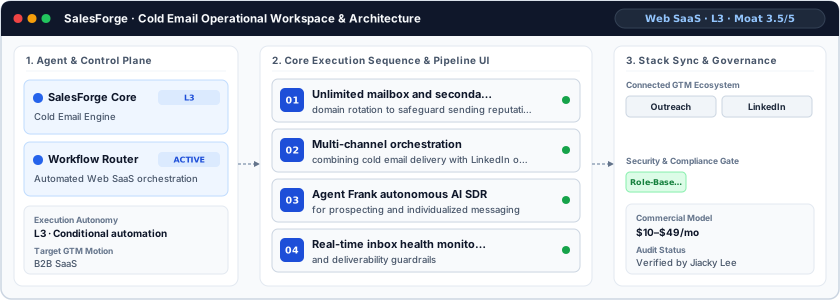
- L3 Architecture & Defensibility: Salesforge combines multi-inbox rotation with multi-channel LinkedIn dispatch and an integrated autonomous agent layer (Agent Frank), shielding senders from domain burn while maintaining sequence velocity.
- Commercial Model Fit: Your procurement budget aligns with $10–$49/mo.
Walk away from SalesForge if (Deal-Breakers)
- Walk away if your workflow requires uncapped enterprise volume on the $10–$49/mo entry plan without upgrading tiers.
- Walk away if your workflow cannot tolerate mailbox warming latency: Provisioning fresh secondary domains requires a essential three-to-four-week warm-up phase, preventing instantaneous campaign scaling.
- Walk away if linkedin session fragility is a deal-breaker for your team: Browser-based and session-cookie LinkedIn automation remains vulnerable to platform security updates and account restriction checkpoints.
SalesForge key facts & scorecard
| Pricing | $10–$49/moVendor pricing page |
|---|---|
| Free plan | No / not disclosed |
| Delivery | Web SaaS |
| Audience | B2B SaaS |
| AI autonomy level | L3 · Conditional automationEditor-verified |
| Moat tier & score | 3.5 / 5.0 · Proprietary moatEditor-verified |
| Funding | Pre-seed |
| Total funding | $500KBacked by BADideas.fund, Spring Capital |
| Founders | Daniel Castellanos, Dovydas Volodko, Frank Sondors |
| Company size | 51-200 employees |
| Ecosystem integrations | Outreach, LinkedIn |
| Governance & docs | Trust & Security ↗ · DPA ↗ · Terms ↗ · Privacy ↗ |
| Headquarters | Tallinn, EE |
| Founded | 2023 |
| Last verified |
SalesForge pros & cons: strengths vs. operational limitations
Pros: core strengths & capabilities
- Unlimited mailbox and secondary: domain rotation to safeguard sending reputation
- Multi-channel orchestration: combining cold email delivery with LinkedIn outreach
- Agent Frank autonomous AI SDR: for prospecting and individualized messaging
- Real-time inbox health monitoring: and deliverability guardrails
Cons: operational limitations & risks
- Mailbox Warming Latency: Provisioning fresh secondary domains requires a essential three-to-four-week warm-up phase, preventing instantaneous campaign scaling.
- LinkedIn Session Fragility: Browser-based and session-cookie LinkedIn automation remains vulnerable to platform security updates and account restriction checkpoints.
- CRM Schema Alignment Overhead: Bidirectional synchronization across multi-inbox architectures creates deduplication challenges and requires continuous manual maintenance of mapping rules.
SalesForge TCO & deal-breaker stress test
Simulate 12-month stepped TCO, hidden cost multipliers, contract lock-in exposure, and stack failure modes using only facts verified by Jiacky Lee on · Capture SHA 9d574108.
SalesForge aligns with your 5-seat / $800/mo profile. Review the walk-away triggers and contract levers below before deployment.
| Plan / Tier | Verified Rate | Scale Fit | Scope & Quota Notes |
|---|---|---|---|
| Essential | $49/mo | Unlimited seats (Entry credits) | Infrastructure Layer |
- Moat Score
- 3.5 / 5.0
- AI Autonomy
- L3
- Free Tier / Trial
- None disclosed
Triggered audit signals & failure modes
- Published Self-Serve Entry FloorVerified Pricing Ledger
SalesForge publishes a transparent entry point ($10–$49/mo) for initial validation before committing.
- Primary Operational Bottleneck: Mailbox Warming LatencyAudit by Jiacky Lee
Provisioning fresh secondary domains requires a essential three-to-four-week warm-up phase, preventing instantaneous campaign scaling.
Hidden TCO Multipliers & Quota Gates
- Annual Billing Headline vs. Monthly Premium: Headline entry rates reflect annual billing commitments; month-to-month flexibility carries a higher effective monthly rate or requires annual prepayment.
- Credit & Usage Burn Multiplier: Automated workflows consume metered credits/usage quotas; multi-step enrichment, voice minutes, or high-frequency agent runs can trigger mid-cycle top-up packs.
- Enterprise Governance & Add-On Gating: Advanced capabilities such as Single Sign-On (SSO), custom role permissions, or specialized analytics modules are gated behind upper tiers or paid add-ons.
When to Walk Away & Negotiation Levers
- Walk away if your workflow requires uncapped enterprise volume on the $10–$49/mo entry plan without upgrading tiers.
- Walk away if your workflow cannot tolerate mailbox warming latency: Provisioning fresh secondary domains requires a essential three-to-four-week warm-up phase, preventing instantaneous campaign scaling.
- Walk away if linkedin session fragility is a deal-breaker for your team: Browser-based and session-cookie LinkedIn automation remains vulnerable to platform security updates and account restriction checkpoints.
- Validate exact quota thresholds (seats, credits, or API calls) included in SalesForge's $10–$49/mo tier before converting from monthly to annual billing.
- Require a sandbox proof-of-concept testing mailbox warming latency against your live CRM/data schema before annual sign-off.
Ask a custom procurement or TCO stress-test question about SalesForge
Fits within $800/mo budget ($37.60–$358/mo · Enterprise plan)
Fits within $800/mo budget ($39–$379/mo)
SalesForge key entities, modules & ecosystem stack
SalesForge moat & subtrack positioning
Salesforge combines multi-inbox rotation with multi-channel LinkedIn dispatch and an integrated autonomous agent layer (Agent Frank), shielding senders from domain burn while maintaining sequence velocity.
Editorial review
Fact-checked by Jiacky Lee (Managing Editor, AI Autonomy & Moat Methodology) on .
Background
Architected to solve domain burn and delivery constraints caused by strict ESP sender controls, SalesForge was established in 2023 in Tallinn, EE. Supported by $500K in pre-seed venture financing, the platform serves revenue development teams, outbound agencies, and enterprise growth operators. By decoupling cold email outreach from single high-risk domains, the system shifts pipeline generation toward distributed multi-inbox and multi-channel workflows.
How SalesForge works
At its architectural core, SalesForge implements an automated mailbox rotation engine paired with its AI SDR module, Agent Frank. The pipeline ingests prospect records, enriches firmographic profiles, and programmatically disperses outgoing SMTP traffic across dozens of connected mailboxes and LinkedIn profiles. Dynamic load-balancing ensures daily sending volumes per account remain strictly below spam-filter heuristic limits, while integrated LLM routines compile tailored copy variations per recipient to eliminate uniform content footprints.
Limitations
Operational considerations and platform boundaries include:
- Mailbox Warming Latency: Provisioning fresh secondary domains requires a essential three-to-four-week warm-up phase, preventing instantaneous campaign scaling.
- LinkedIn Session Fragility: Browser-based and session-cookie LinkedIn automation remains vulnerable to platform security updates and account restriction checkpoints.
- CRM Schema Alignment Overhead: Bidirectional synchronization across multi-inbox architectures creates deduplication challenges and requires continuous manual maintenance of mapping rules.
SalesForge pricing
SalesForge operates under a tiered SaaS subscription structure priced from $10 to $49/month depending on selected sending capacity and active contact volume. The entry tier starts at $10 for base email sequencing, while upper plans scale to $49 or higher configurations for advanced multi-channel LinkedIn integration and higher contact allocations. Platform add-ons scale incrementally based on automated credit consumption and dedicated sender connections.
How SalesForge compares
Within the outbound infrastructure ecosystem, SalesForge competes directly against Instantly.ai, Lavender.ai, and Autobound.ai. While Instantly.ai focuses strictly on volume mailbox pooling, SalesForge incorporates native LinkedIn channel execution alongside email. Conversely, Autobound.ai and Lavender.ai focus on content generation and real-time email scoring, whereas SalesForge delivers the underlying programmatic infrastructure. The platform is best suited for outbound agencies and lean SDR teams requiring distributed delivery with unified pipeline orchestration.
Direct competitors & market radar
Top algorithmic competitors based on category positioning, capability overlap, and ICP alignment.
Frequently asked questions about SalesForge
How much does SalesForge cost and what pricing tiers are available?
Published pricing summary for SalesForge: $10–$49/mo. A permanent free plan is not disclosed for SalesForge. SalesForge operates under a tiered SaaS subscription structure priced from $10 to $49/month depending on selected sending capacity and active contact volume.
How does SalesForge work and how autonomous is its AI architecture?
Multi-mailbox cold email and LinkedIn outreach automation platform powered by autonomous AI SDR agents to maximize deliverability and outbound pipeline. Within Cold Email (Cold Email Sequences & Mailbox Infra), MarTechRadar rates its execution architecture at L3 · Conditional automation with a verified Moat Score of 3.5 / 5.0 (Proprietary moat). Salesforge combines multi-inbox rotation with multi-channel LinkedIn dispatch and an integrated autonomous agent layer (Agent Frank), shielding senders from domain burn while maintaining sequence velocity. Corporate profile: Founded by Daniel Castellanos, Dovydas Volodko, Frank Sondors, operating at 51-200 employees scale.
What are the main limitations of SalesForge and when should buyers walk away?
Based on our editorial technical audit, key operational considerations and boundaries for SalesForge include: (1) Mailbox Warming Latency: Provisioning fresh secondary domains requires a essential three-to-four-week warm-up phase, preventing instantaneous campaign scaling. (2) LinkedIn Session Fragility: Browser-based and session-cookie LinkedIn automation remains vulnerable to platform security updates and account restriction checkpoints. (3) CRM Schema Alignment Overhead: Bidirectional synchronization across multi-inbox architectures creates deduplication challenges and requires continuous manual maintenance of mapping rules. Primary procurement walk-away rule: Walk away if your workflow requires uncapped enterprise volume on the $10–$49/mo entry plan without upgrading tiers.
What integrations, compliance certifications, and contract terms apply to SalesForge?
Verified ecosystem and stack integrations include Outreach, LinkedIn. First-party governance and developer endpoints verified on domain include: Trust/Security (https://trust.salesforge.ai), DPA (https://www.salesforge.ai/legal/dpa). Key TCO multiplier to watch: Annual Billing Headline vs. Monthly Premium (Headline entry rates reflect annual billing commitments; month-to-month flexibility carries a higher effective monthly rate or requires annual prepayment.) Before signing a contract, procurement teams should validate exact quota thresholds (seats, credits, or API calls) included in SalesForge's $10–$49/mo tier before converting from monthly to annual billing.
What are the best SalesForge alternatives and head-to-head competitors in 2026?
Top fact-checked alternatives to SalesForge in Cold Email (Cold Email Sequences & Mailbox Infra) include Instantly.ai ($37.60–$358/mo · Enterprise plan), Buena AI (From $0.20/mo), Smartlead.ai ($39–$379/mo), Singulate (Custom / enterprise pricing). Within the outbound infrastructure ecosystem, SalesForge competes directly against Instantly.ai, Lavender.ai, and Autobound.ai. While Instantly.ai focuses strictly on volume mailbox pooling, SalesForge incorporates native LinkedIn channel execution alongside email.
Verified sources & evidence trail
- Official product domain: https://salesforge.ai
- Commercial pricing verification: https://www.salesforge.ai/pricing
- Verified corporate entity profiles (
sameAs): LinkedIn Company Profile · Crunchbase Entity Record - First-party governance & documentation links: Trust & Security · DPA · Terms · Privacy
- Editorial audit sign-off: Fact-checked by Jiacky Lee on under the MarTechRadar Evidence-Ledger Protocol.