Sitefire Review (2026): GEO Pricing, Limits & Alternatives
Bottom line
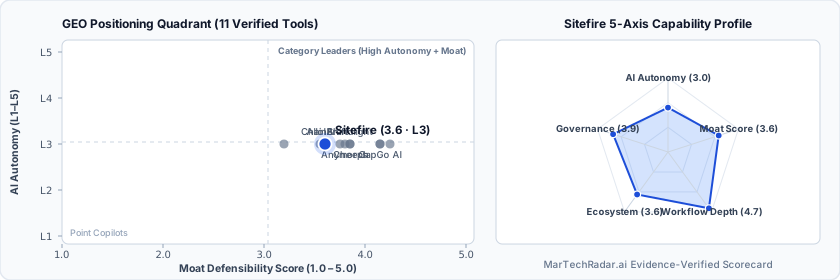
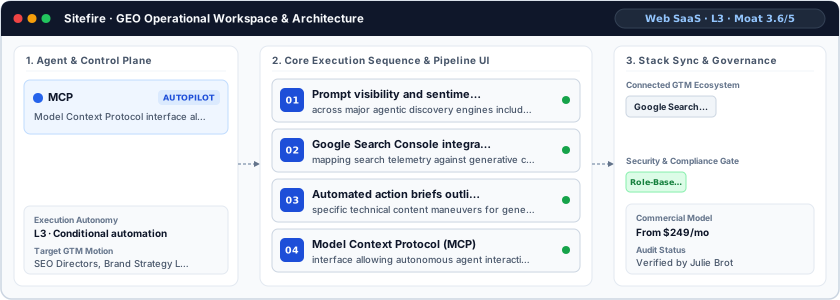
Sitefire is a Web SaaS tool for GEO (GEO Brand Tracking & LLM Rank Tracking) in GEO & AI SEO. Pricing: From $249/mo. Best suited to SEO Directors, Brand Strategy Leaders and Growth Marketers. Editor ratings: AI autonomy L3 (conditional automation); moat score 3.6/5.0 (Proprietary moat). Fact-checked by Julie Brot on Oct 14, 2026.
Marketing intelligence and content optimization platform engineered to audit brand mentions across generative AI models and execute targeted GEO.
Sitefire buyer fit verdict: when to choose vs. when to walk away
Choose Sitefire if (Best Fit)
- Target ICP & Stack Fit: You operate as SEO Directors, Brand Strategy Leaders and Growth Marketers requiring a Web SaaS deployment for GEO, with verified ecosystem connectivity for Google Search Console.
- L3 Architecture & Defensibility: Native Model Context Protocol (MCP) integrations, automated prompt-level sentiment auditing across agentic engines like Perplexity, and algorithmic action briefs linking crawl telemetry directly to generative optimization.
- Commercial Model Fit: Your procurement budget aligns with From $249/mo.
Walk away from Sitefire if (Deal-Breakers)
- Walk away if your team is at early validation stage with a <$250/mo tool budget (Sitefire starts at From $249/mo before seat or usage expansion).
- Walk away if your workflow cannot tolerate prompt quota scaling: The base subscription tier enforces a strict limit of 150 tracked prompts, which restricts broad catalog tracking across complex enterprise product lines.
- Walk away if LLM dynamic variance is a deal-breaker for your team: Generative model non-determinism and frequent algorithmic updates by underlying LLM providers can cause rapid citation drift between measurement intervals.
Sitefire key facts & scorecard
| Pricing | From $249/moVendor pricing page |
|---|---|
| Free plan | No / not disclosed |
| Delivery | Web SaaS |
| Audience | SEO Directors, Brand Strategy Leaders, Growth Marketers |
| AI autonomy level | L3 · Conditional automationEditor-verified |
| Moat tier & score | 3.6 / 5.0 · Proprietary moatEditor-verified |
| Funding | Pre-seed |
| Total funding | $500K |
| Founders | Jochen Madler, Vincent Jeltsch |
| Company size | 2-10 employees |
| Ecosystem integrations | Google Search Console |
| Governance & docs | API & Docs ↗ · Terms ↗ |
| Headquarters | München, Bayern, Germany |
| Founded | 2025 |
| Last verified |
Sitefire pros & cons: strengths vs. operational limitations
Pros: core strengths & capabilities
- Prompt visibility and sentiment tracking: across major agentic discovery engines including Perplexity
- Google Search Console integration: mapping search telemetry against generative citations
- Automated action briefs outlining: specific technical content maneuvers for generative engine optimization
- Model Context Protocol (MCP): interface allowing autonomous agent interaction and programmatic reporting
Cons: operational limitations & risks
- Prompt Quota Scaling: The base subscription tier enforces a strict limit of 150 tracked prompts, which restricts broad catalog tracking across complex enterprise product lines.
- LLM Dynamic Variance: Generative model non-determinism and frequent algorithmic updates by underlying LLM providers can cause rapid citation drift between measurement intervals.
- Search Console Lag: Dependency on asynchronous Google Search Console data imports creates an operational telemetry delay when correlating standard search ranking changes against real-time conversational output shifts.
Sitefire TCO & deal-breaker stress test
Simulate 12-month stepped TCO, hidden cost multipliers, contract lock-in exposure, and stack failure modes using only facts verified by Julie Brot on · Capture SHA 853e5c41.
Sitefire aligns with your 5-seat / $800/mo profile. Review the walk-away triggers and contract levers below before deployment.
| Plan / Tier | Verified Rate | Scale Fit | Scope & Quota Notes |
|---|---|---|---|
| Lite | $249/mo | 1–2 seats | For small brands wanting to get started with monitoring and content. |
| Pro | $499/mo | 5 seats | For growing brands that want to monitor and create content. |
- Moat Score
- 3.6 / 5.0
- AI Autonomy
- L3
- Free Tier / Trial
- None disclosed
Triggered audit signals & failure modes
- Published Self-Serve Entry FloorVerified Pricing Ledger
Sitefire publishes a transparent entry point (From $249/mo) for initial validation before committing.
- Tier Fit for 5-Seat Scale: Pro ($499/mo)Verified Tier Schedule
For growing brands that want to monitor and create content.
- Primary Operational Bottleneck: Prompt Quota ScalingAudit by Julie Brot
The base subscription tier enforces a strict limit of 150 tracked prompts, which restricts broad catalog tracking across complex enterprise product lines.
Hidden TCO Multipliers & Quota Gates
- Prompt Quota Scaling: The base subscription tier enforces a strict limit of 150 tracked prompts, which restricts broad catalog tracking across complex enterprise product lines.
- LLM Dynamic Variance: Generative model non-determinism and frequent algorithmic updates by underlying LLM providers can cause rapid citation drift between measurement intervals.
When to Walk Away & Negotiation Levers
- Walk away if your team is at early validation stage with a <$250/mo tool budget (Sitefire starts at From $249/mo before seat or usage expansion).
- Walk away if your workflow cannot tolerate prompt quota scaling: The base subscription tier enforces a strict limit of 150 tracked prompts, which restricts broad catalog tracking across complex enterprise product lines.
- Walk away if LLM dynamic variance is a deal-breaker for your team: Generative model non-determinism and frequent algorithmic updates by underlying LLM providers can cause rapid citation drift between measurement intervals.
- Negotiate price-lock protection on additional seats and overage credits above the From $249/mo entry tier.
- Require a sandbox proof-of-concept testing prompt quota scaling against your live CRM/data schema before annual sign-off.
Ask a custom procurement or TCO stress-test question about Sitefire
Lower 5-seat floor (~$95/mo vs. $499 / mo)
Lower 5-seat floor (~$29/mo vs. $499 / mo)
Sitefire key entities, modules & ecosystem stack
Model Context Protocol interface allowing autonomous agent interaction and programmatic reporting
Sitefire moat & subtrack positioning
Native Model Context Protocol (MCP) integrations, automated prompt-level sentiment auditing across agentic engines like Perplexity, and algorithmic action briefs linking crawl telemetry directly to generative optimization.
Editorial review
Fact-checked by Julie Brot (Enterprise SaaS Governance & Procurement Editor) on .
Background
Architected specifically for the shift toward generative search engines, Sitefire delivers an optimization suite designed to track how autonomous models present enterprise brands. Headquartered in München, Bayern, Germany and founded in 2025, the company emerged with $500K in venture capital backing to address brand observability across conversational platforms. Built primarily for search marketing directors, digital brand strategists, and technical growth teams, Sitefire continuously monitors synthetic answer outputs, turning opaque multi-model hallucinations into structured visibility indexes.
How Sitefire works
Sitefire functions through a continuous ingestion engine that queries conversational architectures like Perplexity alongside standard search index feeds via Google Search Console. The platform runs programmatic evaluation pipelines across defined prompt corpuses, measuring citation presence, source attribution, and brand sentiment scores. Through native Model Context Protocol (MCP) endpoints, Sitefire feeds query telemetry directly into localized analytics pipelines, outputting prioritized action briefs and machine-generated content drafts tailored to satisfy the algorithmic retrieval heuristics of LLM crawlers.
Limitations
Operational considerations and platform boundaries include:
- Prompt Quota Scaling: The base subscription tier enforces a strict limit of 150 tracked prompts, which restricts broad catalog tracking across complex enterprise product lines.
- LLM Dynamic Variance: Generative model non-determinism and frequent algorithmic updates by underlying LLM providers can cause rapid citation drift between measurement intervals.
- Search Console Lag: Dependency on asynchronous Google Search Console data imports creates an operational telemetry delay when correlating standard search ranking changes against real-time conversational output shifts.
Sitefire pricing
Commercial access is structured via monthly software-as-a-service subscriptions starting at $249 per month for the Lite tier, which accommodates 150 prompt queries, 8 action briefs, and Google Search Console integration. Organizations requiring expanded volume can upgrade to the Pro plan at $499 per month, which increases monitoring capacity to 300 prompts while adding dedicated sentiment tracking across 30 prompts and 18 monthly action briefs.
How Sitefire compares
Within generative engine tracking, Sitefire competes against specialized alternatives like Anymorph, AthenaHQ, and Brandlight. While AthenaHQ and Brandlight emphasize high-level synthetic brand sentiment indexing and legacy search overlap, Sitefire differentiates itself through deep agentic integration, offering native Model Context Protocol interfaces and programmatic action briefs. However, teams managing substantial corporate catalogs may find Anymorph offers broader cross-engine tracking breadth without Sitefire's rigid prompt monitoring quotas, positioning Sitefire primarily for mid-market technical search teams targeting high-impact conversion prompts.
Direct competitors & market radar
Top algorithmic competitors based on category positioning, capability overlap, and ICP alignment.
Frequently asked questions about Sitefire
How much does Sitefire cost and what pricing tiers are available?
Published pricing summary for Sitefire: From $249/mo. A permanent free plan is not disclosed for Sitefire. Verified tier schedule: Lite ($249/mo for 1–2 seats); Pro ($499/mo for 5 seats). Commercial access is structured via monthly software-as-a-service subscriptions starting at $249 per month for the Lite tier, which accommodates 150 prompt queries, 8 action briefs, and Google Search Console integration.
How does Sitefire work and how autonomous is its AI architecture?
Marketing intelligence and content optimization platform engineered to audit brand mentions across generative AI models and execute targeted GEO. Within GEO (GEO Brand Tracking & LLM Rank Tracking), MarTechRadar rates its execution architecture at L3 · Conditional automation with a verified Moat Score of 3.6 / 5.0 (Proprietary moat). Native Model Context Protocol (MCP) integrations, automated prompt-level sentiment auditing across agentic engines like Perplexity, and algorithmic action briefs linking crawl telemetry directly to generative optimization. Corporate profile: Founded by Jochen Madler, Vincent Jeltsch, operating at 2-10 employees scale.
What are the main limitations of Sitefire and when should buyers walk away?
Based on our editorial technical audit, key operational considerations and boundaries for Sitefire include: (1) Prompt Quota Scaling: The base subscription tier enforces a strict limit of 150 tracked prompts, which restricts broad catalog tracking across complex enterprise product lines. (2) LLM Dynamic Variance: Generative model non-determinism and frequent algorithmic updates by underlying LLM providers can cause rapid citation drift between measurement intervals. (3) Search Console Lag: Dependency on asynchronous Google Search Console data imports creates an operational telemetry delay when correlating standard search ranking changes against real-time conversational output shifts. Primary procurement walk-away rule: Walk away if your team is at early validation stage with a <$250/mo tool budget (Sitefire starts at From $249/mo before seat or usage expansion).
What integrations, compliance certifications, and contract terms apply to Sitefire?
Verified ecosystem and stack integrations include Google Search Console. First-party governance and developer endpoints verified on domain include: API Docs (https://sitefire.ai/docs). Key TCO multiplier to watch: Prompt Quota Scaling (The base subscription tier enforces a strict limit of 150 tracked prompts, which restricts broad catalog tracking across complex enterprise product lines.) Before signing a contract, procurement teams should negotiate price-lock protection on additional seats and overage credits above the From $249/mo entry tier.
What are the best Sitefire alternatives and head-to-head competitors in 2026?
Top fact-checked alternatives to Sitefire in GEO (GEO Brand Tracking & LLM Rank Tracking) include Peec AI (From $95/mo · Enterprise plan), Otterly.ai (From $29/mo · Enterprise plan), Searchable ($125–$400/mo), Yolando (Free plan · $0/mo · Enterprise plan). Within generative engine tracking, Sitefire competes against specialized alternatives like Anymorph, AthenaHQ, and Brandlight.
Verified sources & evidence trail
- Official product domain: https://sitefire.ai
- Commercial pricing verification: https://sitefire.ai/pricing
- Verified corporate entity profiles (
sameAs): LinkedIn Company Profile · Crunchbase Entity Record - First-party governance & documentation links: API & Docs · Terms
- Editorial audit sign-off: Fact-checked by Julie Brot on under the MarTechRadar Evidence-Ledger Protocol.