Sovrn Review (2026): Ad Spy Pricing, Limits & Alternatives
Bottom line
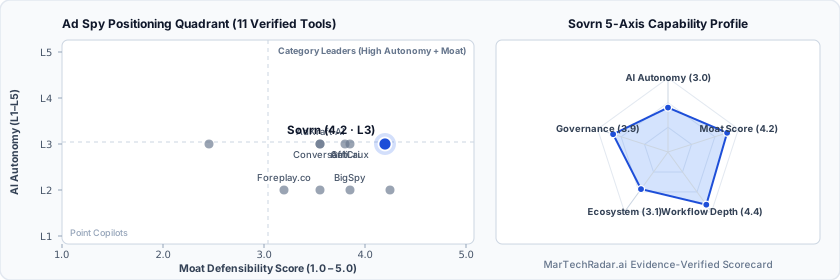
Sovrn is a Web SaaS tool for Ad Spy (Ad Spy, Creative Intelligence & Affiliate) in AdTech & Paid Media. Pricing: Custom / enterprise pricing. Best suited to DTC / eCommerce, Enterprise Brands and Creators / Solo. Editor ratings: AI autonomy L3 (conditional automation); moat score 4.2/5.0 (Proprietary moat). Fact-checked by Vasilia Xia on Oct 14, 2026.
Publisher monetization and commerce media infrastructure automating server-side header bidding, affiliate link transformation, and audience data enrichment.
Sovrn buyer fit verdict: when to choose vs. when to walk away
Choose Sovrn if (Best Fit)
- Target ICP & Stack Fit: You operate as DTC / eCommerce, Enterprise Brands and Creators / Solo requiring a Web SaaS deployment for Ad Spy.
- L3 Architecture & Defensibility: Extensive direct SSP integrations, automated text-to-affiliate link transformation graph, and proprietary attention-measurement algorithms that dynamically price publisher ad inventory.
- Commercial Model Fit: Your procurement budget aligns with Custom / enterprise pricing.
Walk away from Sovrn if (Deal-Breakers)
- Walk away if you require transparent self-serve monthly billing or your budget ceiling is under $1,000/mo (Sovrn requires sales-gated custom quoting).
- Walk away if your workflow cannot tolerate merchant link redirection latency: Dynamic link rewriting introduces intermittent redirect hops through affiliate networks, which occasionally causes merchant link failure or delayed click attribution during retail catalog reorganizations.
- Walk away if client-side script execution overhead is a deal-breaker for your team: Concurrent deployment of commerce link parsers and header bidding tags creates DOM processing contention, impacting Core Web Vitals on script-heavy editorial templates.
Sovrn key facts & scorecard
| Pricing | Custom / enterprise pricing |
|---|---|
| Free plan | No / not disclosed |
| Delivery | Web SaaS |
| Audience | DTC / eCommerce, Enterprise Brands, Creators / Solo |
| AI autonomy level | L3 · Conditional automationEditor-verified |
| Moat tier & score | 4.2 / 5.0 · Proprietary moatEditor-verified |
| Funding | Series C+ |
| Total funding | $121.5M |
| Founders | Jake Braly, Stan James |
| Company size | 51-200 employees |
| Governance & docs | Trust & Security ↗ · System Status ↗ · Terms ↗ · Privacy ↗ |
| Headquarters | Boulder, Colorado |
| Founded | 2014 |
| Last verified |
Sovrn pros & cons: strengths vs. operational limitations
Pros: core strengths & capabilities
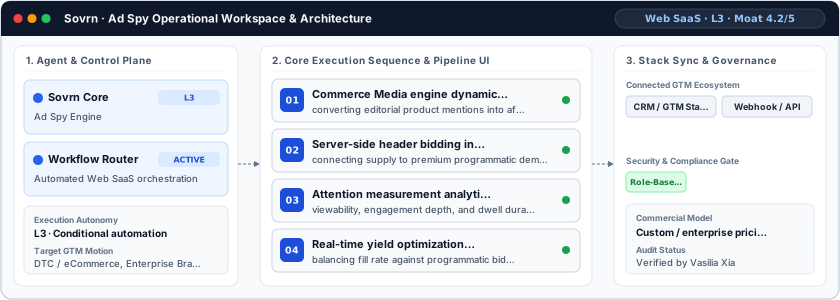
- Commerce Media engine dynamically: converting editorial product mentions into affiliate tracking URLs
- Server-side header bidding infrastructure: connecting supply to premium programmatic demand
- Attention measurement analytics tracking: viewability, engagement depth, and dwell duration
- Real-time yield optimization engine: balancing fill rate against programmatic bid floors
Cons: operational limitations & risks
- Merchant Link Redirection Latency: Dynamic link rewriting introduces intermittent redirect hops through affiliate networks, which occasionally causes merchant link failure or delayed click attribution during retail catalog reorganizations.
- Client-Side Script Execution Overhead: Concurrent deployment of commerce link parsers and header bidding tags creates DOM processing contention, impacting Core Web Vitals on script-heavy editorial templates.
- Third-Party Cookie Deprecation Exposure: Attention scoring mechanisms struggle to maintain consistent audience valuation across browsers enforcing strict partition storage, requiring continual synchronization with alternative identifier frameworks.
Sovrn TCO & deal-breaker stress test
Simulate 12-month stepped TCO, hidden cost multipliers, contract lock-in exposure, and stack failure modes using only facts verified by Vasilia Xia on · Capture SHA cff1f83d.
Sovrn triggers high-severity friction under your 5-seat / $800/mo constraints. Benchmark the verified subtrack alternatives below before committing.
| Plan / Tier | Verified Rate | Scale Fit | Scope & Quota Notes |
|---|---|---|---|
| Enterprise / Custom | Custom quote | 15–50+ seats (Enterprise SLA) | Sales-negotiated annual contract for custom volume, SSO/RBAC governance, and dedicated SLA. |
- Moat Score
- 4.2 / 5.0
- AI Autonomy
- L3
- Free Tier / Trial
- None disclosed
Triggered audit signals & failure modes
- Opaque Enterprise Quoting vs. SMB/Mid-Market BudgetVerified Pricing Ledger
Sovrn does not disclose a public self-serve floor (Custom / enterprise pricing). Buyers with a $800/mo cap face high sales-qualification friction.
- Sales-Gated Contract TermsFact-checked by Vasilia Xia
Sovrn operates primarily on enterprise monetization agreements where commercial pricing is available on request through tailored enterprise sales quotes based on organizational scale and seats.
- Primary Operational Bottleneck: Merchant Link Redirection LatencyAudit by Vasilia Xia
Dynamic link rewriting introduces intermittent redirect hops through affiliate networks, which occasionally causes merchant link failure or delayed click attribution during retail catalog reorganizations.
Hidden TCO Multipliers & Quota Gates
- Merchant Link Redirection Latency: Dynamic link rewriting introduces intermittent redirect hops through affiliate networks, which occasionally causes merchant link failure or delayed click attribution during retail catalog reorganizations.
- Client-Side Script Execution Overhead: Concurrent deployment of commerce link parsers and header bidding tags creates DOM processing contention, impacting Core Web Vitals on script-heavy editorial templates.
When to Walk Away & Negotiation Levers
- Walk away if you require transparent self-serve monthly billing or your budget ceiling is under $1,000/mo (Sovrn requires sales-gated custom quoting).
- Walk away if your workflow cannot tolerate merchant link redirection latency: Dynamic link rewriting introduces intermittent redirect hops through affiliate networks, which occasionally causes merchant link failure or delayed click attribution during retail catalog reorganizations.
- Walk away if client-side script execution overhead is a deal-breaker for your team: Concurrent deployment of commerce link parsers and header bidding tags creates DOM processing contention, impacting Core Web Vitals on script-heavy editorial templates.
- Demand a 30- to 60-day paid pilot opt-out clause in the Sovrn order form before signing a 12-month enterprise commitment.
- Require a sandbox proof-of-concept testing merchant link redirection latency against your live CRM/data schema before annual sign-off.
Ask a custom procurement or TCO stress-test question about Sovrn
Lower 5-seat floor (~$69/mo vs. Custom Quote) · Transparent self-serve entry without mandatory annual lock-in
Lower 5-seat floor (~$50/mo vs. Custom Quote) · Transparent self-serve entry without mandatory annual lock-in
Sovrn moat & subtrack positioning
Extensive direct SSP integrations, automated text-to-affiliate link transformation graph, and proprietary attention-measurement algorithms that dynamically price publisher ad inventory.
Editorial review
Fact-checked by Vasilia Xia (E-Commerce, Lifecycle & Retention Marketing Analyst) on .
Background
Architected as a dual-engine programmatic monetization and commerce media framework, Sovrn was established in 2014 in Boulder, Colorado. Backed by $121.5M in total venture funding, the company engineers tools for independent digital publishers, editorial networks, and commerce media operations seeking to maximize revenue across non-walled-garden web properties. Rather than treating display advertising and affiliate marketing as separate siloes, the platform consolidates programmatic inventory mediation and automated merchant attribution into a unified monetization layer designed for digital media operations.
How Sovrn works
Operating at an L3 autonomy tier, Sovrn executes real-time auction mediation alongside automated commerce monetization. Its lightweight client-side JavaScript agent scans page DOM structures to identify merchant entity mentions, transforming raw anchor links into active affiliate tracking URLs across integrated merchant networks without manual intervention. In parallel, its server-side header bidding container coordinates OpenRTB auctions across demand-side platforms. The system applies attention measurement signals—such as viewport visibility, dwell duration, and scroll velocity—to calibrate dynamic bid floors and elevate CPM yields on active impressions.
Limitations
Operational considerations and platform boundaries include:
- Merchant Link Redirection Latency: Dynamic link rewriting introduces intermittent redirect hops through affiliate networks, which occasionally causes merchant link failure or delayed click attribution during retail catalog reorganizations.
- Client-Side Script Execution Overhead: Concurrent deployment of commerce link parsers and header bidding tags creates DOM processing contention, impacting Core Web Vitals on script-heavy editorial templates.
- Third-Party Cookie Deprecation Exposure: Attention scoring mechanisms struggle to maintain consistent audience valuation across browsers enforcing strict partition storage, requiring continual synchronization with alternative identifier frameworks.
Sovrn pricing
Sovrn operates primarily on enterprise monetization agreements where commercial pricing is available on request through tailored enterprise sales quotes based on organizational scale and seats. The commerce module typically monetizes via programmatic revenue-share splits on affiliate commissions, while the display advertising container charges infrastructure margins on cleared programmatic bid volume.
How Sovrn compares
Within affiliate intelligence and ad monetization, Sovrn occupies a distinct publisher infrastructure footprint compared to competitive platforms. While Foreplay.co and BigSpy operate as client-side ad intelligence and ad-spy repositories for performance creatives, and Affil.ai focuses on algorithmic affiliate campaign automation, Sovrn operates directly on publisher supply. It provides native programmatic auction mechanics and autonomous on-page link monetization, making it suitable for mid-market and enterprise editorial publishers prioritizing yield optimization rather than competitive campaign reconnaissance.
Direct competitors & market radar
Top algorithmic competitors based on category positioning, capability overlap, and ICP alignment.
Frequently asked questions about Sovrn
How much does Sovrn cost and does it require a custom enterprise quote?
Published pricing summary for Sovrn: Custom / enterprise pricing. A permanent free plan is not disclosed for Sovrn. Sovrn operates primarily on enterprise monetization agreements where commercial pricing is available on request through tailored enterprise sales quotes based on organizational scale and seats.
How does Sovrn work and how autonomous is its AI architecture?
Publisher monetization and commerce media infrastructure automating server-side header bidding, affiliate link transformation, and audience data enrichment. Within Ad Spy (Ad Spy, Creative Intelligence & Affiliate), MarTechRadar rates its execution architecture at L3 · Conditional automation with a verified Moat Score of 4.2 / 5.0 (Proprietary moat). Extensive direct SSP integrations, automated text-to-affiliate link transformation graph, and proprietary attention-measurement algorithms that dynamically price publisher ad inventory. Corporate profile: Founded by Jake Braly, Stan James, operating at 51-200 employees scale.
What are the main limitations of Sovrn and when should buyers walk away?
Based on our editorial technical audit, key operational considerations and boundaries for Sovrn include: (1) Merchant Link Redirection Latency: Dynamic link rewriting introduces intermittent redirect hops through affiliate networks, which occasionally causes merchant link failure or delayed click attribution during retail catalog reorganizations. (2) Client-Side Script Execution Overhead: Concurrent deployment of commerce link parsers and header bidding tags creates DOM processing contention, impacting Core Web Vitals on script-heavy editorial templates. (3) Third-Party Cookie Deprecation Exposure: Attention scoring mechanisms struggle to maintain consistent audience valuation across browsers enforcing strict partition storage, requiring continual synchronization with alternative identifier frameworks. Primary procurement walk-away rule: Walk away if you require transparent self-serve monthly billing or your budget ceiling is under $1,000/mo (Sovrn requires sales-gated custom quoting).
What integrations, compliance certifications, and contract terms apply to Sovrn?
First-party governance and developer endpoints verified on domain include: Trust/Security (https://www.sovrn.com/trust-center), Status (https://status.sovrn.com). Key TCO multiplier to watch: Merchant Link Redirection Latency (Dynamic link rewriting introduces intermittent redirect hops through affiliate networks, which occasionally causes merchant link failure or delayed click attribution during retail catalog reorganizations.) Before signing a contract, procurement teams should demand a 30- to 60-day paid pilot opt-out clause in the Sovrn order form before signing a 12-month enterprise commitment.
What are the best Sovrn alternatives and head-to-head competitors in 2026?
Top fact-checked alternatives to Sovrn in Ad Spy (Ad Spy, Creative Intelligence & Affiliate) include MagicBrief (Custom / enterprise pricing), AdKraft AI (Custom / enterprise pricing), Conversant (Custom / enterprise pricing), BigSpy ($69–$499/mo). Within affiliate intelligence and ad monetization, Sovrn occupies a distinct publisher infrastructure footprint compared to competitive platforms.
Verified sources & evidence trail
- Official product domain: https://sovrn.com
- Commercial pricing verification: Verified against official vendor pricing policy (Custom / enterprise pricing)
- Verified corporate entity profiles (
sameAs): LinkedIn Company Profile · Crunchbase Entity Record - First-party governance & documentation links: Trust & Security · System Status · Terms · Privacy
- Editorial audit sign-off: Fact-checked by Vasilia Xia on under the MarTechRadar Evidence-Ledger Protocol.