Stardust Review (2026): DCO Pricing, Limits & Alternatives
Bottom line
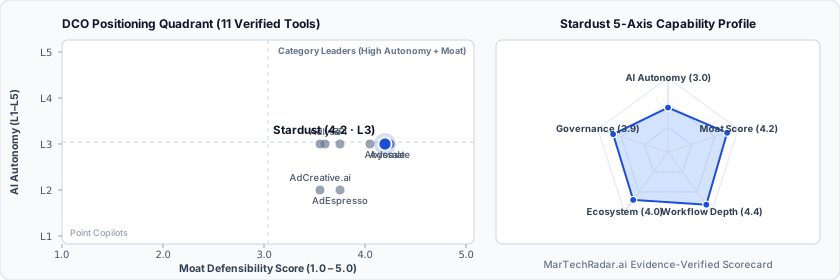
Stardust is a Web SaaS tool for DCO (Dynamic Creative Optimization / DCO) in AdTech & Paid Media. Pricing: Custom / enterprise pricing. Best suited to Performance Marketing Directors, Ad Agencies and Retail Media Advertisers. Editor ratings: AI autonomy L3 (conditional automation); moat score 4.2/5.0 (Proprietary moat). Fact-checked by Tim Fenolz on Oct 11, 2026.
E-commerce dynamic ad and contribution margin optimization engine aligning live ad spend with net profitability across multi-channel retailers.
Stardust buyer fit verdict: when to choose vs. when to walk away
Choose Stardust if (Best Fit)
- Target ICP & Stack Fit: You operate as Performance Marketing Directors, Ad Agencies and Retail Media Advertisers requiring a Web SaaS deployment for DCO, with verified ecosystem connectivity for Shopify, Google Ads.
- L3 Architecture & Defensibility: Deep integration of ERP and e-commerce COGS telemetry with ad network APIs, enabling algorithmic ad spend shifting governed by net contribution margins rather than top-line revenue.
- Commercial Model Fit: Your procurement budget aligns with Custom / enterprise pricing.
Walk away from Stardust if (Deal-Breakers)
- Walk away if you require transparent self-serve monthly billing or your budget ceiling is under $1,000/mo (Stardust requires sales-gated custom quoting).
- Walk away if your workflow cannot tolerate attribution latency and window drift: Delayed reporting from ad network conversion APIs can skew intra-day margin calculations, creating mismatched budget reallocations before conversions fully clear.
- Walk away if cogs schema dependency is a deal-breaker for your team: The autonomous optimization pipeline breaks down if an organization maintains inaccurate, out-of-date, or unmapped landed cost data in their store catalog.
Stardust key facts & scorecard
| Pricing | Custom / enterprise pricing |
|---|---|
| Free plan | No / not disclosed |
| Delivery | Web SaaS |
| Audience | Performance Marketing Directors, Ad Agencies, Retail Media Advertisers |
| AI autonomy level | L3 · Conditional automationEditor-verified |
| Moat tier & score | 4.2 / 5.0 · Proprietary moatEditor-verified |
| Funding | Pre-seed |
| Total funding | €1.7MBacked by StartersHub XO |
| Company size | 1-10 employees |
| Ecosystem integrations | Shopify, Google Ads |
| Governance & docs | Trust & Security ↗ · System Status ↗ · DPA ↗ · Terms ↗ · Privacy ↗ |
| Headquarters | Stockholm |
| Founded | 2025 |
| Last verified |
Stardust pros & cons: strengths vs. operational limitations
Pros: core strengths & capabilities
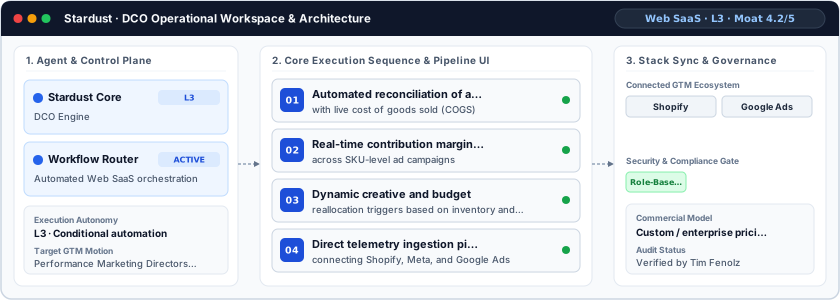
- Automated reconciliation of ad network spend: with live cost of goods sold (COGS)
- Real-time contribution margin tracking: across SKU-level ad campaigns
- Dynamic creative and budget: reallocation triggers based on inventory and net profit
- Direct telemetry ingestion pipelines: connecting Shopify, Meta, and Google Ads
Cons: operational limitations & risks
- Attribution Latency and Window Drift: Delayed reporting from ad network conversion APIs can skew intra-day margin calculations, creating mismatched budget reallocations before conversions fully clear.
- COGS Schema Dependency: The autonomous optimization pipeline breaks down if an organization maintains inaccurate, out-of-date, or unmapped landed cost data in their store catalog.
- Ad Network API Rate Limits: High-frequency campaign budget adjustments across extensive multi-SKU accounts can trigger ad platform rate limits, causing momentary telemetry gaps during peak trading.
Stardust TCO & deal-breaker stress test
Simulate 12-month stepped TCO, hidden cost multipliers, contract lock-in exposure, and stack failure modes using only facts verified by Tim Fenolz on · Capture SHA 351f70b0.
Stardust triggers high-severity friction under your 5-seat / $800/mo constraints. Benchmark the verified subtrack alternatives below before committing.
| Plan / Tier | Verified Rate | Scale Fit | Scope & Quota Notes |
|---|---|---|---|
| Enterprise / Custom | Custom quote | 15–50+ seats (Enterprise SLA) | Sales-negotiated annual contract for custom volume, SSO/RBAC governance, and dedicated SLA. |
- Moat Score
- 4.2 / 5.0
- AI Autonomy
- L3
- Free Tier / Trial
- None disclosed
Triggered audit signals & failure modes
- Opaque Enterprise Quoting vs. SMB/Mid-Market BudgetVerified Pricing Ledger
Stardust does not disclose a public self-serve floor (Custom / enterprise pricing). Buyers with a $800/mo cap face high sales-qualification friction.
- Sales-Gated Contract TermsFact-checked by Tim Fenolz
Stardust operates under a bespoke commercial licensing model. Rather than providing public tiered subscriptions, the vendor deploys custom enterprise pricing accessible by contacting sales directly.
- Primary Operational Bottleneck: Attribution Latency and Window DriftAudit by Tim Fenolz
Delayed reporting from ad network conversion APIs can skew intra-day margin calculations, creating mismatched budget reallocations before conversions fully clear.
Hidden TCO Multipliers & Quota Gates
- Attribution Latency and Window Drift: Delayed reporting from ad network conversion APIs can skew intra-day margin calculations, creating mismatched budget reallocations before conversions fully clear.
- COGS Schema Dependency: The autonomous optimization pipeline breaks down if an organization maintains inaccurate, out-of-date, or unmapped landed cost data in their store catalog.
When to Walk Away & Negotiation Levers
- Walk away if you require transparent self-serve monthly billing or your budget ceiling is under $1,000/mo (Stardust requires sales-gated custom quoting).
- Walk away if your workflow cannot tolerate attribution latency and window drift: Delayed reporting from ad network conversion APIs can skew intra-day margin calculations, creating mismatched budget reallocations before conversions fully clear.
- Walk away if cogs schema dependency is a deal-breaker for your team: The autonomous optimization pipeline breaks down if an organization maintains inaccurate, out-of-date, or unmapped landed cost data in their store catalog.
- Demand a 30- to 60-day paid pilot opt-out clause in the Stardust order form before signing a 12-month enterprise commitment.
- Require a sandbox proof-of-concept testing attribution latency and window drift against your live CRM/data schema before annual sign-off.
Ask a custom procurement or TCO stress-test question about Stardust
Lower 5-seat floor (~$36/mo vs. Custom Quote) · Transparent self-serve entry without mandatory annual lock-in
Lower 5-seat floor (~$49/mo vs. Custom Quote) · Transparent self-serve entry without mandatory annual lock-in
Stardust key entities, modules & ecosystem stack
Stardust moat & subtrack positioning
Deep integration of ERP and e-commerce COGS telemetry with ad network APIs, enabling algorithmic ad spend shifting governed by net contribution margins rather than top-line revenue.
Editorial review
Fact-checked by Tim Fenolz (Lead AdTech, Programmatic & Attribution Analyst) on .
Background
E-commerce growth teams scaling paid acquisition often experience negative margin erosion when top-line advertising metrics mask true product-level unit economics. Stardust, established in 2025 in Stockholm with €1.7M in total funding, addresses this operational breakdown by automating paid campaign decisions around real net profit. Designed primarily for direct-to-consumer founders, chief marketing officers, and performance media directors managing high-volume retail catalogs, the platform bridges the systemic disconnect between e-commerce ERP systems and digital ad platforms.
How Stardust works
At an architectural level, Stardust operates as an autonomous contribution margin decision engine. The ingestion layer establishes continuous API synchronization with digital storefronts like Shopify alongside ad networks such as Meta, Google, and TikTok. Rather than optimizing purely toward blended ROAS or clicks, the system ingests live inventory balances, shipping costs, payment processing fees, and landed cost of goods sold. By computing real-time SKU profitability against incoming click costs, its algorithmic controllers automatically adjust budget allocations and ad delivery to prioritize products delivering positive net margin contribution.
Limitations
Operational considerations and platform boundaries include:
- Attribution Latency and Window Drift: Delayed reporting from ad network conversion APIs can skew intra-day margin calculations, creating mismatched budget reallocations before conversions fully clear.
- COGS Schema Dependency: The autonomous optimization pipeline breaks down if an organization maintains inaccurate, out-of-date, or unmapped landed cost data in their store catalog.
- Ad Network API Rate Limits: High-frequency campaign budget adjustments across extensive multi-SKU accounts can trigger ad platform rate limits, causing momentary telemetry gaps during peak trading.
Stardust pricing
Stardust operates under a bespoke commercial licensing model. Rather than providing public tiered subscriptions, the vendor deploys custom enterprise pricing accessible by contacting sales directly. Commercial contracts are structured through custom proposals determined by aggregate monthly ad spend volume, catalog SKU complexity, and required data ingestion integrations.
How Stardust compares
Within the performance optimization ecosystem, Stardust differentiates by evaluating financial ledger reality instead of purely visual asset iterations. Platforms like AdCreative.ai and Abyssale focus primarily on asset composition and dynamic banner generation, leaving economic profitability validation to downstream analytics. Similarly, 7Pi concentrates on multi-channel creative distribution without direct ERP cost reconciliation. Stardust is purpose-built for mid-market and enterprise e-commerce merchants spending significant capital monthly who need ad delivery directly governed by unit economics.
Direct competitors & market radar
Top algorithmic competitors based on category positioning, capability overlap, and ICP alignment.
Frequently asked questions about Stardust
How much does Stardust cost and does it require a custom enterprise quote?
Published pricing summary for Stardust: Custom / enterprise pricing. A permanent free plan is not disclosed for Stardust. Stardust operates under a bespoke commercial licensing model. Rather than providing public tiered subscriptions, the vendor deploys custom enterprise pricing accessible by contacting sales directly.
How does Stardust work and how autonomous is its AI architecture?
E-commerce dynamic ad and contribution margin optimization engine aligning live ad spend with net profitability across multi-channel retailers. Within DCO (Dynamic Creative Optimization / DCO), MarTechRadar rates its execution architecture at L3 · Conditional automation with a verified Moat Score of 4.2 / 5.0 (Proprietary moat). Deep integration of ERP and e-commerce COGS telemetry with ad network APIs, enabling algorithmic ad spend shifting governed by net contribution margins rather than top-line revenue. Corporate profile: operating at 1-10 employees scale.
What are the main limitations of Stardust and when should buyers walk away?
Based on our editorial technical audit, key operational considerations and boundaries for Stardust include: (1) Attribution Latency and Window Drift: Delayed reporting from ad network conversion APIs can skew intra-day margin calculations, creating mismatched budget reallocations before conversions fully clear. (2) COGS Schema Dependency: The autonomous optimization pipeline breaks down if an organization maintains inaccurate, out-of-date, or unmapped landed cost data in their store catalog. (3) Ad Network API Rate Limits: High-frequency campaign budget adjustments across extensive multi-SKU accounts can trigger ad platform rate limits, causing momentary telemetry gaps during peak trading. Primary procurement walk-away rule: Walk away if you require transparent self-serve monthly billing or your budget ceiling is under $1,000/mo (Stardust requires sales-gated custom quoting).
What integrations, compliance certifications, and contract terms apply to Stardust?
Verified ecosystem and stack integrations include Shopify, Google Ads. First-party governance and developer endpoints verified on domain include: Trust/Security (https://trust.gro.app), Status (https://www.gro.app/status), DPA (https://www.gro.app/subprocessors). Key TCO multiplier to watch: Attribution Latency and Window Drift (Delayed reporting from ad network conversion APIs can skew intra-day margin calculations, creating mismatched budget reallocations before conversions fully clear.) Before signing a contract, procurement teams should demand a 30- to 60-day paid pilot opt-out clause in the Stardust order form before signing a 12-month enterprise commitment.
What are the best Stardust alternatives and head-to-head competitors in 2026?
Top fact-checked alternatives to Stardust in DCO (Dynamic Creative Optimization / DCO) include Celtra (Custom / enterprise pricing), Swiftly (Custom / enterprise pricing), Metric (Custom / enterprise pricing), NativeAds (Custom / enterprise pricing). Within the performance optimization ecosystem, Stardust differentiates by evaluating financial ledger reality instead of purely visual asset iterations.
Verified sources & evidence trail
- Official product domain: https://www.meetstardust.ai
- Commercial pricing verification: Verified against official vendor pricing policy (Custom / enterprise pricing)
- Verified corporate entity profiles (
sameAs): LinkedIn Company Profile · Crunchbase Entity Record - First-party governance & documentation links: Trust & Security · System Status · DPA · Terms · Privacy
- Editorial audit sign-off: Fact-checked by Tim Fenolz on under the MarTechRadar Evidence-Ledger Protocol.