Swiftly Review (2026): DCO Pricing, Limits & Alternatives
Bottom line
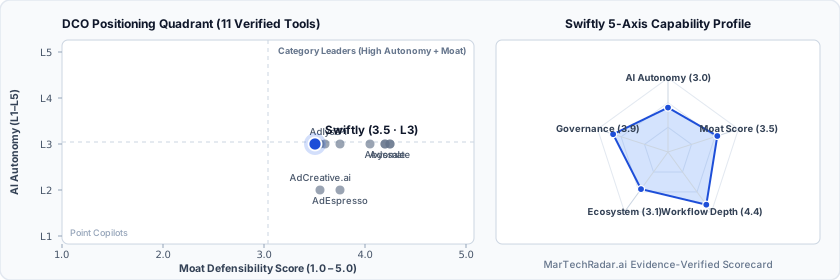
Swiftly is a Web SaaS tool for DCO (Dynamic Creative Optimization / DCO) in AdTech & Paid Media. Pricing: Custom / enterprise pricing. Best suited to Performance Marketing Directors, Ad Agencies and Retail Media Advertisers. Editor ratings: AI autonomy L3 (conditional automation); moat score 3.5/5.0 (Proprietary moat). Fact-checked by Sarah Per on Oct 10, 2026.
Retail media and dynamic creative optimization platform providing enterprise grocers and retailers with AI-driven ad personalization, digital circulars.
Swiftly buyer fit verdict: when to choose vs. when to walk away
Choose Swiftly if (Best Fit)
- Target ICP & Stack Fit: You operate as Performance Marketing Directors, Ad Agencies and Retail Media Advertisers requiring a Web SaaS deployment for DCO.
- L3 Architecture & Defensibility: Deep integration into physical and digital retail data stacks, proprietary point-of-sale catalog mapping, and dedicated closed-loop measurement for retail media networks.
- Commercial Model Fit: Your procurement budget aligns with Custom / enterprise pricing.
Walk away from Swiftly if (Deal-Breakers)
- Walk away if you require transparent self-serve monthly billing or your budget ceiling is under $1,000/mo (Swiftly requires sales-gated custom quoting).
- Walk away if your workflow cannot tolerate catalog synchronization latency: Real-time promotion accuracy depends on frequent point-of-sale and ERP data ingestion, which can trigger creative rendering mismatches during regional inventory stockouts.
- Walk away if deployment overhead is a deal-breaker for your team: Implementation requires structural integration across existing retailer mobile frameworks, data warehouses, and e-commerce stacks, extending initial deployment schedules.
Swiftly key facts & scorecard
| Pricing | Custom / enterprise pricing |
|---|---|
| Free plan | No / not disclosed |
| Delivery | Web SaaS |
| Audience | Performance Marketing Directors, Ad Agencies, Retail Media Advertisers |
| AI autonomy level | L3 · Conditional automationEditor-verified |
| Moat tier & score | 3.5 / 5.0 · Proprietary moatEditor-verified |
| Funding | Series C+ |
| Total funding | $215.6MBacked by Gaingels, Liquid 2 Ventures, PROOF |
| Founders | Daniel Kim, Henry Kim, Karen Ho, Sean Turner |
| Company size | 51-200 employees |
| Governance & docs | Trust & Security ↗ · Privacy ↗ |
| Headquarters | San Francisco, California |
| Founded | 2018 |
| Last verified |
Swiftly pros & cons: strengths vs. operational limitations
Pros: core strengths & capabilities
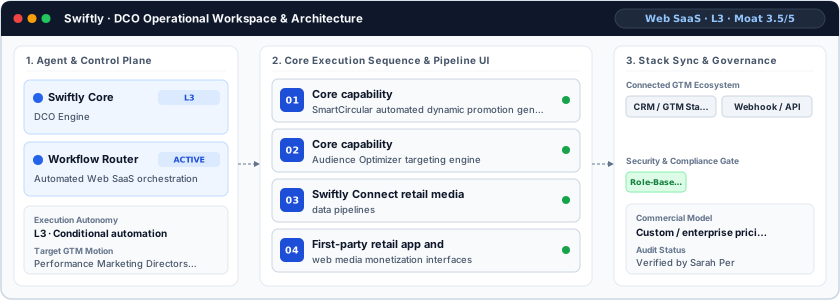
- Core capability: SmartCircular automated dynamic promotion generation
- Core capability: Audience Optimizer targeting engine
- Swiftly Connect retail media: data pipelines
- First-party retail app and: web media monetization interfaces
Cons: operational limitations & risks
- Catalog Synchronization Latency: Real-time promotion accuracy depends on frequent point-of-sale and ERP data ingestion, which can trigger creative rendering mismatches during regional inventory stockouts.
- Deployment Overhead: Implementation requires structural integration across existing retailer mobile frameworks, data warehouses, and e-commerce stacks, extending initial deployment schedules.
- First-Party Data Dependency: Personalization algorithms suffer degradation when applied across newly launched digital channels lacking dense historic transaction records or authenticated loyalty profiles.
Swiftly TCO & deal-breaker stress test
Simulate 12-month stepped TCO, hidden cost multipliers, contract lock-in exposure, and stack failure modes using only facts verified by Sarah Per on · Capture SHA 1adc3a09.
Swiftly triggers high-severity friction under your 5-seat / $800/mo constraints. Benchmark the verified subtrack alternatives below before committing.
| Plan / Tier | Verified Rate | Scale Fit | Scope & Quota Notes |
|---|---|---|---|
| Enterprise / Custom | Custom quote | 15–50+ seats (Enterprise SLA) | Sales-negotiated annual contract for custom volume, SSO/RBAC governance, and dedicated SLA. |
- Moat Score
- 3.5 / 5.0
- AI Autonomy
- L3
- Free Tier / Trial
- None disclosed
Triggered audit signals & failure modes
- Opaque Enterprise Quoting vs. SMB/Mid-Market BudgetVerified Pricing Ledger
Swiftly does not disclose a public self-serve floor (Custom / enterprise pricing). Buyers with a $800/mo cap face high sales-qualification friction.
- Sales-Gated Contract TermsFact-checked by Sarah Per
Swiftly provides commercial licensing strictly via custom enterprise quotes determined through direct sales consultations.
- Primary Operational Bottleneck: Catalog Synchronization LatencyAudit by Sarah Per
Real-time promotion accuracy depends on frequent point-of-sale and ERP data ingestion, which can trigger creative rendering mismatches during regional inventory stockouts.
Hidden TCO Multipliers & Quota Gates
- Catalog Synchronization Latency: Real-time promotion accuracy depends on frequent point-of-sale and ERP data ingestion, which can trigger creative rendering mismatches during regional inventory stockouts.
- Deployment Overhead: Implementation requires structural integration across existing retailer mobile frameworks, data warehouses, and e-commerce stacks, extending initial deployment schedules.
When to Walk Away & Negotiation Levers
- Walk away if you require transparent self-serve monthly billing or your budget ceiling is under $1,000/mo (Swiftly requires sales-gated custom quoting).
- Walk away if your workflow cannot tolerate catalog synchronization latency: Real-time promotion accuracy depends on frequent point-of-sale and ERP data ingestion, which can trigger creative rendering mismatches during regional inventory stockouts.
- Walk away if deployment overhead is a deal-breaker for your team: Implementation requires structural integration across existing retailer mobile frameworks, data warehouses, and e-commerce stacks, extending initial deployment schedules.
- Demand a 30- to 60-day paid pilot opt-out clause in the Swiftly order form before signing a 12-month enterprise commitment.
- Require a sandbox proof-of-concept testing catalog synchronization latency against your live CRM/data schema before annual sign-off.
Ask a custom procurement or TCO stress-test question about Swiftly
Lower 5-seat floor (~$36/mo vs. Custom Quote) · Transparent self-serve entry without mandatory annual lock-in
Verified DCO peer (Custom / enterprise pricing · Moat 4.2/5.0)
Swiftly moat & subtrack positioning
Deep integration into physical and digital retail data stacks, proprietary point-of-sale catalog mapping, and dedicated closed-loop measurement for retail media networks.
Editorial review
Fact-checked by Sarah Per (Principal Content Systems & Generative Media Editor) on .
Background
Backed by $215.6M in venture capital and established in 2018 in San Francisco, California, Swiftly develops enterprise infrastructure that unifies retail media networks, programmatic advertising, and dynamic creative delivery. Designed primarily for enterprise grocery chains, multi-brand retailers, and omnichannel commerce leaders, the platform bridges brick-and-mortar transactional data with digital promotional interfaces. Within modern marketing ecosystems, Swiftly shifts retail organizations away from static promotional circulars toward algorithmically tailored creative variants tied directly to local SKU availability.
How Swiftly works
Swiftly operates an L3 autonomous dynamic creative and retail media engine that synthesizes inventory data, point-of-sale signals, and customer loyalty records into individualized promotional units. The system uses its SmartCircular module and Audience Optimizer to ingest product feeds, evaluate regional pricing differentials, and assemble customized digital displays across mobile apps and web channels. By executing continuous algorithmic adjustments, the software programmatically alternates product offers, discount mechanisms, and visual components according to active shopper purchase histories without manual layout intervention.
Limitations
Operational considerations and platform boundaries include:
- Catalog Synchronization Latency: Real-time promotion accuracy depends on frequent point-of-sale and ERP data ingestion, which can trigger creative rendering mismatches during regional inventory stockouts.
- Deployment Overhead: Implementation requires structural integration across existing retailer mobile frameworks, data warehouses, and e-commerce stacks, extending initial deployment schedules.
- First-Party Data Dependency: Personalization algorithms suffer degradation when applied across newly launched digital channels lacking dense historic transaction records or authenticated loyalty profiles.
Swiftly pricing
Swiftly provides commercial licensing strictly via custom enterprise quotes determined through direct sales consultations. Pricing structures reflect retailer scale, digital traffic, regional footprint, and specific deployment tiers across the Marketing AI Stack and Swiftly Connect infrastructure. Platform access excludes public flat-rate tiers, requiring negotiated master services agreements tailored to custom software deployment and data-pipeline parameters.
How Swiftly compares
Unlike general-purpose creative automation platforms such as Abyssale or AdCreative.ai that emphasize multi-format social banner generation, Swiftly focuses exclusively on enterprise retail media and localized promotional catalogs. Compared to 7Pi's programmatic creative testing for standard digital channels, Swiftly tightly couples ad generation to in-store point-of-sale feeds and inventory databases. Consequently, the platform suits established grocery, convenience, and large-format retail operators building closed-loop retail media networks rather than traditional direct-to-consumer digital agencies.
Direct competitors & market radar
Top algorithmic competitors based on category positioning, capability overlap, and ICP alignment.
Frequently asked questions about Swiftly
How much does Swiftly cost and does it require a custom enterprise quote?
Published pricing summary for Swiftly: Custom / enterprise pricing. A permanent free plan is not disclosed for Swiftly. Swiftly provides commercial licensing strictly via custom enterprise quotes determined through direct sales consultations. Pricing structures reflect retailer scale, digital traffic, regional footprint, and specific deployment tiers across the Marketing AI Stack and Swiftly Connect infrastructure.
How does Swiftly work and how autonomous is its AI architecture?
Retail media and dynamic creative optimization platform providing enterprise grocers and retailers with AI-driven ad personalization, digital circulars. Within DCO (Dynamic Creative Optimization / DCO), MarTechRadar rates its execution architecture at L3 · Conditional automation with a verified Moat Score of 3.5 / 5.0 (Proprietary moat). Deep integration into physical and digital retail data stacks, proprietary point-of-sale catalog mapping, and dedicated closed-loop measurement for retail media networks. Corporate profile: Founded by Daniel Kim, Henry Kim, Karen Ho, Sean Turner, operating at 51-200 employees scale.
What are the main limitations of Swiftly and when should buyers walk away?
Based on our editorial technical audit, key operational considerations and boundaries for Swiftly include: (1) Catalog Synchronization Latency: Real-time promotion accuracy depends on frequent point-of-sale and ERP data ingestion, which can trigger creative rendering mismatches during regional inventory stockouts. (2) Deployment Overhead: Implementation requires structural integration across existing retailer mobile frameworks, data warehouses, and e-commerce stacks, extending initial deployment schedules. (3) First-Party Data Dependency: Personalization algorithms suffer degradation when applied across newly launched digital channels lacking dense historic transaction records or authenticated loyalty profiles. Primary procurement walk-away rule: Walk away if you require transparent self-serve monthly billing or your budget ceiling is under $1,000/mo (Swiftly requires sales-gated custom quoting).
What integrations, compliance certifications, and contract terms apply to Swiftly?
First-party governance and developer endpoints verified on domain include: Trust/Security (https://trust.swiftly.com). Key TCO multiplier to watch: Catalog Synchronization Latency (Real-time promotion accuracy depends on frequent point-of-sale and ERP data ingestion, which can trigger creative rendering mismatches during regional inventory stockouts.) Before signing a contract, procurement teams should demand a 30- to 60-day paid pilot opt-out clause in the Swiftly order form before signing a 12-month enterprise commitment.
What are the best Swiftly alternatives and head-to-head competitors in 2026?
Top fact-checked alternatives to Swiftly in DCO (Dynamic Creative Optimization / DCO) include Topsort (Custom / enterprise pricing), Advolve AI (Custom / enterprise pricing), HyperAd io (Custom / enterprise pricing), Massive Dynamic (Custom / enterprise pricing). Unlike general-purpose creative automation platforms such as Abyssale or AdCreative.ai that emphasize multi-format social banner generation, Swiftly focuses exclusively on enterprise retail media and localized promotional catalogs.
Verified sources & evidence trail
- Official product domain: http://swiftly.com
- Commercial pricing verification: Verified against official vendor pricing policy (Custom / enterprise pricing)
- Verified corporate entity profiles (
sameAs): LinkedIn Company Profile · Crunchbase Entity Record - First-party governance & documentation links: Trust & Security · Privacy
- Editorial audit sign-off: Fact-checked by Sarah Per on under the MarTechRadar Evidence-Ledger Protocol.