Zapier Central for Marketing Review (2026): Workflow Automation Pricing, Limits & Alternatives
Bottom line
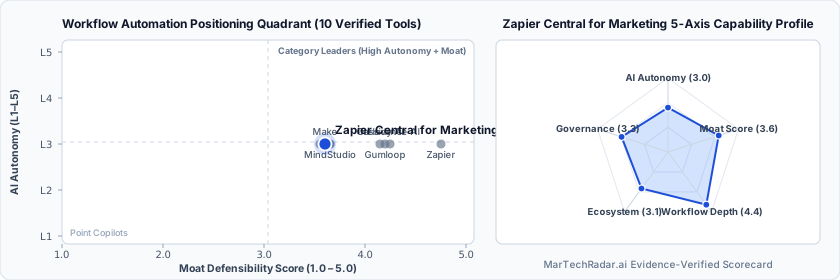
Zapier Central for Marketing is a Web SaaS tool for Workflow Automation (No-Code Marketing Workflow Automation) in Agent & Marketing Ops. Pricing: Custom / enterprise pricing. Best suited to B2B SaaS, DTC / eCommerce and Enterprise Brands. Editor ratings: AI autonomy L3 (conditional automation); moat score 3.6/5.0 (Proprietary moat). Fact-checked by Vasilia Xia on Oct 15, 2026.
Natural language AI agent workspace that turns multi-app marketing workflows into autonomous trigger-action executions across cloud applications.
Zapier Central for Marketing buyer fit verdict: when to choose vs. when to walk away
Choose Zapier Central for Marketing if (Best Fit)
- Target ICP & Stack Fit: You operate as B2B SaaS, DTC / eCommerce and Enterprise Brands requiring a Web SaaS deployment for Workflow Automation, with verified ecosystem connectivity for Notion.
- L3 Architecture & Defensibility: Defensibility stems from Zapier's extensive ecosystem of pre-built API connectors, pairing broad marketing tool interoperability with conversational agent orchestration.
- Commercial Model Fit: Your procurement budget aligns with Custom / enterprise pricing.
Walk away from Zapier Central for Marketing if (Deal-Breakers)
- Walk away if you require transparent self-serve monthly billing or your budget ceiling is under $1,000/mo (Zapier Central for Marketing requires sales-gated custom quoting).
- Walk away if your workflow cannot tolerate API rate limits and polling latency: Because the platform delegates downstream execution to third-party endpoints, high-velocity bulk updates risk exceeding third-party SaaS rate limits or experiencing synchronization delays.
- Walk away if schema drift and prompt degradation is a deal-breaker for your team: Unannounced upstream changes to spreadsheet layouts or custom CRM field schemas frequently cause agent reasoning errors or hallucinated field mappings.
Zapier Central for Marketing key facts & scorecard
| Pricing | Custom / enterprise pricing |
|---|---|
| Free plan | No / not disclosed |
| Delivery | Web SaaS |
| Audience | B2B SaaS, DTC / eCommerce, Enterprise Brands |
| AI autonomy level | L3 · Conditional automationEditor-verified |
| Moat tier & score | 3.6 / 5.0 · Proprietary moatEditor-verified |
| Funding | Venture-backed |
| Ecosystem integrations | Notion |
| Headquarters | United States |
| Founded | 2011 |
| Last verified |
Zapier Central for Marketing pros & cons: strengths vs. operational limitations
Pros: core strengths & capabilities
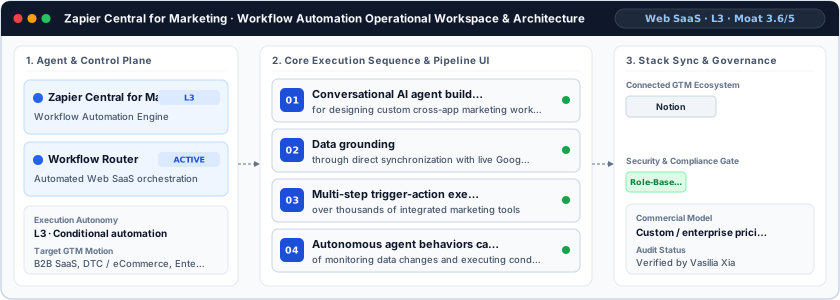
- Conversational AI agent builder: for designing custom cross-app marketing workflows
- Data grounding: through direct synchronization with live Google Sheets, Notion, and CRM tables
- Multi-step trigger-action execution chaining: over thousands of integrated marketing tools
- Autonomous agent behaviors capable: of monitoring data changes and executing conditional follow-ups
Cons: operational limitations & risks
- API Rate Limits and Polling Latency: Because the platform delegates downstream execution to third-party endpoints, high-velocity bulk updates risk exceeding third-party SaaS rate limits or experiencing synchronization delays.
- Schema Drift and Prompt Degradation: Unannounced upstream changes to spreadsheet layouts or custom CRM field schemas frequently cause agent reasoning errors or hallucinated field mappings.
- Complex Conditional Logic Boundaries: Unstructured conversational instructions struggle with intricate nested conditionals compared to deterministic visual flow builders, requiring precise prompt boundary constraints.
Zapier Central for Marketing TCO & deal-breaker stress test
Simulate 12-month stepped TCO, hidden cost multipliers, contract lock-in exposure, and stack failure modes using only facts verified by Vasilia Xia on .
Zapier Central for Marketing triggers high-severity friction under your 5-seat / $800/mo constraints. Benchmark the verified subtrack alternatives below before committing.
| Plan / Tier | Verified Rate | Scale Fit | Scope & Quota Notes |
|---|---|---|---|
| Enterprise / Custom | Custom quote | 15–50+ seats (Enterprise SLA) | Sales-negotiated annual contract for custom volume, SSO/RBAC governance, and dedicated SLA. |
- Moat Score
- 3.6 / 5.0
- AI Autonomy
- L3
- Free Tier / Trial
- None disclosed
Triggered audit signals & failure modes
- Opaque Enterprise Quoting vs. SMB/Mid-Market BudgetVerified Pricing Ledger
Zapier Central for Marketing does not disclose a public self-serve floor (Custom / enterprise pricing). Buyers with a $800/mo cap face high sales-qualification friction.
- Sales-Gated Contract TermsFact-checked by Vasilia Xia
Pricing is available on request through tailored enterprise sales quotes, with custom enterprise tiers structured around organizational scale, user seats, and workflow volume.
- Primary Operational Bottleneck: API Rate Limits and Polling LatencyAudit by Vasilia Xia
Because the platform delegates downstream execution to third-party endpoints, high-velocity bulk updates risk exceeding third-party SaaS rate limits or experiencing synchronization delays.
Hidden TCO Multipliers & Quota Gates
- API Rate Limits and Polling Latency: Because the platform delegates downstream execution to third-party endpoints, high-velocity bulk updates risk exceeding third-party SaaS rate limits or experiencing synchronization delays.
- Schema Drift and Prompt Degradation: Unannounced upstream changes to spreadsheet layouts or custom CRM field schemas frequently cause agent reasoning errors or hallucinated field mappings.
When to Walk Away & Negotiation Levers
- Walk away if you require transparent self-serve monthly billing or your budget ceiling is under $1,000/mo (Zapier Central for Marketing requires sales-gated custom quoting).
- Walk away if your workflow cannot tolerate API rate limits and polling latency: Because the platform delegates downstream execution to third-party endpoints, high-velocity bulk updates risk exceeding third-party SaaS rate limits or experiencing synchronization delays.
- Walk away if schema drift and prompt degradation is a deal-breaker for your team: Unannounced upstream changes to spreadsheet layouts or custom CRM field schemas frequently cause agent reasoning errors or hallucinated field mappings.
- Demand a 30- to 60-day paid pilot opt-out clause in the Zapier Central for Marketing order form before signing a 12-month enterprise commitment.
- Require a sandbox proof-of-concept testing API rate limits and polling latency against your live CRM/data schema before annual sign-off.
Ask a custom procurement or TCO stress-test question about Zapier Central for Marketing
Lower 5-seat floor (~$37/mo vs. Custom Quote) · Transparent self-serve entry without mandatory annual lock-in
Offers a free tier (Free plan · $0/mo · Enterprise plan) · Transparent self-serve entry without mandatory annual lock-in
Zapier Central for Marketing key entities, modules & ecosystem stack
Zapier Central for Marketing moat & subtrack positioning
Defensibility stems from Zapier's extensive ecosystem of pre-built API connectors, pairing broad marketing tool interoperability with conversational agent orchestration.
Editorial review
Fact-checked by Vasilia Xia (E-Commerce, Lifecycle & Retention Marketing Analyst) on .
Background
Marketing operations teams often spend disproportionate engineering resources assembling rigid automation pipelines across disparate growth software. Headquartered in the United States, Zapier Central for Marketing tackles this coordination overhead by translating natural language prompts into autonomous digital coworkers that execute across external software environments. Designed specifically for demand generation leaders and growth operations managers, the platform abstracts complex API integration logic into a conversational workspace. Within the no-code marketing automation category, it functions as an agentic operational layer that coordinates recurring cross-functional marketing actions without requiring manual trigger-action flow configuration.
How Zapier Central for Marketing works
Under the hood, the system couples large language model reasoning with Zapier's underlying integration fabric. Users configure purpose-built marketing bots by declaring natural language directives, attaching external data sources such as spreadsheets or CRM records, and granting permission to specific application actions. When incoming events or scheduled triggers fire, the system leverages contextual memory and tool-calling algorithms to determine the appropriate sequence of external API payloads. By observing structured inputs across web apps and validating output states before chaining the next task, the platform achieves Level 3 autonomy for routine marketing triage, prospect routing, and cross-channel campaign dispatch.
Limitations
Operational considerations and platform boundaries include:
- API Rate Limits and Polling Latency: Because the platform delegates downstream execution to third-party endpoints, high-velocity bulk updates risk exceeding third-party SaaS rate limits or experiencing synchronization delays.
- Schema Drift and Prompt Degradation: Unannounced upstream changes to spreadsheet layouts or custom CRM field schemas frequently cause agent reasoning errors or hallucinated field mappings.
- Complex Conditional Logic Boundaries: Unstructured conversational instructions struggle with intricate nested conditionals compared to deterministic visual flow builders, requiring precise prompt boundary constraints.
Zapier Central for Marketing pricing
Pricing is available on request through tailored enterprise sales quotes, with custom enterprise tiers structured around organizational scale, user seats, and workflow volume.
How Zapier Central for Marketing compares
Compared to direct category competitors like Surface Labs and Memoir, Zapier Central for Marketing functions as an alternative focused on specialized workflow execution. In contrast to Cassidy AI, which centers on internal enterprise knowledge synthesis, and Gumloop, which emphasizes visual node-based generative pipelines, Zapier Central prioritizes conversational delegation across its ecosystem. While Relevance AI delivers deeper multi-agent workforce orchestration for engineering-heavy setups, Zapier Central delivers faster time-to-value for non-technical marketing practitioners who need autonomous campaign execution without custom code. It is best suited for mid-market and enterprise marketing teams looking to automate manual data transfers and multi-tool campaign handoffs.
Frequently asked questions about Zapier Central for Marketing
How much does Zapier Central for Marketing cost and does it require a custom enterprise quote?
Published pricing summary for Zapier Central for Marketing: Custom / enterprise pricing. A permanent free plan is not disclosed for Zapier Central for Marketing. Pricing is available on request through tailored enterprise sales quotes, with custom enterprise tiers structured around organizational scale, user seats, and workflow volume.
How does Zapier Central for Marketing work and how autonomous is its AI architecture?
Natural language AI agent workspace that turns multi-app marketing workflows into autonomous trigger-action executions across cloud applications. Within Workflow Automation (No-Code Marketing Workflow Automation), MarTechRadar rates its execution architecture at L3 · Conditional automation with a verified Moat Score of 3.6 / 5.0 (Proprietary moat). Defensibility stems from Zapier's extensive ecosystem of pre-built API connectors, pairing broad marketing tool interoperability with conversational agent orchestration.
What are the main limitations of Zapier Central for Marketing and when should buyers walk away?
Based on our editorial technical audit, key operational considerations and boundaries for Zapier Central for Marketing include: (1) API Rate Limits and Polling Latency: Because the platform delegates downstream execution to third-party endpoints, high-velocity bulk updates risk exceeding third-party SaaS rate limits or experiencing synchronization delays. (2) Schema Drift and Prompt Degradation: Unannounced upstream changes to spreadsheet layouts or custom CRM field schemas frequently cause agent reasoning errors or hallucinated field mappings. (3) Complex Conditional Logic Boundaries: Unstructured conversational instructions struggle with intricate nested conditionals compared to deterministic visual flow builders, requiring precise prompt boundary constraints. Primary procurement walk-away rule: Walk away if you require transparent self-serve monthly billing or your budget ceiling is under $1,000/mo (Zapier Central for Marketing requires sales-gated custom quoting).
What integrations, compliance certifications, and contract terms apply to Zapier Central for Marketing?
Verified ecosystem and stack integrations include Notion. Key TCO multiplier to watch: API Rate Limits and Polling Latency (Because the platform delegates downstream execution to third-party endpoints, high-velocity bulk updates risk exceeding third-party SaaS rate limits or experiencing synchronization delays.) Before signing a contract, procurement teams should demand a 30- to 60-day paid pilot opt-out clause in the Zapier Central for Marketing order form before signing a 12-month enterprise commitment.
What are the best Zapier Central for Marketing alternatives and head-to-head competitors in 2026?
Top fact-checked alternatives to Zapier Central for Marketing in Workflow Automation (No-Code Marketing Workflow Automation) include Zapier (Free plan · $19.99–$69/mo), Memoir (Custom / enterprise pricing), MindStudio (Custom / enterprise pricing), Stack AI (Custom / enterprise pricing). Compared to direct category competitors like Surface Labs and Memoir, Zapier Central for Marketing functions as an alternative focused on specialized workflow execution.
Verified sources & evidence trail
- Official product domain: https://zapier.com/central
- Commercial pricing verification: Verified against official vendor pricing policy (Custom / enterprise pricing)
- Editorial audit sign-off: Fact-checked by Vasilia Xia on under the MarTechRadar Evidence-Ledger Protocol.