Memoir Review (2026): AI Marketing Agent Pricing, Limits & Alternatives
Bottom line
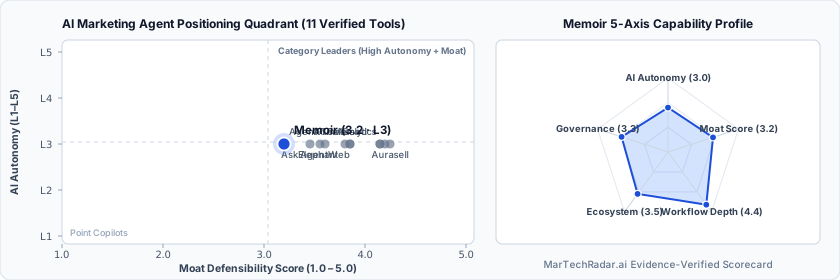
Memoir is a Web SaaS tool for AI Marketing Agent (Autonomous Marketing Agents & Digital Coworkers) in Agent & Marketing Ops. Pricing: Custom / enterprise pricing. Best suited to B2B SaaS and Marketing Agencies. Editor ratings: AI autonomy L3 (conditional automation); moat score 3.2/5.0 (Workflow-embedded (strong)). Fact-checked by Tim Fenolz on Oct 7, 2026.
Autonomous digital coworker capturing conversational context across enterprise communication channels to maintain unified institutional account memory.
Memoir buyer fit verdict: when to choose vs. when to walk away
Choose Memoir if (Best Fit)
- Target ICP & Stack Fit: You operate as B2B SaaS and Marketing Agencies requiring a Web SaaS deployment for AI Marketing Agent, with verified ecosystem connectivity for Slack, Google Workspace.
- L3 Architecture & Defensibility: Defensibility hinges on proprietary entity-resolution pipelines and temporal knowledge graphs that structure unstructured cross-platform interactions into queryable context, though risk of platform domain churn remains notable.
- Commercial Model Fit: Your procurement budget aligns with Custom / enterprise pricing.
Walk away from Memoir if (Deal-Breakers)
- Walk away if you require transparent self-serve monthly billing or your budget ceiling is under $1,000/mo (Memoir requires sales-gated custom quoting).
- Walk away if your workflow cannot tolerate third-party rate limits: High-volume Slack or Google Workspace message firehoses encounter API rate throttling, delaying near-real-time graph updates during peak activity windows.
- Walk away if entity disambiguation failures is a deal-breaker for your team: Informal references to internal product codenames or ambiguous stakeholder names across chat threads can generate corrupted graph linkages requiring manual deduplication.
Memoir key facts & scorecard
| Pricing | Custom / enterprise pricing |
|---|---|
| Free plan | No / not disclosed |
| Delivery | Web SaaS |
| Audience | B2B SaaS, Marketing Agencies |
| AI autonomy level | L3 · Conditional automationEditor-verified |
| Moat tier & score | 3.2 / 5.0 · Workflow-embedded (strong)Editor-verified |
| Funding | Venture-backed |
| Ecosystem integrations | Slack, Google Workspace |
| Headquarters | San Francisco, United States |
| Founded | 2024 |
| Last verified |
Memoir pros & cons: strengths vs. operational limitations
Pros: core strengths & capabilities
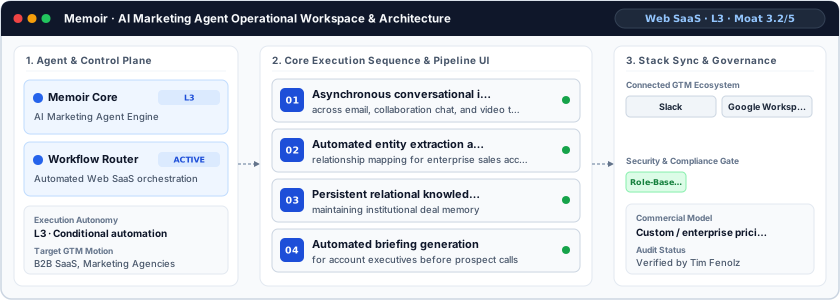
- Asynchronous conversational ingestion: across email, collaboration chat, and video transcripts
- Automated entity extraction and: relationship mapping for enterprise sales accounts
- Persistent relational knowledge graph: maintaining institutional deal memory
- Automated briefing generation: for account executives before prospect calls
Cons: operational limitations & risks
- Third-Party Rate Limits: High-volume Slack or Google Workspace message firehoses encounter API rate throttling, delaying near-real-time graph updates during peak activity windows.
- Entity Disambiguation Failures: Informal references to internal product codenames or ambiguous stakeholder names across chat threads can generate corrupted graph linkages requiring manual deduplication.
- Domain and Operational Continuity: Instability within web infrastructure and secondary domain listings indicates elevated operational churn risks that complicate long-term enterprise software evaluations.
Memoir TCO & deal-breaker stress test
Simulate 12-month stepped TCO, hidden cost multipliers, contract lock-in exposure, and stack failure modes using only facts verified by Tim Fenolz on · Capture SHA ff052b39.
Memoir triggers high-severity friction under your 5-seat / $800/mo constraints. Benchmark the verified subtrack alternatives below before committing.
| Plan / Tier | Verified Rate | Scale Fit | Scope & Quota Notes |
|---|---|---|---|
| Enterprise / Custom | Custom quote | 15–50+ seats (Enterprise SLA) | Sales-negotiated annual contract for custom volume, SSO/RBAC governance, and dedicated SLA. |
- Moat Score
- 3.2 / 5.0
- AI Autonomy
- L3
- Free Tier / Trial
- None disclosed
Triggered audit signals & failure modes
- Opaque Enterprise Quoting vs. SMB/Mid-Market BudgetVerified Pricing Ledger
Memoir does not disclose a public self-serve floor (Custom / enterprise pricing). Buyers with a $800/mo cap face high sales-qualification friction.
- Sales-Gated Contract TermsFact-checked by Tim Fenolz
Commercial procurement for Memoir follows a negotiated enterprise model, with production deployments priced via custom enterprise quotes determined by organizational scale, ingestion volume, and seat allocations.
- Primary Operational Bottleneck: Third-Party Rate LimitsAudit by Tim Fenolz
High-volume Slack or Google Workspace message firehoses encounter API rate throttling, delaying near-real-time graph updates during peak activity windows.
Hidden TCO Multipliers & Quota Gates
- Third-Party Rate Limits: High-volume Slack or Google Workspace message firehoses encounter API rate throttling, delaying near-real-time graph updates during peak activity windows.
- Entity Disambiguation Failures: Informal references to internal product codenames or ambiguous stakeholder names across chat threads can generate corrupted graph linkages requiring manual deduplication.
When to Walk Away & Negotiation Levers
- Walk away if you require transparent self-serve monthly billing or your budget ceiling is under $1,000/mo (Memoir requires sales-gated custom quoting).
- Walk away if your workflow cannot tolerate third-party rate limits: High-volume Slack or Google Workspace message firehoses encounter API rate throttling, delaying near-real-time graph updates during peak activity windows.
- Walk away if entity disambiguation failures is a deal-breaker for your team: Informal references to internal product codenames or ambiguous stakeholder names across chat threads can generate corrupted graph linkages requiring manual deduplication.
- Demand a 30- to 60-day paid pilot opt-out clause in the Memoir order form before signing a 12-month enterprise commitment.
- Require a sandbox proof-of-concept testing third-party rate limits against your live CRM/data schema before annual sign-off.
Ask a custom procurement or TCO stress-test question about Memoir
Lower 5-seat floor (~$100/mo vs. Custom Quote) · Transparent self-serve entry without mandatory annual lock-in
Lower 5-seat floor (~$149/mo vs. Custom Quote) · Transparent self-serve entry without mandatory annual lock-in
Memoir key entities, modules & ecosystem stack
Memoir moat & subtrack positioning
Defensibility hinges on proprietary entity-resolution pipelines and temporal knowledge graphs that structure unstructured cross-platform interactions into queryable context, though risk of platform domain churn remains notable.
Editorial review
Fact-checked by Tim Fenolz (Lead AdTech, Programmatic & Attribution Analyst) on .
Background
To mitigate context loss caused by sales representative turnover and cross-platform communication sprawl, Memoir captures institutional deal context directly from unstructured collaboration channels. Established in 2024 in San Francisco, the company targets revenue operations leads and commercial team managers who need autonomous retention of account histories. As customer-facing conversations scatter across messaging threads, video recordings, and email chains, the software functions as an autonomous digital coworker that synthesizes account interactions into persistent organizational memory.
How Memoir works
At the architectural layer, the system autonomy, Memoir utilizes asynchronous webhooks to continuously ingest multi-modal communications across Google Workspace, Slack, and video conferencing systems. Ingestion pipelines parse incoming dialogue text through entity-extraction models that classify enterprise stakeholders, customer objections, and project milestones. Extracted concepts populate a dynamic relational knowledge graph paired with vector retrieval indexes, allowing autonomous background agents to reconcile conversational updates without manual prompt engineering. The system periodically aggregates historical interactions into structured account dossiers ahead of scheduled meetings.
Limitations
Operational considerations and platform boundaries include:
- Third-Party Rate Limits: High-volume Slack or Google Workspace message firehoses encounter API rate throttling, delaying near-real-time graph updates during peak activity windows.
- Entity Disambiguation Failures: Informal references to internal product codenames or ambiguous stakeholder names across chat threads can generate corrupted graph linkages requiring manual deduplication.
- Domain and Operational Continuity: Instability within web infrastructure and secondary domain listings indicates elevated operational churn risks that complicate long-term enterprise software evaluations.
Memoir pricing
Commercial procurement for Memoir follows a negotiated enterprise model, with production deployments priced via custom enterprise quotes determined by organizational scale, ingestion volume, and seat allocations. Prospective buyers obtain licensing terms directly through enterprise sales engagements rather than open self-service tiers. Dedicated tenant onboarding, audit logging, and custom workspace connectors require tailored commercial agreements reflecting individual security and governance requirements.
How Memoir compares
Memoir competes against autonomous agent frameworks such as ai-marketing-claude, allGood, and AskElephant. While ai-marketing-claude prioritizes prompt-driven copy execution and AskElephant concentrates heavily on meeting transcript parsing, Memoir differentiates by embedding persistent relational memory across disparate collaboration stacks. Conversely, platforms like allGood provide direct operational campaign governance. Memoir best serves mid-market B2B revenue organizations requiring automated account-history consolidation without imposing manual CRM entry burdens on frontline sellers.
Frequently asked questions about Memoir
How much does Memoir cost and does it require a custom enterprise quote?
Published pricing summary for Memoir: Custom / enterprise pricing. A permanent free plan is not disclosed for Memoir. Commercial procurement for Memoir follows a negotiated enterprise model, with production deployments priced via custom enterprise quotes determined by organizational scale, ingestion volume, and seat allocations.
How does Memoir work and how autonomous is its AI architecture?
Autonomous digital coworker capturing conversational context across enterprise communication channels to maintain unified institutional account memory. Within AI Marketing Agent (Autonomous Marketing Agents & Digital Coworkers), MarTechRadar rates its execution architecture at L3 · Conditional automation with a verified Moat Score of 3.2 / 5.0 (Workflow-embedded (strong)). Defensibility hinges on proprietary entity-resolution pipelines and temporal knowledge graphs that structure unstructured cross-platform interactions into queryable context, though risk of platform domain churn remains notable.
What are the main limitations of Memoir and when should buyers walk away?
Based on our editorial technical audit, key operational considerations and boundaries for Memoir include: (1) Third-Party Rate Limits: High-volume Slack or Google Workspace message firehoses encounter API rate throttling, delaying near-real-time graph updates during peak activity windows. (2) Entity Disambiguation Failures: Informal references to internal product codenames or ambiguous stakeholder names across chat threads can generate corrupted graph linkages requiring manual deduplication. (3) Domain and Operational Continuity: Instability within web infrastructure and secondary domain listings indicates elevated operational churn risks that complicate long-term enterprise software evaluations. Primary procurement walk-away rule: Walk away if you require transparent self-serve monthly billing or your budget ceiling is under $1,000/mo (Memoir requires sales-gated custom quoting).
What integrations, compliance certifications, and contract terms apply to Memoir?
Verified ecosystem and stack integrations include Slack, Google Workspace. Key TCO multiplier to watch: Third-Party Rate Limits (High-volume Slack or Google Workspace message firehoses encounter API rate throttling, delaying near-real-time graph updates during peak activity windows.) Before signing a contract, procurement teams should demand a 30- to 60-day paid pilot opt-out clause in the Memoir order form before signing a 12-month enterprise commitment.
What are the best Memoir alternatives and head-to-head competitors in 2026?
Top fact-checked alternatives to Memoir in AI Marketing Agent (Autonomous Marketing Agents & Digital Coworkers) include AskElephant ($99–$119/seat/mo), Workato (Free plan · $100/mo · Enterprise plan), Hightouch (Custom / enterprise pricing), Monaco ($10,000 usage-based). Memoir competes against autonomous agent frameworks such as ai-marketing-claude, allGood, and AskElephant.
Verified sources & evidence trail
- Official product domain: https://memoir.ai
- Commercial pricing verification: Verified against official vendor pricing policy (Custom / enterprise pricing)
- Editorial audit sign-off: Fact-checked by Tim Fenolz on under the MarTechRadar Evidence-Ledger Protocol.