AgentRunner Review (2026): AI Marketing Agent Pricing, Limits & Alternatives
Bottom line
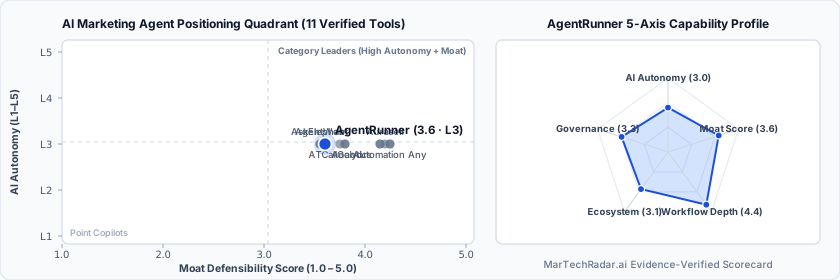
AgentRunner is a Web SaaS tool for AI Marketing Agent (Autonomous Marketing Agents & Digital Coworkers) in Agent & Marketing Ops. Pricing: Custom / enterprise pricing. Best suited to B2B SaaS. Editor ratings: AI autonomy L3 (conditional automation); moat score 3.6/5.0 (Proprietary moat). Fact-checked by Tim Fenolz on Oct 14, 2026.
Enterprise agentic orchestration platform coordinating autonomous digital coworkers and governed marketing task execution across distributed business systems.
AgentRunner buyer fit verdict: when to choose vs. when to walk away
Choose AgentRunner if (Best Fit)
- Target ICP & Stack Fit: You operate as B2B SaaS requiring a Web SaaS deployment for AI Marketing Agent.
- L3 Architecture & Defensibility: Domain-tuned workflow governance engines, persistent state tracking across multi-step execution loops, and structured validation checkpoints isolating enterprise software from unintended automation deviations.
- Commercial Model Fit: Your procurement budget aligns with Custom / enterprise pricing.
Walk away from AgentRunner if (Deal-Breakers)
- Walk away if you require transparent self-serve monthly billing or your budget ceiling is under $1,000/mo (AgentRunner requires sales-gated custom quoting).
- Walk away if your workflow cannot tolerate API rate limits: High-velocity batch execution risks triggering aggressive rate-limiting bottlenecks across third-party software endpoints lacking enterprise concurrency allowances.
- Walk away if schema drift vulnerability is a deal-breaker for your team: Silent schema modifications in connected marketing hubs cause worker failures unless human administrators actively reconfigure data contracts.
AgentRunner key facts & scorecard
| Pricing | Custom / enterprise pricing |
|---|---|
| Free plan | No / not disclosed |
| Delivery | Web SaaS |
| Audience | B2B SaaS |
| AI autonomy level | L3 · Conditional automationEditor-verified |
| Moat tier & score | 3.6 / 5.0 · Proprietary moatEditor-verified |
| Funding | Pre-seed |
| Governance & docs | Trust & Security ↗ · System Status ↗ · Privacy ↗ |
| Headquarters | London |
| Founded | 2023 |
| Last verified |
AgentRunner pros & cons: strengths vs. operational limitations
Pros: core strengths & capabilities
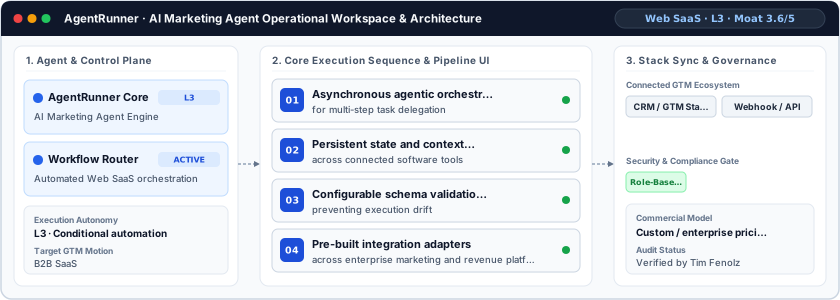
- Asynchronous agentic orchestration engine: for multi-step task delegation
- Persistent state and context memory buffers: across connected software tools
- Configurable schema validation checkpoints: preventing execution drift
- Pre-built integration adapters: across enterprise marketing and revenue platforms
Cons: operational limitations & risks
- API Rate Limits: High-velocity batch execution risks triggering aggressive rate-limiting bottlenecks across third-party software endpoints lacking enterprise concurrency allowances.
- Schema Drift Vulnerability: Silent schema modifications in connected marketing hubs cause worker failures unless human administrators actively reconfigure data contracts.
- Context Window Degradation: Extensive multi-turn execution cycles risk state loss and degraded task fidelity when memory buffers exceed optimal token retention thresholds.
AgentRunner TCO & deal-breaker stress test
Simulate 12-month stepped TCO, hidden cost multipliers, contract lock-in exposure, and stack failure modes using only facts verified by Tim Fenolz on · Capture SHA 791047b3.
AgentRunner triggers high-severity friction under your 5-seat / $800/mo constraints. Benchmark the verified subtrack alternatives below before committing.
| Plan / Tier | Verified Rate | Scale Fit | Scope & Quota Notes |
|---|---|---|---|
| Enterprise / Custom | Custom quote | 15–50+ seats (Enterprise SLA) | Sales-negotiated annual contract for custom volume, SSO/RBAC governance, and dedicated SLA. |
- Moat Score
- 3.6 / 5.0
- AI Autonomy
- L3
- Free Tier / Trial
- None disclosed
Triggered audit signals & failure modes
- Opaque Enterprise Quoting vs. SMB/Mid-Market BudgetVerified Pricing Ledger
AgentRunner does not disclose a public self-serve floor (Custom / enterprise pricing). Buyers with a $800/mo cap face high sales-qualification friction.
- Sales-Gated Contract TermsFact-checked by Tim Fenolz
Commercial pricing is available on request through tailored enterprise sales quotes based on organizational scale and seats.
- Primary Operational Bottleneck: API Rate LimitsAudit by Tim Fenolz
High-velocity batch execution risks triggering aggressive rate-limiting bottlenecks across third-party software endpoints lacking enterprise concurrency allowances.
Hidden TCO Multipliers & Quota Gates
- Credit & Usage Burn Multiplier: Automated workflows consume metered credits/usage quotas; multi-step enrichment, voice minutes, or high-frequency agent runs can trigger mid-cycle top-up packs.
- API Rate Limits: High-velocity batch execution risks triggering aggressive rate-limiting bottlenecks across third-party software endpoints lacking enterprise concurrency allowances.
- Schema Drift Vulnerability: Silent schema modifications in connected marketing hubs cause worker failures unless human administrators actively reconfigure data contracts.
When to Walk Away & Negotiation Levers
- Walk away if you require transparent self-serve monthly billing or your budget ceiling is under $1,000/mo (AgentRunner requires sales-gated custom quoting).
- Walk away if your workflow cannot tolerate API rate limits: High-velocity batch execution risks triggering aggressive rate-limiting bottlenecks across third-party software endpoints lacking enterprise concurrency allowances.
- Walk away if schema drift vulnerability is a deal-breaker for your team: Silent schema modifications in connected marketing hubs cause worker failures unless human administrators actively reconfigure data contracts.
- Demand a 30- to 60-day paid pilot opt-out clause in the AgentRunner order form before signing a 12-month enterprise commitment.
- Require a sandbox proof-of-concept testing API rate limits against your live CRM/data schema before annual sign-off.
Ask a custom procurement or TCO stress-test question about AgentRunner
Lower 5-seat floor (~$25/mo vs. Custom Quote) · Transparent self-serve entry without mandatory annual lock-in
Lower 5-seat floor (~$100/mo vs. Custom Quote) · Transparent self-serve entry without mandatory annual lock-in
AgentRunner moat & subtrack positioning
Domain-tuned workflow governance engines, persistent state tracking across multi-step execution loops, and structured validation checkpoints isolating enterprise software from unintended automation deviations.
Editorial review
Fact-checked by Tim Fenolz (Lead AdTech, Programmatic & Attribution Analyst) on .
Background
Architectural fragmentation in modern growth stacks demands unified operational execution over disconnected automation scripts. Headquartered in London and founded in 2023, AgentRunner engineers autonomous marketing agents and digital coworkers designed to systematically orchestrate multi-step tasks across enterprise software. Directed primarily at technical marketing directors and revenue operations leads, the platform shifts tactical execution from manual human intervention to supervised programmatic workers that maintain operational context across complex operational pipelines.
How AgentRunner works
Under the hood, AgentRunner operates as a Level 3 autonomous execution engine utilizing distributed task decomposition and persistent memory buffers. Inbound data triggers and webhooks pass through an ingestion gateway that parses contextual parameters before routing them to specialized functional agent nodes. These agents query internal context stores, generate deterministic API payloads, and execute write operations across connected martech systems. The engine enforces automated error recovery, schema validation checkpoints, and human-in-the-loop escalation paths when downstream endpoint payloads diverge from established execution parameters.
Limitations
Operational considerations and platform boundaries include:
- API Rate Limits: High-velocity batch execution risks triggering aggressive rate-limiting bottlenecks across third-party software endpoints lacking enterprise concurrency allowances.
- Schema Drift Vulnerability: Silent schema modifications in connected marketing hubs cause worker failures unless human administrators actively reconfigure data contracts.
- Context Window Degradation: Extensive multi-turn execution cycles risk state loss and degraded task fidelity when memory buffers exceed optimal token retention thresholds.
AgentRunner pricing
Commercial pricing is available on request through tailored enterprise sales quotes based on organizational scale and seats. The procurement structure centers on platform access tiers, dedicated agent execution throughput, and custom integration governance rather than public self-serve subscriptions. Prospective buyers must engage sales representatives to scope implementation parameters, custom security requirements, and dedicated API consumption volumes before contract finalization.
How AgentRunner compares
In the AI Marketing Agent landscape, in contrast to prompt-centric generative assistants like ai-marketing-claude or conversation-focused co-pilots such as AskElephant and allGood, AgentRunner prioritizes deterministic backend execution over conversational text synthesis. While point solutions focus on isolated copy drafting, AgentRunner manages persistent multi-system operations across the entire tech stack. The platform serves mid-market to enterprise revenue organizations requiring structured, audited operational workflows rather than ad-hoc chat-based content generation.
Frequently asked questions about AgentRunner
How much does AgentRunner cost and does it require a custom enterprise quote?
Published pricing summary for AgentRunner: Custom / enterprise pricing. A permanent free plan is not disclosed for AgentRunner. Commercial pricing is available on request through tailored enterprise sales quotes based on organizational scale and seats. The procurement structure centers on platform access tiers, dedicated agent execution throughput, and custom integration governance rather than public self-serve subscriptions.
How does AgentRunner work and how autonomous is its AI architecture?
Enterprise agentic orchestration platform coordinating autonomous digital coworkers and governed marketing task execution across distributed business systems. Within AI Marketing Agent (Autonomous Marketing Agents & Digital Coworkers), MarTechRadar rates its execution architecture at L3 · Conditional automation with a verified Moat Score of 3.6 / 5.0 (Proprietary moat). Domain-tuned workflow governance engines, persistent state tracking across multi-step execution loops, and structured validation checkpoints isolating enterprise software from unintended automation deviations.
What are the main limitations of AgentRunner and when should buyers walk away?
Based on our editorial technical audit, key operational considerations and boundaries for AgentRunner include: (1) API Rate Limits: High-velocity batch execution risks triggering aggressive rate-limiting bottlenecks across third-party software endpoints lacking enterprise concurrency allowances. (2) Schema Drift Vulnerability: Silent schema modifications in connected marketing hubs cause worker failures unless human administrators actively reconfigure data contracts. (3) Context Window Degradation: Extensive multi-turn execution cycles risk state loss and degraded task fidelity when memory buffers exceed optimal token retention thresholds. Primary procurement walk-away rule: Walk away if you require transparent self-serve monthly billing or your budget ceiling is under $1,000/mo (AgentRunner requires sales-gated custom quoting).
What integrations, compliance certifications, and contract terms apply to AgentRunner?
First-party governance and developer endpoints verified on domain include: Trust/Security (https://trust.capably.ai), Status (https://status.capably.ai). Key TCO multiplier to watch: Credit & Usage Burn Multiplier (Automated workflows consume metered credits/usage quotas; multi-step enrichment, voice minutes, or high-frequency agent runs can trigger mid-cycle top-up packs.) Before signing a contract, procurement teams should demand a 30- to 60-day paid pilot opt-out clause in the AgentRunner order form before signing a 12-month enterprise commitment.
What are the best AgentRunner alternatives and head-to-head competitors in 2026?
Top fact-checked alternatives to AgentRunner in AI Marketing Agent (Autonomous Marketing Agents & Digital Coworkers) include Roadway (Custom / enterprise pricing), PureblueAI (Custom / enterprise pricing), UiPath Automation Cloud (From $25/mo), Piper (Custom / enterprise pricing). In the AI Marketing Agent landscape, in contrast to prompt-centric generative assistants like ai-marketing-claude or conversation-focused co-pilots such as AskElephant and allGood, AgentRunner prioritizes deterministic backend execution over conversational text synthesis.
Verified sources & evidence trail
- Official product domain: https://agentrunner.ai
- Commercial pricing verification: Verified against official vendor pricing policy (Custom / enterprise pricing)
- Verified corporate entity profiles (
sameAs): LinkedIn Company Profile - First-party governance & documentation links: Trust & Security · System Status · Privacy
- Editorial audit sign-off: Fact-checked by Tim Fenolz on under the MarTechRadar Evidence-Ledger Protocol.