AgentWeb Review (2026): AI Marketing Agent Pricing, Limits & Alternatives
Bottom line
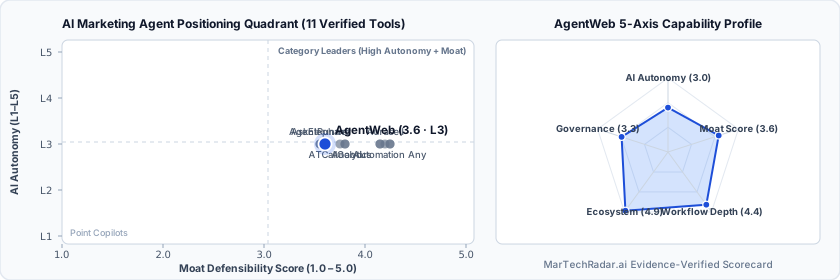
AgentWeb is a Web SaaS tool for AI Marketing Agent (Autonomous Marketing Agents & Digital Coworkers) in Agent & Marketing Ops. Pricing: Free plan · $0/mo · Enterprise plan. Best suited to Growth Marketing Teams and Digital Marketing Leaders. Editor ratings: AI autonomy L3 (conditional automation); moat score 3.6/5.0 (Proprietary moat). Fact-checked by Tim Fenolz on Oct 14, 2026.
AgentWeb deploys autonomous AI marketing operators like Emma to orchestrate cross-functional campaign workflows and execution tasks without human.
AgentWeb buyer fit verdict: when to choose vs. when to walk away
Choose AgentWeb if (Best Fit)
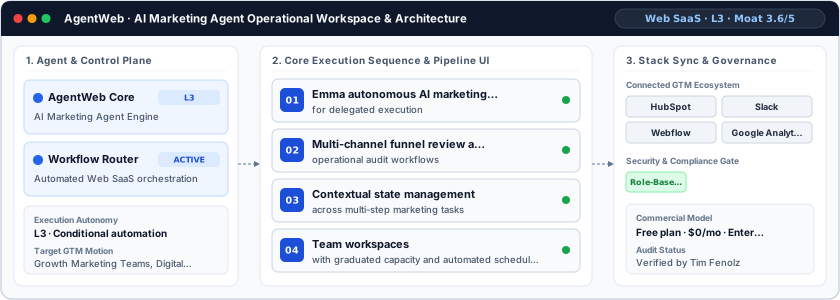
- Target ICP & Stack Fit: You operate as Growth Marketing Teams and Digital Marketing Leaders requiring a Web SaaS deployment for AI Marketing Agent, with verified ecosystem connectivity for HubSpot, Slack, Webflow, Google Analytics 4 (GA4).
- L3 Architecture & Defensibility: AgentWeb's defensive moat relies on its contextual memory persistence and pre-built operational playbooks for multi-step marketing execution, though baseline LLM wrapper dependency remains an architectural vulnerability.
- Commercial Model Fit: Your procurement budget aligns with Free plan · $0/mo · Enterprise plan and want a self-serve free tier for zero-cost initial validation.
Walk away from AgentWeb if (Deal-Breakers)
- Walk away if your workflow requires uncapped enterprise volume on the Free plan · $0/mo · Enterprise plan entry plan without upgrading tiers.
- Walk away if your workflow cannot tolerate context window drift: Extended multi-step marketing campaigns experience state dilution across chained prompts, occasionally requiring manual prompt resets when handling complex dependencies.
- Walk away if third-party API rate throttling is a deal-breaker for your team: Synchronous task runs against connected ad networks and CRM endpoints face execution latency when provider rate limits trigger backoff delays.
AgentWeb key facts & scorecard
| Pricing | Free plan · $0/mo · Enterprise planVendor pricing page |
|---|---|
| Free plan | Yes |
| Delivery | Web SaaS |
| Audience | Growth Marketing Teams, Digital Marketing Leaders |
| AI autonomy level | L3 · Conditional automationEditor-verified |
| Moat tier & score | 3.6 / 5.0 · Proprietary moatEditor-verified |
| Funding | Pre-seed |
| Founders | Fangfang Tan, Harsha Vankayalapati, Matthew Wilmer, Rui Wang |
| Company size | 2-10 employees |
| Ecosystem integrations | HubSpot, Slack, Webflow, Google Analytics 4 (GA4) |
| Governance & docs | Terms ↗ · Privacy ↗ |
| Headquarters | San Francisco |
| Founded | 2025 |
| Last verified |
AgentWeb pros & cons: strengths vs. operational limitations
Pros: core strengths & capabilities
- Emma autonomous AI marketing operator: for delegated execution
- Multi-channel funnel review and: operational audit workflows
- Contextual state management: across multi-step marketing tasks
- Team workspaces: with graduated capacity and automated scheduling
Cons: operational limitations & risks
- Context Window Drift: Extended multi-step marketing campaigns experience state dilution across chained prompts, occasionally requiring manual prompt resets when handling complex dependencies.
- Third-Party API Rate Throttling: Synchronous task runs against connected ad networks and CRM endpoints face execution latency when provider rate limits trigger backoff delays.
- Schema Drift Vulnerability: Unannounced interface adjustments or data payload modifications in downstream SaaS tools cause task pipeline failure requiring manual workflow remapping.
AgentWeb TCO & deal-breaker stress test
Simulate 12-month stepped TCO, hidden cost multipliers, contract lock-in exposure, and stack failure modes using only facts verified by Tim Fenolz on · Capture SHA c391c0c7.
AgentWeb is viable for 5 seats, but requires commercial or technical verification on the flagged items below.
| Plan / Tier | Verified Rate | Scale Fit | Scope & Quota Notes |
|---|---|---|---|
| Free / Sandbox | $0 | 1–2 seats (Evaluation) | Entry free tier with capped usage or feature quotas for initial workflow testing. |
| Free | $199/mo | 1–2 seats | 20x higher usage limits than Free |
| Pro | $499/mo | 5 seats | 5x higher usage limits than Starter |
| Enterprise / Custom | Custom quote | 15–50+ seats (Enterprise SLA) | Sales-negotiated annual contract for custom volume, SSO/RBAC governance, and dedicated SLA. |
- Moat Score
- 3.6 / 5.0
- AI Autonomy
- L3
- Free Tier / Trial
- Free plan
Triggered audit signals & failure modes
- Opaque Enterprise Quoting vs. SMB/Mid-Market BudgetVerified Pricing Ledger
AgentWeb does not disclose a public self-serve floor (Free plan · $0/mo · Enterprise plan). Buyers with a $800/mo cap face high sales-qualification friction.
- Published Self-Serve Entry FloorVerified Pricing Ledger
AgentWeb publishes a transparent entry point (Free plan · $0/mo · Enterprise plan) with a free tier for initial validation before committing.
- Tier Fit for 5-Seat Scale: Free ($199/mo)Verified Tier Schedule
20x higher usage limits than Free
- Primary Operational Bottleneck: Context Window DriftAudit by Tim Fenolz
Extended multi-step marketing campaigns experience state dilution across chained prompts, occasionally requiring manual prompt resets when handling complex dependencies.
Hidden TCO Multipliers & Quota Gates
- Credit & Usage Burn Multiplier: Automated workflows consume metered credits/usage quotas; multi-step enrichment, voice minutes, or high-frequency agent runs can trigger mid-cycle top-up packs.
- Context Window Drift: Extended multi-step marketing campaigns experience state dilution across chained prompts, occasionally requiring manual prompt resets when handling complex dependencies.
- Third-Party API Rate Throttling: Synchronous task runs against connected ad networks and CRM endpoints face execution latency when provider rate limits trigger backoff delays.
When to Walk Away & Negotiation Levers
- Walk away if your workflow requires uncapped enterprise volume on the Free plan · $0/mo · Enterprise plan entry plan without upgrading tiers.
- Walk away if your workflow cannot tolerate context window drift: Extended multi-step marketing campaigns experience state dilution across chained prompts, occasionally requiring manual prompt resets when handling complex dependencies.
- Walk away if third-party API rate throttling is a deal-breaker for your team: Synchronous task runs against connected ad networks and CRM endpoints face execution latency when provider rate limits trigger backoff delays.
- Validate exact quota thresholds (seats, credits, or API calls) included in AgentWeb's Free plan · $0/mo · Enterprise plan tier before converting from monthly to annual billing.
- Require a sandbox proof-of-concept testing context window drift against your live CRM/data schema before annual sign-off.
Ask a custom procurement or TCO stress-test question about AgentWeb
Lower 5-seat floor (~$100/mo vs. Custom Quote)
Lower 5-seat floor (~$149/mo vs. Custom Quote)
AgentWeb key entities, modules & ecosystem stack
AgentWeb moat & subtrack positioning
AgentWeb's defensive moat relies on its contextual memory persistence and pre-built operational playbooks for multi-step marketing execution, though baseline LLM wrapper dependency remains an architectural vulnerability.
Editorial review
Fact-checked by Tim Fenolz (Lead AdTech, Programmatic & Attribution Analyst) on .
Background
Modern growth organizations face operational bottlenecks when coordinating cross-channel marketing campaigns manually across disparate tools. AgentWeb, founded in 2025 and headquartered in San Francisco, addresses this coordination friction by deploying Emma, an autonomous digital marketing operator. Built specifically for marketing directors and growth practitioners, the platform automates end-to-end task execution rather than functioning as a passive drafting tool.
How AgentWeb works
Under the hood, AgentWeb operates as an L3 autonomous agent system using a task orchestration layer that breaks complex directives into discrete, stateful subtasks. Inbound funnel signals and operator prompts trigger event-driven workflows that reference persistent context memory buffers. The system manages deterministic execution loops, dynamic prompt routing, and tool calling via API integrations, evaluating real-time operational feedback to adjust actions without ongoing human intervention, alongside native workflow integrations for HubSpot, Slack, Webflow, and Google Analytics.
Limitations
Operational considerations and platform boundaries include:
- Context Window Drift: Extended multi-step marketing campaigns experience state dilution across chained prompts, occasionally requiring manual prompt resets when handling complex dependencies.
- Third-Party API Rate Throttling: Synchronous task runs against connected ad networks and CRM endpoints face execution latency when provider rate limits trigger backoff delays.
- Schema Drift Vulnerability: Unannounced interface adjustments or data payload modifications in downstream SaaS tools cause task pipeline failure requiring manual workflow remapping.
AgentWeb pricing
Commercial access is organized across self-serve capacity tiers and custom contracts. The entry tier starts at $0 per month, offering base capacity to test operational delegation. Scaling deployments require custom enterprise plans tailored to organizational concurrency, dedicated workspace requirements, elevated execution volume, and specialized onboarding assistance.
How AgentWeb compares
In the AI Marketing Agent landscape, agentWeb competes against agentic marketing solutions including ai-marketing-claude, allGood, and AskElephant. While ai-marketing-claude centers on conversational reasoning and AskElephant focuses on conversational retrieval, AgentWeb emphasizes autonomous operational execution and workflow offloading. The system fits mid-market and enterprise marketing teams needing persistent digital coworkers to handle routine execution workflows without adding operational overhead. Enterprise procurement teams evaluating deployment readiness should assess API webhook throughput, role-based access governance, and bilateral data synchronization latency against existing marketing technology infrastructure before committing to multi-year production rollouts.
Direct competitors & market radar
Top algorithmic competitors based on category positioning, capability overlap, and ICP alignment.
Frequently asked questions about AgentWeb
How much does AgentWeb cost and what pricing tiers are available?
Published pricing summary for AgentWeb: Free plan · $0/mo · Enterprise plan. AgentWeb includes a free tier or sandbox entry point. Verified tier schedule: Free / Sandbox ($0 for 1–2 seats (Evaluation)); Free ($199/mo for 1–2 seats); Pro ($499/mo for 5 seats); Enterprise / Custom (Custom quote for 15–50+ seats (Enterprise SLA)). Commercial access is organized across self-serve capacity tiers and custom contracts. The entry tier starts at $0 per month, offering base capacity to test operational delegation.
How does AgentWeb work and how autonomous is its AI architecture?
AgentWeb deploys autonomous AI marketing operators like Emma to orchestrate cross-functional campaign workflows and execution tasks without human. Within AI Marketing Agent (Autonomous Marketing Agents & Digital Coworkers), MarTechRadar rates its execution architecture at L3 · Conditional automation with a verified Moat Score of 3.6 / 5.0 (Proprietary moat). AgentWeb's defensive moat relies on its contextual memory persistence and pre-built operational playbooks for multi-step marketing execution, though baseline LLM wrapper dependency remains an architectural vulnerability. Corporate profile: Founded by Fangfang Tan, Harsha Vankayalapati, Matthew Wilmer, Rui Wang, operating at 2-10 employees scale.
What are the main limitations of AgentWeb and when should buyers walk away?
Based on our editorial technical audit, key operational considerations and boundaries for AgentWeb include: (1) Context Window Drift: Extended multi-step marketing campaigns experience state dilution across chained prompts, occasionally requiring manual prompt resets when handling complex dependencies. (2) Third-Party API Rate Throttling: Synchronous task runs against connected ad networks and CRM endpoints face execution latency when provider rate limits trigger backoff delays. (3) Schema Drift Vulnerability: Unannounced interface adjustments or data payload modifications in downstream SaaS tools cause task pipeline failure requiring manual workflow remapping. Primary procurement walk-away rule: Walk away if your workflow requires uncapped enterprise volume on the Free plan · $0/mo · Enterprise plan entry plan without upgrading tiers.
What integrations, compliance certifications, and contract terms apply to AgentWeb?
Verified ecosystem and stack integrations include HubSpot, Slack, Webflow, Google Analytics 4 (GA4). Key TCO multiplier to watch: Credit & Usage Burn Multiplier (Automated workflows consume metered credits/usage quotas; multi-step enrichment, voice minutes, or high-frequency agent runs can trigger mid-cycle top-up packs.) Before signing a contract, procurement teams should validate exact quota thresholds (seats, credits, or API calls) included in AgentWeb's Free plan · $0/mo · Enterprise plan tier before converting from monthly to annual billing.
What are the best AgentWeb alternatives and head-to-head competitors in 2026?
Top fact-checked alternatives to AgentWeb in AI Marketing Agent (Autonomous Marketing Agents & Digital Coworkers) include ATC Analytics (From $100/mo), LemonLime (From $999/mo), Menteo (From $149/mo), Zero ($60–$77/seat/mo). In the AI Marketing Agent landscape, agentWeb competes against agentic marketing solutions including ai-marketing-claude, allGood, and AskElephant.
Verified sources & evidence trail
- Official product domain: https://www.agentweb.pro/
- Commercial pricing verification: https://www.hireemma.ai/pricing
- Verified corporate entity profiles (
sameAs): LinkedIn Company Profile · Crunchbase Entity Record - First-party governance & documentation links: Terms · Privacy
- Editorial audit sign-off: Fact-checked by Tim Fenolz on under the MarTechRadar Evidence-Ledger Protocol.