AskElephant Review (2026): AI Marketing Agent Pricing, Limits & Alternatives
Bottom line
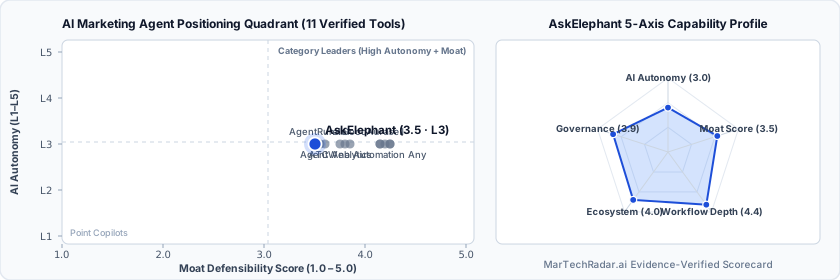
AskElephant is a Web SaaS tool for AI Marketing Agent (Autonomous Marketing Agents & Digital Coworkers) in Agent & Marketing Ops. Pricing: $99–$119/seat/mo. Best suited to GTM Operations Teams, Enterprise Marketing Executives and Automated Ops Teams. Editor ratings: AI autonomy L3 (conditional automation); moat score 3.5/5.0 (Proprietary moat). Fact-checked by Sarah Per on Oct 10, 2026.
Autonomous revenue operations agent that automates CRM data hygiene, cross-functional customer context handoffs, call coaching, and early churn risk.
AskElephant buyer fit verdict: when to choose vs. when to walk away
Choose AskElephant if (Best Fit)
- Target ICP & Stack Fit: You operate as GTM Operations Teams, Enterprise Marketing Executives and Automated Ops Teams requiring a Web SaaS deployment for AI Marketing Agent, with verified ecosystem connectivity for Salesforce, HubSpot.
- L3 Architecture & Defensibility: AskElephant relies on deep bi-directional synchronization with primary CRM databases and automated conversational extraction. Its primary defensive posture stems from contextual multi-turn conversation parsing that updates complex CRM schemas without human intervention, reinforced by its operational integration into the Fullcast revenue execution platform.
- Commercial Model Fit: Your procurement budget aligns with $99–$119/seat/mo.
Walk away from AskElephant if (Deal-Breakers)
- Walk away if your workflow requires uncapped enterprise volume on the $99–$119/seat/mo entry plan without upgrading tiers.
- Walk away if your workflow cannot tolerate custom object schema latency: Highly customized enterprise CRM schemas require continuous mapping maintenance when custom validation rules or complex relational lookups reject automated agent write-backs.
- Walk away if context window drift is a deal-breaker for your team: Extended, multi-stakeholder enterprise sales cycles with scattered touchpoints can introduce hallucinated context during automated sales-to-CS handoff summarization.
AskElephant key facts & scorecard
| Pricing | $99–$119/seat/moVendor pricing page |
|---|---|
| Free plan | No / not disclosed |
| Delivery | Web SaaS |
| Audience | GTM Operations Teams, Enterprise Marketing Executives, Automated Ops Teams |
| AI autonomy level | L3 · Conditional automationEditor-verified |
| Moat tier & score | 3.5 / 5.0 · Proprietary moatEditor-verified |
| Funding | AcquiredAcquired by FullCast |
| Total funding | $13.7MBacked by SaaS Ventures, Jump Capital, High Alpha |
| Founders | Kaden Wilkinson, Woody Klemetson |
| Company size | 11-50 employees |
| Ecosystem integrations | Salesforce, HubSpot |
| Governance & docs | Trust & Security ↗ · Terms ↗ · Privacy ↗ |
| Headquarters | Lehi, Utah |
| Founded | 2023 |
| Last verified |
AskElephant pros & cons: strengths vs. operational limitations
Pros: core strengths & capabilities
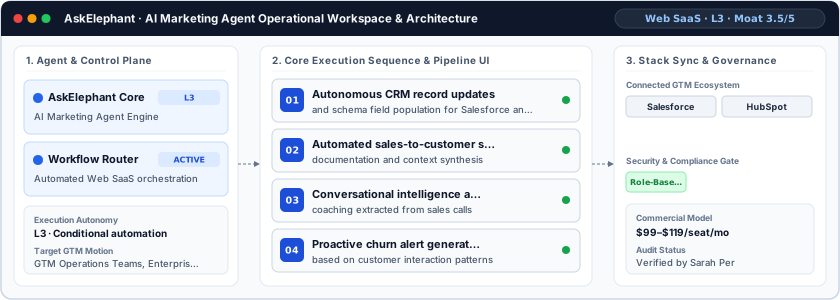
- Autonomous CRM record updates: and schema field population for Salesforce and HubSpot
- Automated sales-to-customer success handoff: documentation and context synthesis
- Conversational intelligence and rep: coaching extracted from sales calls
- Proactive churn alert generation: based on customer interaction patterns
Cons: operational limitations & risks
- Custom Object Schema Latency: Highly customized enterprise CRM schemas require continuous mapping maintenance when custom validation rules or complex relational lookups reject automated agent write-backs.
- Context Window Drift: Extended, multi-stakeholder enterprise sales cycles with scattered touchpoints can introduce hallucinated context during automated sales-to-CS handoff summarization.
- API Rate Limit Constraints: High-volume transactional call ingestion risks throttling on standard CRM REST endpoints during peak end-of-quarter operational bursts.
AskElephant TCO & deal-breaker stress test
Simulate 12-month stepped TCO, hidden cost multipliers, contract lock-in exposure, and stack failure modes using only facts verified by Sarah Per on · Capture SHA 2c2959f5.
AskElephant aligns with your 5-seat / $800/mo profile. Review the walk-away triggers and contract levers below before deployment.
| Plan / Tier | Verified Rate | Scale Fit | Scope & Quota Notes |
|---|---|---|---|
| Entry / Starter | $99/seat/mo | 1–2 seats | How much does AskElephant cost? |
| Growth / Professional | $119/seat/mo | 5 seats | What is included in AskElephant pricing? |
- Moat Score
- 3.5 / 5.0
- AI Autonomy
- L3
- Free Tier / Trial
- None disclosed
Triggered audit signals & failure modes
- Published Self-Serve Entry FloorVerified Pricing Ledger
AskElephant publishes a transparent entry point ($99–$119/seat/mo) for initial validation before committing.
- Linear Per-Seat Scaling (5 Seats × $99/seat/mo)Commercial Model Audit
Base license scales linearly with operator headcount ($495/mo for 5 seats on Entry / Starter).
- Primary Operational Bottleneck: Custom Object Schema LatencyAudit by Sarah Per
Highly customized enterprise CRM schemas require continuous mapping maintenance when custom validation rules or complex relational lookups reject automated agent write-backs.
Hidden TCO Multipliers & Quota Gates
- Per-Seat Linear Scaling: AskElephant prices licenses on a per-user/seat basis ($99–$119/seat/mo); expanding from 2 to 15+ operators multiplies base recurring spend linearly.
- Annual Billing Headline vs. Monthly Premium: Headline entry rates reflect annual billing commitments (Save 20%); month-to-month flexibility carries a higher effective monthly rate or requires annual prepayment.
- Enterprise Governance & Add-On Gating: Advanced capabilities such as Single Sign-On (SSO), custom role permissions, or specialized analytics modules are gated behind upper tiers or paid add-ons.
When to Walk Away & Negotiation Levers
- Walk away if your workflow requires uncapped enterprise volume on the $99–$119/seat/mo entry plan without upgrading tiers.
- Walk away if your workflow cannot tolerate custom object schema latency: Highly customized enterprise CRM schemas require continuous mapping maintenance when custom validation rules or complex relational lookups reject automated agent write-backs.
- Walk away if context window drift is a deal-breaker for your team: Extended, multi-stakeholder enterprise sales cycles with scattered touchpoints can introduce hallucinated context during automated sales-to-CS handoff summarization.
- Validate exact quota thresholds (seats, credits, or API calls) included in AskElephant's $99–$119/seat/mo tier before converting from monthly to annual billing.
- Require a sandbox proof-of-concept testing custom object schema latency against your live CRM/data schema before annual sign-off.
Ask a custom procurement or TCO stress-test question about AskElephant
Lower 5-seat floor (~$100/mo vs. $495 / mo)
Offers a free tier (Free plan · $0/mo · Enterprise plan)
AskElephant key entities, modules & ecosystem stack
AskElephant moat & subtrack positioning
AskElephant relies on deep bi-directional synchronization with primary CRM databases and automated conversational extraction. Its primary defensive posture stems from contextual multi-turn conversation parsing that updates complex CRM schemas without human intervention, reinforced by its operational integration into the Fullcast revenue execution platform.
Editorial review
Fact-checked by Sarah Per (Principal Content Systems & Generative Media Editor) on .
Background
Backed by $13.7M in venture financing and founded in 2023 in Lehi, Utah, AskElephant addresses operational friction across RevOps and commercial growth teams. Joining Fullcast to extend its revenue execution footprint, the vendor provides digital coworker capabilities designed for revenue operations leaders, sales directors, and customer success managers seeking to eliminate manual pipeline administration.
How AskElephant works
Operating at an L3 autonomy level, AskElephant deploys autonomous agent task planning to monitor conversation channels, extract intent, and resolve entity relationships across operational databases. The platform ingests unstructured interaction logs and meeting transcripts, processing semantic tokens through targeted LLM pipelines to execute automated field enrichment in HubSpot and Salesforce via REST APIs. By standardizing structured deal updates, synthesizing sales-to-customer success handoffs, and evaluating conversational sentiment for churn markers, the system runs end-to-end data stewardship routines with selective human oversight.
Limitations
Operational considerations and platform boundaries include:
- Custom Object Schema Latency: Highly customized enterprise CRM schemas require continuous mapping maintenance when custom validation rules or complex relational lookups reject automated agent write-backs.
- Context Window Drift: Extended, multi-stakeholder enterprise sales cycles with scattered touchpoints can introduce hallucinated context during automated sales-to-CS handoff summarization.
- API Rate Limit Constraints: High-volume transactional call ingestion risks throttling on standard CRM REST endpoints during peak end-of-quarter operational bursts.
AskElephant pricing
AskElephant deploys a per-seat subscription model with published tiers ranging from $99 to $119 per user per month. The entry tier at $99 per user per month covers core CRM data hygiene and handoff automation, while the expanded tier at $119 per user per month unlocks comprehensive call coaching and proactive churn alert workflows.
How AskElephant compares
Within the autonomous agent and revenue operations ecosystem, AskElephant directly contrasts with point-solution platforms like ai-marketing-claude, allGood, and ATC Analytics. While ai-marketing-claude prioritizes creative content orchestration and ATC Analytics concentrates on deterministic data modeling, AskElephant specializes in bidirectional CRM data fidelity and pipeline handoff continuity. It is optimal for mid-market B2B teams running Salesforce or HubSpot that require disciplined post-call data hygiene without increasing headcount.
Direct competitors & market radar
Top algorithmic competitors based on category positioning, capability overlap, and ICP alignment.
Frequently asked questions about AskElephant
How much does AskElephant cost per seat and does it have a free plan?
Published pricing summary for AskElephant: $99–$119/seat/mo. A permanent free plan is not disclosed for AskElephant. Verified tier schedule: Entry / Starter ($99/seat/mo for 1–2 seats); Growth / Professional ($119/seat/mo for 5 seats). AskElephant deploys a per-seat subscription model with published tiers ranging from $99 to $119 per user per month.
How does AskElephant work and how autonomous is its AI architecture?
Autonomous revenue operations agent that automates CRM data hygiene, cross-functional customer context handoffs, call coaching, and early churn risk. Within AI Marketing Agent (Autonomous Marketing Agents & Digital Coworkers), MarTechRadar rates its execution architecture at L3 · Conditional automation with a verified Moat Score of 3.5 / 5.0 (Proprietary moat). AskElephant relies on deep bi-directional synchronization with primary CRM databases and automated conversational extraction. Its primary defensive posture stems from contextual multi-turn conversation parsing that updates complex CRM schemas without human intervention, reinforced by its operational integration into the Fullcast revenue execution platform. Corporate profile: Founded by Kaden Wilkinson, Woody Klemetson, operating at 11-50 employees scale, acquired by FullCast.
What are the main limitations of AskElephant and when should buyers walk away?
Based on our editorial technical audit, key operational considerations and boundaries for AskElephant include: (1) Custom Object Schema Latency: Highly customized enterprise CRM schemas require continuous mapping maintenance when custom validation rules or complex relational lookups reject automated agent write-backs. (2) Context Window Drift: Extended, multi-stakeholder enterprise sales cycles with scattered touchpoints can introduce hallucinated context during automated sales-to-CS handoff summarization. (3) API Rate Limit Constraints: High-volume transactional call ingestion risks throttling on standard CRM REST endpoints during peak end-of-quarter operational bursts. Primary procurement walk-away rule: Walk away if your workflow requires uncapped enterprise volume on the $99–$119/seat/mo entry plan without upgrading tiers.
What integrations, compliance certifications, and contract terms apply to AskElephant?
Verified ecosystem and stack integrations include Salesforce, HubSpot. First-party governance and developer endpoints verified on domain include: Trust/Security (https://trust.askelephant.ai). Key TCO multiplier to watch: Per-Seat Linear Scaling (AskElephant prices licenses on a per-user/seat basis ($99–$119/seat/mo); expanding from 2 to 15+ operators multiplies base recurring spend linearly.) Before signing a contract, procurement teams should validate exact quota thresholds (seats, credits, or API calls) included in AskElephant's $99–$119/seat/mo tier before converting from monthly to annual billing.
What are the best AskElephant alternatives and head-to-head competitors in 2026?
Top fact-checked alternatives to AskElephant in AI Marketing Agent (Autonomous Marketing Agents & Digital Coworkers) include allGood (Custom / enterprise pricing), ATC Analytics (From $100/mo), GenAI Works (Custom / enterprise pricing), LangChain (Free plan · $0/mo · Enterprise plan). Within the autonomous agent and revenue operations ecosystem, AskElephant directly contrasts with point-solution platforms like ai-marketing-claude, allGood, and ATC Analytics.
Verified sources & evidence trail
- Official product domain: https://www.askelephant.ai
- Commercial pricing verification: https://www.askelephant.ai/pricing
- Verified corporate entity profiles (
sameAs): LinkedIn Company Profile · Crunchbase Entity Record - First-party governance & documentation links: Trust & Security · Terms · Privacy
- Editorial audit sign-off: Fact-checked by Sarah Per on under the MarTechRadar Evidence-Ledger Protocol.