LangChain Review (2026): AI Marketing Agent Pricing, Limits & Alternatives
Bottom line
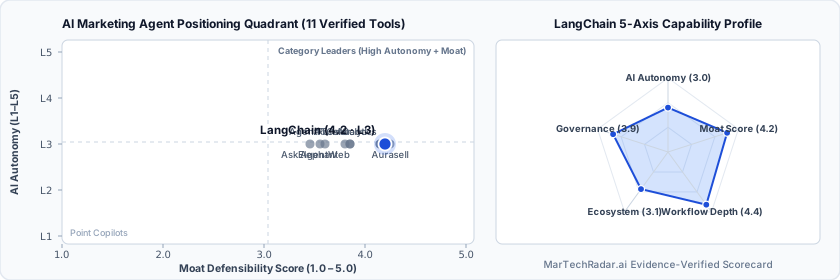
LangChain is a Web SaaS tool for AI Marketing Agent (Autonomous Marketing Agents & Digital Coworkers) in Agent & Marketing Ops. Pricing: Free plan · $0/mo · Enterprise plan. Best suited to B2B SaaS, DTC / eCommerce and Enterprise Brands. Editor ratings: AI autonomy L3 (conditional automation); moat score 4.2/5.0 (Proprietary moat). Fact-checked by Jagmeet Sine on Oct 14, 2026.
Open framework and orchestration platform for constructing, debugging, and serving stateful LLM-driven autonomous agents.
LangChain buyer fit verdict: when to choose vs. when to walk away
Choose LangChain if (Best Fit)
- Target ICP & Stack Fit: You operate as B2B SaaS, DTC / eCommerce and Enterprise Brands requiring a Web SaaS deployment for AI Marketing Agent.
- L3 Architecture & Defensibility: Deep ecosystem capture as the standard developer abstraction layer for compound AI systems, reinforced by LangSmith tracing telemetry and widespread enterprise developer adoption.
- Commercial Model Fit: Your procurement budget aligns with Free plan · $0/mo · Enterprise plan and want a self-serve free tier for zero-cost initial validation.
Walk away from LangChain if (Deal-Breakers)
- Walk away if your workflow requires uncapped enterprise volume on the Free plan · $0/mo · Enterprise plan entry plan without upgrading tiers.
- Walk away if your workflow cannot tolerate state graph latency overhead: Multi-hop cyclical routing introduces serial token-generation delays, creating runtime latency spikes during complex cross-system queries.
- Walk away if breaking framework upgrades is a deal-breaker for your team: Rapid version iteration across core Python and TypeScript packages necessitates ongoing schema refactoring and dependency maintenance.
LangChain key facts & scorecard
| Pricing | Free plan · $0/mo · Enterprise planVendor pricing page |
|---|---|
| Free plan | Yes |
| Delivery | Web SaaS |
| Audience | B2B SaaS, DTC / eCommerce, Enterprise Brands |
| AI autonomy level | L3 · Conditional automationEditor-verified |
| Moat tier & score | 4.2 / 5.0 · Proprietary moatEditor-verified |
| Funding | Venture-backed |
| Total funding | $160M |
| Founders | Ankush Gola, Harrison Chase |
| Company size | 201-500 employees |
| Governance & docs | Trust & Security ↗ · System Status ↗ · API & Docs ↗ · Changelog ↗ · Terms ↗ · Privacy ↗ |
| Headquarters | San Francisco, CA |
| Founded | 2022 |
| Last verified |
LangChain pros & cons: strengths vs. operational limitations
Pros: core strengths & capabilities
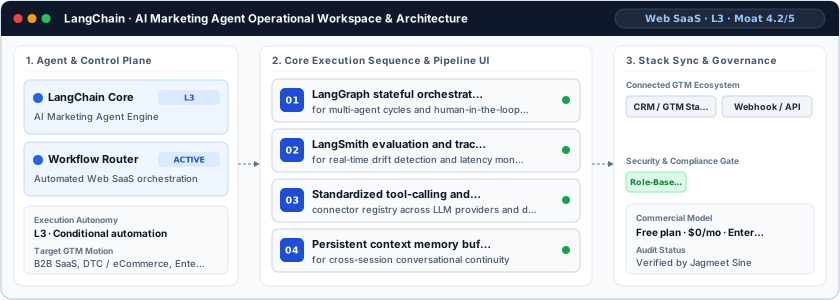
- LangGraph stateful orchestration: for multi-agent cycles and human-in-the-loop workflows
- LangSmith evaluation and tracing engine: for real-time drift detection and latency monitoring
- Standardized tool-calling and API: connector registry across LLM providers and data stores
- Persistent context memory buffers: for cross-session conversational continuity
Cons: operational limitations & risks
- State Graph Latency Overhead: Multi-hop cyclical routing introduces serial token-generation delays, creating runtime latency spikes during complex cross-system queries.
- Breaking Framework Upgrades: Rapid version iteration across core Python and TypeScript packages necessitates ongoing schema refactoring and dependency maintenance.
- Telemetry Volume Scaling: High-frequency trace logging through LangSmith during autonomous batch workflows can overwhelm developer compute budgets without sampling rules.
LangChain TCO & deal-breaker stress test
Simulate 12-month stepped TCO, hidden cost multipliers, contract lock-in exposure, and stack failure modes using only facts verified by Jagmeet Sine on · Capture SHA 801a474e.
LangChain is viable for 5 seats, but requires commercial or technical verification on the flagged items below.
| Plan / Tier | Verified Rate | Scale Fit | Scope & Quota Notes |
|---|---|---|---|
| Free / Sandbox | $0 | Unlimited seats (capped credits) | Entry free tier with capped usage or feature quotas for initial workflow testing. |
| Entry / Starter | $1/mo | Unlimited seats (Entry credits) | Observability & Evals |
| Plus | $39/mo | Unlimited seats (Growth credits) | For teams building and deploying agents. |
| Enterprise / Custom | Custom quote | Unlimited seats (Enterprise SLA) | Sales-negotiated annual contract for custom volume, SSO/RBAC governance, and dedicated SLA. |
- Moat Score
- 4.2 / 5.0
- AI Autonomy
- L3
- Free Tier / Trial
- Free plan
Triggered audit signals & failure modes
- Opaque Enterprise Quoting vs. SMB/Mid-Market BudgetVerified Pricing Ledger
LangChain does not disclose a public self-serve floor (Free plan · $0/mo · Enterprise plan). Buyers with a $800/mo cap face high sales-qualification friction.
- Published Self-Serve Entry FloorVerified Pricing Ledger
LangChain publishes a transparent entry point (Free plan · $0/mo · Enterprise plan) with a free tier for initial validation before committing.
- Tier Fit for 5-Seat Scale: Entry / Starter ($1/mo)Verified Tier Schedule
Observability & Evals
- Primary Operational Bottleneck: State Graph Latency OverheadAudit by Jagmeet Sine
Multi-hop cyclical routing introduces serial token-generation delays, creating runtime latency spikes during complex cross-system queries.
Hidden TCO Multipliers & Quota Gates
- Per-Seat Linear Scaling: LangChain prices licenses on a per-user/seat basis (Free plan · $0/mo · Enterprise plan); expanding from 2 to 15+ operators multiplies base recurring spend linearly.
- Credit & Usage Burn Multiplier: Automated workflows consume metered credits/usage quotas; multi-step enrichment, voice minutes, or high-frequency agent runs can trigger mid-cycle top-up packs.
- Enterprise Governance & Add-On Gating: Advanced capabilities such as Single Sign-On (SSO), custom role permissions, or specialized analytics modules are gated behind upper tiers or paid add-ons.
When to Walk Away & Negotiation Levers
- Walk away if your workflow requires uncapped enterprise volume on the Free plan · $0/mo · Enterprise plan entry plan without upgrading tiers.
- Walk away if your workflow cannot tolerate state graph latency overhead: Multi-hop cyclical routing introduces serial token-generation delays, creating runtime latency spikes during complex cross-system queries.
- Walk away if breaking framework upgrades is a deal-breaker for your team: Rapid version iteration across core Python and TypeScript packages necessitates ongoing schema refactoring and dependency maintenance.
- Validate exact quota thresholds (seats, credits, or API calls) included in LangChain's Free plan · $0/mo · Enterprise plan tier before converting from monthly to annual billing.
- Require a sandbox proof-of-concept testing state graph latency overhead against your live CRM/data schema before annual sign-off.
Ask a custom procurement or TCO stress-test question about LangChain
Lower 5-seat floor (~$495/mo vs. Custom Quote)
Lower 5-seat floor (~$100/mo vs. Custom Quote)
LangChain moat & subtrack positioning
Deep ecosystem capture as the standard developer abstraction layer for compound AI systems, reinforced by LangSmith tracing telemetry and widespread enterprise developer adoption.
Editorial review
Fact-checked by Jagmeet Sine (Senior MarTech Infrastructure & Agentic Workflow Architect) on .
Background
Architectural abstractions dictate the operational velocity of autonomous marketing agents. Headquartered in San Francisco, CA, and founded in 2022, LangChain provides foundational developer infrastructure and runtime orchestration for compound generative systems. Supported by $160M in venture funding, the company engineers orchestration frameworks for enterprise software architects and technical marketing operations leads deploying digital coworkers.
How LangChain works
Operating at an L3 autonomy profile, LangChain coordinates asynchronous agentic routines across disparate business stacks. The platform utilizes directed cyclical graphs via LangGraph to maintain state, handle conditional branching, and execute multi-agent task handoffs. Data ingestion pipelines map unstructured enterprise context into vector indexes and persistent memory buffers. The runtime integrates with the LangSmith engine, which evaluates execution traces, inspects input-output tokens, detects schema drift, and validates deterministic API calls before committing changes to downstream customer platforms.
Limitations
Operational considerations and platform boundaries include:
- State Graph Latency Overhead: Multi-hop cyclical routing introduces serial token-generation delays, creating runtime latency spikes during complex cross-system queries.
- Breaking Framework Upgrades: Rapid version iteration across core Python and TypeScript packages necessitates ongoing schema refactoring and dependency maintenance.
- Telemetry Volume Scaling: High-frequency trace logging through LangSmith during autonomous batch workflows can overwhelm developer compute budgets without sampling rules.
LangChain pricing
LangChain operates a hybrid monetization strategy combining open-source software libraries with hosted LangSmith telemetry services. Commercial access begins with a free Developer tier at $0 per seat per month, covering base tracing limits. Growth infrastructure scales into paid tiers and custom enterprise contracts governed by data residency agreements, dedicated support, and trace consumption volumes.
How LangChain compares
Within autonomous workflows, LangChain competes alongside applied agent platforms such as ai-marketing-claude, allGood, and AskElephant. While vertical competitors offer pre-packaged, zero-code business interfaces, LangChain prioritizes programmatic extensibility, granular observability, and model-agnostic execution graphs. It remains optimal for technical engineering teams requiring bespoke autonomous systems over turnkey SaaS frontends. Enterprise procurement teams evaluating deployment readiness should assess API webhook throughput, role-based access governance, and bilateral data synchronization latency against existing marketing technology infrastructure before committing to multi-year production rollouts.
Direct competitors & market radar
Top algorithmic competitors based on category positioning, capability overlap, and ICP alignment.
Frequently asked questions about LangChain
How much does LangChain cost and what pricing tiers are available?
Published pricing summary for LangChain: Free plan · $0/mo · Enterprise plan. LangChain includes a free tier or sandbox entry point. Verified tier schedule: Free / Sandbox ($0 for Unlimited seats (capped credits)); Entry / Starter ($1/mo for Unlimited seats (Entry credits)); Plus ($39/mo for Unlimited seats (Growth credits)); Enterprise / Custom (Custom quote for Unlimited seats (Enterprise SLA)). LangChain operates a hybrid monetization strategy combining open-source software libraries with hosted LangSmith telemetry services. Commercial access begins with a free Developer tier at $0 per seat per month, covering base tracing limits.
How does LangChain work and how autonomous is its AI architecture?
Open framework and orchestration platform for constructing, debugging, and serving stateful LLM-driven autonomous agents. Within AI Marketing Agent (Autonomous Marketing Agents & Digital Coworkers), MarTechRadar rates its execution architecture at L3 · Conditional automation with a verified Moat Score of 4.2 / 5.0 (Proprietary moat). Deep ecosystem capture as the standard developer abstraction layer for compound AI systems, reinforced by LangSmith tracing telemetry and widespread enterprise developer adoption. Corporate profile: Founded by Ankush Gola, Harrison Chase, operating at 201-500 employees scale.
What are the main limitations of LangChain and when should buyers walk away?
Based on our editorial technical audit, key operational considerations and boundaries for LangChain include: (1) State Graph Latency Overhead: Multi-hop cyclical routing introduces serial token-generation delays, creating runtime latency spikes during complex cross-system queries. (2) Breaking Framework Upgrades: Rapid version iteration across core Python and TypeScript packages necessitates ongoing schema refactoring and dependency maintenance. (3) Telemetry Volume Scaling: High-frequency trace logging through LangSmith during autonomous batch workflows can overwhelm developer compute budgets without sampling rules. Primary procurement walk-away rule: Walk away if your workflow requires uncapped enterprise volume on the Free plan · $0/mo · Enterprise plan entry plan without upgrading tiers.
What integrations, compliance certifications, and contract terms apply to LangChain?
First-party governance and developer endpoints verified on domain include: Trust/Security (https://trust.langchain.com), Status (https://status.smith.langchain.com), API Docs (https://docs.langchain.com). Key TCO multiplier to watch: Per-Seat Linear Scaling (LangChain prices licenses on a per-user/seat basis (Free plan · $0/mo · Enterprise plan); expanding from 2 to 15+ operators multiplies base recurring spend linearly.) Before signing a contract, procurement teams should validate exact quota thresholds (seats, credits, or API calls) included in LangChain's Free plan · $0/mo · Enterprise plan tier before converting from monthly to annual billing.
What are the best LangChain alternatives and head-to-head competitors in 2026?
Top fact-checked alternatives to LangChain in AI Marketing Agent (Autonomous Marketing Agents & Digital Coworkers) include GenAI Works (Custom / enterprise pricing), allGood (Custom / enterprise pricing), AskElephant ($99–$119/seat/mo), Aurasell (From $15,000/yr). Within autonomous workflows, LangChain competes alongside applied agent platforms such as ai-marketing-claude, allGood, and AskElephant.
Verified sources & evidence trail
- Official product domain: https://langchain.com
- Commercial pricing verification: https://www.langchain.com/pricing
- Verified corporate entity profiles (
sameAs): LinkedIn Company Profile · Crunchbase Entity Record - First-party governance & documentation links: Trust & Security · System Status · API & Docs · Changelog · Terms · Privacy
- Editorial audit sign-off: Fact-checked by Jagmeet Sine on under the MarTechRadar Evidence-Ledger Protocol.