Aether Review (2026): Pitch Deck Pricing, Limits & Alternatives
Bottom line
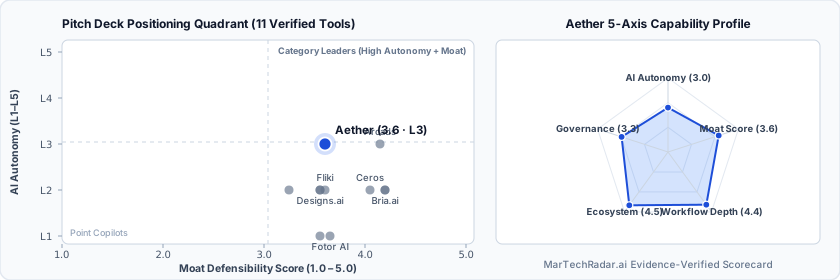
Aether is a Web SaaS tool for Pitch Deck (Marketing Visuals & Pitch Decks) in Visual & Creative Media. Pricing: Custom / enterprise pricing. Best suited to eCommerce Brands, Creative Agencies and Performance Video Marketers. Editor ratings: AI autonomy L3 (conditional automation); moat score 3.6/5.0 (Proprietary moat). Fact-checked by Tim Fenolz on Oct 14, 2026.
Enterprise presentation automation platform converting structured institutional data and strategy documents into branded, audience-ready slide decks.
Aether buyer fit verdict: when to choose vs. when to walk away
Choose Aether if (Best Fit)
- Target ICP & Stack Fit: You operate as eCommerce Brands, Creative Agencies and Performance Video Marketers requiring a Web SaaS deployment for Pitch Deck, with verified ecosystem connectivity for HubSpot, Intercom, Notion.
- L3 Architecture & Defensibility: Algorithmic layout constraints coupled with programmatic ingestion of enterprise data sources, enforcing strict brand style guardrails at scale.
- Commercial Model Fit: Your procurement budget aligns with Custom / enterprise pricing.
Walk away from Aether if (Deal-Breakers)
- Walk away if you require transparent self-serve monthly billing or your budget ceiling is under $1,000/mo (Aether requires sales-gated custom quoting).
- Walk away if your workflow cannot tolerate data ingestion schema sensitivity: The parsing pipeline exhibits vulnerability when handling non-standardized tabular data or deeply nested spreadsheets, occasionally requiring pre-cleansing of source files to prevent layout errors.
- Walk away if custom template flexibility is a deal-breaker for your team: Strict adherence to programmatic brand governance limits ad-hoc, freeform visual alterations, forcing designers to adjust global master templates rather than making arbitrary slide-level adjustments.
Aether key facts & scorecard
| Pricing | Custom / enterprise pricing |
|---|---|
| Free plan | No / not disclosed |
| Delivery | Web SaaS |
| Audience | eCommerce Brands, Creative Agencies, Performance Video Marketers |
| AI autonomy level | L3 · Conditional automationEditor-verified |
| Moat tier & score | 3.6 / 5.0 · Proprietary moatEditor-verified |
| Funding | Seed |
| Founders | Daniel Alexander, Rosanna Dedecius, Ursula Keisenberg |
| Company size | 2-10 employees |
| Ecosystem integrations | HubSpot, Intercom, Notion |
| Governance & docs | Privacy ↗ |
| Headquarters | Auckland, AUK |
| Founded | 2025 |
| Last verified |
Aether pros & cons: strengths vs. operational limitations
Pros: core strengths & capabilities
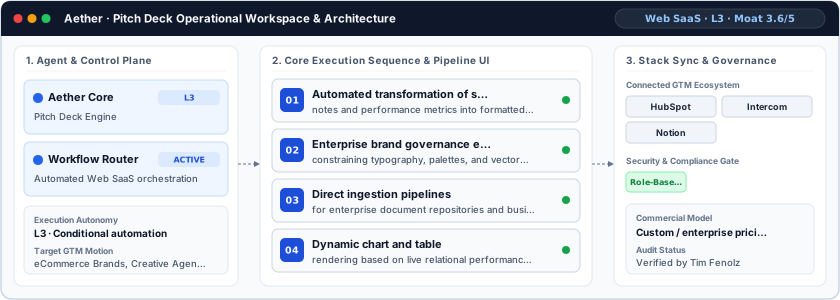
- Automated transformation of strategic: notes and performance metrics into formatted slide decks
- Enterprise brand governance engine: constraining typography, palettes, and vector assets
- Direct ingestion pipelines: for enterprise document repositories and business intelligence reports
- Dynamic chart and table: rendering based on live relational performance datasets
Cons: operational limitations & risks
- Data Ingestion Schema Sensitivity: The parsing pipeline exhibits vulnerability when handling non-standardized tabular data or deeply nested spreadsheets, occasionally requiring pre-cleansing of source files to prevent layout errors.
- Custom Template Flexibility: Strict adherence to programmatic brand governance limits ad-hoc, freeform visual alterations, forcing designers to adjust global master templates rather than making arbitrary slide-level adjustments.
- Asset Rendering Latency: High-density reports featuring numerous data visualizations incur compilation latency spikes during batch export operations across larger corporate slide decks.
Aether TCO & deal-breaker stress test
Simulate 12-month stepped TCO, hidden cost multipliers, contract lock-in exposure, and stack failure modes using only facts verified by Tim Fenolz on · Capture SHA dcf7a0a7.
Aether triggers high-severity friction under your 5-seat / $800/mo constraints. Benchmark the verified subtrack alternatives below before committing.
| Plan / Tier | Verified Rate | Scale Fit | Scope & Quota Notes |
|---|---|---|---|
| Enterprise / Custom | Custom quote | 15–50+ seats (Enterprise SLA) | Sales-negotiated annual contract for custom volume, SSO/RBAC governance, and dedicated SLA. |
- Moat Score
- 3.6 / 5.0
- AI Autonomy
- L3
- Free Tier / Trial
- None disclosed
Triggered audit signals & failure modes
- Opaque Enterprise Quoting vs. SMB/Mid-Market BudgetVerified Pricing Ledger
Aether does not disclose a public self-serve floor (Custom / enterprise pricing). Buyers with a $800/mo cap face high sales-qualification friction.
- Sales-Gated Contract TermsFact-checked by Tim Fenolz
Aether operates on a direct B2B deployment model where commercial pricing is available on request through tailored enterprise sales quotes based on organizational scale and seats.
- Primary Operational Bottleneck: Data Ingestion Schema SensitivityAudit by Tim Fenolz
The parsing pipeline exhibits vulnerability when handling non-standardized tabular data or deeply nested spreadsheets, occasionally requiring pre-cleansing of source files to prevent layout errors.
Hidden TCO Multipliers & Quota Gates
- Data Ingestion Schema Sensitivity: The parsing pipeline exhibits vulnerability when handling non-standardized tabular data or deeply nested spreadsheets, occasionally requiring pre-cleansing of source files to prevent layout errors.
- Custom Template Flexibility: Strict adherence to programmatic brand governance limits ad-hoc, freeform visual alterations, forcing designers to adjust global master templates rather than making arbitrary slide-level adjustments.
When to Walk Away & Negotiation Levers
- Walk away if you require transparent self-serve monthly billing or your budget ceiling is under $1,000/mo (Aether requires sales-gated custom quoting).
- Walk away if your workflow cannot tolerate data ingestion schema sensitivity: The parsing pipeline exhibits vulnerability when handling non-standardized tabular data or deeply nested spreadsheets, occasionally requiring pre-cleansing of source files to prevent layout errors.
- Walk away if custom template flexibility is a deal-breaker for your team: Strict adherence to programmatic brand governance limits ad-hoc, freeform visual alterations, forcing designers to adjust global master templates rather than making arbitrary slide-level adjustments.
- Demand a 30- to 60-day paid pilot opt-out clause in the Aether order form before signing a 12-month enterprise commitment.
- Require a sandbox proof-of-concept testing data ingestion schema sensitivity against your live CRM/data schema before annual sign-off.
Ask a custom procurement or TCO stress-test question about Aether
Lower 5-seat floor (~$30/mo vs. Custom Quote) · Transparent self-serve entry without mandatory annual lock-in
Lower 5-seat floor (~$10/mo vs. Custom Quote) · Transparent self-serve entry without mandatory annual lock-in
Aether key entities, modules & ecosystem stack
Aether moat & subtrack positioning
Algorithmic layout constraints coupled with programmatic ingestion of enterprise data sources, enforcing strict brand style guardrails at scale.
Editorial review
Fact-checked by Tim Fenolz (Lead AdTech, Programmatic & Attribution Analyst) on .
Background
Modern strategy and marketing operations teams frequently expend high-value analyst hours translating raw performance data into executive slide decks. Founded in 2025 in Auckland, New Zealand, Aether addresses this bottleneck by functioning as an automated presentation and reporting engine for enterprise strategy leaders and revenue operations directors. Rather than treating deck design as a manual graphic production task, Aether ingests institutional documents and structured business intelligence to generate audience-ready presentations that conform to predefined corporate identities.
How Aether works
At its technical core, Aether operates a document-to-layout synthesis pipeline structured around L3 autonomy. Ingestion services parse unstructured strategy memos, spreadsheets, and reporting exports, decomposing text and metrics into semantically tagged data tokens. An orchestration layer then passes these structured payloads through layout composition algorithms conditioned on strict brand tokens, including font hierarchies, color palettes, and locked grid systems. The engine programmatically renders native presentation artifacts, applying automated visual verification checks to prevent formatting regressions and broken data bindings, alongside native workflow integrations for HubSpot, Intercom, and Notion.
Limitations
Operational considerations and platform boundaries include:
- Data Ingestion Schema Sensitivity: The parsing pipeline exhibits vulnerability when handling non-standardized tabular data or deeply nested spreadsheets, occasionally requiring pre-cleansing of source files to prevent layout errors.
- Custom Template Flexibility: Strict adherence to programmatic brand governance limits ad-hoc, freeform visual alterations, forcing designers to adjust global master templates rather than making arbitrary slide-level adjustments.
- Asset Rendering Latency: High-density reports featuring numerous data visualizations incur compilation latency spikes during batch export operations across larger corporate slide decks.
Aether pricing
Aether operates on a direct B2B deployment model where commercial pricing is available on request through tailored enterprise sales quotes based on organizational scale and seats. Contracts scale alongside workspace utilization, user seat tiers, and platform integration requirements, bundling standard support and template governance services into enterprise license agreements.
How Aether compares
Within the Pitch Deck and presentation and visual automation ecosystem, Aether differentiates itself through structured enterprise reporting automation. Unlike Ceros, which specializes in bespoke interactive web experiences for experiential marketing, Aether targets structured, operational slide generation. Compared to design-first raster tools like Fotor AI and social asset generators like Picmaker, Aether optimizes for programmatic corporate governance and quantitative data ingestion. It is ideally architected for mid-market and enterprise organizations requiring consistent, automated slide delivery directly from recurring business performance data.
Direct competitors & market radar
Top algorithmic competitors based on category positioning, capability overlap, and ICP alignment.
Frequently asked questions about Aether
How much does Aether cost and does it require a custom enterprise quote?
Published pricing summary for Aether: Custom / enterprise pricing. A permanent free plan is not disclosed for Aether. Aether operates on a direct B2B deployment model where commercial pricing is available on request through tailored enterprise sales quotes based on organizational scale and seats.
How does Aether work and how autonomous is its AI architecture?
Enterprise presentation automation platform converting structured institutional data and strategy documents into branded, audience-ready slide decks. Within Pitch Deck (Marketing Visuals & Pitch Decks), MarTechRadar rates its execution architecture at L3 · Conditional automation with a verified Moat Score of 3.6 / 5.0 (Proprietary moat). Algorithmic layout constraints coupled with programmatic ingestion of enterprise data sources, enforcing strict brand style guardrails at scale. Corporate profile: Founded by Daniel Alexander, Rosanna Dedecius, Ursula Keisenberg, operating at 2-10 employees scale.
What are the main limitations of Aether and when should buyers walk away?
Based on our editorial technical audit, key operational considerations and boundaries for Aether include: (1) Data Ingestion Schema Sensitivity: The parsing pipeline exhibits vulnerability when handling non-standardized tabular data or deeply nested spreadsheets, occasionally requiring pre-cleansing of source files to prevent layout errors. (2) Custom Template Flexibility: Strict adherence to programmatic brand governance limits ad-hoc, freeform visual alterations, forcing designers to adjust global master templates rather than making arbitrary slide-level adjustments. (3) Asset Rendering Latency: High-density reports featuring numerous data visualizations incur compilation latency spikes during batch export operations across larger corporate slide decks. Primary procurement walk-away rule: Walk away if you require transparent self-serve monthly billing or your budget ceiling is under $1,000/mo (Aether requires sales-gated custom quoting).
What integrations, compliance certifications, and contract terms apply to Aether?
Verified ecosystem and stack integrations include HubSpot, Intercom, Notion. Key TCO multiplier to watch: Data Ingestion Schema Sensitivity (The parsing pipeline exhibits vulnerability when handling non-standardized tabular data or deeply nested spreadsheets, occasionally requiring pre-cleansing of source files to prevent layout errors.) Before signing a contract, procurement teams should demand a 30- to 60-day paid pilot opt-out clause in the Aether order form before signing a 12-month enterprise commitment.
What are the best Aether alternatives and head-to-head competitors in 2026?
Top fact-checked alternatives to Aether in Pitch Deck (Marketing Visuals & Pitch Decks) include VistaCreate (Free plan · From $10/mo), Moovly (Custom / enterprise pricing), Luma Dream Machine (From $30/mo), CapCut Commerce Pro (Custom / enterprise pricing). Within the Pitch Deck and presentation and visual automation ecosystem, Aether differentiates itself through structured enterprise reporting automation. Unlike Ceros, which specializes in bespoke interactive web experiences for experiential marketing, Aether targets structured, operational slide generation.
Verified sources & evidence trail
- Official product domain: https://www.theaether.co/
- Commercial pricing verification: Verified against official vendor pricing policy (Custom / enterprise pricing)
- Verified corporate entity profiles (
sameAs): LinkedIn Company Profile · Crunchbase Entity Record - First-party governance & documentation links: Privacy
- Editorial audit sign-off: Fact-checked by Tim Fenolz on under the MarTechRadar Evidence-Ledger Protocol.