Picmaker Review (2026): Pitch Deck Pricing, Limits & Alternatives
Bottom line
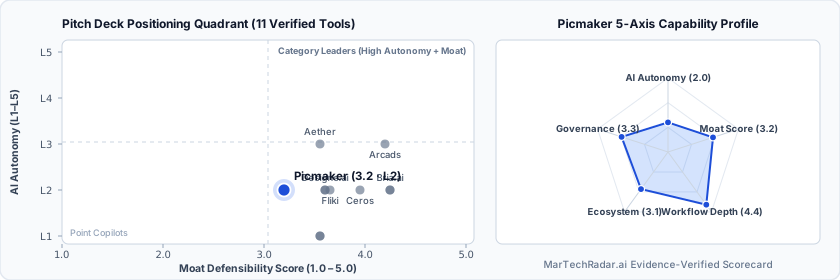
Picmaker is a Web SaaS tool for Pitch Deck (Marketing Visuals & Pitch Decks) in Visual & Creative Media. Pricing: From $9/mo. Best suited to Creators / Solo. Editor ratings: AI autonomy L2 (workflow copilot); moat score 3.2/5.0 (Workflow-embedded (strong)). Fact-checked by Tim Fenolz on Oct 7, 2026.
AI-assisted design suite and social media management platform combining template-driven creative production with multi-channel publishing workflows.
Picmaker buyer fit verdict: when to choose vs. when to walk away
Choose Picmaker if (Best Fit)
- Target ICP & Stack Fit: You operate as Creators / Solo requiring a Web SaaS deployment for Pitch Deck.
- L2 Architecture & Defensibility: Defensibility relies on its integrated workflow connecting automated graphic design heuristics (the MAD engine) directly to social publishing schedulers, backed by ecosystem synergy from parent company Animaker. However, lack of proprietary foundational vision models limits its moat against broader graphic platforms.
- Commercial Model Fit: Your procurement budget aligns with From $9/mo.
Walk away from Picmaker if (Deal-Breakers)
- Walk away if your workflow requires uncapped enterprise volume on the From $9/mo entry plan without upgrading tiers.
- Walk away if your workflow cannot tolerate algorithmic layout rigidity: The heuristic-based MAD engine struggles with non-standard canvas dimensions and complex multi-layered hierarchy requirements, resulting in manual repositioning needs.
- Walk away if high-volume asset storage bottlenecks is a deal-breaker for your team: Mid-tier plans enforce asset storage caps that restrict high-resolution raster asset storage and raw video catalogs for high-velocity teams.
Picmaker key facts & scorecard
| Pricing | From $9/moVendor pricing page |
|---|---|
| Free plan | No / not disclosed |
| Delivery | Web SaaS |
| Audience | Creators / Solo |
| AI autonomy level | L2 · Workflow copilotEditor-verified |
| Moat tier & score | 3.2 / 5.0 · Workflow-embedded (strong)Editor-verified |
| Funding | Bootstrapped |
| Company size | 51-200 employees |
| Governance & docs | Changelog ↗ · Terms ↗ · Privacy ↗ |
| Headquarters | Palo Alto, California |
| Founded | 2018 |
| Last verified |
Picmaker pros & cons: strengths vs. operational limitations
Pros: core strengths & capabilities
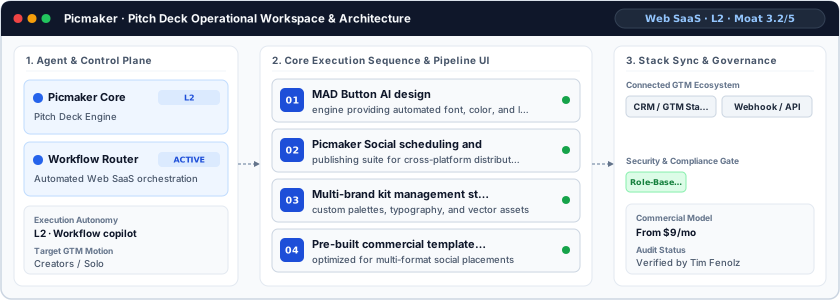
- MAD Button AI design: engine providing automated font, color, and layout re-combinations
- Picmaker Social scheduling and: publishing suite for cross-platform distribution
- Multi-brand kit management storing: custom palettes, typography, and vector assets
- Pre-built commercial template library: optimized for multi-format social placements
Cons: operational limitations & risks
- Algorithmic layout rigidity: The heuristic-based MAD engine struggles with non-standard canvas dimensions and complex multi-layered hierarchy requirements, resulting in manual repositioning needs.
- High-volume asset storage bottlenecks: Mid-tier plans enforce asset storage caps that restrict high-resolution raster asset storage and raw video catalogs for high-velocity teams.
- API token and social sync disconnects: Social platform authorization expirations cause scheduled delivery drops without aggressive proactive alerting mechanisms for administrators.
Picmaker TCO & deal-breaker stress test
Simulate 12-month stepped TCO, hidden cost multipliers, contract lock-in exposure, and stack failure modes using only facts verified by Tim Fenolz on · Capture SHA 069ba730.
Picmaker aligns with your 5-seat / $800/mo profile. Review the walk-away triggers and contract levers below before deployment.
| Plan / Tier | Verified Rate | Scale Fit | Scope & Quota Notes |
|---|---|---|---|
| Pro | $9/mo | 1–2 seats | Best for agencies, startups, social media teams, and SMBs |
- Moat Score
- 3.2 / 5.0
- AI Autonomy
- L2
- Free Tier / Trial
- None disclosed
Triggered audit signals & failure modes
- Published Self-Serve Entry FloorVerified Pricing Ledger
Picmaker publishes a transparent entry point (From $9/mo) for initial validation before committing.
- Primary Operational Bottleneck: High-volume asset storage bottlenecksAudit by Tim Fenolz
Mid-tier plans enforce asset storage caps that restrict high-resolution raster asset storage and raw video catalogs for high-velocity teams.
Hidden TCO Multipliers & Quota Gates
- Annual Billing Headline vs. Monthly Premium: Headline entry rates reflect annual billing commitments (Save 50%); month-to-month flexibility carries a higher effective monthly rate or requires annual prepayment.
- Credit & Usage Burn Multiplier: Automated workflows consume metered credits/usage quotas; multi-step enrichment, voice minutes, or high-frequency agent runs can trigger mid-cycle top-up packs.
When to Walk Away & Negotiation Levers
- Walk away if your workflow requires uncapped enterprise volume on the From $9/mo entry plan without upgrading tiers.
- Walk away if your workflow cannot tolerate algorithmic layout rigidity: The heuristic-based MAD engine struggles with non-standard canvas dimensions and complex multi-layered hierarchy requirements, resulting in manual repositioning needs.
- Walk away if high-volume asset storage bottlenecks is a deal-breaker for your team: Mid-tier plans enforce asset storage caps that restrict high-resolution raster asset storage and raw video catalogs for high-velocity teams.
- Validate exact quota thresholds (seats, credits, or API calls) included in Picmaker's From $9/mo tier before converting from monthly to annual billing.
- Require a sandbox proof-of-concept testing algorithmic layout rigidity against your live CRM/data schema before annual sign-off.
Ask a custom procurement or TCO stress-test question about Picmaker
Fits within $800/mo budget (Free plan · $10.99–$23.99/mo)
Fits within $800/mo budget (From $19/mo)
Picmaker moat & subtrack positioning
Defensibility relies on its integrated workflow connecting automated graphic design heuristics (the MAD engine) directly to social publishing schedulers, backed by ecosystem synergy from parent company Animaker. However, lack of proprietary foundational vision models limits its moat against broader graphic platforms.
Editorial review
Fact-checked by Tim Fenolz (Lead AdTech, Programmatic & Attribution Analyst) on .
Background
Established in 2018 in Palo Alto, California, Picmaker addresses the operational friction marketing teams face when balancing multi-channel creative generation against manual design overhead. Operating as a graphic and social management environment, the platform serves social media managers, agency operators, and digital marketing teams. It consolidates asset generation and social publishing into a unified interface, targeting organizations that require rapid visual content iteration without dedicated creative agency resources.
How Picmaker works
At an L2 autonomy rating, the platform executes task automation through its proprietary algorithmic layout engine known as the MAD Button. The system ingests user-uploaded brand assets, vectors, and baseline text strings, then applies rule-based heuristic permutation logic to adjust typographic pairings, color balances, and composition hierarchies. These rendered canvases integrate directly with the Picmaker Social scheduling layer, utilizing social platform APIs to orchestrate scheduled content delivery without external file transfers.
Limitations
Operational considerations and platform boundaries include:
- Algorithmic layout rigidity: The heuristic-based MAD engine struggles with non-standard canvas dimensions and complex multi-layered hierarchy requirements, resulting in manual repositioning needs.
- High-volume asset storage bottlenecks: Mid-tier plans enforce asset storage caps that restrict high-resolution raster asset storage and raw video catalogs for high-velocity teams.
- API token and social sync disconnects: Social platform authorization expirations cause scheduled delivery drops without aggressive proactive alerting mechanisms for administrators.
Picmaker pricing
Commercial access operates on a SaaS subscription structure, with public entry tiers starting at $9 per month for the Pro tier. Plans scale according to team seats, brand kit allocations, cloud storage volume, and connected social account limits. Higher-volume enterprise tiers require custom licensing for scaled collaborative governance.
How Picmaker compares
Within the visual production category, Picmaker competes against VistaCreate, Fotor AI, and Ceros. While VistaCreate and Fotor AI prioritize consumer-grade template volume and photo-filtering toolsets, Picmaker differentiates through native scheduling and unified multi-brand management. Conversely, enterprise interactive design platforms like Ceros provide dynamic vector interactivity and custom event tracking that exceed Picmaker's social-centric layout capabilities. Picmaker fits small-to-mid-market growth teams prioritizing fast social turnaround.
Frequently asked questions about Picmaker
How much does Picmaker cost and what pricing tiers are available?
Published pricing summary for Picmaker: From $9/mo. A permanent free plan is not disclosed for Picmaker. Commercial access operates on a SaaS subscription structure, with public entry tiers starting at $9 per month for the Pro tier. Plans scale according to team seats, brand kit allocations, cloud storage volume, and connected social account limits.
How does Picmaker work and how autonomous is its AI architecture?
AI-assisted design suite and social media management platform combining template-driven creative production with multi-channel publishing workflows. Within Pitch Deck (Marketing Visuals & Pitch Decks), MarTechRadar rates its execution architecture at L2 · Workflow copilot with a verified Moat Score of 3.2 / 5.0 (Workflow-embedded (strong)). Defensibility relies on its integrated workflow connecting automated graphic design heuristics (the MAD engine) directly to social publishing schedulers, backed by ecosystem synergy from parent company Animaker. However, lack of proprietary foundational vision models limits its moat against broader graphic platforms. Corporate profile: operating at 51-200 employees scale.
What are the main limitations of Picmaker and when should buyers walk away?
Based on our editorial technical audit, key operational considerations and boundaries for Picmaker include: (1) Algorithmic layout rigidity: The heuristic-based MAD engine struggles with non-standard canvas dimensions and complex multi-layered hierarchy requirements, resulting in manual repositioning needs. (2) High-volume asset storage bottlenecks: Mid-tier plans enforce asset storage caps that restrict high-resolution raster asset storage and raw video catalogs for high-velocity teams. (3) API token and social sync disconnects: Social platform authorization expirations cause scheduled delivery drops without aggressive proactive alerting mechanisms for administrators. Primary procurement walk-away rule: Walk away if your workflow requires uncapped enterprise volume on the From $9/mo entry plan without upgrading tiers.
What integrations, compliance certifications, and contract terms apply to Picmaker?
Key TCO multiplier to watch: Annual Billing Headline vs. Monthly Premium (Headline entry rates reflect annual billing commitments (Save 50%); month-to-month flexibility carries a higher effective monthly rate or requires annual prepayment.) Before signing a contract, procurement teams should validate exact quota thresholds (seats, credits, or API calls) included in Picmaker's From $9/mo tier before converting from monthly to annual billing.
What are the best Picmaker alternatives and head-to-head competitors in 2026?
Top fact-checked alternatives to Picmaker in Pitch Deck (Marketing Visuals & Pitch Decks) include Fotor AI (Free plan · $10.99–$23.99/mo), VistaCreate (Free plan · From $10/mo), Ceros (Custom / enterprise pricing), QuickAds.ai (Free plan · $0/mo · Enterprise plan). Within the visual production category, Picmaker competes against VistaCreate, Fotor AI, and Ceros. While VistaCreate and Fotor AI prioritize consumer-grade template volume and photo-filtering toolsets, Picmaker differentiates through native scheduling and unified multi-brand management.
Verified sources & evidence trail
- Official product domain: https://picmaker.com
- Commercial pricing verification: https://app.picmaker.com/pricing/
- Verified corporate entity profiles (
sameAs): LinkedIn Company Profile · Crunchbase Entity Record - First-party governance & documentation links: Changelog · Terms · Privacy
- Editorial audit sign-off: Fact-checked by Tim Fenolz on under the MarTechRadar Evidence-Ledger Protocol.