Designs.ai Review (2026): Pitch Deck Pricing, Limits & Alternatives
Bottom line
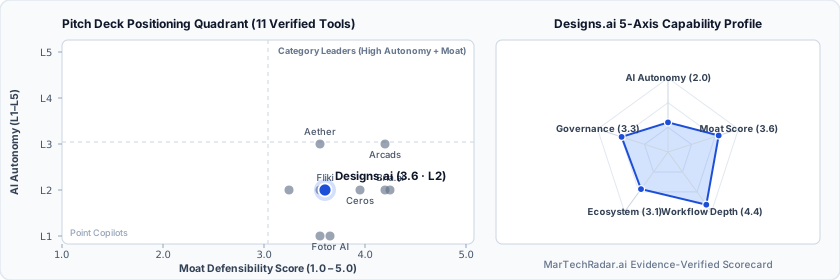
Designs.ai is a Web SaaS tool for Pitch Deck (Marketing Visuals & Pitch Decks) in Visual & Creative Media. Pricing: Free plan · $0/mo · Enterprise plan. Best suited to Creators / Solo. Editor ratings: AI autonomy L2 (workflow copilot); moat score 3.6/5.0 (Proprietary moat). Fact-checked by Vasilia Xia on Oct 15, 2026.
Multi-modal creative automation suite orchestrating specialized agents to generate marketing collateral, vector logos, video scripts, audio voiceovers.
Designs.ai buyer fit verdict: when to choose vs. when to walk away
Choose Designs.ai if (Best Fit)
- Target ICP & Stack Fit: You operate as Creators / Solo requiring a Web SaaS deployment for Pitch Deck.
- L2 Architecture & Defensibility: Deep integration with Inmagine Group proprietary asset repositories alongside a coordinated multi-agent pipeline spanning vector graphics, synthetic audio, and video composition.
- Commercial Model Fit: Your procurement budget aligns with Free plan · $0/mo · Enterprise plan and want a self-serve free tier for zero-cost initial validation.
Walk away from Designs.ai if (Deal-Breakers)
- Walk away if your workflow requires uncapped enterprise volume on the Free plan · $0/mo · Enterprise plan entry plan without upgrading tiers.
- Walk away if your workflow cannot tolerate agent brief ambiguity failure: When input prompts lack explicit constraints, the multi-agent orchestrator frequently misaligns visual styles across simultaneous outputs, requiring manual asset-by-asset correction.
- Walk away if credit burn and concurrency bottlenecks is a deal-breaker for your team: High-resolution rendering runs consume shared credit pools quickly, creating operational halts for teams running multi-variant social campaign batches simultaneously.
Designs.ai key facts & scorecard
| Pricing | Free plan · $0/mo · Enterprise planVendor pricing page |
|---|---|
| Free plan | Yes |
| Delivery | Web SaaS |
| Audience | Creators / Solo |
| AI autonomy level | L2 · Workflow copilotEditor-verified |
| Moat tier & score | 3.6 / 5.0 · Proprietary moatEditor-verified |
| Funding | Venture-backed |
| Company size | 51-200 employees |
| Governance & docs | Trust & Security ↗ · Terms ↗ · Privacy ↗ |
| Headquarters | Singapore, Central Region, Singapore |
| Founded | 2019 |
| Last verified |
Designs.ai pros & cons: strengths vs. operational limitations
Pros: core strengths & capabilities
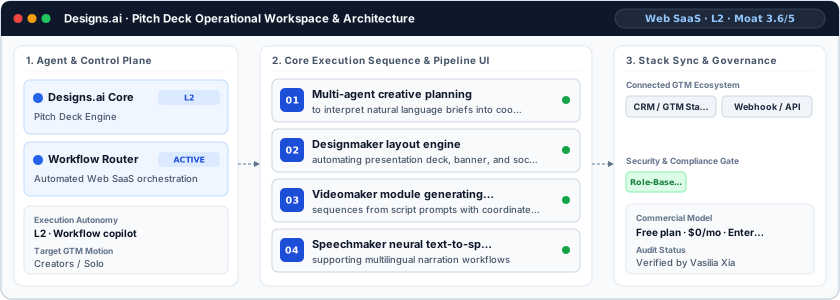
- Multi-agent creative planning: to interpret natural language briefs into coordinated multi-format assets
- Designmaker layout engine: automating presentation deck, banner, and social collateral production
- Videomaker module generating video: sequences from script prompts with coordinated audio and overlays
- Speechmaker neural text-to-speech engine: supporting multilingual narration workflows
Cons: operational limitations & risks
- Agent Brief Ambiguity Failure: When input prompts lack explicit constraints, the multi-agent orchestrator frequently misaligns visual styles across simultaneous outputs, requiring manual asset-by-asset correction.
- Credit Burn and Concurrency Bottlenecks: High-resolution rendering runs consume shared credit pools quickly, creating operational halts for teams running multi-variant social campaign batches simultaneously.
- Template Rigidity and Schema Drift: Design layouts rely heavily on deterministic bounding boxes, resulting in severe typographic clipping when importing localized copy with expanded text length.
- Infrastructure Latency and Dependency Overhead: Users encounter operational friction and integration bottlenecks, as the pipeline struggles with API latency, token limits, and external dependency drift during high-concurrency production spikes.
Designs.ai TCO & deal-breaker stress test
Simulate 12-month stepped TCO, hidden cost multipliers, contract lock-in exposure, and stack failure modes using only facts verified by Vasilia Xia on · Capture SHA 26bcec59.
Designs.ai triggers high-severity friction under your 5-seat / $800/mo constraints. Benchmark the verified subtrack alternatives below before committing.
| Plan / Tier | Verified Rate | Scale Fit | Scope & Quota Notes |
|---|---|---|---|
| Free / Sandbox | $0 | 1–2 seats (Evaluation) | Entry free tier with capped usage or feature quotas for initial workflow testing. |
| Starter | $30/mo | 1–2 seats | 2,500 Credits |
| Enterprise / Custom | Custom quote | 15–50+ seats (Enterprise SLA) | Sales-negotiated annual contract for custom volume, SSO/RBAC governance, and dedicated SLA. |
- Moat Score
- 3.6 / 5.0
- AI Autonomy
- L2
- Free Tier / Trial
- Free plan
Triggered audit signals & failure modes
- Opaque Enterprise Quoting vs. SMB/Mid-Market BudgetVerified Pricing Ledger
Designs.ai does not disclose a public self-serve floor (Free plan · $0/mo · Enterprise plan). Buyers with a $800/mo cap face high sales-qualification friction.
- Published Self-Serve Entry FloorVerified Pricing Ledger
Designs.ai publishes a transparent entry point (Free plan · $0/mo · Enterprise plan) with a free tier for initial validation before committing.
- Usage / Credit Burn VolatilityCommercial Model Audit
Designs.ai uses credit or usage-metered billing (Free plan · $0/mo · Enterprise plan). High-volume automated workflows across 5 seats can trigger mid-cycle overage charges.
- Primary Operational Bottleneck: Credit Burn and Concurrency BottlenecksAudit by Vasilia Xia
High-resolution rendering runs consume shared credit pools quickly, creating operational halts for teams running multi-variant social campaign batches simultaneously.
Hidden TCO Multipliers & Quota Gates
- Annual Billing Headline vs. Monthly Premium: Headline entry rates reflect annual billing commitments (Save 50%); month-to-month flexibility carries a higher effective monthly rate or requires annual prepayment.
- Credit & Usage Burn Multiplier: Automated workflows consume metered credits/usage quotas; multi-step enrichment, voice minutes, or high-frequency agent runs can trigger mid-cycle top-up packs.
When to Walk Away & Negotiation Levers
- Walk away if your workflow requires uncapped enterprise volume on the Free plan · $0/mo · Enterprise plan entry plan without upgrading tiers.
- Walk away if your workflow cannot tolerate agent brief ambiguity failure: When input prompts lack explicit constraints, the multi-agent orchestrator frequently misaligns visual styles across simultaneous outputs, requiring manual asset-by-asset correction.
- Walk away if credit burn and concurrency bottlenecks is a deal-breaker for your team: High-resolution rendering runs consume shared credit pools quickly, creating operational halts for teams running multi-variant social campaign batches simultaneously.
- Validate exact quota thresholds (seats, credits, or API calls) included in Designs.ai's Free plan · $0/mo · Enterprise plan tier before converting from monthly to annual billing.
- Require a sandbox proof-of-concept testing agent brief ambiguity failure against your live CRM/data schema before annual sign-off.
Ask a custom procurement or TCO stress-test question about Designs.ai
Lower 5-seat floor (~$11/mo vs. Custom Quote)
Lower 5-seat floor (~$19/mo vs. Custom Quote)
Designs.ai moat & subtrack positioning
Deep integration with Inmagine Group proprietary asset repositories alongside a coordinated multi-agent pipeline spanning vector graphics, synthetic audio, and video composition.
Editorial review
Fact-checked by Vasilia Xia (E-Commerce, Lifecycle & Retention Marketing Analyst) on .
Background
Designs.ai was established in 2019 in Singapore, Central Region, Singapore, engineered to eliminate creative production bottlenecks for growth marketers and brand teams. Positioned within modern collateral automation ecosystems, the platform addresses the overhead of coordinating disjointed creative tools. It replaces fragmented subscriptions for design, copy, audio, and video by uniting them under an automated multi-agent framework. Creative directors, growth marketers, and campaign operations managers leverage the system to transform structured brand briefs into deployable marketing assets without expanding agency headcount.
How Designs.ai works
At its architectural core, Designs.ai deploys a multi-agent orchestration system that parses campaign briefs to coordinate specialized downstream models. The ingestion pipeline accepts structured text parameters, brand identity guidelines, and asset constraints. The orchestrator routes tasks across specialized engines: Designmaker coordinates layout heuristics for slide decks and static graphics, Videomaker binds synthesized speech from Speechmaker with stock footage, and Logomaker generates vector asset packs. The system delivers Level 2 task autonomy, producing bounded drafts that require human review and fine-tuning before production release.
Limitations
Operational considerations and platform boundaries include:
- Agent Brief Ambiguity Failure: When input prompts lack explicit constraints, the multi-agent orchestrator frequently misaligns visual styles across simultaneous outputs, requiring manual asset-by-asset correction.
- Credit Burn and Concurrency Bottlenecks: High-resolution rendering runs consume shared credit pools quickly, creating operational halts for teams running multi-variant social campaign batches simultaneously.
- Template Rigidity and Schema Drift: Design layouts rely heavily on deterministic bounding boxes, resulting in severe typographic clipping when importing localized copy with expanded text length.
- Infrastructure Latency and Dependency Overhead: Users encounter operational friction and integration bottlenecks, as the pipeline struggles with API latency, token limits, and external dependency drift during high-concurrency production spikes.
Designs.ai pricing
Commercial access follows a credit-based tiered subscription model starting with a free tier at $0 per month for baseline evaluation. Paid production tiers include the Go plan at $9.90 per month and the Plus plan, discounted from $39 to $19.50 per month, scaling monthly credit allocations, user seats, and commercial licensing permissions. High-volume marketing departments require custom enterprise agreements to secure dedicated rendering pipelines, unified billing, and advanced brand governance controls.
How Designs.ai compares
Designs.ai competes directly against visual generation and interactive design platforms such as Ceros, Fotor AI, and Picmaker. While Ceros focuses on bespoke interactive enterprise web experiences with steep authoring curves, Designs.ai prioritizes multi-format speed via generative agents. Compared to consumer-skewed editors like Fotor AI and social-graphic engines like Picmaker, Designs.ai offers broader multi-modal breadth by bundling voiceover and video rendering. It fits mid-market marketing organizations needing rapid, high-volume asset output across diverse media channels from unified briefs. It is best suited for enterprise marketing teams and growth practitioners seeking disciplined workflow orchestration.
Direct competitors & market radar
Top algorithmic competitors based on category positioning, capability overlap, and ICP alignment.
Frequently asked questions about Designs.ai
How much does Designs.ai cost and what pricing tiers are available?
Published pricing summary for Designs.ai: Free plan · $0/mo · Enterprise plan. Designs.ai includes a free tier or sandbox entry point. Verified tier schedule: Free / Sandbox ($0 for 1–2 seats (Evaluation)); Starter ($30/mo for 1–2 seats); Enterprise / Custom (Custom quote for 15–50+ seats (Enterprise SLA)). Commercial access follows a credit-based tiered subscription model starting with a free tier at $0 per month for baseline evaluation.
How does Designs.ai work and how autonomous is its AI architecture?
Multi-modal creative automation suite orchestrating specialized agents to generate marketing collateral, vector logos, video scripts, audio voiceovers. Within Pitch Deck (Marketing Visuals & Pitch Decks), MarTechRadar rates its execution architecture at L2 · Workflow copilot with a verified Moat Score of 3.6 / 5.0 (Proprietary moat). Deep integration with Inmagine Group proprietary asset repositories alongside a coordinated multi-agent pipeline spanning vector graphics, synthetic audio, and video composition. Corporate profile: operating at 51-200 employees scale.
What are the main limitations of Designs.ai and when should buyers walk away?
Based on our editorial technical audit, key operational considerations and boundaries for Designs.ai include: (1) Agent Brief Ambiguity Failure: When input prompts lack explicit constraints, the multi-agent orchestrator frequently misaligns visual styles across simultaneous outputs, requiring manual asset-by-asset correction. (2) Credit Burn and Concurrency Bottlenecks: High-resolution rendering runs consume shared credit pools quickly, creating operational halts for teams running multi-variant social campaign batches simultaneously. (3) Template Rigidity and Schema Drift: Design layouts rely heavily on deterministic bounding boxes, resulting in severe typographic clipping when importing localized copy with expanded text length. (4) Infrastructure Latency and Dependency Overhead: Users encounter operational friction and integration bottlenecks, as the pipeline struggles with API latency, token limits, and external dependency drift during high-concurrency production spikes. Primary procurement walk-away rule: Walk away if your workflow requires uncapped enterprise volume on the Free plan · $0/mo · Enterprise plan entry plan without upgrading tiers.
What integrations, compliance certifications, and contract terms apply to Designs.ai?
First-party governance and developer endpoints verified on domain include: Trust/Security (https://designs.ai/security). Key TCO multiplier to watch: Annual Billing Headline vs. Monthly Premium (Headline entry rates reflect annual billing commitments (Save 50%); month-to-month flexibility carries a higher effective monthly rate or requires annual prepayment.) Before signing a contract, procurement teams should validate exact quota thresholds (seats, credits, or API calls) included in Designs.ai's Free plan · $0/mo · Enterprise plan tier before converting from monthly to annual billing.
What are the best Designs.ai alternatives and head-to-head competitors in 2026?
Top fact-checked alternatives to Designs.ai in Pitch Deck (Marketing Visuals & Pitch Decks) include Fotor AI (Free plan · $10.99–$23.99/mo), Picmaker (From $9/mo), Ceros (Custom / enterprise pricing), Steve.ai (From $19/mo). Designs.ai competes directly against visual generation and interactive design platforms such as Ceros, Fotor AI, and Picmaker. While Ceros focuses on bespoke interactive enterprise web experiences with steep authoring curves, Designs.ai prioritizes multi-format speed via generative agents.
Verified sources & evidence trail
- Official product domain: https://designs.ai
- Commercial pricing verification: https://designs.ai/en/pricing
- Verified corporate entity profiles (
sameAs): LinkedIn Company Profile · Crunchbase Entity Record - First-party governance & documentation links: Trust & Security · Terms · Privacy
- Editorial audit sign-off: Fact-checked by Vasilia Xia on under the MarTechRadar Evidence-Ledger Protocol.