Fliki Review (2026): Pitch Deck Pricing, Limits & Alternatives
Bottom line
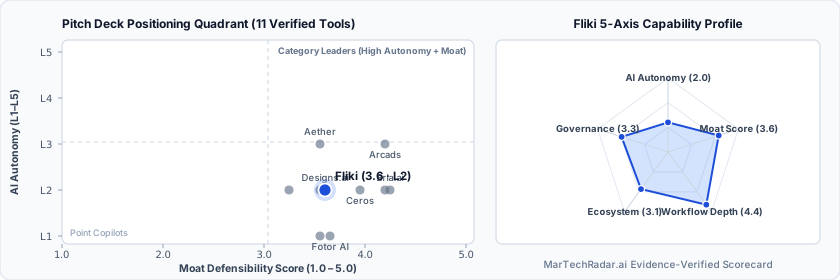
Fliki is a Web SaaS tool for Pitch Deck (Marketing Visuals & Pitch Decks) in Visual & Creative Media. Pricing: Free plan · $0/mo · Enterprise plan. Best suited to B2B SaaS and Creators / Solo. Editor ratings: AI autonomy L2 (workflow copilot); moat score 3.6/5.0 (Proprietary moat). Fact-checked by Tim Fenolz on Oct 15, 2026.
Text-to-video automation engine combining neural speech synthesis, script-to-scene storyboard generation, and stock asset retrieval for automated video.
Fliki buyer fit verdict: when to choose vs. when to walk away
Choose Fliki if (Best Fit)
- Target ICP & Stack Fit: You operate as B2B SaaS and Creators / Solo requiring a Web SaaS deployment for Pitch Deck.
- L2 Architecture & Defensibility: Fliki maintains defensibility through an integrated workflow unifying neural text-to-speech across 80+ languages with programmatic scene composition and stock licensing feeds, lowering rendering latency for high-volume content operations.
- Commercial Model Fit: Your procurement budget aligns with Free plan · $0/mo · Enterprise plan and want a self-serve free tier for zero-cost initial validation.
Walk away from Fliki if (Deal-Breakers)
- Walk away if your workflow requires uncapped enterprise volume on the Free plan · $0/mo · Enterprise plan entry plan without upgrading tiers.
- Walk away if your workflow cannot tolerate semantic asset mapping drift: The algorithmic mapping of text chunks to stock b-roll frequently retrieves literal or mismatched visual metaphors, requiring manual intervention to swap asset layers.
- Walk away if timeline editing granularity is a deal-breaker for your team: Lacking non-linear multi-track precision, the scene-based block interface restricts complex video layering, advanced color grading, and custom frame-by-frame pacing adjustments.
Fliki key facts & scorecard
| Pricing | Free plan · $0/mo · Enterprise planVendor pricing page |
|---|---|
| Free plan | Yes |
| Delivery | Web SaaS |
| Audience | B2B SaaS, Creators / Solo |
| AI autonomy level | L2 · Workflow copilotEditor-verified |
| Moat tier & score | 3.6 / 5.0 · Proprietary moatEditor-verified |
| Funding | Venture-backed |
| Founders | Atul Yadav, Sabir Ahmed |
| Company size | 2-10 employees |
| Governance & docs | API & Docs ↗ · Changelog ↗ · Terms ↗ · Privacy ↗ |
| Headquarters | Dover, Delaware |
| Founded | 2022 |
| Last verified |
Fliki pros & cons: strengths vs. operational limitations
Pros: core strengths & capabilities
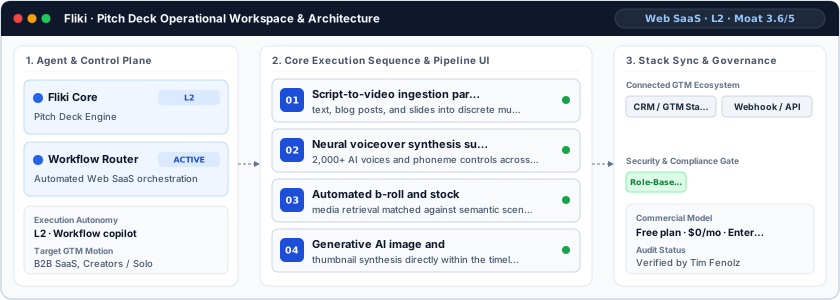
- Script-to-video ingestion parsing raw: text, blog posts, and slides into discrete multi-layer scenes
- Neural voiceover synthesis supporting: 2,000+ AI voices and phoneme controls across 80+ languages
- Automated b-roll and stock: media retrieval matched against semantic scene context
- Generative AI image and: thumbnail synthesis directly within the timeline canvas
Cons: operational limitations & risks
- Semantic Asset Mapping Drift: The algorithmic mapping of text chunks to stock b-roll frequently retrieves literal or mismatched visual metaphors, requiring manual intervention to swap asset layers.
- Timeline Editing Granularity: Lacking non-linear multi-track precision, the scene-based block interface restricts complex video layering, advanced color grading, and custom frame-by-frame pacing adjustments.
- Resolution and Credit Bottlenecks: High-volume rendering runs into credit metering limits and fixed resolution boundaries, which complicates sustained enterprise batch rendering at 4K output standards.
- Infrastructure Latency and Dependency Overhead: Users encounter operational friction and integration bottlenecks, as the pipeline struggles with API latency, token limits, and external dependency drift during high-concurrency production spikes.
Fliki TCO & deal-breaker stress test
Simulate 12-month stepped TCO, hidden cost multipliers, contract lock-in exposure, and stack failure modes using only facts verified by Tim Fenolz on · Capture SHA b73d538f.
Fliki is viable for 5 seats, but requires commercial or technical verification on the flagged items below.
| Plan / Tier | Verified Rate | Scale Fit | Scope & Quota Notes |
|---|---|---|---|
| Free / Sandbox | $0 | 1–2 seats (Evaluation) | Entry free tier with capped usage or feature quotas for initial workflow testing. |
| Standard | $28/mo | 1–2 seats | For creators venturing into AI video production. |
| Growth / Professional | $88/mo | 5 seats | 600 credits per month |
| Enterprise / Custom | Custom quote | 15–50+ seats (Enterprise SLA) | Sales-negotiated annual contract for custom volume, SSO/RBAC governance, and dedicated SLA. |
- Moat Score
- 3.6 / 5.0
- AI Autonomy
- L2
- Free Tier / Trial
- Free plan
Triggered audit signals & failure modes
- Opaque Enterprise Quoting vs. SMB/Mid-Market BudgetVerified Pricing Ledger
Fliki does not disclose a public self-serve floor (Free plan · $0/mo · Enterprise plan). Buyers with a $800/mo cap face high sales-qualification friction.
- Published Self-Serve Entry FloorVerified Pricing Ledger
Fliki publishes a transparent entry point (Free plan · $0/mo · Enterprise plan) with a free tier for initial validation before committing.
- Tier Fit for 5-Seat Scale: Standard ($28/mo)Verified Tier Schedule
For creators venturing into AI video production.
- Primary Operational Bottleneck: Resolution and Credit BottlenecksAudit by Tim Fenolz
High-volume rendering runs into credit metering limits and fixed resolution boundaries, which complicates sustained enterprise batch rendering at 4K output standards.
Hidden TCO Multipliers & Quota Gates
- Per-Seat Linear Scaling: Fliki prices licenses on a per-user/seat basis (Free plan · $0/mo · Enterprise plan); expanding from 2 to 15+ operators multiplies base recurring spend linearly.
- Credit & Usage Burn Multiplier: Automated workflows consume metered credits/usage quotas; multi-step enrichment, voice minutes, or high-frequency agent runs can trigger mid-cycle top-up packs.
When to Walk Away & Negotiation Levers
- Walk away if your workflow requires uncapped enterprise volume on the Free plan · $0/mo · Enterprise plan entry plan without upgrading tiers.
- Walk away if your workflow cannot tolerate semantic asset mapping drift: The algorithmic mapping of text chunks to stock b-roll frequently retrieves literal or mismatched visual metaphors, requiring manual intervention to swap asset layers.
- Walk away if timeline editing granularity is a deal-breaker for your team: Lacking non-linear multi-track precision, the scene-based block interface restricts complex video layering, advanced color grading, and custom frame-by-frame pacing adjustments.
- Validate exact quota thresholds (seats, credits, or API calls) included in Fliki's Free plan · $0/mo · Enterprise plan tier before converting from monthly to annual billing.
- Require a sandbox proof-of-concept testing semantic asset mapping drift against your live CRM/data schema before annual sign-off.
Ask a custom procurement or TCO stress-test question about Fliki
Lower 5-seat floor (~$11/mo vs. Custom Quote)
Lower 5-seat floor (~$19/mo vs. Custom Quote)
Fliki moat & subtrack positioning
Fliki maintains defensibility through an integrated workflow unifying neural text-to-speech across 80+ languages with programmatic scene composition and stock licensing feeds, lowering rendering latency for high-volume content operations.
Editorial review
Fact-checked by Tim Fenolz (Lead AdTech, Programmatic & Attribution Analyst) on .
Background
Fliki addresses the core operational job of translating static written copy into formatted video assets without traditional studio equipment or post-production timelines. Headquartered in Dover, Delaware, and founded in 2022, the platform is engineered for growth marketing teams, corporate instructional designers, and social media managers tasked with producing high-velocity explainer and short-form video collateral. By consolidating text-to-speech conversion and algorithmic scene composition into a unified workspace, Fliki replaces multi-tool editing overhead with structured text inputs.
How Fliki works
At an architectural level, the platform operates as an L2 assistive generation system using an audio-first compositional pipeline. Users submit structured text prompts, slide decks, or blog URLs, which an internal natural language parser segments into discrete storyboard scenes. Each block triggers concurrent downstream jobs: a neural speech synthesis model generates timed voice tracks across target phonemes and languages, while a semantic retrieval agent queries licensed asset repositories or diffusion engines to assign matching background visual media. The rendering engine then programmatically aligns captions, background audio, and visual tracks into unified MP4 exports.
Limitations
Operational considerations and platform boundaries include:
- Semantic Asset Mapping Drift: The algorithmic mapping of text chunks to stock b-roll frequently retrieves literal or mismatched visual metaphors, requiring manual intervention to swap asset layers.
- Timeline Editing Granularity: Lacking non-linear multi-track precision, the scene-based block interface restricts complex video layering, advanced color grading, and custom frame-by-frame pacing adjustments.
- Resolution and Credit Bottlenecks: High-volume rendering runs into credit metering limits and fixed resolution boundaries, which complicates sustained enterprise batch rendering at 4K output standards.
- Infrastructure Latency and Dependency Overhead: Users encounter operational friction and integration bottlenecks, as the pipeline struggles with API latency, token limits, and external dependency drift during high-concurrency production spikes.
Fliki pricing
Fliki utilizes a tiered subscription structure tied to generation credits and feature access. The entry point is a free tier available at $0 per month, which provisions 3 monthly credits and watermarked 720p exports. Paid tiers expand usage quotas, unlock higher resolution outputs, and extend access across the full synthetic voice catalog, while custom enterprise agreements deliver dedicated licensing and team administration.
How Fliki compares
Compared to direct category competitors like Flair.ai and Photoroom, Fliki functions as an alternative focused on specialized workflow execution. Within the visual production category, Fliki occupies a specialized script-to-video niche alongside platforms like Ceros, Fotor AI, and Picmaker. While Ceros focuses on bespoke interactive web experiences and Picmaker optimizes static graphic collaterals, Fliki prioritizes automated video creation driven by voiceover synthesis. Fotor AI delivers broader raster image editing, but Fliki remains the optimal selection for content operations requiring rapid transformation of documentation, articles, and training scripts into captioned multimedia assets. It is best suited for enterprise marketing teams and growth practitioners seeking disciplined workflow orchestration.
Direct competitors & market radar
Top algorithmic competitors based on category positioning, capability overlap, and ICP alignment.
Frequently asked questions about Fliki
How much does Fliki cost and what pricing tiers are available?
Published pricing summary for Fliki: Free plan · $0/mo · Enterprise plan. Fliki includes a free tier or sandbox entry point. Verified tier schedule: Free / Sandbox ($0 for 1–2 seats (Evaluation)); Standard ($28/mo for 1–2 seats); Growth / Professional ($88/mo for 5 seats); Enterprise / Custom (Custom quote for 15–50+ seats (Enterprise SLA)). Fliki utilizes a tiered subscription structure tied to generation credits and feature access. The entry point is a free tier available at $0 per month, which provisions 3 monthly credits and watermarked 720p exports.
How does Fliki work and how autonomous is its AI architecture?
Text-to-video automation engine combining neural speech synthesis, script-to-scene storyboard generation, and stock asset retrieval for automated video. Within Pitch Deck (Marketing Visuals & Pitch Decks), MarTechRadar rates its execution architecture at L2 · Workflow copilot with a verified Moat Score of 3.6 / 5.0 (Proprietary moat). Fliki maintains defensibility through an integrated workflow unifying neural text-to-speech across 80+ languages with programmatic scene composition and stock licensing feeds, lowering rendering latency for high-volume content operations. Corporate profile: Founded by Atul Yadav, Sabir Ahmed, operating at 2-10 employees scale.
What are the main limitations of Fliki and when should buyers walk away?
Based on our editorial technical audit, key operational considerations and boundaries for Fliki include: (1) Semantic Asset Mapping Drift: The algorithmic mapping of text chunks to stock b-roll frequently retrieves literal or mismatched visual metaphors, requiring manual intervention to swap asset layers. (2) Timeline Editing Granularity: Lacking non-linear multi-track precision, the scene-based block interface restricts complex video layering, advanced color grading, and custom frame-by-frame pacing adjustments. (3) Resolution and Credit Bottlenecks: High-volume rendering runs into credit metering limits and fixed resolution boundaries, which complicates sustained enterprise batch rendering at 4K output standards. (4) Infrastructure Latency and Dependency Overhead: Users encounter operational friction and integration bottlenecks, as the pipeline struggles with API latency, token limits, and external dependency drift during high-concurrency production spikes. Primary procurement walk-away rule: Walk away if your workflow requires uncapped enterprise volume on the Free plan · $0/mo · Enterprise plan entry plan without upgrading tiers.
What integrations, compliance certifications, and contract terms apply to Fliki?
First-party governance and developer endpoints verified on domain include: API Docs (https://developer.fliki.ai). Key TCO multiplier to watch: Per-Seat Linear Scaling (Fliki prices licenses on a per-user/seat basis (Free plan · $0/mo · Enterprise plan); expanding from 2 to 15+ operators multiplies base recurring spend linearly.) Before signing a contract, procurement teams should validate exact quota thresholds (seats, credits, or API calls) included in Fliki's Free plan · $0/mo · Enterprise plan tier before converting from monthly to annual billing.
What are the best Fliki alternatives and head-to-head competitors in 2026?
Top fact-checked alternatives to Fliki in Pitch Deck (Marketing Visuals & Pitch Decks) include Topview.ai (From $0.12/mo), Lumen5 (From $19/mo), Fotor AI (Free plan · $10.99–$23.99/mo), Picmaker (From $9/mo). Compared to direct category competitors like Flair.ai and Photoroom, Fliki functions as an alternative focused on specialized workflow execution. Within the visual production category, Fliki occupies a specialized script-to-video niche alongside platforms like Ceros, Fotor AI, and Picmaker.
Verified sources & evidence trail
- Official product domain: https://fliki.ai
- Commercial pricing verification: https://fliki.ai/pricing
- Verified corporate entity profiles (
sameAs): LinkedIn Company Profile · Crunchbase Entity Record - First-party governance & documentation links: API & Docs · Changelog · Terms · Privacy
- Editorial audit sign-off: Fact-checked by Tim Fenolz on under the MarTechRadar Evidence-Ledger Protocol.