Aircover Review (2026): AI SDR Pricing, Limits & Alternatives
Bottom line
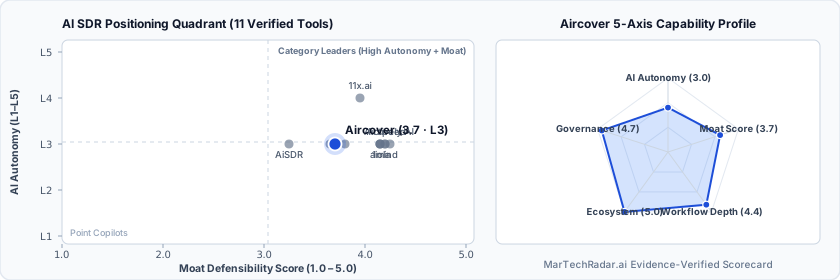
Aircover is a Web SaaS tool for AI SDR (Autonomous B2B Sales Agents & AI BDRs) in AI SDR & Outbound. Pricing: Pricing not disclosed. Best suited to B2B SaaS and Marketing & Growth Teams. Editor ratings: AI autonomy L3 (conditional automation); moat score 3.7/5.0 (Proprietary moat). Fact-checked by Jagmeet Sine on Oct 17, 2026.
Enterprise real-time in-call sales intelligence and AI sales engineering copilot with MCP integration.
Aircover buyer fit verdict: when to choose vs. when to walk away
Choose Aircover if (Best Fit)
- Target ICP & Stack Fit: You operate as B2B SaaS and Marketing & Growth Teams requiring a Web SaaS deployment for AI SDR, with verified ecosystem connectivity for Salesforce, HubSpot, Gong, Microsoft Teams.
- L3 Architecture & Defensibility: Aircover builds enterprise sales enablement defensibility by combining real-time in-meeting objection handling and virtual sales engineering with automated CRM write-backs and Model Context Protocol (MCP) support.
- Commercial Model Fit: Your procurement budget aligns with Pricing not disclosed.
Walk away from Aircover if (Deal-Breakers)
- Walk away if you require transparent self-serve monthly billing or your budget ceiling is under $1,000/mo (Aircover requires sales-gated custom quoting).
- Walk away if your workflow cannot tolerate knowledge repository curation bottleneck: Because Aircover's real-time Virtual Sales Engineer relies on internal battlecards, product docs, and past call transcripts, organizations with outdated enablement wikis face a content-cleanup learning curve before launch.
- Walk away if enterprise per-seat procurement model is a deal-breaker for your team: Aircover scopes commercial pricing by team size bands (1–10, 11–50, 51–200, 200+ seats) via sales consultations rather than offering a public flat-rate credit card checkout.
Aircover key facts & scorecard
| Pricing | Pricing not disclosed |
|---|---|
| Free plan | No / not disclosed |
| Delivery | Web SaaS |
| Audience | B2B SaaS, Marketing & Growth Teams |
| AI autonomy level | L3 · Conditional automationEditor-verified |
| Moat tier & score | 3.7 / 5.0 · Proprietary moatEditor-verified |
| Funding | Seed |
| Total funding | $8.2M |
| Founders | Alex Young, Andrew Levy, David Levy |
| Company size | 11-50 employees |
| Ecosystem integrations | Salesforce, HubSpot, Gong, Microsoft Teams, Zoom |
| Compliance & governance | SOC 2 |
| Governance & docs | Trust & Security ↗ · API & Docs ↗ · Privacy ↗ |
| Headquarters | San Francisco, CA |
| Founded | 2021 |
| Last verified |
Aircover pros & cons: strengths vs. operational limitations
Pros: core strengths & capabilities
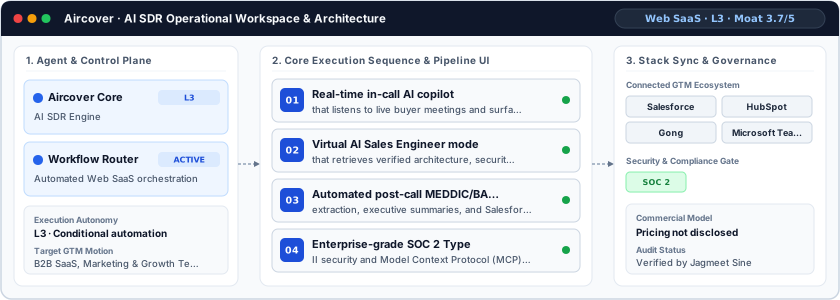
- Real-time in-call AI copilot: that listens to live buyer meetings and surfaces instant technical answers and battlecards
- Virtual AI Sales Engineer mode: that retrieves verified architecture, security, and RFP answers mid-conversation
- Automated post-call MEDDIC/BANT scorecard: extraction, executive summaries, and Salesforce/HubSpot sync
- Enterprise-grade SOC 2 Type: II security and Model Context Protocol (MCP) connectivity for custom GTM agents
Cons: operational limitations & risks
- Knowledge Repository Curation Bottleneck: Because Aircover's real-time Virtual Sales Engineer relies on internal battlecards, product docs, and past call transcripts, organizations with outdated enablement wikis face a content-cleanup learning curve before launch.
- Enterprise Per-Seat Procurement Model: Aircover scopes commercial pricing by team size bands (1–10, 11–50, 51–200, 200+ seats) via sales consultations rather than offering a public flat-rate credit card checkout.
- Live Screen-Space & Rep Attention Balance: Account executives must calibrate notification frequency so real-time prompts support discovery flow without distracting from active executive listening.
Aircover TCO & deal-breaker stress test
Simulate 12-month stepped TCO, hidden cost multipliers, contract lock-in exposure, and stack failure modes using only facts verified by Jagmeet Sine on · Capture SHA f53cf250.
Aircover triggers high-severity friction under your 5-seat / $800/mo constraints. Benchmark the verified subtrack alternatives below before committing.
| Plan / Tier | Verified Rate | Scale Fit | Scope & Quota Notes |
|---|---|---|---|
| Enterprise / Custom | Custom quote | 15–50+ seats (Enterprise SLA) | Sales-negotiated annual contract for custom volume, SSO/RBAC governance, and dedicated SLA. |
- Moat Score
- 3.7 / 5.0
- AI Autonomy
- L3
- Free Tier / Trial
- None disclosed
Triggered audit signals & failure modes
- Opaque Enterprise Quoting vs. SMB/Mid-Market BudgetVerified Pricing Ledger
Aircover does not disclose a public self-serve floor (Pricing not disclosed). Buyers with a $800/mo cap face high sales-qualification friction.
- Sales-Gated Contract TermsFact-checked by Jagmeet Sine
Pricing is available on request through per-user enterprise subscriptions scaled across team size tiers (1–10, 11–50, 51–200, and 200+ reps) with annual billing options.
- Primary Operational Bottleneck: Enterprise Per-Seat Procurement ModelAudit by Jagmeet Sine
Aircover scopes commercial pricing by team size bands (1–10, 11–50, 51–200, 200+ seats) via sales consultations rather than offering a public flat-rate credit card checkout.
Hidden TCO Multipliers & Quota Gates
- Credit & Usage Burn Multiplier: Automated workflows consume metered credits/usage quotas; multi-step enrichment, voice minutes, or high-frequency agent runs can trigger mid-cycle top-up packs.
- Knowledge Repository Curation Bottleneck: Because Aircover's real-time Virtual Sales Engineer relies on internal battlecards, product docs, and past call transcripts, organizations with outdated enablement wikis face a content-cleanup learning curve before launch.
- Enterprise Per-Seat Procurement Model: Aircover scopes commercial pricing by team size bands (1–10, 11–50, 51–200, 200+ seats) via sales consultations rather than offering a public flat-rate credit card checkout.
When to Walk Away & Negotiation Levers
- Walk away if you require transparent self-serve monthly billing or your budget ceiling is under $1,000/mo (Aircover requires sales-gated custom quoting).
- Walk away if your workflow cannot tolerate knowledge repository curation bottleneck: Because Aircover's real-time Virtual Sales Engineer relies on internal battlecards, product docs, and past call transcripts, organizations with outdated enablement wikis face a content-cleanup learning curve before launch.
- Walk away if enterprise per-seat procurement model is a deal-breaker for your team: Aircover scopes commercial pricing by team size bands (1–10, 11–50, 51–200, 200+ seats) via sales consultations rather than offering a public flat-rate credit card checkout.
- Demand a 30- to 60-day paid pilot opt-out clause in the Aircover order form before signing a 12-month enterprise commitment.
- Require a sandbox proof-of-concept testing knowledge repository curation bottleneck against your live CRM/data schema before annual sign-off.
Ask a custom procurement or TCO stress-test question about Aircover
Lower 5-seat floor (~$495/mo vs. Custom Quote) · Transparent self-serve entry without mandatory annual lock-in
Lower 5-seat floor (~$39/mo vs. Custom Quote) · Transparent self-serve entry without mandatory annual lock-in
Aircover key entities, modules & ecosystem stack
Aircover moat & subtrack positioning
Aircover builds enterprise sales enablement defensibility by combining real-time in-meeting objection handling and virtual sales engineering with automated CRM write-backs and Model Context Protocol (MCP) support.
Editorial review
Fact-checked by Jagmeet Sine (Senior MarTech Infrastructure & Agentic Workflow Architect) on .
Background
Founded in 2021 by Alex Young, Andrew Levy, and David Levy and headquartered in San Francisco, CA, Aircover (aircover.ai) is an enterprise real-time sales intelligence and in-meeting AI copilot platform built for B2B account executives, sales engineers, and revenue enablement leaders. Operating with a team of 11 to 50 employees and backed by $8.2M in Seed funding from Defy.vc, Flex Capital, Ridge Ventures, and Firebolt Ventures, the company shifts conversation intelligence from passive post-call recording to active, real-time deal execution during live customer meetings.
How Aircover works
Aircover operates at Level 3 autonomy through a low-latency live meeting audio analyzer, an enterprise retrieval-augmented knowledge engine, and a native Model Context Protocol (MCP) integration layer. Whereas legacy recorders only summarize calls after the meeting ends, Aircover processes live Zoom, Microsoft Teams, and Google Meet conversations as they unfold. The platform detects competitor mentions, pricing pushback, and deep technical questions in real time, pushing verified battlecards and security documentation onto the rep's screen while automatically tracking qualification frameworks (such as MEDDIC) and syncing structured deal notes back into Salesforce or HubSpot.
Limitations
Operational limitations and technical trade-offs include:
- Knowledge Repository Curation Bottleneck: Because Aircover's real-time Virtual Sales Engineer relies on internal battlecards, product docs, and past call transcripts, organizations with outdated enablement wikis face a content-cleanup learning curve before launch.
- Enterprise Per-Seat Procurement Model: Aircover scopes commercial pricing by team size bands (1–10, 11–50, 51–200, 200+ seats) via sales consultations rather than offering a public flat-rate credit card checkout.
- Live Screen-Space & Rep Attention Balance: Account executives must calibrate notification frequency so real-time prompts support discovery flow without distracting from active executive listening.
Aircover pricing
Pricing is available on request through per-user enterprise subscriptions scaled across team size tiers (1–10, 11–50, 51–200, and 200+ reps) with annual billing options. B2B sales and enablement leaders can request a personalized live demo and pricing quote via the Aircover website.
How Aircover compares
Within the Autonomous B2B Sales Agents & AI BDRs and Conversation Intelligence category, Aircover competes against post-call and live enablement alternatives such as Gong, Caretta, and Clari Copilot. Versus post-mortem call archives like Gong that cannot rescue a stalled live discovery call, Aircover differentiates itself through real-time in-meeting Virtual Sales Engineer assistance, SOC 2 Type II enterprise governance, and MCP extensibility. Complex B2B software and cybersecurity sales teams choose Aircover to win technical evaluations faster.
Frequently asked questions about Aircover
How much does Aircover cost and does it require a custom enterprise quote?
Published pricing summary for Aircover: Pricing not disclosed. A permanent free plan is not disclosed for Aircover. Pricing is available on request through per-user enterprise subscriptions scaled across team size tiers (1–10, 11–50, 51–200, and 200+ reps) with annual billing options. B2B sales and enablement leaders can request a personalized live demo and pricing quote via the Aircover website.
How does Aircover work and how autonomous is its AI architecture?
Enterprise real-time in-call sales intelligence and AI sales engineering copilot with MCP integration. Within AI SDR (Autonomous B2B Sales Agents & AI BDRs), MarTechRadar rates its execution architecture at L3 · Conditional automation with a verified Moat Score of 3.7 / 5.0 (Proprietary moat). Aircover builds enterprise sales enablement defensibility by combining real-time in-meeting objection handling and virtual sales engineering with automated CRM write-backs and Model Context Protocol (MCP) support. Corporate profile: Founded by Alex Young, Andrew Levy, David Levy, operating at 11-50 employees scale.
What are the main limitations of Aircover and when should buyers walk away?
Based on our editorial technical audit, key operational considerations and boundaries for Aircover include: (1) Knowledge Repository Curation Bottleneck: Because Aircover's real-time Virtual Sales Engineer relies on internal battlecards, product docs, and past call transcripts, organizations with outdated enablement wikis face a content-cleanup learning curve before launch. (2) Enterprise Per-Seat Procurement Model: Aircover scopes commercial pricing by team size bands (1–10, 11–50, 51–200, 200+ seats) via sales consultations rather than offering a public flat-rate credit card checkout. (3) Live Screen-Space & Rep Attention Balance: Account executives must calibrate notification frequency so real-time prompts support discovery flow without distracting from active executive listening. Primary procurement walk-away rule: Walk away if you require transparent self-serve monthly billing or your budget ceiling is under $1,000/mo (Aircover requires sales-gated custom quoting).
What integrations, compliance certifications, and contract terms apply to Aircover?
Verified ecosystem and stack integrations include Salesforce, HubSpot, Gong, Microsoft Teams, Zoom. Documented security and governance attestations include SOC 2. First-party governance and developer endpoints verified on domain include: Trust/Security (https://www.aircover.ai/trust-center), API Docs (https://www.aircover.ai/developers). Key TCO multiplier to watch: Credit & Usage Burn Multiplier (Automated workflows consume metered credits/usage quotas; multi-step enrichment, voice minutes, or high-frequency agent runs can trigger mid-cycle top-up packs.) Before signing a contract, procurement teams should demand a 30- to 60-day paid pilot opt-out clause in the Aircover order form before signing a 12-month enterprise commitment.
What are the best Aircover alternatives and head-to-head competitors in 2026?
Top fact-checked alternatives to Aircover in AI SDR (Autonomous B2B Sales Agents & AI BDRs) include Caretta (Free plan · $99/seat/mo · Enterprise plan), Apten (Pricing not disclosed), Peppr AI (Pricing not disclosed), Sellva (Custom / enterprise pricing). Within the Autonomous B2B Sales Agents & AI BDRs and Conversation Intelligence category, Aircover competes against post-call and live enablement alternatives such as Gong, Caretta, and Clari Copilot.
Verified sources & evidence trail
- Official product domain: https://aircover.ai
- Commercial pricing verification: Verified against official vendor pricing policy (Pricing not disclosed)
- Verified corporate entity profiles (
sameAs): LinkedIn Company Profile · Crunchbase Entity Record - First-party governance & documentation links: Trust & Security · API & Docs · Privacy
- Editorial audit sign-off: Fact-checked by Jagmeet Sine on under the MarTechRadar Evidence-Ledger Protocol.