Balto Review (2026): AI Calling Pricing, Limits & Alternatives
Bottom line
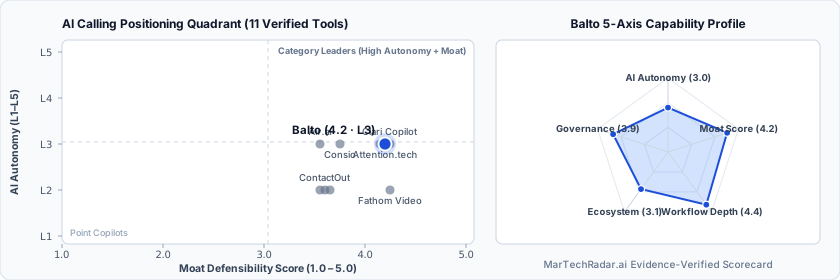
Balto is a Web SaaS tool for AI Calling (Conversational Voice Calling Agents) in AI SDR & Outbound. Pricing: Custom / enterprise pricing. Best suited to B2B SaaS, DTC / eCommerce and Enterprise Brands. Editor ratings: AI autonomy L3 (conditional automation); moat score 4.2/5.0 (Proprietary moat). Fact-checked by Anthony Hay on Oct 14, 2026.
Real-time contact center intelligence platform delivering live agent guidance, automated quality assurance, and conversational analytics during voice calls.
Balto buyer fit verdict: when to choose vs. when to walk away
Choose Balto if (Best Fit)
- Target ICP & Stack Fit: You operate as B2B SaaS, DTC / eCommerce and Enterprise Brands requiring a Web SaaS deployment for AI Calling.
- L3 Architecture & Defensibility: Proprietary low-latency speech recognition and intent classification models tuned for continuous in-call conversational guidance, combined with an automated post-call quality management framework that bridges human agents with autonomous workflows.
- Commercial Model Fit: Your procurement budget aligns with Custom / enterprise pricing.
Walk away from Balto if (Deal-Breakers)
- Walk away if you require transparent self-serve monthly billing or your budget ceiling is under $1,000/mo (Balto requires sales-gated custom quoting).
- Walk away if your workflow cannot tolerate audio stream degradation: Packet loss, acoustic crosstalk, and degraded VoIP codecs hinder live transcription fidelity, periodically causing inaccurate prompt activations.
- Walk away if taxonomy maintenance overhead is a deal-breaker for your team: Complex conversation trees require continual administrative rule tuning and validation to avoid surfacing redundant recommendations to experienced representatives.
Balto key facts & scorecard
| Pricing | Custom / enterprise pricing |
|---|---|
| Free plan | No / not disclosed |
| Delivery | Web SaaS |
| Audience | B2B SaaS, DTC / eCommerce, Enterprise Brands |
| AI autonomy level | L3 · Conditional automationEditor-verified |
| Moat tier & score | 4.2 / 5.0 · Proprietary moatEditor-verified |
| Funding | Series B |
| Total funding | $57.6M |
| Founders | Chris Kontes, Davidson Girard, Marc Bernstein |
| Company size | 51-200 employees |
| Governance & docs | System Status ↗ · Terms ↗ · Privacy ↗ |
| Headquarters | St Louis, Missouri |
| Founded | 2017 |
| Last verified |
Balto pros & cons: strengths vs. operational limitations
Pros: core strengths & capabilities
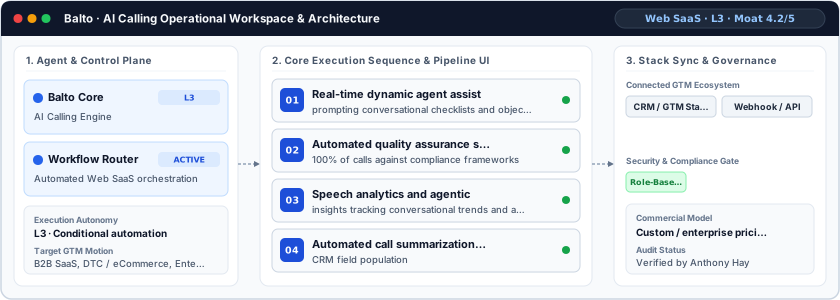
- Real-time dynamic agent assist: prompting conversational checklists and objection handling
- Automated quality assurance scoring: 100% of calls against compliance frameworks
- Speech analytics and agentic: insights tracking conversational trends and adherence
- Automated call summarization and: CRM field population
Cons: operational limitations & risks
- Audio Stream Degradation: Packet loss, acoustic crosstalk, and degraded VoIP codecs hinder live transcription fidelity, periodically causing inaccurate prompt activations.
- Taxonomy Maintenance Overhead: Complex conversation trees require continual administrative rule tuning and validation to avoid surfacing redundant recommendations to experienced representatives.
- Telephony Integration Constraints: Deep deployment requires specific softphone and contact center infrastructure support, occasionally limiting utility across legacy on-premises PBX switches.
Balto TCO & deal-breaker stress test
Simulate 12-month stepped TCO, hidden cost multipliers, contract lock-in exposure, and stack failure modes using only facts verified by Anthony Hay on · Capture SHA d45cce2d.
Balto triggers high-severity friction under your 5-seat / $800/mo constraints. Benchmark the verified subtrack alternatives below before committing.
| Plan / Tier | Verified Rate | Scale Fit | Scope & Quota Notes |
|---|---|---|---|
| Enterprise / Custom | Custom quote | 15–50+ seats (Enterprise SLA) | Sales-negotiated annual contract for custom volume, SSO/RBAC governance, and dedicated SLA. |
- Moat Score
- 4.2 / 5.0
- AI Autonomy
- L3
- Free Tier / Trial
- None disclosed
Triggered audit signals & failure modes
- Opaque Enterprise Quoting vs. SMB/Mid-Market BudgetVerified Pricing Ledger
Balto does not disclose a public self-serve floor (Custom / enterprise pricing). Buyers with a $800/mo cap face high sales-qualification friction.
- Sales-Gated Contract TermsFact-checked by Anthony Hay
Commercial pricing is available on request through tailored enterprise sales quotes based on organizational scale and seats.
- Primary Operational Bottleneck: Audio Stream DegradationAudit by Anthony Hay
Packet loss, acoustic crosstalk, and degraded VoIP codecs hinder live transcription fidelity, periodically causing inaccurate prompt activations.
Hidden TCO Multipliers & Quota Gates
- Audio Stream Degradation: Packet loss, acoustic crosstalk, and degraded VoIP codecs hinder live transcription fidelity, periodically causing inaccurate prompt activations.
- Taxonomy Maintenance Overhead: Complex conversation trees require continual administrative rule tuning and validation to avoid surfacing redundant recommendations to experienced representatives.
When to Walk Away & Negotiation Levers
- Walk away if you require transparent self-serve monthly billing or your budget ceiling is under $1,000/mo (Balto requires sales-gated custom quoting).
- Walk away if your workflow cannot tolerate audio stream degradation: Packet loss, acoustic crosstalk, and degraded VoIP codecs hinder live transcription fidelity, periodically causing inaccurate prompt activations.
- Walk away if taxonomy maintenance overhead is a deal-breaker for your team: Complex conversation trees require continual administrative rule tuning and validation to avoid surfacing redundant recommendations to experienced representatives.
- Demand a 30- to 60-day paid pilot opt-out clause in the Balto order form before signing a 12-month enterprise commitment.
- Require a sandbox proof-of-concept testing audio stream degradation against your live CRM/data schema before annual sign-off.
Ask a custom procurement or TCO stress-test question about Balto
Offers a free tier (Free plan · $0/mo · Enterprise plan) · Transparent self-serve entry without mandatory annual lock-in
Transparent self-serve entry without mandatory annual lock-in
Balto moat & subtrack positioning
Proprietary low-latency speech recognition and intent classification models tuned for continuous in-call conversational guidance, combined with an automated post-call quality management framework that bridges human agents with autonomous workflows.
Editorial review
Fact-checked by Anthony Hay (Senior SEO, Search Intelligence & Content Operations Editor) on .
Background
Modern contact centers struggle to enforce conversational compliance and script adherence across distributed teams without introducing significant post-call administrative overhead. Balto addresses this operational challenge as a real-time agent guidance and conversational intelligence platform. Headquartered in St Louis, Missouri and established in 2017, the company has secured $57.6M in venture backing to transform conversational execution across enterprise contact center environments. Designed primarily for contact center directors, revenue leaders, and quality assurance supervisors, the platform bridges the gap between static scripting and dynamic customer dialogue.
How Balto works
Balto operates at an L3 conditional autonomy tier by processing bidirectional audio streams directly alongside representative workflows. The platform ingests telephony audio via softphone integrations, feeding raw voice packets into a specialized low-latency speech recognition engine. As acoustic data is transcribed, natural language understanding models match real-time utterances against structured compliance logic, talk tracks, and objection taxonomies. The engine surfaces contextual dynamic prompts to agents in under a second. Following call completion, automated scoring routines evaluate regulatory adherence and generate structured summaries for downstream CRM synchronization without human intervention.
Limitations
Operational considerations and platform boundaries include:
- Audio Stream Degradation: Packet loss, acoustic crosstalk, and degraded VoIP codecs hinder live transcription fidelity, periodically causing inaccurate prompt activations.
- Taxonomy Maintenance Overhead: Complex conversation trees require continual administrative rule tuning and validation to avoid surfacing redundant recommendations to experienced representatives.
- Telephony Integration Constraints: Deep deployment requires specific softphone and contact center infrastructure support, occasionally limiting utility across legacy on-premises PBX switches.
Balto pricing
Commercial pricing is available on request through tailored enterprise sales quotes based on organizational scale and seats. Deployments typically configure licensing around user capacity, committed call volumes, and selected capabilities such as real-time coaching or automated quality assurance. Enterprise contracts include onboarding packages, custom speech profile modeling, dedicated customer success management, and integration support for supported contact center platforms.
How Balto compares
Within conversational voice systems, Balto focuses on live human augmentation and guided agent workflows rather than completely autonomous call delegation. Platforms like Bland.ai prioritize fully synthetic, unassisted autonomous voice agents handling outbound cold transfers and inbound queues without humans. Consio targets automated voice interactions, whereas Dialpad Ai embeds native intelligence directly into its proprietary cloud telephony unified communications suite. Balto excels in regulated financial services, healthcare, and insurance organizations that require human oversight paired with real-time computational guardrails.
Direct competitors & market radar
Top algorithmic competitors based on category positioning, capability overlap, and ICP alignment.
Frequently asked questions about Balto
How much does Balto cost and does it require a custom enterprise quote?
Published pricing summary for Balto: Custom / enterprise pricing. A permanent free plan is not disclosed for Balto. Commercial pricing is available on request through tailored enterprise sales quotes based on organizational scale and seats. Deployments typically configure licensing around user capacity, committed call volumes, and selected capabilities such as real-time coaching or automated quality assurance.
How does Balto work and how autonomous is its AI architecture?
Real-time contact center intelligence platform delivering live agent guidance, automated quality assurance, and conversational analytics during voice calls. Within AI Calling (Conversational Voice Calling Agents), MarTechRadar rates its execution architecture at L3 · Conditional automation with a verified Moat Score of 4.2 / 5.0 (Proprietary moat). Proprietary low-latency speech recognition and intent classification models tuned for continuous in-call conversational guidance, combined with an automated post-call quality management framework that bridges human agents with autonomous workflows. Corporate profile: Founded by Chris Kontes, Davidson Girard, Marc Bernstein, operating at 51-200 employees scale.
What are the main limitations of Balto and when should buyers walk away?
Based on our editorial technical audit, key operational considerations and boundaries for Balto include: (1) Audio Stream Degradation: Packet loss, acoustic crosstalk, and degraded VoIP codecs hinder live transcription fidelity, periodically causing inaccurate prompt activations. (2) Taxonomy Maintenance Overhead: Complex conversation trees require continual administrative rule tuning and validation to avoid surfacing redundant recommendations to experienced representatives. (3) Telephony Integration Constraints: Deep deployment requires specific softphone and contact center infrastructure support, occasionally limiting utility across legacy on-premises PBX switches. Primary procurement walk-away rule: Walk away if you require transparent self-serve monthly billing or your budget ceiling is under $1,000/mo (Balto requires sales-gated custom quoting).
What integrations, compliance certifications, and contract terms apply to Balto?
First-party governance and developer endpoints verified on domain include: Status (https://status.balto.ai). Key TCO multiplier to watch: Audio Stream Degradation (Packet loss, acoustic crosstalk, and degraded VoIP codecs hinder live transcription fidelity, periodically causing inaccurate prompt activations.) Before signing a contract, procurement teams should demand a 30- to 60-day paid pilot opt-out clause in the Balto order form before signing a 12-month enterprise commitment.
What are the best Balto alternatives and head-to-head competitors in 2026?
Top fact-checked alternatives to Balto in AI Calling (Conversational Voice Calling Agents) include Alpharun (Custom / enterprise pricing), VerseIQ LTD (Custom / enterprise pricing), Vapi.ai (From $0.05 usage-based), Sybill AI (Free plan · $0/mo · Enterprise plan). Within conversational voice systems, Balto focuses on live human augmentation and guided agent workflows rather than completely autonomous call delegation. Platforms like Bland.ai prioritize fully synthetic, unassisted autonomous voice agents handling outbound cold transfers and inbound queues without humans.
Verified sources & evidence trail
- Official product domain: https://balto.ai
- Commercial pricing verification: Verified against official vendor pricing policy (Custom / enterprise pricing)
- Verified corporate entity profiles (
sameAs): LinkedIn Company Profile · Crunchbase Entity Record - First-party governance & documentation links: System Status · Terms · Privacy
- Editorial audit sign-off: Fact-checked by Anthony Hay on under the MarTechRadar Evidence-Ledger Protocol.