Vapi.ai Review (2026): AI Calling Pricing, Limits & Alternatives
Bottom line
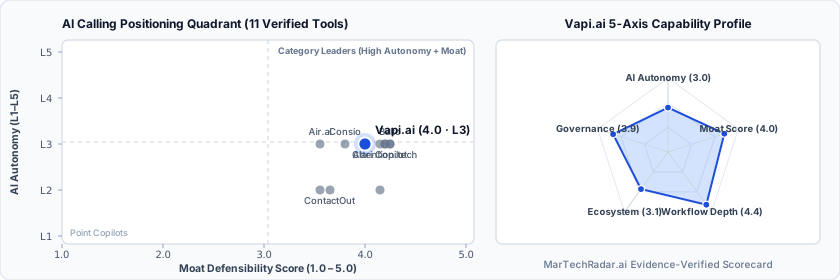
Vapi.ai is a Web SaaS tool for AI Calling (Conversational Voice Calling Agents) in AI SDR & Outbound. Pricing: From $0.05 usage-based. Best suited to B2B SaaS and Marketing Agencies. Editor ratings: AI autonomy L3 (conditional automation); moat score 4.0/5.0 (Proprietary moat). Fact-checked by Anna Xia on Oct 7, 2026.
Voice AI developer platform orchestrating ultra-low-latency telephony, speech recognition, LLM reasoning, and neural voice synthesis via real-time APIs.
Vapi.ai buyer fit verdict: when to choose vs. when to walk away
Choose Vapi.ai if (Best Fit)
- Target ICP & Stack Fit: You operate as B2B SaaS and Marketing Agencies requiring a Web SaaS deployment for AI Calling.
- L3 Architecture & Defensibility: Proprietary low-latency pipeline orchestration layer syncing WebSockets, SIP trunks, turn detection, and modular model swapping with minimal latency jitter.
- Commercial Model Fit: Your procurement budget aligns with From $0.05 usage-based.
Walk away from Vapi.ai if (Deal-Breakers)
- Walk away if your workflow requires uncapped enterprise volume on the From $0.05 usage-based entry plan without upgrading tiers.
- Walk away if your workflow cannot tolerate latency stacking: Compound latency across decoupled external transcribers, reasoning engines, and synthesis APIs creates occasional regional jitter exceeding conversational comfort thresholds.
- Walk away if carrier regulatory overhead is a deal-breaker for your team: Scaling outbound calling campaigns requires external carrier registration, 10DLC compliance verification, and manual STIR/SHAKEN attestation management.
Vapi.ai key facts & scorecard
| Pricing | From $0.05 usage-basedVendor pricing page |
|---|---|
| Free plan | No / not disclosed |
| Delivery | Web SaaS |
| Audience | B2B SaaS, Marketing Agencies |
| AI autonomy level | L3 · Conditional automationEditor-verified |
| Moat tier & score | 4.0 / 5.0 · Proprietary moatEditor-verified |
| Funding | Series B |
| Total funding | $70.6MBacked by Peak XV, Bessemer Venture Partners |
| Founders | John Dearsley, Nik Gupta |
| Company size | 51-200 employees |
| Governance & docs | API & Docs ↗ · Terms ↗ · Privacy ↗ |
| Headquarters | San Francisco, California |
| Founded | 2023 |
| Last verified |
Vapi.ai pros & cons: strengths vs. operational limitations
Pros: core strengths & capabilities
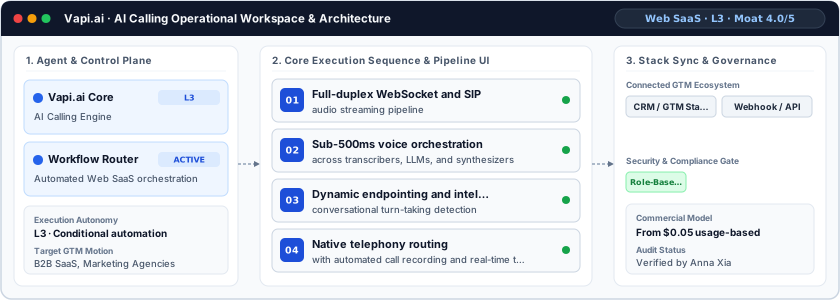
- Full-duplex WebSocket and SIP: audio streaming pipeline
- Sub-500ms voice orchestration: across transcribers, LLMs, and synthesizers
- Dynamic endpointing and intelligent: conversational turn-taking detection
- Native telephony routing: with automated call recording and real-time tool calling
Cons: operational limitations & risks
- Latency Stacking: Compound latency across decoupled external transcribers, reasoning engines, and synthesis APIs creates occasional regional jitter exceeding conversational comfort thresholds.
- Carrier Regulatory Overhead: Scaling outbound calling campaigns requires external carrier registration, 10DLC compliance verification, and manual STIR/SHAKEN attestation management.
- Deterministic Tool Execution: Complex mid-call tool invocations introducing webhook response delays can desynchronize speech generation, producing audible pauses or conversational hallucination during runtime.
Vapi.ai TCO & deal-breaker stress test
Simulate 12-month stepped TCO, hidden cost multipliers, contract lock-in exposure, and stack failure modes using only facts verified by Anna Xia on · Capture SHA cabd4c51.
Vapi.ai is viable for 5 seats, but requires commercial or technical verification on the flagged items below.
| Plan / Tier | Verified Rate | Scale Fit | Scope & Quota Notes |
|---|---|---|---|
| Entry / Starter | $0.05/mo | 1–2 seats | Models pass-through at cost |
| Free | $5/mo | 5 seats | 1 included Vapi phone number |
- Moat Score
- 4.0 / 5.0
- AI Autonomy
- L3
- Free Tier / Trial
- None disclosed
Triggered audit signals & failure modes
- Published Self-Serve Entry FloorVerified Pricing Ledger
Vapi.ai publishes a transparent entry point (From $0.05 usage-based) for initial validation before committing.
- Usage / Credit Burn VolatilityCommercial Model Audit
Vapi.ai uses credit or usage-metered billing (From $0.05 usage-based). High-volume automated workflows across 5 seats can trigger mid-cycle overage charges.
- Tier Fit for 5-Seat Scale: Entry / Starter ($0.05/mo)Verified Tier Schedule
Models pass-through at cost
- Primary Operational Bottleneck: Latency StackingAudit by Anna Xia
Compound latency across decoupled external transcribers, reasoning engines, and synthesis APIs creates occasional regional jitter exceeding conversational comfort thresholds.
Hidden TCO Multipliers & Quota Gates
- Credit & Usage Burn Multiplier: Automated workflows consume metered credits/usage quotas; multi-step enrichment, voice minutes, or high-frequency agent runs can trigger mid-cycle top-up packs.
- Enterprise Governance & Add-On Gating: Advanced capabilities such as Single Sign-On (SSO), custom role permissions, or specialized analytics modules are gated behind upper tiers or paid add-ons.
When to Walk Away & Negotiation Levers
- Walk away if your workflow requires uncapped enterprise volume on the From $0.05 usage-based entry plan without upgrading tiers.
- Walk away if your workflow cannot tolerate latency stacking: Compound latency across decoupled external transcribers, reasoning engines, and synthesis APIs creates occasional regional jitter exceeding conversational comfort thresholds.
- Walk away if carrier regulatory overhead is a deal-breaker for your team: Scaling outbound calling campaigns requires external carrier registration, 10DLC compliance verification, and manual STIR/SHAKEN attestation management.
- Validate exact quota thresholds (seats, credits, or API calls) included in Vapi.ai's From $0.05 usage-based tier before converting from monthly to annual billing.
- Require a sandbox proof-of-concept testing latency stacking against your live CRM/data schema before annual sign-off.
Ask a custom procurement or TCO stress-test question about Vapi.ai
Lower 5-seat floor (~$299/mo vs. Usage-Metered)
Offers a free tier (Free plan · $0/mo · Enterprise plan)
Vapi.ai moat & subtrack positioning
Proprietary low-latency pipeline orchestration layer syncing WebSockets, SIP trunks, turn detection, and modular model swapping with minimal latency jitter.
Editorial review
Fact-checked by Anna Xia (Senior B2B GTM & Revenue Systems Analyst) on .
Background
Voice application development historically forced engineers to manually wire independent telecommunication protocols, transcription engines, large language models, and audio synthesizers into brittle pipelines. Headquartered in San Francisco, California, Vapi.ai was founded in 2023 to resolve this architectural friction through a unified runtime for conversational bots. Backed by $70.6M in venture financing, the infrastructure platform targets software engineers, telecommunications architects, and product teams deploying programmatic voice agents for inbound lead qualification and automated customer service operations.
How Vapi.ai works
Vapi.ai operates as an orchestration middleware layer connecting SIP trunks and WebSockets to underlying speech services. The platform synchronizes speech-to-text providers like Deepgram, generative reasoning layers including OpenAI, and audio generators such as ElevenLabs into a continuous bi-directional streaming pipeline. Its transport layer uses proprietary interruption handling and endpoint detection algorithms to monitor acoustic pauses and vocal collisions, allowing synthetic agents to yield speech immediately upon customer interruption while maintaining context state across function-calling hooks.
Limitations
Operational considerations and platform boundaries include:
- Latency Stacking: Compound latency across decoupled external transcribers, reasoning engines, and synthesis APIs creates occasional regional jitter exceeding conversational comfort thresholds.
- Carrier Regulatory Overhead: Scaling outbound calling campaigns requires external carrier registration, 10DLC compliance verification, and manual STIR/SHAKEN attestation management.
- Deterministic Tool Execution: Complex mid-call tool invocations introducing webhook response delays can desynchronize speech generation, producing audible pauses or conversational hallucination during runtime.
Vapi.ai pricing
The platform relies on an infrastructure billing framework with charges calculated per minute of audio runtime. Production platform access starts from $0.05 per minute for core orchestration services, while third-party downstream usage across transcription, LLM tokens, and neural voice synthesis passes through dynamically or bills directly. New accounts receive $5 in testing credits, with production tiers scaling concurrency limits and enterprise routing across dedicated infrastructure agreements.
How Vapi.ai compares
Vapi.ai occupies an infrastructure-centric position relative to specialized competitors like Bland.ai, Consio, and Dialpad Ai. While Dialpad Ai delivers an out-of-the-box contact center suite with native workforce workflows, and Bland.ai focuses heavily on programmatic outbound telephony campaigns, Vapi.ai isolates developer control at the orchestration layer. It remains ideal for software organizations needing granular API-level governance over custom prompts, external vector stores, and modular neural component stacks.
Direct competitors & market radar
Top algorithmic competitors based on category positioning, capability overlap, and ICP alignment.
Frequently asked questions about Vapi.ai
How does Vapi.ai usage and credit pricing work in 2026?
Published pricing summary for Vapi.ai: From $0.05 usage-based. A permanent free plan is not disclosed for Vapi.ai. Verified tier schedule: Entry / Starter ($0.05/mo for 1–2 seats); Free ($5/mo for 5 seats). The platform relies on an infrastructure billing framework with charges calculated per minute of audio runtime.
How does Vapi.ai work and how autonomous is its AI architecture?
Voice AI developer platform orchestrating ultra-low-latency telephony, speech recognition, LLM reasoning, and neural voice synthesis via real-time APIs. Within AI Calling (Conversational Voice Calling Agents), MarTechRadar rates its execution architecture at L3 · Conditional automation with a verified Moat Score of 4.0 / 5.0 (Proprietary moat). Proprietary low-latency pipeline orchestration layer syncing WebSockets, SIP trunks, turn detection, and modular model swapping with minimal latency jitter. Corporate profile: Founded by John Dearsley, Nik Gupta, operating at 51-200 employees scale.
What are the main limitations of Vapi.ai and when should buyers walk away?
Based on our editorial technical audit, key operational considerations and boundaries for Vapi.ai include: (1) Latency Stacking: Compound latency across decoupled external transcribers, reasoning engines, and synthesis APIs creates occasional regional jitter exceeding conversational comfort thresholds. (2) Carrier Regulatory Overhead: Scaling outbound calling campaigns requires external carrier registration, 10DLC compliance verification, and manual STIR/SHAKEN attestation management. (3) Deterministic Tool Execution: Complex mid-call tool invocations introducing webhook response delays can desynchronize speech generation, producing audible pauses or conversational hallucination during runtime. Primary procurement walk-away rule: Walk away if your workflow requires uncapped enterprise volume on the From $0.05 usage-based entry plan without upgrading tiers.
What integrations, compliance certifications, and contract terms apply to Vapi.ai?
First-party governance and developer endpoints verified on domain include: API Docs (https://docs.vapi.ai). Key TCO multiplier to watch: Credit & Usage Burn Multiplier (Automated workflows consume metered credits/usage quotas; multi-step enrichment, voice minutes, or high-frequency agent runs can trigger mid-cycle top-up packs.) Before signing a contract, procurement teams should validate exact quota thresholds (seats, credits, or API calls) included in Vapi.ai's From $0.05 usage-based tier before converting from monthly to annual billing.
What are the best Vapi.ai alternatives and head-to-head competitors in 2026?
Top fact-checked alternatives to Vapi.ai in AI Calling (Conversational Voice Calling Agents) include Bland.ai (Free plan · $299/mo · Enterprise plan), Retell AI ($0.07–$0.31 usage-based), Synthflow AI (From $30,000/yr), Sybill AI (Free plan · $0/mo · Enterprise plan). Vapi.ai occupies an infrastructure-centric position relative to specialized competitors like Bland.ai, Consio, and Dialpad Ai.
Verified sources & evidence trail
- Official product domain: https://vapi.ai
- Commercial pricing verification: https://vapi.ai/pricing
- Verified corporate entity profiles (
sameAs): LinkedIn Company Profile · Crunchbase Entity Record - First-party governance & documentation links: API & Docs · Terms · Privacy
- Editorial audit sign-off: Fact-checked by Anna Xia on under the MarTechRadar Evidence-Ledger Protocol.