Blankspace Review (2026): DCO Pricing, Limits & Alternatives
Bottom line
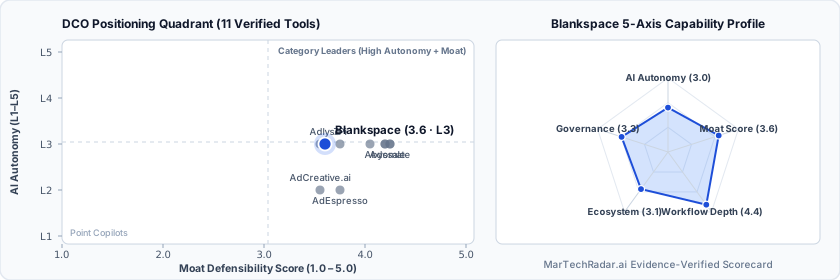
Blankspace is a Web SaaS tool for DCO (Dynamic Creative Optimization / DCO) in AdTech & Paid Media. Pricing: Custom / enterprise pricing. Best suited to Performance Marketing Directors, Ad Agencies and Retail Media Advertisers. Editor ratings: AI autonomy L3 (conditional automation); moat score 3.6/5.0 (Proprietary moat). Fact-checked by Jagmeet Sine on Oct 14, 2026.
Edge-computed monetization engine that intercepts AI search agents and crawler traffic at the CDN layer to conduct programmatic real-time auctions.
Blankspace buyer fit verdict: when to choose vs. when to walk away
Choose Blankspace if (Best Fit)
- Target ICP & Stack Fit: You operate as Performance Marketing Directors, Ad Agencies and Retail Media Advertisers requiring a Web SaaS deployment for DCO.
- L3 Architecture & Defensibility: Defensibility centers on edge-layer crawler fingerprinting combined with low-latency programmatic auctions executed before payload delivery, preventing scraper exploitation while remaining imperceptible to normal users.
- Commercial Model Fit: Your procurement budget aligns with Custom / enterprise pricing.
Walk away from Blankspace if (Deal-Breakers)
- Walk away if you require transparent self-serve monthly billing or your budget ceiling is under $1,000/mo (Blankspace requires sales-gated custom quoting).
- Walk away if your workflow cannot tolerate edge latency budgets: Executing dynamic auctions at the CDN worker layer introduces sub-second execution overhead that risks failing strict AI retrieval bot timeouts if ad exchanges stall.
- Walk away if bot cloaking and fingerprint drift is a deal-breaker for your team: Sophisticated AI agents frequently rotate user-agent headers and proxy networks, leading to misclassification risks that either leak content or risk throttling legitimate crawlers.
Blankspace key facts & scorecard
| Pricing | Custom / enterprise pricing |
|---|---|
| Free plan | No / not disclosed |
| Delivery | Web SaaS |
| Audience | Performance Marketing Directors, Ad Agencies, Retail Media Advertisers |
| AI autonomy level | L3 · Conditional automationEditor-verified |
| Moat tier & score | 3.6 / 5.0 · Proprietary moatEditor-verified |
| Funding | Pre-seed |
| Company size | 2-10 employees |
| Governance & docs | API & Docs ↗ · Terms ↗ · Privacy ↗ |
| Headquarters | London |
| Founded | 2025 |
| Last verified |
Blankspace pros & cons: strengths vs. operational limitations
Pros: core strengths & capabilities
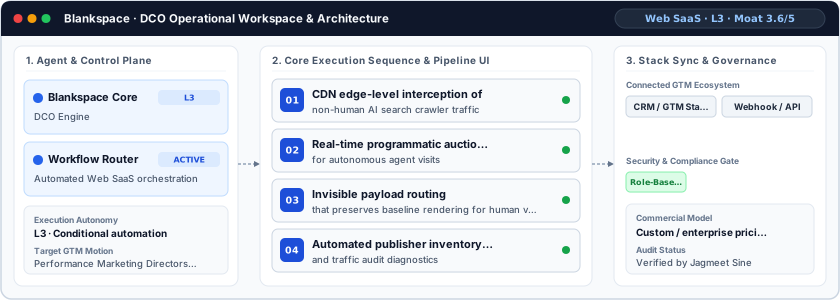
- CDN edge-level interception of: non-human AI search crawler traffic
- Real-time programmatic auction execution: for autonomous agent visits
- Invisible payload routing: that preserves baseline rendering for human visitors
- Automated publisher inventory valuation: and traffic audit diagnostics
Cons: operational limitations & risks
- Edge Latency Budgets: Executing dynamic auctions at the CDN worker layer introduces sub-second execution overhead that risks failing strict AI retrieval bot timeouts if ad exchanges stall.
- Bot Cloaking and Fingerprint Drift: Sophisticated AI agents frequently rotate user-agent headers and proxy networks, leading to misclassification risks that either leak content or risk throttling legitimate crawlers.
- Ad Exchange Liquidity: Programmatic advertiser demand specifically tailored for non-human agent consumption remains constrained compared to traditional display exchanges, limiting fill rates.
Blankspace TCO & deal-breaker stress test
Simulate 12-month stepped TCO, hidden cost multipliers, contract lock-in exposure, and stack failure modes using only facts verified by Jagmeet Sine on · Capture SHA 797aab6a.
Blankspace triggers high-severity friction under your 5-seat / $800/mo constraints. Benchmark the verified subtrack alternatives below before committing.
| Plan / Tier | Verified Rate | Scale Fit | Scope & Quota Notes |
|---|---|---|---|
| Enterprise / Custom | Custom quote | 15–50+ seats (Enterprise SLA) | Sales-negotiated annual contract for custom volume, SSO/RBAC governance, and dedicated SLA. |
- Moat Score
- 3.6 / 5.0
- AI Autonomy
- L3
- Free Tier / Trial
- None disclosed
Triggered audit signals & failure modes
- Opaque Enterprise Quoting vs. SMB/Mid-Market BudgetVerified Pricing Ledger
Blankspace does not disclose a public self-serve floor (Custom / enterprise pricing). Buyers with a $800/mo cap face high sales-qualification friction.
- Sales-Gated Contract TermsFact-checked by Jagmeet Sine
Blankspace operates under enterprise licensing where commercial pricing is available on request through tailored enterprise sales quotes based on organizational scale and seats.
- Primary Operational Bottleneck: Edge Latency BudgetsAudit by Jagmeet Sine
Executing dynamic auctions at the CDN worker layer introduces sub-second execution overhead that risks failing strict AI retrieval bot timeouts if ad exchanges stall.
Hidden TCO Multipliers & Quota Gates
- Edge Latency Budgets: Executing dynamic auctions at the CDN worker layer introduces sub-second execution overhead that risks failing strict AI retrieval bot timeouts if ad exchanges stall.
- Bot Cloaking and Fingerprint Drift: Sophisticated AI agents frequently rotate user-agent headers and proxy networks, leading to misclassification risks that either leak content or risk throttling legitimate crawlers.
When to Walk Away & Negotiation Levers
- Walk away if you require transparent self-serve monthly billing or your budget ceiling is under $1,000/mo (Blankspace requires sales-gated custom quoting).
- Walk away if your workflow cannot tolerate edge latency budgets: Executing dynamic auctions at the CDN worker layer introduces sub-second execution overhead that risks failing strict AI retrieval bot timeouts if ad exchanges stall.
- Walk away if bot cloaking and fingerprint drift is a deal-breaker for your team: Sophisticated AI agents frequently rotate user-agent headers and proxy networks, leading to misclassification risks that either leak content or risk throttling legitimate crawlers.
- Demand a 30- to 60-day paid pilot opt-out clause in the Blankspace order form before signing a 12-month enterprise commitment.
- Require a sandbox proof-of-concept testing edge latency budgets against your live CRM/data schema before annual sign-off.
Ask a custom procurement or TCO stress-test question about Blankspace
Lower 5-seat floor (~$36/mo vs. Custom Quote) · Transparent self-serve entry without mandatory annual lock-in
Lower 5-seat floor (~$99/mo vs. Custom Quote) · Transparent self-serve entry without mandatory annual lock-in
Blankspace moat & subtrack positioning
Defensibility centers on edge-layer crawler fingerprinting combined with low-latency programmatic auctions executed before payload delivery, preventing scraper exploitation while remaining imperceptible to normal users.
Editorial review
Fact-checked by Jagmeet Sine (Senior MarTech Infrastructure & Agentic Workflow Architect) on .
Background
Architected at the edge compute tier, Blankspace decouples publisher content monetization from conventional browser-based ad impressions. Headquartered in London, the platform targets digital publishing engineering leads and monetization directors facing unmonetized traffic from autonomous scrapers and generative AI retrieval engines. Rather than allowing search agents to consume editorial material without commercial attribution, Blankspace acts as an edge proxy to identify, evaluate, and monetize machine-driven page requests without disrupting human reading workflows.
How Blankspace works
Operating at an L3 conditional autonomy tier, Blankspace intercepts incoming HTTP requests directly at the content delivery network layer. The ingestion pipeline applies request fingerprinting, header analysis, and autonomous crawler classification to separate human sessions from live AI retrieval bots. When an AI search agent is identified, the system halts zero-revenue scraping and executes an automated, real-time programmatic auction. The platform dynamically renders contextual sponsor signals or paid content structures into the served machine response, programmatically extracting revenue while serving unchanged source markup to human sessions.
Limitations
Operational considerations and platform boundaries include:
- Edge Latency Budgets: Executing dynamic auctions at the CDN worker layer introduces sub-second execution overhead that risks failing strict AI retrieval bot timeouts if ad exchanges stall.
- Bot Cloaking and Fingerprint Drift: Sophisticated AI agents frequently rotate user-agent headers and proxy networks, leading to misclassification risks that either leak content or risk throttling legitimate crawlers.
- Ad Exchange Liquidity: Programmatic advertiser demand specifically tailored for non-human agent consumption remains constrained compared to traditional display exchanges, limiting fill rates.
Blankspace pricing
Blankspace operates under enterprise licensing where commercial pricing is available on request through tailored enterprise sales quotes based on organizational scale and seats. Contracts reflect edge request volumes, domain footprint, and custom publisher integration requirements, with sales teams provisioning structured technical onboarding and network telemetry audits.
How Blankspace compares
Within modern optimization stacks, Blankspace diverges from design-centric DCO suites like Abyssale and AdCreative.ai, which focus on dynamic visual asset generation, and algorithmic creative bidding platforms like 7Pi. Blankspace bypasses canvas rendering entirely, shifting the dynamic optimization surface to raw machine ingestion traffic at the CDN boundary. This architecture fits large-scale digital publishers requiring programmatic monetization infrastructure against web-scale AI scraping.
Direct competitors & market radar
Top algorithmic competitors based on category positioning, capability overlap, and ICP alignment.
Frequently asked questions about Blankspace
How much does Blankspace cost and does it require a custom enterprise quote?
Published pricing summary for Blankspace: Custom / enterprise pricing. A permanent free plan is not disclosed for Blankspace. Blankspace operates under enterprise licensing where commercial pricing is available on request through tailored enterprise sales quotes based on organizational scale and seats.
How does Blankspace work and how autonomous is its AI architecture?
Edge-computed monetization engine that intercepts AI search agents and crawler traffic at the CDN layer to conduct programmatic real-time auctions. Within DCO (Dynamic Creative Optimization / DCO), MarTechRadar rates its execution architecture at L3 · Conditional automation with a verified Moat Score of 3.6 / 5.0 (Proprietary moat). Defensibility centers on edge-layer crawler fingerprinting combined with low-latency programmatic auctions executed before payload delivery, preventing scraper exploitation while remaining imperceptible to normal users. Corporate profile: operating at 2-10 employees scale.
What are the main limitations of Blankspace and when should buyers walk away?
Based on our editorial technical audit, key operational considerations and boundaries for Blankspace include: (1) Edge Latency Budgets: Executing dynamic auctions at the CDN worker layer introduces sub-second execution overhead that risks failing strict AI retrieval bot timeouts if ad exchanges stall. (2) Bot Cloaking and Fingerprint Drift: Sophisticated AI agents frequently rotate user-agent headers and proxy networks, leading to misclassification risks that either leak content or risk throttling legitimate crawlers. (3) Ad Exchange Liquidity: Programmatic advertiser demand specifically tailored for non-human agent consumption remains constrained compared to traditional display exchanges, limiting fill rates. Primary procurement walk-away rule: Walk away if you require transparent self-serve monthly billing or your budget ceiling is under $1,000/mo (Blankspace requires sales-gated custom quoting).
What integrations, compliance certifications, and contract terms apply to Blankspace?
First-party governance and developer endpoints verified on domain include: API Docs (https://docs.blankspace.so/publishers/getting-started). Key TCO multiplier to watch: Edge Latency Budgets (Executing dynamic auctions at the CDN worker layer introduces sub-second execution overhead that risks failing strict AI retrieval bot timeouts if ad exchanges stall.) Before signing a contract, procurement teams should demand a 30- to 60-day paid pilot opt-out clause in the Blankspace order form before signing a 12-month enterprise commitment.
What are the best Blankspace alternatives and head-to-head competitors in 2026?
Top fact-checked alternatives to Blankspace in DCO (Dynamic Creative Optimization / DCO) include PubMatic Convert (Custom / enterprise pricing), Magnite (Custom / enterprise pricing), Swash (Custom / enterprise pricing), Taiv (Custom / enterprise pricing). Within modern optimization stacks, Blankspace diverges from design-centric DCO suites like Abyssale and AdCreative.ai, which focus on dynamic visual asset generation, and algorithmic creative bidding platforms like 7Pi.
Verified sources & evidence trail
- Official product domain: https://blankspace.so/
- Commercial pricing verification: Verified against official vendor pricing policy (Custom / enterprise pricing)
- Verified corporate entity profiles (
sameAs): LinkedIn Company Profile - First-party governance & documentation links: API & Docs · Terms · Privacy
- Editorial audit sign-off: Fact-checked by Jagmeet Sine on under the MarTechRadar Evidence-Ledger Protocol.