Branch Metrics AI Review (2026): Marketing Attribution Pricing, Limits & Alternatives
Bottom line
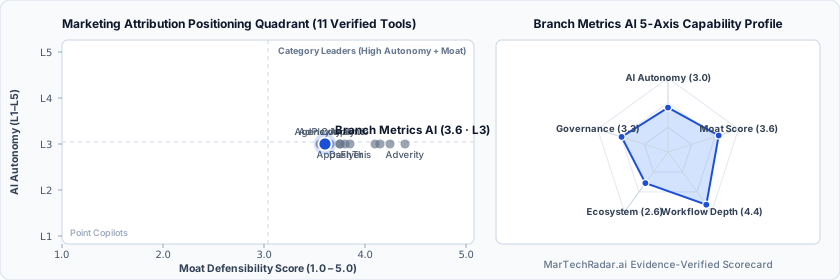
Branch Metrics AI is a API / SDK tool for Marketing Attribution (Multi-Touch Attribution & eCommerce Dashboards) in Analytics & Attribution. Pricing: Custom / enterprise pricing. Best suited to DTC / eCommerce and Enterprise Brands. Editor ratings: AI autonomy L3 (conditional automation); moat score 3.6/5.0 (Proprietary moat). Fact-checked by Anthony Hay on Oct 14, 2026.
Enterprise attribution and deep-linking platform unifying web-to-app routing, cross-channel campaign measurement, and deferred link resolution.
Branch Metrics AI buyer fit verdict: when to choose vs. when to walk away
Choose Branch Metrics AI if (Best Fit)
- Target ICP & Stack Fit: You operate as DTC / eCommerce and Enterprise Brands requiring a API / SDK deployment for Marketing Attribution.
- L3 Architecture & Defensibility: Defensibility centers on extensive mobile SDK deployments, robust deferred deep-linking edge infrastructure, and deterministic web-to-app routing graph algorithms.
- Commercial Model Fit: Your procurement budget aligns with Custom / enterprise pricing.
Walk away from Branch Metrics AI if (Deal-Breakers)
- Walk away if you require transparent self-serve monthly billing or your budget ceiling is under $1,000/mo (Branch Metrics AI requires sales-gated custom quoting).
- Walk away if your workflow cannot tolerate privacy framework constraints: Aggressive platform privacy frameworks like Apple App Tracking Transparency (ATT) restrict deterministic cross-app tracking, forcing reliance on SKAdNetwork aggregations and modeled probabilistic estimates.
- Walk away if SDK footprint & governance overhead is a deal-breaker for your team: Maintaining parity across iOS and Android SDK updates introduces continuous mobile engineering cycles to prevent deferred routing failures and link breakage during native application builds.
Branch Metrics AI key facts & scorecard
| Pricing | Custom / enterprise pricing |
|---|---|
| Free plan | No / not disclosed |
| Delivery | API / SDK |
| Audience | DTC / eCommerce, Enterprise Brands |
| AI autonomy level | L3 · Conditional automationEditor-verified |
| Moat tier & score | 3.6 / 5.0 · Proprietary moatEditor-verified |
| Funding | Venture-backed |
| Governance & docs | Privacy ↗ |
| Headquarters | United States |
| Founded | 2014 |
| Last verified |
Branch Metrics AI pros & cons: strengths vs. operational limitations
Pros: core strengths & capabilities
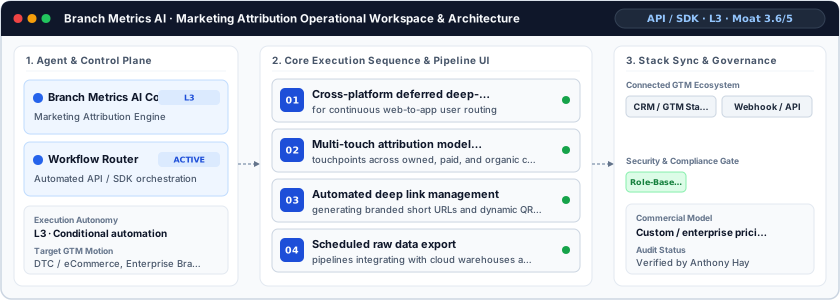
- Cross-platform deferred deep-linking engine: for continuous web-to-app user routing
- Multi-touch attribution models capturing: touchpoints across owned, paid, and organic channels
- Automated deep link management: generating branded short URLs and dynamic QR codes at scale
- Scheduled raw data export: pipelines integrating with cloud warehouses and downstream analytics systems
Cons: operational limitations & risks
- Privacy Framework Constraints: Aggressive platform privacy frameworks like Apple App Tracking Transparency (ATT) restrict deterministic cross-app tracking, forcing reliance on SKAdNetwork aggregations and modeled probabilistic estimates.
- SDK Footprint & Governance Overhead: Maintaining parity across iOS and Android SDK updates introduces continuous mobile engineering cycles to prevent deferred routing failures and link breakage during native application builds.
- Export Processing Latency: While core attribution decisions run near real-time, bulk data exports to external cloud storage buckets experience batch scheduling intervals, causing sync lags for downstream production dashboards.
Branch Metrics AI TCO & deal-breaker stress test
Simulate 12-month stepped TCO, hidden cost multipliers, contract lock-in exposure, and stack failure modes using only facts verified by Anthony Hay on · Capture SHA e857519c.
Branch Metrics AI triggers high-severity friction under your 5-seat / $800/mo constraints. Benchmark the verified subtrack alternatives below before committing.
| Plan / Tier | Verified Rate | Scale Fit | Scope & Quota Notes |
|---|---|---|---|
| Enterprise / Custom | Custom quote | 15–50+ seats (Enterprise SLA) | Sales-negotiated annual contract for custom volume, SSO/RBAC governance, and dedicated SLA. |
- Moat Score
- 3.6 / 5.0
- AI Autonomy
- L3
- Free Tier / Trial
- None disclosed
Triggered audit signals & failure modes
- Opaque Enterprise Quoting vs. SMB/Mid-Market BudgetVerified Pricing Ledger
Branch Metrics AI does not disclose a public self-serve floor (Custom / enterprise pricing). Buyers with a $800/mo cap face high sales-qualification friction.
- Sales-Gated Contract TermsFact-checked by Anthony Hay
Commercial access operates under custom enterprise licensing structured around tracked user volume, monthly active users (MAU), and platform data throughput. Pricing is available on request through tailored enterprise sales quotes based on organizational scale and seats.
- Primary Operational Bottleneck: Privacy Framework ConstraintsAudit by Anthony Hay
Aggressive platform privacy frameworks like Apple App Tracking Transparency (ATT) restrict deterministic cross-app tracking, forcing reliance on SKAdNetwork aggregations and modeled probabilistic estimates.
Hidden TCO Multipliers & Quota Gates
- Privacy Framework Constraints: Aggressive platform privacy frameworks like Apple App Tracking Transparency (ATT) restrict deterministic cross-app tracking, forcing reliance on SKAdNetwork aggregations and modeled probabilistic estimates.
- SDK Footprint & Governance Overhead: Maintaining parity across iOS and Android SDK updates introduces continuous mobile engineering cycles to prevent deferred routing failures and link breakage during native application builds.
When to Walk Away & Negotiation Levers
- Walk away if you require transparent self-serve monthly billing or your budget ceiling is under $1,000/mo (Branch Metrics AI requires sales-gated custom quoting).
- Walk away if your workflow cannot tolerate privacy framework constraints: Aggressive platform privacy frameworks like Apple App Tracking Transparency (ATT) restrict deterministic cross-app tracking, forcing reliance on SKAdNetwork aggregations and modeled probabilistic estimates.
- Walk away if SDK footprint & governance overhead is a deal-breaker for your team: Maintaining parity across iOS and Android SDK updates introduces continuous mobile engineering cycles to prevent deferred routing failures and link breakage during native application builds.
- Demand a 30- to 60-day paid pilot opt-out clause in the Branch Metrics AI order form before signing a 12-month enterprise commitment.
- Require a sandbox proof-of-concept testing privacy framework constraints against your live CRM/data schema before annual sign-off.
Ask a custom procurement or TCO stress-test question about Branch Metrics AI
Lower 5-seat floor (~$15/mo vs. Custom Quote) · Transparent self-serve entry without mandatory annual lock-in
Lower 5-seat floor (~$79/mo vs. Custom Quote) · Transparent self-serve entry without mandatory annual lock-in
Branch Metrics AI moat & subtrack positioning
Defensibility centers on extensive mobile SDK deployments, robust deferred deep-linking edge infrastructure, and deterministic web-to-app routing graph algorithms.
Editorial review
Fact-checked by Anthony Hay (Senior SEO, Search Intelligence & Content Operations Editor) on .
Background
Architectured to bridge cross-platform conversion attribution gaps, Branch Metrics AI functions as an attribution engine and mobile linking platform headquartered in the United States. Designed for enterprise growth engineers, mobile marketing architects, and digital product directors, the system anchors identity across fragmented mobile ecosystems. By uniting web-to-app routing and conversion tracking, the platform eliminates touchpoint blind spots across owned, paid, and organic marketing properties without relying on static browser cookies.
How Branch Metrics AI works
At technical core, the platform operates via client-side SDKs integrated into iOS and Android applications, coupled with lightweight JavaScript wrappers across web endpoints. When a user engages with an activation asset—such as a dynamic QR code, banner, or branded short link—the engine captures probabilistic and deterministic session fingerprints. It executes deferred deep-linking routines to route users directly into target native app views even after deferred installation. Downstream conversion events stream through an algorithmic attribution pipeline, deduplicating multi-touch interactions and exporting raw event schemas into enterprise data warehouses via automated pipelines.
Limitations
Operational considerations and platform boundaries include:
- Privacy Framework Constraints: Aggressive platform privacy frameworks like Apple App Tracking Transparency (ATT) restrict deterministic cross-app tracking, forcing reliance on SKAdNetwork aggregations and modeled probabilistic estimates.
- SDK Footprint & Governance Overhead: Maintaining parity across iOS and Android SDK updates introduces continuous mobile engineering cycles to prevent deferred routing failures and link breakage during native application builds.
- Export Processing Latency: While core attribution decisions run near real-time, bulk data exports to external cloud storage buckets experience batch scheduling intervals, causing sync lags for downstream production dashboards.
Branch Metrics AI pricing
Commercial access operates under custom enterprise licensing structured around tracked user volume, monthly active users (MAU), and platform data throughput. Pricing is available on request through tailored enterprise sales quotes based on organizational scale and seats. Contracts typically cover core deep-linking functionality, advanced attribution modules, and enterprise-grade data export connectors without public tiered usage bands.
How Branch Metrics AI compares
Within multi-touch attribution and mobile measurement, Branch Metrics AI competes alongside dedicated mobile measurement partners like Adjust and AppsFlyer, as well as cross-channel data orchestration platforms like Adverity. While AppsFlyer and Adjust focus heavily on paid ad spend attribution and ad-fraud telemetry, Branch differentiates through deeper web-to-app routing, dynamic banners, and deferred link preservation. Conversely, Adverity excels in marketing ETL extraction without native deep-linking runtimes. Branch serves enterprise brands requiring robust mobile application conversion funnels and integrated web-to-app user flows.
Frequently asked questions about Branch Metrics AI
How much does Branch Metrics AI cost and does it require a custom enterprise quote?
Published pricing summary for Branch Metrics AI: Custom / enterprise pricing. A permanent free plan is not disclosed for Branch Metrics AI. Commercial access operates under custom enterprise licensing structured around tracked user volume, monthly active users (MAU), and platform data throughput. Pricing is available on request through tailored enterprise sales quotes based on organizational scale and seats.
How does Branch Metrics AI work and how autonomous is its AI architecture?
Enterprise attribution and deep-linking platform unifying web-to-app routing, cross-channel campaign measurement, and deferred link resolution. Within Marketing Attribution (Multi-Touch Attribution & eCommerce Dashboards), MarTechRadar rates its execution architecture at L3 · Conditional automation with a verified Moat Score of 3.6 / 5.0 (Proprietary moat). Defensibility centers on extensive mobile SDK deployments, robust deferred deep-linking edge infrastructure, and deterministic web-to-app routing graph algorithms.
What are the main limitations of Branch Metrics AI and when should buyers walk away?
Based on our editorial technical audit, key operational considerations and boundaries for Branch Metrics AI include: (1) Privacy Framework Constraints: Aggressive platform privacy frameworks like Apple App Tracking Transparency (ATT) restrict deterministic cross-app tracking, forcing reliance on SKAdNetwork aggregations and modeled probabilistic estimates. (2) SDK Footprint & Governance Overhead: Maintaining parity across iOS and Android SDK updates introduces continuous mobile engineering cycles to prevent deferred routing failures and link breakage during native application builds. (3) Export Processing Latency: While core attribution decisions run near real-time, bulk data exports to external cloud storage buckets experience batch scheduling intervals, causing sync lags for downstream production dashboards. Primary procurement walk-away rule: Walk away if you require transparent self-serve monthly billing or your budget ceiling is under $1,000/mo (Branch Metrics AI requires sales-gated custom quoting).
What integrations, compliance certifications, and contract terms apply to Branch Metrics AI?
Key TCO multiplier to watch: Privacy Framework Constraints (Aggressive platform privacy frameworks like Apple App Tracking Transparency (ATT) restrict deterministic cross-app tracking, forcing reliance on SKAdNetwork aggregations and modeled probabilistic estimates.) Before signing a contract, procurement teams should demand a 30- to 60-day paid pilot opt-out clause in the Branch Metrics AI order form before signing a 12-month enterprise commitment.
What are the best Branch Metrics AI alternatives and head-to-head competitors in 2026?
Top fact-checked alternatives to Branch Metrics AI in Marketing Attribution (Multi-Touch Attribution & eCommerce Dashboards) include Corvera (Pricing not disclosed), Oviond (Custom / enterprise pricing), Pathmatics (Custom / enterprise pricing), Porter Metrics (Custom / enterprise pricing). Within multi-touch attribution and mobile measurement, Branch Metrics AI competes alongside dedicated mobile measurement partners like Adjust and AppsFlyer, as well as cross-channel data orchestration platforms like Adverity.
Verified sources & evidence trail
- Official product domain: https://branch.io
- Commercial pricing verification: Verified against official vendor pricing policy (Custom / enterprise pricing)
- First-party governance & documentation links: Privacy
- Editorial audit sign-off: Fact-checked by Anthony Hay on under the MarTechRadar Evidence-Ledger Protocol.