Brandwatch Review (2026): Predictive AI Pricing, Limits & Alternatives
Bottom line
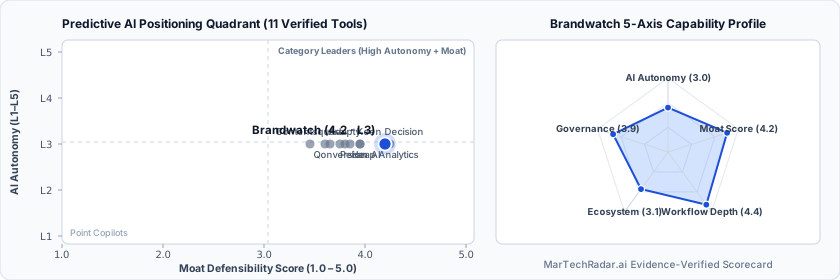
Brandwatch is a Web SaaS tool for Predictive AI (Predictive LTV, Churn & Customer Analytics) in Analytics & Attribution. Pricing: Custom / enterprise pricing. Best suited to Enterprise Brands. Editor ratings: AI autonomy L3 (conditional automation); moat score 4.2/5.0 (Proprietary moat). Fact-checked by Anthony Hay on Oct 12, 2026.
Enterprise consumer intelligence and social listening platform analyzing global digital conversations to extract customer sentiment and brand perception.
Brandwatch buyer fit verdict: when to choose vs. when to walk away
Choose Brandwatch if (Best Fit)
- Target ICP & Stack Fit: You operate as Enterprise Brands requiring a Web SaaS deployment for Predictive AI.
- L3 Architecture & Defensibility: Proprietary crawl index covering more than 1.4 trillion historical web conversations, coupled with deep social network firehose access and the Iris AI NLP analytics engine.
- Commercial Model Fit: Your procurement budget aligns with Custom / enterprise pricing.
Walk away from Brandwatch if (Deal-Breakers)
- Walk away if you require transparent self-serve monthly billing or your budget ceiling is under $1,000/mo (Brandwatch requires sales-gated custom quoting).
- Walk away if your workflow cannot tolerate walled-garden ingestion boundaries: Data coverage remains strictly limited by third-party social API restrictions, leaving closed messaging applications and gated network environments inaccessible for customer analysis.
- Walk away if entity disambiguation drift is a deal-breaker for your team: Iris AI models encounter classification degradation when tracking generic brand names, polysemous terms, or rapid shifts in colloquial internet syntax, requiring continuous manual query hygiene.
Brandwatch key facts & scorecard
| Pricing | Custom / enterprise pricing |
|---|---|
| Free plan | No / not disclosed |
| Delivery | Web SaaS |
| Audience | Enterprise Brands |
| AI autonomy level | L3 · Conditional automationEditor-verified |
| Moat tier & score | 4.2 / 5.0 · Proprietary moatEditor-verified |
| Funding | AcquiredAcquired by Cision |
| Total funding | $64.7MBacked by Highland Europe |
| Founders | Giles Palmer, Ulrik Bo Larsen |
| Company size | 501-1,000 employees |
| Governance & docs | System Status ↗ · Changelog ↗ |
| Headquarters | London, United Kingdom |
| Founded | 2007 |
| Last verified |
Brandwatch pros & cons: strengths vs. operational limitations
Pros: core strengths & capabilities
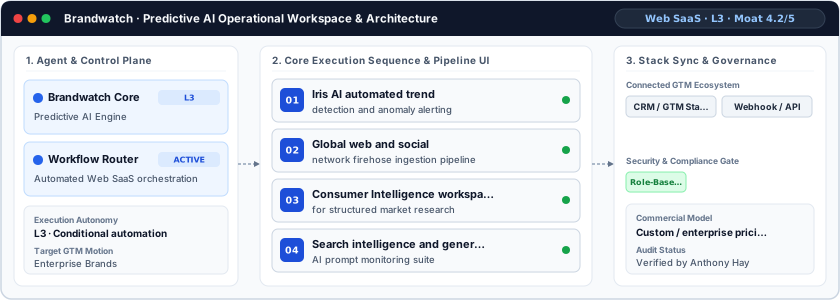
- Iris AI automated trend: detection and anomaly alerting
- Global web and social: network firehose ingestion pipeline
- Consumer Intelligence workspace: for structured market research
- Search intelligence and generative: AI prompt monitoring suite
Cons: operational limitations & risks
- Walled-garden ingestion boundaries: Data coverage remains strictly limited by third-party social API restrictions, leaving closed messaging applications and gated network environments inaccessible for customer analysis.
- Entity disambiguation drift: Iris AI models encounter classification degradation when tracking generic brand names, polysemous terms, or rapid shifts in colloquial internet syntax, requiring continuous manual query hygiene.
- Firehose volume budget exhaustion: Unplanned viral surges or broad query definitions rapidly deplete contracted monthly mention caps, forcing teams to throttle ingestion feeds or accept retroactive query omissions.
Brandwatch TCO & deal-breaker stress test
Simulate 12-month stepped TCO, hidden cost multipliers, contract lock-in exposure, and stack failure modes using only facts verified by Anthony Hay on · Capture SHA 6b729df8.
Brandwatch triggers high-severity friction under your 5-seat / $800/mo constraints. Benchmark the verified subtrack alternatives below before committing.
| Plan / Tier | Verified Rate | Scale Fit | Scope & Quota Notes |
|---|---|---|---|
| Enterprise / Custom | Custom quote | 15–50+ seats (Enterprise SLA) | Sales-negotiated annual contract for custom volume, SSO/RBAC governance, and dedicated SLA. |
- Moat Score
- 4.2 / 5.0
- AI Autonomy
- L3
- Free Tier / Trial
- None disclosed
Triggered audit signals & failure modes
- Opaque Enterprise Quoting vs. SMB/Mid-Market BudgetVerified Pricing Ledger
Brandwatch does not disclose a public self-serve floor (Custom / enterprise pricing). Buyers with a $800/mo cap face high sales-qualification friction.
- Sales-Gated Contract TermsFact-checked by Anthony Hay
Commercial procurement operates through tailored enterprise sales quotes based on organizational scale and seats.
- Primary Operational Bottleneck: Firehose volume budget exhaustionAudit by Anthony Hay
Unplanned viral surges or broad query definitions rapidly deplete contracted monthly mention caps, forcing teams to throttle ingestion feeds or accept retroactive query omissions.
Hidden TCO Multipliers & Quota Gates
- Walled-garden ingestion boundaries: Data coverage remains strictly limited by third-party social API restrictions, leaving closed messaging applications and gated network environments inaccessible for customer analysis.
- Entity disambiguation drift: Iris AI models encounter classification degradation when tracking generic brand names, polysemous terms, or rapid shifts in colloquial internet syntax, requiring continuous manual query hygiene.
When to Walk Away & Negotiation Levers
- Walk away if you require transparent self-serve monthly billing or your budget ceiling is under $1,000/mo (Brandwatch requires sales-gated custom quoting).
- Walk away if your workflow cannot tolerate walled-garden ingestion boundaries: Data coverage remains strictly limited by third-party social API restrictions, leaving closed messaging applications and gated network environments inaccessible for customer analysis.
- Walk away if entity disambiguation drift is a deal-breaker for your team: Iris AI models encounter classification degradation when tracking generic brand names, polysemous terms, or rapid shifts in colloquial internet syntax, requiring continuous manual query hygiene.
- Demand a 30- to 60-day paid pilot opt-out clause in the Brandwatch order form before signing a 12-month enterprise commitment.
- Require a sandbox proof-of-concept testing walled-garden ingestion boundaries against your live CRM/data schema before annual sign-off.
Ask a custom procurement or TCO stress-test question about Brandwatch
Transparent self-serve entry without mandatory annual lock-in
Offers a free tier (Free plan · $2,500 · Enterprise plan) · Transparent self-serve entry without mandatory annual lock-in
Brandwatch moat & subtrack positioning
Proprietary crawl index covering more than 1.4 trillion historical web conversations, coupled with deep social network firehose access and the Iris AI NLP analytics engine.
Editorial review
Fact-checked by Anthony Hay (Senior SEO, Search Intelligence & Content Operations Editor) on .
Background
Established in 2007 in London, United Kingdom, Brandwatch scaled through $64.7M in venture capital funding prior to its strategic acquisition by PR software conglomerate Cision. Operating as an enterprise consumer intelligence and brand analytics suite, the platform serves market research executives, brand strategists, and customer intelligence leaders. Brandwatch captures unstructured public web discourse to translate external market sentiment into structured behavioral signals, giving commercial teams visibility into customer perception, competitive positioning, and macro demand shifts across digital channels.
How Brandwatch works
Brandwatch deploys high-throughput ingestion pipelines consuming real-time firehoses and web crawlers across social platforms, news aggregators, message boards, and review sites. Ingestion streams pass through Brandwatch's proprietary Iris AI natural language processing engine, which executes syntactic parsing, multi-lingual sentiment extraction, named entity recognition, and automated cluster categorization. Operating at Level 3 conditional autonomy, the platform surfaces statistical anomalies, conversation spikes, and emerging brand risks autonomously, while human market researchers configure Boolean taxonomy filters and query logic to analyze audience cohorts and product associations.
Limitations
Operational considerations and platform boundaries include:
- Walled-garden ingestion boundaries: Data coverage remains strictly limited by third-party social API restrictions, leaving closed messaging applications and gated network environments inaccessible for customer analysis.
- Entity disambiguation drift: Iris AI models encounter classification degradation when tracking generic brand names, polysemous terms, or rapid shifts in colloquial internet syntax, requiring continuous manual query hygiene.
- Firehose volume budget exhaustion: Unplanned viral surges or broad query definitions rapidly deplete contracted monthly mention caps, forcing teams to throttle ingestion feeds or accept retroactive query omissions.
Brandwatch pricing
Commercial procurement operates through tailored enterprise sales quotes based on organizational scale and seats. Contracts scale based on contracted annual mention volumes, named user seats across Consumer Intelligence and Social Media modules, historical query archive depth, and access to advanced Iris AI predictive features without public self-serve tiers.
How Brandwatch compares
Whereas Pecan AI focuses on automated predictive modeling over internal transactional tabular data, and digital experience engines like Contentsquare or Heap Analytics track first-party on-site behavioral telemetry, Brandwatch captures external macroeconomic sentiment. The platform suits global enterprises requiring macro consumer sentiment and risk monitoring, trading direct first-party behavioral capture for deep external market listening.
Direct competitors & market radar
Top algorithmic competitors based on category positioning, capability overlap, and ICP alignment.
Frequently asked questions about Brandwatch
How much does Brandwatch cost and does it require a custom enterprise quote?
Published pricing summary for Brandwatch: Custom / enterprise pricing. A permanent free plan is not disclosed for Brandwatch. Commercial procurement operates through tailored enterprise sales quotes based on organizational scale and seats.
How does Brandwatch work and how autonomous is its AI architecture?
Enterprise consumer intelligence and social listening platform analyzing global digital conversations to extract customer sentiment and brand perception. Within Predictive AI (Predictive LTV, Churn & Customer Analytics), MarTechRadar rates its execution architecture at L3 · Conditional automation with a verified Moat Score of 4.2 / 5.0 (Proprietary moat). Proprietary crawl index covering more than 1.4 trillion historical web conversations, coupled with deep social network firehose access and the Iris AI NLP analytics engine. Corporate profile: Founded by Giles Palmer, Ulrik Bo Larsen, operating at 501-1,000 employees scale, acquired by Cision.
What are the main limitations of Brandwatch and when should buyers walk away?
Based on our editorial technical audit, key operational considerations and boundaries for Brandwatch include: (1) Walled-garden ingestion boundaries: Data coverage remains strictly limited by third-party social API restrictions, leaving closed messaging applications and gated network environments inaccessible for customer analysis. (2) Entity disambiguation drift: Iris AI models encounter classification degradation when tracking generic brand names, polysemous terms, or rapid shifts in colloquial internet syntax, requiring continuous manual query hygiene. (3) Firehose volume budget exhaustion: Unplanned viral surges or broad query definitions rapidly deplete contracted monthly mention caps, forcing teams to throttle ingestion feeds or accept retroactive query omissions. Primary procurement walk-away rule: Walk away if you require transparent self-serve monthly billing or your budget ceiling is under $1,000/mo (Brandwatch requires sales-gated custom quoting).
What integrations, compliance certifications, and contract terms apply to Brandwatch?
First-party governance and developer endpoints verified on domain include: Status (https://status.brandwatch.com). Key TCO multiplier to watch: Walled-garden ingestion boundaries (Data coverage remains strictly limited by third-party social API restrictions, leaving closed messaging applications and gated network environments inaccessible for customer analysis.) Before signing a contract, procurement teams should demand a 30- to 60-day paid pilot opt-out clause in the Brandwatch order form before signing a 12-month enterprise commitment.
What are the best Brandwatch alternatives and head-to-head competitors in 2026?
Top fact-checked alternatives to Brandwatch in Predictive AI (Predictive LTV, Churn & Customer Analytics) include Contentsquare (€39–€79/mo), BlueOceanAI (Custom / enterprise pricing), Pecan AI (Custom / enterprise pricing), Heap Analytics (Custom / enterprise pricing). Whereas Pecan AI focuses on automated predictive modeling over internal transactional tabular data, and digital experience engines like Contentsquare or Heap Analytics track first-party on-site behavioral telemetry, Brandwatch captures external macroeconomic sentiment.
Verified sources & evidence trail
- Official product domain: https://brandwatch.com
- Commercial pricing verification: Verified against official vendor pricing policy (Custom / enterprise pricing)
- Verified corporate entity profiles (
sameAs): LinkedIn Company Profile · Crunchbase Entity Record - First-party governance & documentation links: System Status · Changelog
- Editorial audit sign-off: Fact-checked by Anthony Hay on under the MarTechRadar Evidence-Ledger Protocol.