Keen Decision Systems Review (2026): Predictive AI Pricing, Limits & Alternatives
Bottom line
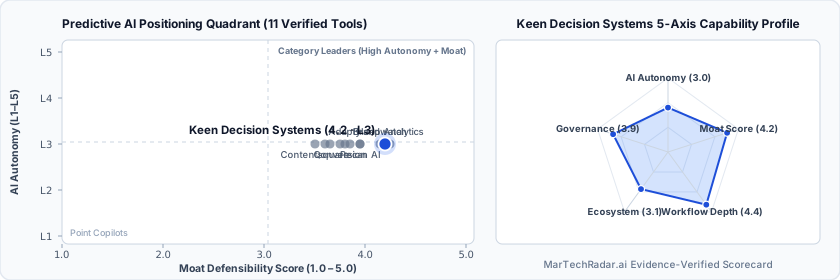
Keen Decision Systems is a Web SaaS tool for Predictive AI (Predictive LTV, Churn & Customer Analytics) in Analytics & Attribution. Pricing: Custom / enterprise pricing. Best suited to DTC / eCommerce and Enterprise Brands. Editor ratings: AI autonomy L3 (conditional automation); moat score 4.2/5.0 (Proprietary moat). Fact-checked by Julie Brot on Oct 14, 2026.
Predictive marketing investment decision engine leveraging econometric modeling and Bayesian algorithms to optimize cross-channel budget allocation.
Keen Decision Systems buyer fit verdict: when to choose vs. when to walk away
Choose Keen Decision Systems if (Best Fit)
- Target ICP & Stack Fit: You operate as DTC / eCommerce and Enterprise Brands requiring a Web SaaS deployment for Predictive AI.
- L3 Architecture & Defensibility: Proprietary Bayesian marketing mix modeling engine trained across continuous retail and marketing telemetry, offering fast predictive scenario simulation without relying on user-level tracking.
- Commercial Model Fit: Your procurement budget aligns with Custom / enterprise pricing.
Walk away from Keen Decision Systems if (Deal-Breakers)
- Walk away if you require transparent self-serve monthly billing or your budget ceiling is under $1,000/mo (Keen Decision Systems requires sales-gated custom quoting).
- Walk away if your workflow cannot tolerate cold-start data latency: The underlying econometric models demand a minimum of twelve to twenty-four months of continuous, clean historical media and sales data before producing statistically sound predictive allocations.
- Walk away if granular tactical blind spots is a deal-breaker for your team: Because the system constructs high-level macro investment curves, it cannot optimize intraday programmatic bid adjustments, creative variants, or real-time keyword auctions.
Keen Decision Systems key facts & scorecard
| Pricing | Custom / enterprise pricing |
|---|---|
| Free plan | No / not disclosed |
| Delivery | Web SaaS |
| Audience | DTC / eCommerce, Enterprise Brands |
| AI autonomy level | L3 · Conditional automationEditor-verified |
| Moat tier & score | 4.2 / 5.0 · Proprietary moatEditor-verified |
| Funding | Series C+ |
| Total funding | $17.9M |
| Founders | Alan Hart, Greg Dolan, John Busbice |
| Company size | 11-50 employees |
| Governance & docs | Privacy ↗ |
| Headquarters | Research Triangle Park, North Carolina |
| Founded | 2010 |
| Last verified |
Keen Decision Systems pros & cons: strengths vs. operational limitations
Pros: core strengths & capabilities
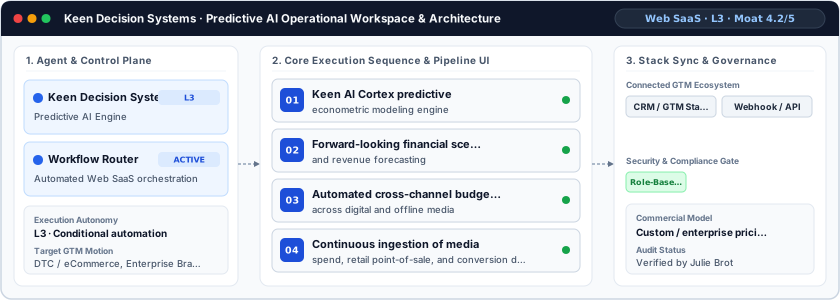
- Keen AI Cortex predictive: econometric modeling engine
- Forward-looking financial scenario simulation: and revenue forecasting
- Automated cross-channel budget optimization: across digital and offline media
- Continuous ingestion of media: spend, retail point-of-sale, and conversion data
Cons: operational limitations & risks
- Cold-Start Data Latency: The underlying econometric models demand a minimum of twelve to twenty-four months of continuous, clean historical media and sales data before producing statistically sound predictive allocations.
- Granular Tactical Blind Spots: Because the system constructs high-level macro investment curves, it cannot optimize intraday programmatic bid adjustments, creative variants, or real-time keyword auctions.
- Schema and Baseline Volatility: Sudden exogenous shocks, rapid supply-chain disruptions, or unrecorded pricing alterations skew model baselines, requiring manual calibration of model priors by data analysts.
Keen Decision Systems TCO & deal-breaker stress test
Simulate 12-month stepped TCO, hidden cost multipliers, contract lock-in exposure, and stack failure modes using only facts verified by Julie Brot on · Capture SHA 000a703b.
Keen Decision Systems triggers high-severity friction under your 5-seat / $800/mo constraints. Benchmark the verified subtrack alternatives below before committing.
| Plan / Tier | Verified Rate | Scale Fit | Scope & Quota Notes |
|---|---|---|---|
| Enterprise / Custom | Custom quote | 15–50+ seats (Enterprise SLA) | Sales-negotiated annual contract for custom volume, SSO/RBAC governance, and dedicated SLA. |
- Moat Score
- 4.2 / 5.0
- AI Autonomy
- L3
- Free Tier / Trial
- None disclosed
Triggered audit signals & failure modes
- Opaque Enterprise Quoting vs. SMB/Mid-Market BudgetVerified Pricing Ledger
Keen Decision Systems does not disclose a public self-serve floor (Custom / enterprise pricing). Buyers with a $800/mo cap face high sales-qualification friction.
- Sales-Gated Contract TermsFact-checked by Julie Brot
Commercial access to the platform follows a dedicated enterprise software subscription model. Pricing is available on request through tailored enterprise sales quotes based on organizational scale and seats.
- Primary Operational Bottleneck: Cold-Start Data LatencyAudit by Julie Brot
The underlying econometric models demand a minimum of twelve to twenty-four months of continuous, clean historical media and sales data before producing statistically sound predictive allocations.
Hidden TCO Multipliers & Quota Gates
- Cold-Start Data Latency: The underlying econometric models demand a minimum of twelve to twenty-four months of continuous, clean historical media and sales data before producing statistically sound predictive allocations.
- Granular Tactical Blind Spots: Because the system constructs high-level macro investment curves, it cannot optimize intraday programmatic bid adjustments, creative variants, or real-time keyword auctions.
When to Walk Away & Negotiation Levers
- Walk away if you require transparent self-serve monthly billing or your budget ceiling is under $1,000/mo (Keen Decision Systems requires sales-gated custom quoting).
- Walk away if your workflow cannot tolerate cold-start data latency: The underlying econometric models demand a minimum of twelve to twenty-four months of continuous, clean historical media and sales data before producing statistically sound predictive allocations.
- Walk away if granular tactical blind spots is a deal-breaker for your team: Because the system constructs high-level macro investment curves, it cannot optimize intraday programmatic bid adjustments, creative variants, or real-time keyword auctions.
- Demand a 30- to 60-day paid pilot opt-out clause in the Keen Decision Systems order form before signing a 12-month enterprise commitment.
- Require a sandbox proof-of-concept testing cold-start data latency against your live CRM/data schema before annual sign-off.
Ask a custom procurement or TCO stress-test question about Keen Decision Systems
Transparent self-serve entry without mandatory annual lock-in
Offers a free tier (Free plan · $2,500 · Enterprise plan) · Transparent self-serve entry without mandatory annual lock-in
Keen Decision Systems moat & subtrack positioning
Proprietary Bayesian marketing mix modeling engine trained across continuous retail and marketing telemetry, offering fast predictive scenario simulation without relying on user-level tracking.
Editorial review
Fact-checked by Julie Brot (Enterprise SaaS Governance & Procurement Editor) on .
Background
To solve the persistent challenge of accurately projecting returns on cross-channel marketing spend, Keen Decision Systems provides an algorithmic investment decision engine. Headquartered in Research Triangle Park, North Carolina, and founded in 2010, the company has raised $17.9M in total venture capital funding. Engineered primarily for Chief Marketing Officers, financial planners, and media decision-makers managing complex multi-channel budgets, the platform operationalizes predictive analytics to forecast marginal revenue gains rather than simply diagnosing historical performance.
How Keen Decision Systems works
At its technical core, the platform operates through the Keen AI Cortex, an econometric modeling pipeline driven by adaptive Bayesian statistical methods. The system ingests structured financial metrics, marketing delivery telemetry, macroeconomic signals, and point-of-sale records. Rather than relying on fragile deterministic click identifiers, the engine models media lag effects, diminishing marginal returns, and baseline brand equity over rolling multi-year horizons. Operating at an L3 conditional autonomy tier, the system automatically simulates forward-looking financial outcomes, allowing operators to run programmatic what-if scenarios to optimize prospective capital allocation.
Limitations
Operational considerations and platform boundaries include:
- Cold-Start Data Latency: The underlying econometric models demand a minimum of twelve to twenty-four months of continuous, clean historical media and sales data before producing statistically sound predictive allocations.
- Granular Tactical Blind Spots: Because the system constructs high-level macro investment curves, it cannot optimize intraday programmatic bid adjustments, creative variants, or real-time keyword auctions.
- Schema and Baseline Volatility: Sudden exogenous shocks, rapid supply-chain disruptions, or unrecorded pricing alterations skew model baselines, requiring manual calibration of model priors by data analysts.
Keen Decision Systems pricing
Commercial access to the platform follows a dedicated enterprise software subscription model. Pricing is available on request through tailored enterprise sales quotes based on organizational scale and seats. Contracts are scoped annually and depend on modeled brand portfolios, overall tracked media expenditure, and dedicated onboarding engineering requirements.
How Keen Decision Systems compares
Within analytics ecosystems, Keen Decision Systems distinguishes itself through macro investment modeling rather than micro-level user pathing. Digital experience analytics engines like Contentsquare and Heap Analytics capture fine-grained on-site behavioral events and clickstream funnels, whereas Keen projects macro revenue impacts across offline and online media. Brandwatch focuses on unstructured social listening and market sentiment signals. Consequently, Keen is purpose-built for mid-market to enterprise omnichannel brands allocating significant media capital across fragmented retail and direct-to-consumer environments.
Direct competitors & market radar
Top algorithmic competitors based on category positioning, capability overlap, and ICP alignment.
Frequently asked questions about Keen Decision Systems
How much does Keen Decision Systems cost and does it require a custom enterprise quote?
Published pricing summary for Keen Decision Systems: Custom / enterprise pricing. A permanent free plan is not disclosed for Keen Decision Systems. Commercial access to the platform follows a dedicated enterprise software subscription model. Pricing is available on request through tailored enterprise sales quotes based on organizational scale and seats.
How does Keen Decision Systems work and how autonomous is its AI architecture?
Predictive marketing investment decision engine leveraging econometric modeling and Bayesian algorithms to optimize cross-channel budget allocation. Within Predictive AI (Predictive LTV, Churn & Customer Analytics), MarTechRadar rates its execution architecture at L3 · Conditional automation with a verified Moat Score of 4.2 / 5.0 (Proprietary moat). Proprietary Bayesian marketing mix modeling engine trained across continuous retail and marketing telemetry, offering fast predictive scenario simulation without relying on user-level tracking. Corporate profile: Founded by Alan Hart, Greg Dolan, John Busbice, operating at 11-50 employees scale.
What are the main limitations of Keen Decision Systems and when should buyers walk away?
Based on our editorial technical audit, key operational considerations and boundaries for Keen Decision Systems include: (1) Cold-Start Data Latency: The underlying econometric models demand a minimum of twelve to twenty-four months of continuous, clean historical media and sales data before producing statistically sound predictive allocations. (2) Granular Tactical Blind Spots: Because the system constructs high-level macro investment curves, it cannot optimize intraday programmatic bid adjustments, creative variants, or real-time keyword auctions. (3) Schema and Baseline Volatility: Sudden exogenous shocks, rapid supply-chain disruptions, or unrecorded pricing alterations skew model baselines, requiring manual calibration of model priors by data analysts. Primary procurement walk-away rule: Walk away if you require transparent self-serve monthly billing or your budget ceiling is under $1,000/mo (Keen Decision Systems requires sales-gated custom quoting).
What integrations, compliance certifications, and contract terms apply to Keen Decision Systems?
Key TCO multiplier to watch: Cold-Start Data Latency (The underlying econometric models demand a minimum of twelve to twenty-four months of continuous, clean historical media and sales data before producing statistically sound predictive allocations.) Before signing a contract, procurement teams should demand a 30- to 60-day paid pilot opt-out clause in the Keen Decision Systems order form before signing a 12-month enterprise commitment.
What are the best Keen Decision Systems alternatives and head-to-head competitors in 2026?
Top fact-checked alternatives to Keen Decision Systems in Predictive AI (Predictive LTV, Churn & Customer Analytics) include Contentsquare (€39–€79/mo), Brandwatch (Custom / enterprise pricing), Heap Analytics (Custom / enterprise pricing), Faraday (Pricing not disclosed). Within analytics ecosystems, Keen Decision Systems distinguishes itself through macro investment modeling rather than micro-level user pathing.
Verified sources & evidence trail
- Official product domain: https://keends.com
- Commercial pricing verification: Verified against official vendor pricing policy (Custom / enterprise pricing)
- Verified corporate entity profiles (
sameAs): LinkedIn Company Profile · Crunchbase Entity Record - First-party governance & documentation links: Privacy
- Editorial audit sign-off: Fact-checked by Julie Brot on under the MarTechRadar Evidence-Ledger Protocol.