RevenueCat Review (2026): Predictive AI Pricing, Limits & Alternatives
Bottom line
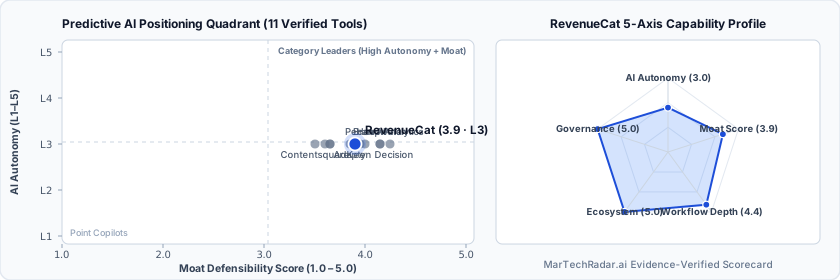
RevenueCat is a SaaS Platform tool for Predictive AI (Predictive LTV, Churn & Customer Analytics) in Analytics & Attribution. Pricing: Free plan · $2,500 · Enterprise plan. Best suited to B2B Marketing & GTM Teams. Editor ratings: AI autonomy L3 (conditional automation); moat score 3.9/5.0 (Proprietary moat). Fact-checked by Jiacky Lee on Oct 18, 2026.
In-app subscription backend and monetization platform delivering predictive LTV cohort analytics, remote paywalls, and churn recovery.
RevenueCat buyer fit verdict: when to choose vs. when to walk away
Choose RevenueCat if (Best Fit)
- Target ICP & Stack Fit: You operate as B2B Marketing & GTM Teams requiring a SaaS Platform deployment for Predictive AI, with verified ecosystem connectivity for Twilio Segment, Amplitude, Mixpanel, Meta Ads.
- L3 Architecture & Defensibility: RevenueCat commands a category-defining infrastructure moat across tens of thousands of apps through its battle-tested cross-platform entitlement ledger, predictive LTV cohort engine, and unbundled Growth Tools.
- Commercial Model Fit: Your procurement budget aligns with Free plan · $2,500 · Enterprise plan and want a self-serve free tier for zero-cost initial validation.
Walk away from RevenueCat if (Deal-Breakers)
- Walk away if your team is at early validation stage with a <$250/mo tool budget (RevenueCat starts at Free plan · $2,500 · Enterprise plan before seat or usage expansion).
- Walk away if your workflow cannot tolerate B2C subscription architecture boundary: RevenueCat is purpose-built for high-volume consumer and prosumer subscription apps across app stores and web checkouts, meaning B2B SaaS organizations requiring custom CPQ quoting, multi-entity net-terms invoicing, or complex usage-tiered enterprise contracts must look to B2B billing engines.
- Walk away if early-cohort forecast variance bottleneck is a deal-breaker for your team: Predictive LTV models rely on historical renewal curves and store category priors; when an app introduces an entirely new annual price point or enters an emerging geographic market, early LTV projections face higher variance until local renewal cohorts mature.
RevenueCat key facts & scorecard
| Pricing | Free plan · $2,500 · Enterprise planVendor pricing page |
|---|---|
| Free plan | Yes |
| Delivery | SaaS Platform |
| Audience | B2B Marketing & GTM Teams |
| AI autonomy level | L3 · Conditional automationEditor-verified |
| Moat tier & score | 3.9 / 5.0 · Proprietary moatEditor-verified |
| Funding | Series C+ |
| Total funding | $118.5MBacked by Index Ventures, Y Combinator, Bain Capital Ventures, FundersClub, SaaStr |
| Founders | Jacob Eiting, Miguel Carranza |
| Company size | 51-200 employees |
| Ecosystem integrations | Twilio Segment, Amplitude, Mixpanel, Meta Ads, Braze |
| Compliance & governance | SOC 2, GDPR, CCPA |
| Governance & docs | System Status ↗ · API & Docs ↗ · Changelog ↗ · Terms ↗ · Privacy ↗ |
| Headquarters | Brandon, Florida, United States |
| Founded | 2017 |
| Last verified |
RevenueCat pros & cons: strengths vs. operational limitations
Pros: core strengths & capabilities
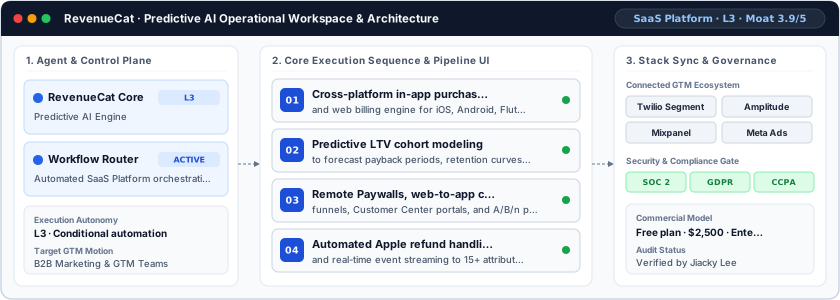
- Cross-platform in-app purchase backend: and web billing engine for iOS, Android, Flutter, React Native, and Unity
- Predictive LTV cohort modeling: to forecast payback periods, retention curves, and acquisition ROAS
- Remote Paywalls, web-to-app conversion: funnels, Customer Center portals, and A/B/n price testing
- Automated Apple refund handling: and real-time event streaming to 15+ attribution, analytics, and CRM platforms
Cons: operational limitations & risks
- B2C Subscription Architecture Boundary: RevenueCat is purpose-built for high-volume consumer and prosumer subscription apps across app stores and web checkouts, meaning B2B SaaS organizations requiring custom CPQ quoting, multi-entity net-terms invoicing, or complex usage-tiered enterprise contracts must look to B2B billing engines.
- Early-Cohort Forecast Variance Bottleneck: Predictive LTV models rely on historical renewal curves and store category priors; when an app introduces an entirely new annual price point or enters an emerging geographic market, early LTV projections face higher variance until local renewal cohorts mature.
- Percentage Fee Scaling Trade-Off: While a 1% revenue-share model eliminates upfront fixed software costs for early-stage developers, consumer apps scaling into tens of millions in monthly recurring revenue must evaluate Enterprise volume discounts against internal engineering maintenance costs.
RevenueCat TCO & deal-breaker stress test
Simulate 12-month stepped TCO, hidden cost multipliers, contract lock-in exposure, and stack failure modes using only facts verified by Jiacky Lee on · Capture SHA f3cb99af.
RevenueCat triggers high-severity friction under your 5-seat / $800/mo constraints. Benchmark the verified subtrack alternatives below before committing.
| Plan / Tier | Verified Rate | Scale Fit | Scope & Quota Notes |
|---|---|---|---|
| Free / Sandbox | $0 | 1–2 seats (Evaluation) | Entry free tier with capped usage or feature quotas for initial workflow testing. |
| Entry / Starter | $2500/mo | 1–2 seats | Verified $2500/mo published rate on vendor pricing schedule. |
| Enterprise / Custom | Custom quote | 15–50+ seats (Enterprise SLA) | Sales-negotiated annual contract for custom volume, SSO/RBAC governance, and dedicated SLA. |
- Moat Score
- 3.9 / 5.0
- AI Autonomy
- L3
- Free Tier / Trial
- Free plan
Triggered audit signals & failure modes
- Budget Ceiling Breached ($2,500/mo vs. $800/mo cap)Verified Pricing Ledger
At 5 seats, RevenueCat's verified entry floor (Free plan · $2,500 · Enterprise plan) exceeds your $800/mo budget before add-ons or overages.
- Published Self-Serve Entry FloorVerified Pricing Ledger
RevenueCat publishes a transparent entry point (Free plan · $2,500 · Enterprise plan) with a free tier for initial validation before committing.
- Primary Operational Bottleneck: B2C Subscription Architecture BoundaryAudit by Jiacky Lee
RevenueCat is purpose-built for high-volume consumer and prosumer subscription apps across app stores and web checkouts, meaning B2B SaaS organizations requiring custom CPQ quoting, multi-entity net-terms invoicing, or complex usage-tiered enterprise contracts must look to B2B billing engines.
Hidden TCO Multipliers & Quota Gates
- Credit & Usage Burn Multiplier: Automated workflows consume metered credits/usage quotas; multi-step enrichment, voice minutes, or high-frequency agent runs can trigger mid-cycle top-up packs.
- B2C Subscription Architecture Boundary: RevenueCat is purpose-built for high-volume consumer and prosumer subscription apps across app stores and web checkouts, meaning B2B SaaS organizations requiring custom CPQ quoting, multi-entity net-terms invoicing, or complex usage-tiered enterprise contracts must look to B2B billing engines.
- Early-Cohort Forecast Variance Bottleneck: Predictive LTV models rely on historical renewal curves and store category priors; when an app introduces an entirely new annual price point or enters an emerging geographic market, early LTV projections face higher variance until local renewal cohorts mature.
When to Walk Away & Negotiation Levers
- Walk away if your team is at early validation stage with a <$250/mo tool budget (RevenueCat starts at Free plan · $2,500 · Enterprise plan before seat or usage expansion).
- Walk away if your workflow cannot tolerate B2C subscription architecture boundary: RevenueCat is purpose-built for high-volume consumer and prosumer subscription apps across app stores and web checkouts, meaning B2B SaaS organizations requiring custom CPQ quoting, multi-entity net-terms invoicing, or complex usage-tiered enterprise contracts must look to B2B billing engines.
- Walk away if early-cohort forecast variance bottleneck is a deal-breaker for your team: Predictive LTV models rely on historical renewal curves and store category priors; when an app introduces an entirely new annual price point or enters an emerging geographic market, early LTV projections face higher variance until local renewal cohorts mature.
- Negotiate price-lock protection on additional seats and overage credits above the Free plan · $2,500 · Enterprise plan entry tier.
- Require a sandbox proof-of-concept testing B2C subscription architecture boundary against your live CRM/data schema before annual sign-off.
Ask a custom procurement or TCO stress-test question about RevenueCat
Offers a free tier (Free plan · $0/mo · Enterprise plan)
Offers a free tier (Free plan · $7,000 · Enterprise plan)
RevenueCat key entities, modules & ecosystem stack
RevenueCat moat & subtrack positioning
RevenueCat commands a category-defining infrastructure moat across tens of thousands of apps through its battle-tested cross-platform entitlement ledger, predictive LTV cohort engine, and unbundled Growth Tools.
Editorial review
Fact-checked by Jiacky Lee (Managing Editor, AI Autonomy & Moat Methodology) on .
Background
Founded in 2017 by Jacob Eiting and Miguel Carranza and headquartered in Brandon, Florida, United States, RevenueCat (revenuecat.com) is a cross-platform in-app subscription backend, paywall experimentation, and predictive LTV analytics platform built for mobile and web consumer application developers. Operating with a team of 51-200 employees and backed by $118.5M in Series C funding from Index Ventures, Y Combinator, Bain Capital Ventures, FundersClub, and SaaStr, the company provides unified purchase infrastructure across iOS, Android, Flutter, React Native, Unity, and web checkouts. Rather than maintaining brittle server-side receipt validation microservices and manual cohort spreadsheets as Apple StoreKit and Google Play Billing APIs evolve, mobile growth and engineering teams rely on RevenueCat as their single source of truth for subscriber entitlements and monetization telemetry.
How RevenueCat works
RevenueCat operates at Level 3 autonomy by combining a cross-platform subscription state ledger with predictive LTV cohort modeling, remote Paywalls, web-to-app conversion funnels, and A/B/n price testing. As applications ingest trial starts, initial purchases, renewals, grace-period recoveries, and refund notifications through open-source SDKs and RevenueCat Billing, the platform's predictive LTV engine models long-term realized and projected revenue by acquisition cohort, enabling user acquisition managers to estimate payback periods and ROAS within hours of install. Growth teams can deploy remote paywall templates, customer center self-service portals, and web-to-app checkout flows without shipping new binary builds, while automated refund handling rules submit consumption data to Apple to mitigate chargeback leakage. Real-time webhooks and native connectors stream clean subscription events to Adjust, Airbridge, Apple Search Ads, AppsFlyer, Branch, Meta Ads, Singular, SplitMetrics Acquire, Tenjin, Amplitude, Firebase, Mixpanel, mParticle, PostHog, Segment, Statsig, Superwall, and Braze under SOC 2 Type II, GDPR, CCPA/CPRA, and LGPD compliance.
Limitations
Operational limitations and technical trade-offs include:
- B2C Subscription Architecture Boundary: RevenueCat is purpose-built for high-volume consumer and prosumer subscription apps across app stores and web checkouts, meaning B2B SaaS organizations requiring custom CPQ quoting, multi-entity net-terms invoicing, or complex usage-tiered enterprise contracts must look to B2B billing engines.
- Early-Cohort Forecast Variance Bottleneck: Predictive LTV models rely on historical renewal curves and store category priors; when an app introduces an entirely new annual price point or enters an emerging geographic market, early LTV projections face higher variance until local renewal cohorts mature.
- Percentage Fee Scaling Trade-Off: While a 1% revenue-share model eliminates upfront fixed software costs for early-stage developers, consumer apps scaling into tens of millions in monthly recurring revenue must evaluate Enterprise volume discounts against internal engineering maintenance costs.
RevenueCat pricing
RevenueCat offers an ungated, usage-aligned pricing structure where every platform feature is unlocked from day one. Under the Pro plan, developers pay nothing up to $2,500 in monthly tracked revenue (MTR), and then pay 1% of MTR once tracked revenue exceeds $2,500 per month. Alternatively, publishers that already maintain their own internal in-app purchase ledger can adopt RevenueCat's standalone Growth Tools (Paywalls, web-to-app funnels, and A/B/n testing) and pay 1% of MTR solely on conversions generated by those tools. High-volume publishers can negotiate custom Enterprise contracts featuring volume discounts, flexible tracking configurations, dedicated support, and custom uptime SLAs.
How RevenueCat compares
Within the Predictive LTV, Churn & Customer Analytics category, RevenueCat competes against mobile subscription monetization platforms such as Adapty, Qonversion, and Superwall. Versus Superwall, which specializes primarily in advanced paywall UI customization and behavioral trigger rules, RevenueCat differentiates itself as a widely adopted cross-platform entitlement backend and web billing engine backed by deep cohort LTV datasets across tens of thousands of apps. Compared to Adapty and Qonversion, RevenueCat offers an unbundled Growth Tools option that can layer directly on top of a publisher's existing in-house IAP infrastructure.
Frequently asked questions about RevenueCat
How much does RevenueCat cost and what pricing tiers are available?
Published pricing summary for RevenueCat: Free plan · $2,500 · Enterprise plan. RevenueCat includes a free tier or sandbox entry point. Verified tier schedule: Free / Sandbox ($0 for 1–2 seats (Evaluation)); Entry / Starter ($2500/mo for 1–2 seats); Enterprise / Custom (Custom quote for 15–50+ seats (Enterprise SLA)). RevenueCat offers an ungated, usage-aligned pricing structure where every platform feature is unlocked from day one. Under the Pro plan, developers pay nothing up to $2,500 in monthly tracked revenue (MTR), and then pay 1% of MTR once tracked revenue exceeds $2,500 per month.
How does RevenueCat work and how autonomous is its AI architecture?
In-app subscription backend and monetization platform delivering predictive LTV cohort analytics, remote paywalls, and churn recovery. Within Predictive AI (Predictive LTV, Churn & Customer Analytics), MarTechRadar rates its execution architecture at L3 · Conditional automation with a verified Moat Score of 3.9 / 5.0 (Proprietary moat). RevenueCat commands a category-defining infrastructure moat across tens of thousands of apps through its battle-tested cross-platform entitlement ledger, predictive LTV cohort engine, and unbundled Growth Tools. Corporate profile: Founded by Jacob Eiting, Miguel Carranza, operating at 51-200 employees scale.
What are the main limitations of RevenueCat and when should buyers walk away?
Based on our editorial technical audit, key operational considerations and boundaries for RevenueCat include: (1) B2C Subscription Architecture Boundary: RevenueCat is purpose-built for high-volume consumer and prosumer subscription apps across app stores and web checkouts, meaning B2B SaaS organizations requiring custom CPQ quoting, multi-entity net-terms invoicing, or complex usage-tiered enterprise contracts must look to B2B billing engines. (2) Early-Cohort Forecast Variance Bottleneck: Predictive LTV models rely on historical renewal curves and store category priors; when an app introduces an entirely new annual price point or enters an emerging geographic market, early LTV projections face higher variance until local renewal cohorts mature. (3) Percentage Fee Scaling Trade-Off: While a 1% revenue-share model eliminates upfront fixed software costs for early-stage developers, consumer apps scaling into tens of millions in monthly recurring revenue must evaluate Enterprise volume discounts against internal engineering maintenance costs. Primary procurement walk-away rule: Walk away if your team is at early validation stage with a <$250/mo tool budget (RevenueCat starts at Free plan · $2,500 · Enterprise plan before seat or usage expansion).
What integrations, compliance certifications, and contract terms apply to RevenueCat?
Verified ecosystem and stack integrations include Twilio Segment, Amplitude, Mixpanel, Meta Ads, Braze. Documented security and governance attestations include SOC 2, GDPR, CCPA. First-party governance and developer endpoints verified on domain include: Status (https://status.revenuecat.com), API Docs (https://www.revenuecat.com/docs). Key TCO multiplier to watch: Credit & Usage Burn Multiplier (Automated workflows consume metered credits/usage quotas; multi-step enrichment, voice minutes, or high-frequency agent runs can trigger mid-cycle top-up packs.) Before signing a contract, procurement teams should negotiate price-lock protection on additional seats and overage credits above the Free plan · $2,500 · Enterprise plan entry tier.
What are the best RevenueCat alternatives and head-to-head competitors in 2026?
Top fact-checked alternatives to RevenueCat in Predictive AI (Predictive LTV, Churn & Customer Analytics) include Adapty (Free plan · $0/mo · Enterprise plan), Superwall ($0/mo · Enterprise plan), Qonversion (Free plan · $7,000 · Enterprise plan), Tenjin (Custom / enterprise pricing). Within the Predictive LTV, Churn & Customer Analytics category, RevenueCat competes against mobile subscription monetization platforms such as Adapty, Qonversion, and Superwall.
Verified sources & evidence trail
- Official product domain: https://revenuecat.com
- Commercial pricing verification: https://www.revenuecat.com/pricing
- Verified corporate entity profiles (
sameAs): LinkedIn Company Profile · Crunchbase Entity Record - First-party governance & documentation links: System Status · API & Docs · Changelog · Terms · Privacy
- Editorial audit sign-off: Fact-checked by Jiacky Lee on under the MarTechRadar Evidence-Ledger Protocol.