Superwall Review (2026): AI Landing Page Pricing, Limits & Alternatives
Bottom line
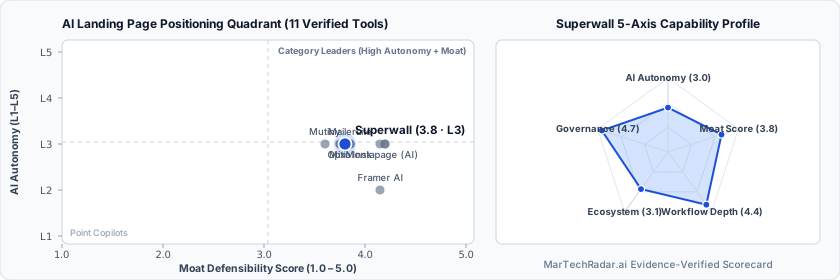
Superwall is a SaaS Platform tool for AI Landing Page (Landing Page Builders & Autonomous CRO) in Lifecycle & CDP. Pricing: $0/mo · Enterprise plan. Best suited to B2B Marketing & GTM Teams. Editor ratings: AI autonomy L3 (conditional automation); moat score 3.8/5.0 (Proprietary moat). Fact-checked by Jiacky Lee on Oct 18, 2026.
AI-powered mobile app paywall builder and remote monetization experimentation platform for dynamic conversion optimization.
Superwall buyer fit verdict: when to choose vs. when to walk away
Choose Superwall if (Best Fit)
- Target ICP & Stack Fit: You operate as B2B Marketing & GTM Teams requiring a SaaS Platform deployment for AI Landing Page.
- L3 Architecture & Defensibility: Superwall maintains a strong developer and growth moat through its remote paywall rendering SDKs, CLI and Claude Code agent skills, Demand Score propensity targeting, and $1.5B+ in tracked component ARR.
- Commercial Model Fit: Your procurement budget aligns with $0/mo · Enterprise plan.
Walk away from Superwall if (Deal-Breakers)
- Walk away if your workflow requires uncapped enterprise volume on the $0/mo · Enterprise plan entry plan without upgrading tiers.
- Walk away if your workflow cannot tolerate mobile-first monetization scope: Superwall is architected specifically around consumer app paywalls, trial-to-paid flows, and self-serve web-to-app checkouts, offering minimal utility for B2B enterprises relying on multi-stakeholder sales-assisted demos or custom CPQ contracts.
- Walk away if experiment traffic bottleneck is a deal-breaker for your team: Running simultaneous multivariate tests across localized paywall copy, pricing tiers, and behavioral placement triggers requires substantial daily active user traffic to reach statistical significance without prolonging test cycles.
Superwall key facts & scorecard
| Pricing | $0/mo · Enterprise planVendor pricing page |
|---|---|
| Free plan | No / not disclosed |
| Delivery | SaaS Platform |
| Audience | B2B Marketing & GTM Teams |
| AI autonomy level | L3 · Conditional automationEditor-verified |
| Moat tier & score | 3.8 / 5.0 · Proprietary moatEditor-verified |
| Funding | Seed |
| Total funding | $4.2MBacked by Y Combinator, Acurio Ventures, FJ Labs, Weekend Fund, Shrug Capital |
| Founders | Brian Anglin, Jake Mor |
| Company size | 11-50 employees |
| Compliance & governance | GDPR |
| Governance & docs | System Status ↗ · API & Docs ↗ · Changelog ↗ · DPA ↗ · Terms ↗ · Privacy ↗ |
| Headquarters | Claymont, Delaware, United States |
| Founded | 2021 |
| Last verified |
Superwall pros & cons: strengths vs. operational limitations
Pros: core strengths & capabilities
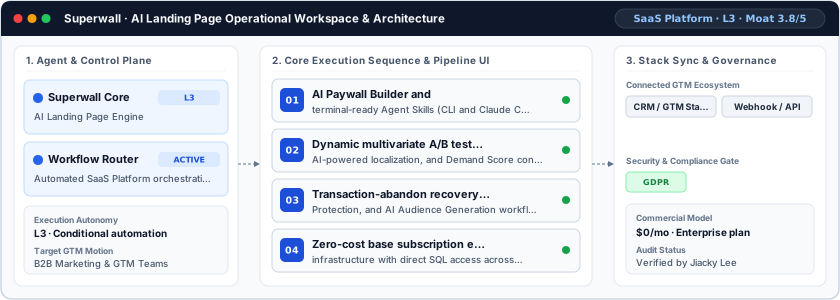
- AI Paywall Builder and: terminal-ready Agent Skills (CLI and Claude Code) for remote paywall creation
- Dynamic multivariate A/B testing,: AI-powered localization, and Demand Score conversion propensity targeting
- Transaction-abandon recovery surveys, Refund: Protection, and AI Audience Generation workflows
- Zero-cost base subscription entitlement: infrastructure with direct SQL access across iOS, Android, and Web
Cons: operational limitations & risks
- Mobile-First Monetization Scope: Superwall is architected specifically around consumer app paywalls, trial-to-paid flows, and self-serve web-to-app checkouts, offering minimal utility for B2B enterprises relying on multi-stakeholder sales-assisted demos or custom CPQ contracts.
- Experiment Traffic Bottleneck: Running simultaneous multivariate tests across localized paywall copy, pricing tiers, and behavioral placement triggers requires substantial daily active user traffic to reach statistical significance without prolonging test cycles.
- Event Taxonomy Learning Curve: Unlocking granular campaign targeting and transaction-abandon triggers requires engineering teams to instrument clean placement events and user attribute schemas across their mobile codebase during initial setup.
Superwall TCO & deal-breaker stress test
Simulate 12-month stepped TCO, hidden cost multipliers, contract lock-in exposure, and stack failure modes using only facts verified by Jiacky Lee on · Capture SHA a90bb0ca.
Superwall is viable for 5 seats, but requires commercial or technical verification on the flagged items below.
| Plan / Tier | Verified Rate | Scale Fit | Scope & Quota Notes |
|---|---|---|---|
| Entry / Starter | $49/mo | 1–2 seats | Continue with Startup |
| Scale | $199/mo | 5 seats | Continue with Scale |
| Enterprise / Custom | Custom quote | 15–50+ seats (Enterprise SLA) | Sales-negotiated annual contract for custom volume, SSO/RBAC governance, and dedicated SLA. |
- Moat Score
- 3.8 / 5.0
- AI Autonomy
- L3
- Free Tier / Trial
- None disclosed
Triggered audit signals & failure modes
- Opaque Enterprise Quoting vs. SMB/Mid-Market BudgetVerified Pricing Ledger
Superwall does not disclose a public self-serve floor ($0/mo · Enterprise plan). Buyers with a $800/mo cap face high sales-qualification friction.
- Published Self-Serve Entry FloorVerified Pricing Ledger
Superwall publishes a transparent entry point ($0/mo · Enterprise plan) for initial validation before committing.
- Tier Fit for 5-Seat Scale: Entry / Starter ($49/mo)Verified Tier Schedule
Continue with Startup
- Primary Operational Bottleneck: Mobile-First Monetization ScopeAudit by Jiacky Lee
Superwall is architected specifically around consumer app paywalls, trial-to-paid flows, and self-serve web-to-app checkouts, offering minimal utility for B2B enterprises relying on multi-stakeholder sales-assisted demos or custom CPQ contracts.
Hidden TCO Multipliers & Quota Gates
- Credit & Usage Burn Multiplier: Automated workflows consume metered credits/usage quotas; multi-step enrichment, voice minutes, or high-frequency agent runs can trigger mid-cycle top-up packs.
- Enterprise Governance & Add-On Gating: Advanced capabilities such as Single Sign-On (SSO), custom role permissions, or specialized analytics modules are gated behind upper tiers or paid add-ons.
When to Walk Away & Negotiation Levers
- Walk away if your workflow requires uncapped enterprise volume on the $0/mo · Enterprise plan entry plan without upgrading tiers.
- Walk away if your workflow cannot tolerate mobile-first monetization scope: Superwall is architected specifically around consumer app paywalls, trial-to-paid flows, and self-serve web-to-app checkouts, offering minimal utility for B2B enterprises relying on multi-stakeholder sales-assisted demos or custom CPQ contracts.
- Walk away if experiment traffic bottleneck is a deal-breaker for your team: Running simultaneous multivariate tests across localized paywall copy, pricing tiers, and behavioral placement triggers requires substantial daily active user traffic to reach statistical significance without prolonging test cycles.
- Validate exact quota thresholds (seats, credits, or API calls) included in Superwall's $0/mo · Enterprise plan tier before converting from monthly to annual billing.
- Require a sandbox proof-of-concept testing mobile-first monetization scope against your live CRM/data schema before annual sign-off.
Ask a custom procurement or TCO stress-test question about Superwall
Lower 5-seat floor (~$10/mo vs. Custom Quote)
Lower 5-seat floor (~$79/mo vs. Custom Quote)
Superwall key entities, modules & ecosystem stack
Superwall moat & subtrack positioning
Superwall maintains a strong developer and growth moat through its remote paywall rendering SDKs, CLI and Claude Code agent skills, Demand Score propensity targeting, and $1.5B+ in tracked component ARR.
Editorial review
Fact-checked by Jiacky Lee (Managing Editor, AI Autonomy & Moat Methodology) on .
Background
Founded in 2021 by Brian Anglin and Jake Mor and headquartered in Claymont, Delaware, United States, Superwall (superwall.com) is an AI-powered mobile paywall builder and remote conversion rate optimization (CRO) platform built for consumer subscription apps. Operating with a team of 11-50 employees and backed by $4.2M in Seed funding from Y Combinator, Acurio Ventures, FJ Labs, Weekend Fund, and Shrug Capital, the company powers paywall experimentation and subscription infrastructure across more than 10,000 apps tracking over 1.5 billion USD in annual recurring revenue. Instead of waiting days for App Store or Google Play review cycles every time a growth team wants to test a new pricing table, trial length, or checkout layout, Superwall decouples paywall presentation and campaign targeting rules from native application binaries.
How Superwall works
Superwall operates at Level 3 autonomy through its AI Paywall Builder, Superwall Agent Skills (including CLI and Claude Code integrations), and automated audience segmentation engine. Growth engineers and product managers can prompt the AI Paywall Builder or invoke terminal-based agent skills to generate responsive, component-tracked paywalls, apply AI-powered localization across global storefronts, and deploy multi-variant A/B tests instantaneously. At runtime, the lightweight client SDK—available for iOS, Android, Flutter, React Native, Expo, Unity, Kotlin Multiplatform, Capacitor, and Web—evaluates user attributes, behavioral triggers, and Demand Score propensity signals to serve the highest-converting paywall or transaction-abandon recovery survey. Underlying subscription infrastructure, including entitlements, purchase APIs, Apple Search Ads attribution, webhook delivery, and direct SQL access to raw subscription telemetry, operates continuously alongside GDPR data processing safeguards.
Limitations
Operational limitations and technical trade-offs include:
- Mobile-First Monetization Scope: Superwall is architected specifically around consumer app paywalls, trial-to-paid flows, and self-serve web-to-app checkouts, offering minimal utility for B2B enterprises relying on multi-stakeholder sales-assisted demos or custom CPQ contracts.
- Experiment Traffic Bottleneck: Running simultaneous multivariate tests across localized paywall copy, pricing tiers, and behavioral placement triggers requires substantial daily active user traffic to reach statistical significance without prolonging test cycles.
- Event Taxonomy Learning Curve: Unlocking granular campaign targeting and transaction-abandon triggers requires engineering teams to instrument clean placement events and user attribute schemas across their mobile codebase during initial setup.
Superwall pricing
Superwall separates its subscription infrastructure layer—which is free at any scale—from its paywall optimization layer, which scales via tiered base fees plus a percentage of monthly attributed revenue (MAR). The Indie plan starts at $0/month for apps generating up to 10,000 USD in MAR (charging 1% of MAR above that threshold). The Startup plan costs $49/month plus 1% of MAR, adding in-app surveys, AI-powered localization, and team collaboration seats. The Scale plan is priced at $199/month plus 1% of MAR, unlocking a dedicated account manager, Demand Score analytics, Refund Protection, Transaction Abandon flows, and AI Audience Generation, while high-growth publishers can negotiate custom flat-rate Enterprise contracts with SSO and custom SLAs.
How Superwall compares
Within the Landing Page Builders & Autonomous CRO category for mobile and web-to-app monetization, Superwall competes against platforms such as Adapty, RevenueCat, and Qonversion. Versus RevenueCat and Qonversion, which originated as backend receipt validation and subscription analytics ledgers before adding basic paywall templates, Superwall differentiates itself through its deep specialization in remote paywall UI rendering, component-level conversion telemetry, Demand Score propensity targeting, and developer-friendly CLI agent skills. Compared to Adapty, Superwall offers zero-cost base entitlement infrastructure and direct SQL access on every plan while billing solely on revenue attributed to its paywall engine.
Frequently asked questions about Superwall
How much does Superwall cost and what pricing tiers are available?
Published pricing summary for Superwall: $0/mo · Enterprise plan. A permanent free plan is not disclosed for Superwall. Verified tier schedule: Entry / Starter ($49/mo for 1–2 seats); Scale ($199/mo for 5 seats); Enterprise / Custom (Custom quote for 15–50+ seats (Enterprise SLA)). Superwall separates its subscription infrastructure layer—which is free at any scale—from its paywall optimization layer, which scales via tiered base fees plus a percentage of monthly attributed revenue (MAR).
How does Superwall work and how autonomous is its AI architecture?
AI-powered mobile app paywall builder and remote monetization experimentation platform for dynamic conversion optimization. Within AI Landing Page (Landing Page Builders & Autonomous CRO), MarTechRadar rates its execution architecture at L3 · Conditional automation with a verified Moat Score of 3.8 / 5.0 (Proprietary moat). Superwall maintains a strong developer and growth moat through its remote paywall rendering SDKs, CLI and Claude Code agent skills, Demand Score propensity targeting, and $1.5B+ in tracked component ARR. Corporate profile: Founded by Brian Anglin, Jake Mor, operating at 11-50 employees scale.
What are the main limitations of Superwall and when should buyers walk away?
Based on our editorial technical audit, key operational considerations and boundaries for Superwall include: (1) Mobile-First Monetization Scope: Superwall is architected specifically around consumer app paywalls, trial-to-paid flows, and self-serve web-to-app checkouts, offering minimal utility for B2B enterprises relying on multi-stakeholder sales-assisted demos or custom CPQ contracts. (2) Experiment Traffic Bottleneck: Running simultaneous multivariate tests across localized paywall copy, pricing tiers, and behavioral placement triggers requires substantial daily active user traffic to reach statistical significance without prolonging test cycles. (3) Event Taxonomy Learning Curve: Unlocking granular campaign targeting and transaction-abandon triggers requires engineering teams to instrument clean placement events and user attribute schemas across their mobile codebase during initial setup. Primary procurement walk-away rule: Walk away if your workflow requires uncapped enterprise volume on the $0/mo · Enterprise plan entry plan without upgrading tiers.
What integrations, compliance certifications, and contract terms apply to Superwall?
Documented security and governance attestations include GDPR. First-party governance and developer endpoints verified on domain include: Status (https://status.superwall.com), API Docs (https://superwall.com/docs/home), DPA (https://superwall.com/legal/dpa). Key TCO multiplier to watch: Credit & Usage Burn Multiplier (Automated workflows consume metered credits/usage quotas; multi-step enrichment, voice minutes, or high-frequency agent runs can trigger mid-cycle top-up packs.) Before signing a contract, procurement teams should validate exact quota thresholds (seats, credits, or API calls) included in Superwall's $0/mo · Enterprise plan tier before converting from monthly to annual billing.
What are the best Superwall alternatives and head-to-head competitors in 2026?
Top fact-checked alternatives to Superwall in AI Landing Page (Landing Page Builders & Autonomous CRO) include Adapty (Free plan · $0/mo · Enterprise plan), RevenueCat (Free plan · $2,500 · Enterprise plan), Qonversion (Free plan · $7,000 · Enterprise plan), Helium (Pricing not disclosed). Within the Landing Page Builders & Autonomous CRO category for mobile and web-to-app monetization, Superwall competes against platforms such as Adapty, RevenueCat, and Qonversion.
Verified sources & evidence trail
- Official product domain: https://superwall.com
- Commercial pricing verification: https://superwall.com/pricing
- Verified corporate entity profiles (
sameAs): LinkedIn Company Profile · Crunchbase Entity Record - First-party governance & documentation links: System Status · API & Docs · Changelog · DPA · Terms · Privacy
- Editorial audit sign-off: Fact-checked by Jiacky Lee on under the MarTechRadar Evidence-Ledger Protocol.