Instapage (AI) Review (2026): AI Landing Page Pricing, Limits & Alternatives
Bottom line
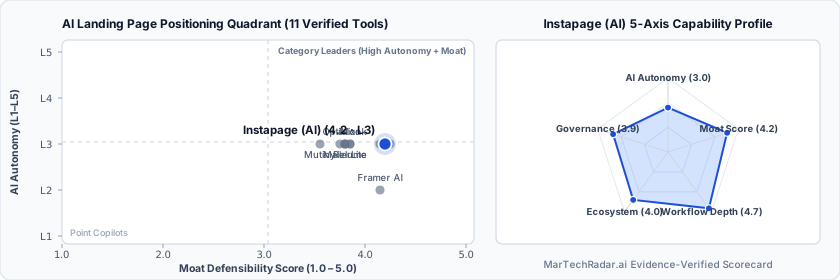
Instapage (AI) is a Web SaaS tool for AI Landing Page (Landing Page Builders & Autonomous CRO) in Lifecycle & CDP. Pricing: From $79/mo. Best suited to B2B SaaS, DTC / eCommerce and Enterprise Brands. Editor ratings: AI autonomy L3 (conditional automation); moat score 4.2/5.0 (Proprietary moat). Fact-checked by Anthony Hay on Oct 12, 2026.
Post-click conversion optimization platform pairing programmatic ad campaign mapping with AI-driven landing page personalization.
Instapage (AI) buyer fit verdict: when to choose vs. when to walk away
Choose Instapage (AI) if (Best Fit)
- Target ICP & Stack Fit: You operate as B2B SaaS, DTC / eCommerce and Enterprise Brands requiring a Web SaaS deployment for AI Landing Page, with verified ecosystem connectivity for Google Ads, Meta Ads.
- L3 Architecture & Defensibility: Moat rests on proprietary AdMap infrastructure linking advertising hierarchies directly to contextual landing page variants, protected by legacy integrations with primary ad networks and enterprise collaboration frameworks.
- Commercial Model Fit: Your procurement budget aligns with From $79/mo.
Walk away from Instapage (AI) if (Deal-Breakers)
- Walk away if your workflow requires uncapped enterprise volume on the From $79/mo entry plan without upgrading tiers.
- Walk away if your workflow cannot tolerate global design system fragility: Shared CSS components and global blocks can introduce layout regressions across legacy variants during bulk template updates, necessitating manual layout reviews.
- Walk away if traffic volume gatekeeping is a deal-breaker for your team: Analytics instrumentation and edge traffic allocation degrade under abrupt high-concurrency spikes, occasionally skewing multivariate sample balancing.
Instapage (AI) key facts & scorecard
| Pricing | From $79/moVendor pricing page |
|---|---|
| Free plan | No / not disclosed |
| Delivery | Web SaaS |
| Audience | B2B SaaS, DTC / eCommerce, Enterprise Brands |
| AI autonomy level | L3 · Conditional automationEditor-verified |
| Moat tier & score | 4.2 / 5.0 · Proprietary moatEditor-verified |
| Funding | AcquiredAcquired by airSlate |
| Total funding | $16.6MBacked by Morgan Stanley Expansion Capital |
| Founders | Tyson Quick |
| Company size | 201-500 employees |
| Ecosystem integrations | Google Ads, Meta Ads |
| Governance & docs | Trust & Security ↗ · System Status ↗ · Changelog ↗ · Terms ↗ · Privacy ↗ |
| Headquarters | San Francisco, CA |
| Founded | 2012 |
| Last verified |
Instapage (AI) pros & cons: strengths vs. operational limitations
Pros: core strengths & capabilities
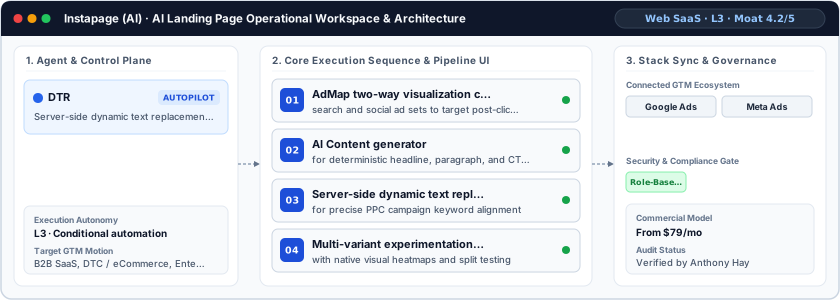
- AdMap two-way visualization connecting: search and social ad sets to target post-click URLs
- AI Content generator: for deterministic headline, paragraph, and CTA variant synthesis
- Server-side dynamic text replacement (DTR): for precise PPC campaign keyword alignment
- Multi-variant experimentation engine: with native visual heatmaps and split testing
Cons: operational limitations & risks
- Global Design System Fragility: Shared CSS components and global blocks can introduce layout regressions across legacy variants during bulk template updates, necessitating manual layout reviews.
- Traffic Volume Gatekeeping: Analytics instrumentation and edge traffic allocation degrade under abrupt high-concurrency spikes, occasionally skewing multivariate sample balancing.
- Ad Network Token Expirations: AdMap API pipelines experience sync drops when third-party advertising account credentials rotate, disconnecting automated message matching schemas.
Instapage (AI) TCO & deal-breaker stress test
Simulate 12-month stepped TCO, hidden cost multipliers, contract lock-in exposure, and stack failure modes using only facts verified by Anthony Hay on · Capture SHA bd0998ca.
Instapage (AI) aligns with your 5-seat / $800/mo profile. Review the walk-away triggers and contract levers below before deployment.
| Plan / Tier | Verified Rate | Scale Fit | Scope & Quota Notes |
|---|---|---|---|
| Entry / Starter | $79/mo | 1–2 seats | unique monthly visitors |
| Growth / Professional | $159/mo | 5 seats | 30,000 unique monthly visitors |
- Moat Score
- 4.2 / 5.0
- AI Autonomy
- L3
- Free Tier / Trial
- None disclosed
Triggered audit signals & failure modes
- Published Self-Serve Entry FloorVerified Pricing Ledger
Instapage (AI) publishes a transparent entry point (From $79/mo) for initial validation before committing.
- Tier Fit for 5-Seat Scale: Growth / Professional ($159/mo)Verified Tier Schedule
30,000 unique monthly visitors
- Primary Operational Bottleneck: Global Design System FragilityAudit by Anthony Hay
Shared CSS components and global blocks can introduce layout regressions across legacy variants during bulk template updates, necessitating manual layout reviews.
Hidden TCO Multipliers & Quota Gates
- Annual Billing Headline vs. Monthly Premium: Headline entry rates reflect annual billing commitments (Save up to 20%); month-to-month flexibility carries a higher effective monthly rate or requires annual prepayment.
- Credit & Usage Burn Multiplier: Automated workflows consume metered credits/usage quotas; multi-step enrichment, voice minutes, or high-frequency agent runs can trigger mid-cycle top-up packs.
- Enterprise Governance & Add-On Gating: Advanced capabilities such as Single Sign-On (SSO), custom role permissions, or specialized analytics modules are gated behind upper tiers or paid add-ons.
When to Walk Away & Negotiation Levers
- Walk away if your workflow requires uncapped enterprise volume on the From $79/mo entry plan without upgrading tiers.
- Walk away if your workflow cannot tolerate global design system fragility: Shared CSS components and global blocks can introduce layout regressions across legacy variants during bulk template updates, necessitating manual layout reviews.
- Walk away if traffic volume gatekeeping is a deal-breaker for your team: Analytics instrumentation and edge traffic allocation degrade under abrupt high-concurrency spikes, occasionally skewing multivariate sample balancing.
- Validate exact quota thresholds (seats, credits, or API calls) included in Instapage (AI)'s From $79/mo tier before converting from monthly to annual billing.
- Require a sandbox proof-of-concept testing global design system fragility against your live CRM/data schema before annual sign-off.
Ask a custom procurement or TCO stress-test question about Instapage (AI)
Lower 5-seat floor (~$10/mo vs. $159 / mo)
Lower 5-seat floor (~$11/mo vs. $159 / mo)
Instapage (AI) key entities, modules & ecosystem stack
Server-side dynamic text replacement for precise PPC campaign keyword alignment
Instapage (AI) moat & subtrack positioning
Moat rests on proprietary AdMap infrastructure linking advertising hierarchies directly to contextual landing page variants, protected by legacy integrations with primary ad networks and enterprise collaboration frameworks.
Editorial review
Fact-checked by Anthony Hay (Senior SEO, Search Intelligence & Content Operations Editor) on .
Background
Architectured specifically for performance media teams, Instapage operates as a specialized post-click conversion system designed to eliminate ad spend degradation between impression and conversion. Established in 2012 and headquartered in San Francisco, CA, the enterprise platform secured $16.6M in funding prior to joining airSlate. Targeted at paid media directors, demand generation architects, and agency growth teams, the platform replaces static web content systems with dedicated advertising destinations that match incoming traffic intent.
How Instapage (AI) works
The platform functions by decoupling landing page infrastructure from core content management backends, serving pre-rendered static assets across edge networks. Its AdMap protocol connects to ad networks including Google Ads and Meta Ads, mapping ad groups to individualized page variants. At the application layer, an AI content engine synthesizes headline variations and body copy based on query metadata and audience parameters. Dynamic text replacement (DTR) modifies on-page string variables at the edge before final rendering, maintaining message congruency without regenerating entire templates.
Limitations
Operational considerations and platform boundaries include:
- Global Design System Fragility: Shared CSS components and global blocks can introduce layout regressions across legacy variants during bulk template updates, necessitating manual layout reviews.
- Traffic Volume Gatekeeping: Analytics instrumentation and edge traffic allocation degrade under abrupt high-concurrency spikes, occasionally skewing multivariate sample balancing.
- Ad Network Token Expirations: AdMap API pipelines experience sync drops when third-party advertising account credentials rotate, disconnecting automated message matching schemas.
Instapage (AI) pricing
Instapage licenses its software under tiered subscription models beginning from $79 per month. Lower tiers restrict maximum monthly unique visitor quotas and active published experiences, while higher custom tiers unlock automated personalization, heatmaps, and enterprise governance controls.
How Instapage (AI) compares
Within post-click conversion workflows, Instapage competes against design-centric canvas engines like Framer AI and Dora AI, as well as integrated automation tools like MailerLite. While Framer AI and Dora AI focus on dynamic vector animations and rapid prototype generation, they lack deep paid media attribution mechanics. Instapage prioritizes conversion attribution, ad-network synchronization, and high-velocity testing for paid acquisition teams over broader web-publishing flexibility.
Frequently asked questions about Instapage (AI)
How much does Instapage (AI) cost and what pricing tiers are available?
Published pricing summary for Instapage (AI): From $79/mo. A permanent free plan is not disclosed for Instapage (AI). Verified tier schedule: Entry / Starter ($79/mo for 1–2 seats); Growth / Professional ($159/mo for 5 seats). Instapage licenses its software under tiered subscription models beginning from $79 per month. Lower tiers restrict maximum monthly unique visitor quotas and active published experiences, while higher custom tiers unlock automated personalization, heatmaps, and enterprise governance controls.
How does Instapage (AI) work and how autonomous is its AI architecture?
Post-click conversion optimization platform pairing programmatic ad campaign mapping with AI-driven landing page personalization. Within AI Landing Page (Landing Page Builders & Autonomous CRO), MarTechRadar rates its execution architecture at L3 · Conditional automation with a verified Moat Score of 4.2 / 5.0 (Proprietary moat). Moat rests on proprietary AdMap infrastructure linking advertising hierarchies directly to contextual landing page variants, protected by legacy integrations with primary ad networks and enterprise collaboration frameworks. Corporate profile: Founded by Tyson Quick, operating at 201-500 employees scale, acquired by airSlate.
What are the main limitations of Instapage (AI) and when should buyers walk away?
Based on our editorial technical audit, key operational considerations and boundaries for Instapage (AI) include: (1) Global Design System Fragility: Shared CSS components and global blocks can introduce layout regressions across legacy variants during bulk template updates, necessitating manual layout reviews. (2) Traffic Volume Gatekeeping: Analytics instrumentation and edge traffic allocation degrade under abrupt high-concurrency spikes, occasionally skewing multivariate sample balancing. (3) Ad Network Token Expirations: AdMap API pipelines experience sync drops when third-party advertising account credentials rotate, disconnecting automated message matching schemas. Primary procurement walk-away rule: Walk away if your workflow requires uncapped enterprise volume on the From $79/mo entry plan without upgrading tiers.
What integrations, compliance certifications, and contract terms apply to Instapage (AI)?
Verified ecosystem and stack integrations include Google Ads, Meta Ads. First-party governance and developer endpoints verified on domain include: Trust/Security (https://instapage.com/security), Status (https://status.instapage.com). Key TCO multiplier to watch: Annual Billing Headline vs. Monthly Premium (Headline entry rates reflect annual billing commitments (Save up to 20%); month-to-month flexibility carries a higher effective monthly rate or requires annual prepayment.) Before signing a contract, procurement teams should validate exact quota thresholds (seats, credits, or API calls) included in Instapage (AI)'s From $79/mo tier before converting from monthly to annual billing.
What are the best Instapage (AI) alternatives and head-to-head competitors in 2026?
Top fact-checked alternatives to Instapage (AI) in AI Landing Page (Landing Page Builders & Autonomous CRO) include Framer AI (Free plan · $10–$30/mo), MailerLite (From $10.80/mo), OptiMonk (From $19/mo), Relume (From $12/mo). Within post-click conversion workflows, Instapage competes against design-centric canvas engines like Framer AI and Dora AI, as well as integrated automation tools like MailerLite.
Verified sources & evidence trail
- Official product domain: https://instapage.com
- Commercial pricing verification: https://instapage.com/plans
- Verified corporate entity profiles (
sameAs): LinkedIn Company Profile · Crunchbase Entity Record - First-party governance & documentation links: Trust & Security · System Status · Changelog · Terms · Privacy
- Editorial audit sign-off: Fact-checked by Anthony Hay on under the MarTechRadar Evidence-Ledger Protocol.