Framer AI Review (2026): AI Landing Page Pricing, Limits & Alternatives
Bottom line
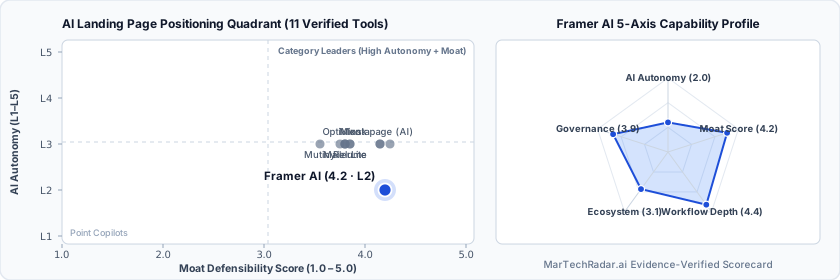
Framer AI is a Web SaaS tool for AI Landing Page (Landing Page Builders & Autonomous CRO) in Lifecycle & CDP. Pricing: Free plan · $10–$30/mo. Best suited to B2B SaaS and Marketing Agencies. Editor ratings: AI autonomy L2 (workflow copilot); moat score 4.2/5.0 (Proprietary moat). Fact-checked by Julie Brot on Oct 11, 2026.
Visual web publishing platform and AI design agent compiling natural language prompts into responsive, production-ready React applications.
Framer AI buyer fit verdict: when to choose vs. when to walk away
Choose Framer AI if (Best Fit)
- Target ICP & Stack Fit: You operate as B2B SaaS and Marketing Agencies requiring a Web SaaS deployment for AI Landing Page.
- L2 Architecture & Defensibility: Defensibility stems from a proprietary layout compiler that maps canvas manipulations and LLM prompts directly into semantically valid React DOM trees, combined with integrated edge deployment infrastructure.
- Commercial Model Fit: Your procurement budget aligns with Free plan · $10–$30/mo and want a self-serve free tier for zero-cost initial validation.
Walk away from Framer AI if (Deal-Breakers)
- Walk away if your workflow requires uncapped enterprise volume on the Free plan · $10–$30/mo entry plan without upgrading tiers.
- Walk away if your workflow cannot tolerate dynamic state complexity: Arbitrary backend logic and authenticated user state require custom React integrations, limiting completely autonomous workflows to marketing pages.
- Walk away if design drift is a deal-breaker for your team: Unconstrained generative regeneration can override custom breakpoints and bespoke CSS overrides, demanding manual structural locking across layouts.
Framer AI key facts & scorecard
| Pricing | Free plan · $10–$30/moVendor pricing page |
|---|---|
| Free plan | Yes |
| Delivery | Web SaaS |
| Audience | B2B SaaS, Marketing Agencies |
| AI autonomy level | L2 · Workflow copilotEditor-verified |
| Moat tier & score | 4.2 / 5.0 · Proprietary moatEditor-verified |
| Funding | Venture-backed |
| Total funding | $161M |
| Founders | Jorn van Dijk, Koen Bok |
| Company size | 51-100 employees |
| Governance & docs | Trust & Security ↗ · API & Docs ↗ |
| Headquarters | Amsterdam, Noord-Holland, The Netherlands |
| Founded | 2015 |
| Last verified |
Framer AI pros & cons: strengths vs. operational limitations
Pros: core strengths & capabilities
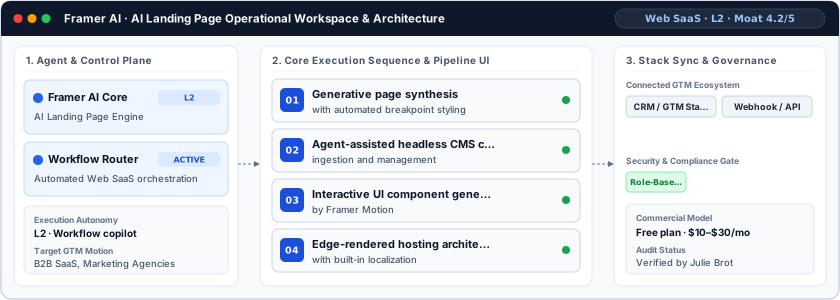
- Generative page synthesis: with automated breakpoint styling
- Agent-assisted headless CMS content: ingestion and management
- Interactive UI component generation powered: by Framer Motion
- Edge-rendered hosting architecture: with built-in localization
Cons: operational limitations & risks
- Dynamic State Complexity: Arbitrary backend logic and authenticated user state require custom React integrations, limiting completely autonomous workflows to marketing pages.
- Design Drift: Unconstrained generative regeneration can override custom breakpoints and bespoke CSS overrides, demanding manual structural locking across layouts.
- Credit Throttling: Recursive agentic modifications consume recurring workspace tokens, imposing execution ceilings during continuous automated CMS population runs.
Framer AI TCO & deal-breaker stress test
Simulate 12-month stepped TCO, hidden cost multipliers, contract lock-in exposure, and stack failure modes using only facts verified by Julie Brot on · Capture SHA 596c26ca.
Framer AI aligns with your 5-seat / $800/mo profile. Review the walk-away triggers and contract levers below before deployment.
| Plan / Tier | Verified Rate | Scale Fit | Scope & Quota Notes |
|---|---|---|---|
| Free / Sandbox | $0 | 1–2 seats (Evaluation) | Entry free tier with capped usage or feature quotas for initial workflow testing. |
| Entry / Starter | $10/mo | 1–2 seats | Verified $10/mo published rate on vendor pricing schedule. |
| Growth / Professional | $30/mo | 5 seats | Verified $30/mo published rate on vendor pricing schedule. |
- Moat Score
- 4.2 / 5.0
- AI Autonomy
- L2
- Free Tier / Trial
- Free plan
Triggered audit signals & failure modes
- Published Self-Serve Entry FloorVerified Pricing Ledger
Framer AI publishes a transparent entry point (Free plan · $10–$30/mo) with a free tier for initial validation before committing.
- Tier Fit for 5-Seat Scale: Growth / Professional ($30/mo)Verified Tier Schedule
Verified $30/mo published rate on vendor pricing schedule.
- Primary Operational Bottleneck: Credit ThrottlingAudit by Julie Brot
Recursive agentic modifications consume recurring workspace tokens, imposing execution ceilings during continuous automated CMS population runs.
Hidden TCO Multipliers & Quota Gates
- Per-Seat Linear Scaling: Framer AI prices licenses on a per-user/seat basis (Free plan · $10–$30/mo); expanding from 2 to 15+ operators multiplies base recurring spend linearly.
- Annual Billing Headline vs. Monthly Premium: Headline entry rates reflect annual billing commitments (save 50%); month-to-month flexibility carries a higher effective monthly rate or requires annual prepayment.
- Credit & Usage Burn Multiplier: Automated workflows consume metered credits/usage quotas; multi-step enrichment, voice minutes, or high-frequency agent runs can trigger mid-cycle top-up packs.
When to Walk Away & Negotiation Levers
- Walk away if your workflow requires uncapped enterprise volume on the Free plan · $10–$30/mo entry plan without upgrading tiers.
- Walk away if your workflow cannot tolerate dynamic state complexity: Arbitrary backend logic and authenticated user state require custom React integrations, limiting completely autonomous workflows to marketing pages.
- Walk away if design drift is a deal-breaker for your team: Unconstrained generative regeneration can override custom breakpoints and bespoke CSS overrides, demanding manual structural locking across layouts.
- Validate exact quota thresholds (seats, credits, or API calls) included in Framer AI's Free plan · $10–$30/mo tier before converting from monthly to annual billing.
- Require a sandbox proof-of-concept testing dynamic state complexity against your live CRM/data schema before annual sign-off.
Ask a custom procurement or TCO stress-test question about Framer AI
Lower 5-seat floor (~$11/mo vs. $30 / mo)
Fits within $800/mo budget (From $39/mo)
Framer AI moat & subtrack positioning
Defensibility stems from a proprietary layout compiler that maps canvas manipulations and LLM prompts directly into semantically valid React DOM trees, combined with integrated edge deployment infrastructure.
Editorial review
Fact-checked by Julie Brot (Enterprise SaaS Governance & Procurement Editor) on .
Background
Framer AI approaches web development as a direct compilation problem, mapping design abstractions straight to production code. Headquartered in Amsterdam, Noord-Holland, The Netherlands, Framer was founded in 2015 and has secured $161M in total funding. The system primarily serves product designers, conversion specialists, and growth marketing teams seeking to build and deploy high-fidelity digital touchpoints without front-end engineering handoffs.
How Framer AI works
Operating at an L2 autonomy tier, the engine leverages generative layout algorithms alongside natural language interfaces to translate descriptive prompts into responsive page architectures. The pipeline parses user directives to select typography tokens, dynamic color palettes, and container structures, assembling interactive interfaces backed by React and Framer Motion. The system automatically reconciles desktop, tablet, and mobile breakpoints while exposing agentic controls for copy generation and programmatic headless CMS schemas directly inside the canvas.
Limitations
Operational considerations and platform boundaries include:
- Dynamic State Complexity: Arbitrary backend logic and authenticated user state require custom React integrations, limiting completely autonomous workflows to marketing pages.
- Design Drift: Unconstrained generative regeneration can override custom breakpoints and bespoke CSS overrides, demanding manual structural locking across layouts.
- Credit Throttling: Recursive agentic modifications consume recurring workspace tokens, imposing execution ceilings during continuous automated CMS population runs.
Framer AI pricing
Commercial access follows a tiered SaaS subscription billed annually, supplemented by consumption credits for agent executions. Framer offers a Free plan for basic site deployment and experimentation. Paid tiers range from $10 to $30/month (billed yearly), unlocking custom domains, expanded CMS collections, greater edge bandwidth, and increased monthly AI credit allocations for generative design operations.
How Framer AI compares
Within the landing page ecosystem, Framer AI balances creative flexibility against structured automation. Whereas Dora AI focuses heavily on 3D spatial transitions and MailerLite confines users to rigid template grids, Framer generates fully customizable React components. Instapage (AI) concentrates heavily on post-click enterprise ad variations, yet Framer provides superior aesthetic fidelity, making it suitable for brand-led tech companies requiring bespoke visual craft.
Direct competitors & market radar
Top algorithmic competitors based on category positioning, capability overlap, and ICP alignment.
Frequently asked questions about Framer AI
How much does Framer AI cost and what pricing tiers are available?
Published pricing summary for Framer AI: Free plan · $10–$30/mo. Framer AI includes a free tier or sandbox entry point. Verified tier schedule: Free / Sandbox ($0 for 1–2 seats (Evaluation)); Entry / Starter ($10/mo for 1–2 seats); Growth / Professional ($30/mo for 5 seats). Commercial access follows a tiered SaaS subscription billed annually, supplemented by consumption credits for agent executions. Framer offers a Free plan for basic site deployment and experimentation.
How does Framer AI work and how autonomous is its AI architecture?
Visual web publishing platform and AI design agent compiling natural language prompts into responsive, production-ready React applications. Within AI Landing Page (Landing Page Builders & Autonomous CRO), MarTechRadar rates its execution architecture at L2 · Workflow copilot with a verified Moat Score of 4.2 / 5.0 (Proprietary moat). Defensibility stems from a proprietary layout compiler that maps canvas manipulations and LLM prompts directly into semantically valid React DOM trees, combined with integrated edge deployment infrastructure. Corporate profile: Founded by Jorn van Dijk, Koen Bok, operating at 51-100 employees scale.
What are the main limitations of Framer AI and when should buyers walk away?
Based on our editorial technical audit, key operational considerations and boundaries for Framer AI include: (1) Dynamic State Complexity: Arbitrary backend logic and authenticated user state require custom React integrations, limiting completely autonomous workflows to marketing pages. (2) Design Drift: Unconstrained generative regeneration can override custom breakpoints and bespoke CSS overrides, demanding manual structural locking across layouts. (3) Credit Throttling: Recursive agentic modifications consume recurring workspace tokens, imposing execution ceilings during continuous automated CMS population runs. Primary procurement walk-away rule: Walk away if your workflow requires uncapped enterprise volume on the Free plan · $10–$30/mo entry plan without upgrading tiers.
What integrations, compliance certifications, and contract terms apply to Framer AI?
First-party governance and developer endpoints verified on domain include: Trust/Security (https://www.framer.com/legal/security), API Docs (https://www.framer.com/developers). Key TCO multiplier to watch: Per-Seat Linear Scaling (Framer AI prices licenses on a per-user/seat basis (Free plan · $10–$30/mo); expanding from 2 to 15+ operators multiplies base recurring spend linearly.) Before signing a contract, procurement teams should validate exact quota thresholds (seats, credits, or API calls) included in Framer AI's Free plan · $10–$30/mo tier before converting from monthly to annual billing.
What are the best Framer AI alternatives and head-to-head competitors in 2026?
Top fact-checked alternatives to Framer AI in AI Landing Page (Landing Page Builders & Autonomous CRO) include Omneky (Custom / enterprise pricing), Creatify.ai (From $39/mo), Dora AI (Custom / enterprise pricing), Instapage (AI) (From $79/mo). Within the landing page ecosystem, Framer AI balances creative flexibility against structured automation. Whereas Dora AI focuses heavily on 3D spatial transitions and MailerLite confines users to rigid template grids, Framer generates fully customizable React components.
Verified sources & evidence trail
- Official product domain: https://framer.com
- Commercial pricing verification: https://www.framer.com/pricing
- Verified corporate entity profiles (
sameAs): Crunchbase Entity Record - First-party governance & documentation links: Trust & Security · API & Docs
- Editorial audit sign-off: Fact-checked by Julie Brot on under the MarTechRadar Evidence-Ledger Protocol.