Mutiny Review (2026): AI Landing Page Pricing, Limits & Alternatives
Bottom line
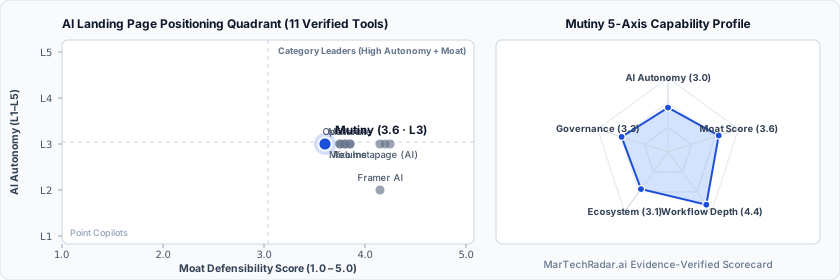
Mutiny is a Web SaaS tool for AI Landing Page (Landing Page Builders & Autonomous CRO) in Lifecycle & CDP. Pricing: Custom / enterprise pricing. Best suited to B2B SaaS. Editor ratings: AI autonomy L3 (conditional automation); moat score 3.6/5.0 (Proprietary moat). Fact-checked by Jagmeet Sine on Oct 7, 2026.
Autonomous conversion rate optimization and B2B web personalization platform applying contextual machine learning to dynamic page components.
Mutiny buyer fit verdict: when to choose vs. when to walk away
Choose Mutiny if (Best Fit)
- Target ICP & Stack Fit: You operate as B2B SaaS requiring a Web SaaS deployment for AI Landing Page.
- L3 Architecture & Defensibility: Defensibility stems from account-level behavioral telemetry coupled with multi-armed bandit algorithmic experimentation directly injected into live digital storefronts without manual engineering overhead.
- Commercial Model Fit: Your procurement budget aligns with Custom / enterprise pricing.
Walk away from Mutiny if (Deal-Breakers)
- Walk away if your inbound web traffic volume is too low to achieve statistical significance across multi-armed bandit algorithmic models.
- Walk away if your target audience predominantly browses through corporate VPNs or consumer ISPs that degrade reverse-IP firmographic enrichment accuracy.
- Walk away if your site performance mandates cannot tolerate client-side DOM flickering or cumulative layout shifts caused by asynchronous script injection.
Mutiny key facts & scorecard
| Pricing | Custom / enterprise pricingVendor pricing page |
|---|---|
| Free plan | No / not disclosed |
| Delivery | Web SaaS |
| Audience | B2B SaaS |
| AI autonomy level | L3 · Conditional automationEditor-verified |
| Moat tier & score | 3.6 / 5.0 · Proprietary moatEditor-verified |
| Funding | Venture-backed |
| Founders | Jaleh Rezaei, Nikhil Mathew |
| Company size | 51-200 employees |
| Governance & docs | DPA ↗ · Terms ↗ · Privacy ↗ |
| Headquarters | United States |
| Founded | 2018 |
| Last verified |
Mutiny pros & cons: strengths vs. operational limitations
Pros: core strengths & capabilities
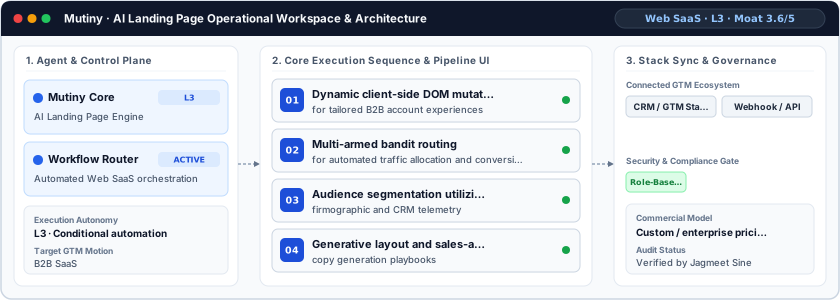
- Dynamic client-side DOM mutation: for tailored B2B account experiences
- Multi-armed bandit routing: for automated traffic allocation and conversion lift
- Audience segmentation utilizing reverse-IP: firmographic and CRM telemetry
- Generative layout and sales-assisted: copy generation playbooks
Cons: operational limitations & risks
- DOM flickering and layout shift: Client-side script execution introduces cumulative layout shift risks and browser rendering latency if tag managers process payload bundles asynchronously.
- Reverse-IP data decay: Firmographic enrichment accuracy degrades across distributed remote workforces utilizing consumer internet service providers or corporate VPN connections.
- Statistical noise in low-traffic funnels: Algorithmic multi-armed bandit models fail to achieve deterministic statistical significance on low-volume, high-value enterprise landing pages without months of baseline calibration.
Mutiny TCO & deal-breaker stress test
Simulate 12-month stepped TCO, hidden cost multipliers, contract lock-in exposure, and stack failure modes using only facts verified by Jagmeet Sine on · Capture SHA 8806642f.
Mutiny triggers high-severity friction under your 5-seat / $800/mo constraints. Benchmark the verified subtrack alternatives below before committing.
| Plan / Tier | Verified Rate | Scale Fit | Scope & Quota Notes |
|---|---|---|---|
| Enterprise / Custom | Custom quote | 15–50+ seats (Enterprise SLA) | Sales-negotiated annual contract for custom volume, SSO/RBAC governance, and dedicated SLA. |
- Moat Score
- 3.6 / 5.0
- AI Autonomy
- L3
- Free Tier / Trial
- None disclosed
Triggered audit signals & failure modes
- Opaque Enterprise Quoting vs. SMB/Mid-Market BudgetVerified Pricing Ledger
Mutiny does not disclose a public self-serve floor (Custom / enterprise pricing). Buyers with a $800/mo cap face high sales-qualification friction.
- Sales-Gated Contract TermsFact-checked by Jagmeet Sine
Commercial procurement for Mutiny operates via custom enterprise licensing frameworks. Prospective buyers obtain specialized sales proposals structured around monthly unique visitor volume, domain scale, seat access, and algorithmic execution units.
- Primary Operational Bottleneck: DOM flickering and layout shiftAudit by Jagmeet Sine
Client-side script execution introduces cumulative layout shift risks and browser rendering latency if tag managers process payload bundles asynchronously.
Hidden TCO Multipliers & Quota Gates
- Visitor Volume and Execution Unit Scaling: Contract pricing expands with increases in monthly unique visitor volume, domain count, seat allocations, and algorithmic execution units, driving compounding costs as site traffic grows.
- Enterprise Integration and Feature Gating: Critical enterprise capabilities such as Salesforce integration, single sign-on (SSO), custom MSA/DPA terms, and dedicated growth onboarding are restricted to custom enterprise tier agreements.
When to Walk Away & Negotiation Levers
- Walk away if your inbound web traffic volume is too low to achieve statistical significance across multi-armed bandit algorithmic models.
- Walk away if your target audience predominantly browses through corporate VPNs or consumer ISPs that degrade reverse-IP firmographic enrichment accuracy.
- Walk away if your site performance mandates cannot tolerate client-side DOM flickering or cumulative layout shifts caused by asynchronous script injection.
- Tie annual contract commitments to minimum reverse-IP firmographic match rates and verified conversion lift benchmarks across traffic cohorts.
- Require contractually guaranteed script latency thresholds and edge-injection SLAs to protect site performance from cumulative layout shifts.
Ask a custom procurement or TCO stress-test question about Mutiny
Lower 5-seat floor (~$10/mo vs. Custom Quote) · Transparent self-serve entry without mandatory annual lock-in
Lower 5-seat floor (~$22/mo vs. Custom Quote) · Transparent self-serve entry without mandatory annual lock-in
Mutiny moat & subtrack positioning
Defensibility stems from account-level behavioral telemetry coupled with multi-armed bandit algorithmic experimentation directly injected into live digital storefronts without manual engineering overhead.
Editorial review
Fact-checked by Jagmeet Sine (Senior MarTech Infrastructure & Agentic Workflow Architect) on .
Background
Mutiny functions as an autonomous conversion rate optimization and web personalization engine designed to transform static corporate websites into adaptive commercial touchpoints. Established in 2018 and headquartered in the United States, the platform serves enterprise growth engineers, demand generation leaders, and revenue marketing teams. The software circumvents the rigid release cycles of standard content management systems by decoupling client-facing interface adjustments from core engineering sprint backlogs.
How Mutiny works
Operating at an L3 autonomy tier, the architecture employs a lightweight client-side JavaScript snippet or edge reverse-proxy configuration to evaluate inbound web traffic in real time. The ingestion pipeline decodes visitor network footprints through reverse-IP firmographic lookup tables and CRM data layers, mapping incoming sessions against predefined persona matrices. Mutiny then invokes an automated algorithmic pipeline utilizing multi-armed bandit statistical frameworks to serve tailored page variations, dynamically injecting personalized copy, social proof components, and customized forms directly into the Document Object Model.
Limitations
Operational considerations and platform boundaries include:
- DOM flickering and layout shift: Client-side script execution introduces cumulative layout shift risks and browser rendering latency if tag managers process payload bundles asynchronously.
- Reverse-IP data decay: Firmographic enrichment accuracy degrades across distributed remote workforces utilizing consumer internet service providers or corporate VPN connections.
- Statistical noise in low-traffic funnels: Algorithmic multi-armed bandit models fail to achieve deterministic statistical significance on low-volume, high-value enterprise landing pages without months of baseline calibration.
Mutiny pricing
Commercial procurement for Mutiny operates via custom enterprise licensing frameworks. Prospective buyers obtain specialized sales proposals structured around monthly unique visitor volume, domain scale, seat access, and algorithmic execution units. Organizations typically evaluate deployments through structured enterprise procurement cycles, with bespoke contract terms matching technical requirements.
How Mutiny compares
Mutiny competes against design-centric visual builders such as Framer AI and Dora AI, as well as enterprise landing page environments like Instapage AI. While Framer AI and Dora AI prioritize 3D spatial dynamics and visual portfolio prototyping, they lack native firmographic attribution and automated multi-armed bandit routing. Instapage AI offers robust standalone post-click landing page deployment, whereas Mutiny modifies live, pre-existing site architectures in place. The ideal buyer is a B2B enterprise marketing team with established digital traffic seeking automated behavioral optimization over ground-up canvas redesigns.
Direct competitors & market radar
Top algorithmic competitors based on category positioning, capability overlap, and ICP alignment.
Frequently asked questions about Mutiny
How much does Mutiny cost and does it require a custom enterprise quote?
Published pricing summary for Mutiny: Custom / enterprise pricing. A permanent free plan is not disclosed for Mutiny. Commercial procurement for Mutiny operates via custom enterprise licensing frameworks. Prospective buyers obtain specialized sales proposals structured around monthly unique visitor volume, domain scale, seat access, and algorithmic execution units.
How does Mutiny work and how autonomous is its AI architecture?
Autonomous conversion rate optimization and B2B web personalization platform applying contextual machine learning to dynamic page components. Within AI Landing Page (Landing Page Builders & Autonomous CRO), MarTechRadar rates its execution architecture at L3 · Conditional automation with a verified Moat Score of 3.6 / 5.0 (Proprietary moat). Defensibility stems from account-level behavioral telemetry coupled with multi-armed bandit algorithmic experimentation directly injected into live digital storefronts without manual engineering overhead. Corporate profile: Founded by Jaleh Rezaei, Nikhil Mathew, operating at 51-200 employees scale.
What are the main limitations of Mutiny and when should buyers walk away?
Based on our editorial technical audit, key operational considerations and boundaries for Mutiny include: (1) DOM flickering and layout shift: Client-side script execution introduces cumulative layout shift risks and browser rendering latency if tag managers process payload bundles asynchronously. (2) Reverse-IP data decay: Firmographic enrichment accuracy degrades across distributed remote workforces utilizing consumer internet service providers or corporate VPN connections. (3) Statistical noise in low-traffic funnels: Algorithmic multi-armed bandit models fail to achieve deterministic statistical significance on low-volume, high-value enterprise landing pages without months of baseline calibration. Primary procurement walk-away rule: Walk away if your inbound web traffic volume is too low to achieve statistical significance across multi-armed bandit algorithmic models.
What integrations, compliance certifications, and contract terms apply to Mutiny?
First-party governance and developer endpoints verified on domain include: DPA (https://www.mutinyhq.com/dpa). Key TCO multiplier to watch: Visitor Volume and Execution Unit Scaling (Contract pricing expands with increases in monthly unique visitor volume, domain count, seat allocations, and algorithmic execution units, driving compounding costs as site traffic grows.) Before signing a contract, procurement teams should tie annual contract commitments to minimum reverse-IP firmographic match rates and verified conversion lift benchmarks across traffic cohorts.
What are the best Mutiny alternatives and head-to-head competitors in 2026?
Top fact-checked alternatives to Mutiny in AI Landing Page (Landing Page Builders & Autonomous CRO) include Framer AI (Free plan · $10–$30/mo), Tofu (Custom / enterprise pricing), Dora AI (Custom / enterprise pricing), Kameleoon (From $495/mo). Mutiny competes against design-centric visual builders such as Framer AI and Dora AI, as well as enterprise landing page environments like Instapage AI.
Verified sources & evidence trail
- Official product domain: https://mutinyhq.com
- Commercial pricing verification: https://www.mutinyhq.com/pricing
- Verified corporate entity profiles (
sameAs): LinkedIn Company Profile · Crunchbase Entity Record - First-party governance & documentation links: DPA · Terms · Privacy
- Editorial audit sign-off: Fact-checked by Jagmeet Sine on under the MarTechRadar Evidence-Ledger Protocol.