Dora AI Review (2026): AI Landing Page Pricing, Limits & Alternatives
Bottom line
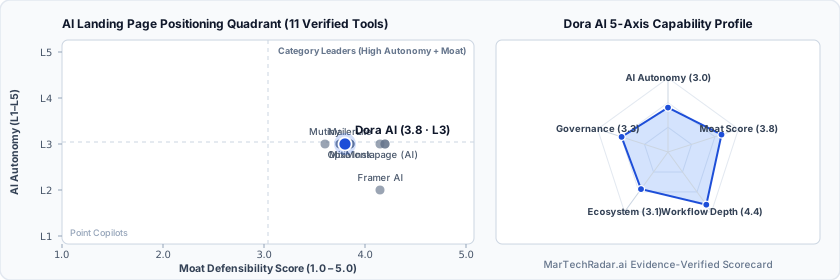
Dora AI is a Web SaaS tool for AI Landing Page (Landing Page Builders & Autonomous CRO) in Lifecycle & CDP. Pricing: Custom / enterprise pricing. Best suited to B2B SaaS, DTC / eCommerce and Enterprise Brands. Editor ratings: AI autonomy L3 (conditional automation); moat score 3.8/5.0 (Proprietary moat). Fact-checked by Tim Fenolz on Oct 12, 2026.
Generative spatial web canvas compiling natural language prompts and 3D assets into interactive, WebGL-powered web layouts.
Dora AI buyer fit verdict: when to choose vs. when to walk away
Choose Dora AI if (Best Fit)
- Target ICP & Stack Fit: You operate as B2B SaaS, DTC / eCommerce and Enterprise Brands requiring a Web SaaS deployment for AI Landing Page.
- L3 Architecture & Defensibility: Defensible spatial layout pipeline integrating natural language generation with real-time WebGL rendering, camera transforms, and interactive 3D model runtimes without hand-coded shaders.
- Commercial Model Fit: Your procurement budget aligns with Custom / enterprise pricing.
Walk away from Dora AI if (Deal-Breakers)
- Walk away if you require transparent self-serve monthly billing or your budget ceiling is under $1,000/mo (Dora AI requires sales-gated custom quoting).
- Walk away if your workflow cannot tolerate client-side render overhead: Heavy 3D geometries and dynamic WebGL shaders substantially elevate mobile GPU utilization, degrading Core Web Vitals on low-spec hardware.
- Walk away if dynamic CMS rigidity is a deal-breaker for your team: The spatial framework prioritizes static visual narrative layouts, lacking native connectors for high-velocity relational database updates or headless CMS syncs.
Dora AI key facts & scorecard
| Pricing | Custom / enterprise pricing |
|---|---|
| Free plan | No / not disclosed |
| Delivery | Web SaaS |
| Audience | B2B SaaS, DTC / eCommerce, Enterprise Brands |
| AI autonomy level | L3 · Conditional automationEditor-verified |
| Moat tier & score | 3.8 / 5.0 · Proprietary moatEditor-verified |
| Funding | Seed |
| Company size | 11-50 employees |
| Headquarters | Los Angeles, US |
| Founded | 2021 |
| Last verified |
Dora AI pros & cons: strengths vs. operational limitations
Pros: core strengths & capabilities
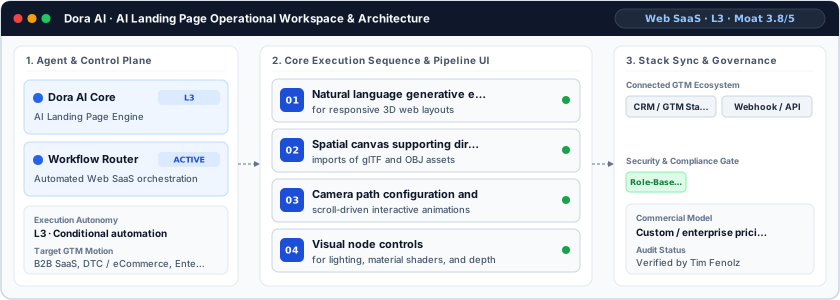
- Natural language generative engine: for responsive 3D web layouts
- Spatial canvas supporting direct: imports of glTF and OBJ assets
- Camera path configuration and: scroll-driven interactive animations
- Visual node controls: for lighting, material shaders, and depth
Cons: operational limitations & risks
- Client-Side Render Overhead: Heavy 3D geometries and dynamic WebGL shaders substantially elevate mobile GPU utilization, degrading Core Web Vitals on low-spec hardware.
- Dynamic CMS Rigidity: The spatial framework prioritizes static visual narrative layouts, lacking native connectors for high-velocity relational database updates or headless CMS syncs.
- Enterprise Asset Schema Governance: Automated prompt generation can produce erratic mesh coordinates and texture compression artifacts, requiring manual polygon optimization prior to production deployment.
Dora AI TCO & deal-breaker stress test
Simulate 12-month stepped TCO, hidden cost multipliers, contract lock-in exposure, and stack failure modes using only facts verified by Tim Fenolz on · Capture SHA c9342114.
Dora AI triggers high-severity friction under your 5-seat / $800/mo constraints. Benchmark the verified subtrack alternatives below before committing.
| Plan / Tier | Verified Rate | Scale Fit | Scope & Quota Notes |
|---|---|---|---|
| Enterprise / Custom | Custom quote | 15–50+ seats (Enterprise SLA) | Sales-negotiated annual contract for custom volume, SSO/RBAC governance, and dedicated SLA. |
- Moat Score
- 3.8 / 5.0
- AI Autonomy
- L3
- Free Tier / Trial
- None disclosed
Triggered audit signals & failure modes
- Opaque Enterprise Quoting vs. SMB/Mid-Market BudgetVerified Pricing Ledger
Dora AI does not disclose a public self-serve floor (Custom / enterprise pricing). Buyers with a $800/mo cap face high sales-qualification friction.
- Sales-Gated Contract TermsFact-checked by Tim Fenolz
Dora AI distributes its platform under a direct enterprise licensing structure.
- Primary Operational Bottleneck: Client-Side Render OverheadAudit by Tim Fenolz
Heavy 3D geometries and dynamic WebGL shaders substantially elevate mobile GPU utilization, degrading Core Web Vitals on low-spec hardware.
Hidden TCO Multipliers & Quota Gates
- Credit & Usage Burn Multiplier: Automated workflows consume metered credits/usage quotas; multi-step enrichment, voice minutes, or high-frequency agent runs can trigger mid-cycle top-up packs.
- Client-Side Render Overhead: Heavy 3D geometries and dynamic WebGL shaders substantially elevate mobile GPU utilization, degrading Core Web Vitals on low-spec hardware.
- Dynamic CMS Rigidity: The spatial framework prioritizes static visual narrative layouts, lacking native connectors for high-velocity relational database updates or headless CMS syncs.
When to Walk Away & Negotiation Levers
- Walk away if you require transparent self-serve monthly billing or your budget ceiling is under $1,000/mo (Dora AI requires sales-gated custom quoting).
- Walk away if your workflow cannot tolerate client-side render overhead: Heavy 3D geometries and dynamic WebGL shaders substantially elevate mobile GPU utilization, degrading Core Web Vitals on low-spec hardware.
- Walk away if dynamic CMS rigidity is a deal-breaker for your team: The spatial framework prioritizes static visual narrative layouts, lacking native connectors for high-velocity relational database updates or headless CMS syncs.
- Demand a 30- to 60-day paid pilot opt-out clause in the Dora AI order form before signing a 12-month enterprise commitment.
- Require a sandbox proof-of-concept testing client-side render overhead against your live CRM/data schema before annual sign-off.
Ask a custom procurement or TCO stress-test question about Dora AI
Lower 5-seat floor (~$10/mo vs. Custom Quote) · Transparent self-serve entry without mandatory annual lock-in
Lower 5-seat floor (~$11/mo vs. Custom Quote) · Transparent self-serve entry without mandatory annual lock-in
Dora AI moat & subtrack positioning
Defensible spatial layout pipeline integrating natural language generation with real-time WebGL rendering, camera transforms, and interactive 3D model runtimes without hand-coded shaders.
Editorial review
Fact-checked by Tim Fenolz (Lead AdTech, Programmatic & Attribution Analyst) on .
Background
Architected as a spatial visual canvas, Dora AI bridges generative text-to-layout synthesis with browser-native 3D rendering. Established in 2021 and headquartered in Los Angeles, US, the company targets creative directors, digital agencies, and front-end interaction designers seeking to construct interactive web environments without manual shader scripting. The platform eliminates the necessity of writing raw Three.js or WebGL code by translating declarative design intents directly into production-grade browser runtimes.
How Dora AI works
Under the hood, Dora AI combines an LLM-driven prompt compiler with a spatial rendering pipeline. Users supply natural language inputs that the platform parses into modular layout nodes, dynamic typography hierarchies, and keyframe animations. The core engine ingests standard 3D assets in glTF and OBJ formats, exposing viewport camera parameters, depth buffers, and lighting coordinates through a visual editor. This architecture converts complex scroll triggers and spatial rotations into hardware-accelerated browser directives operating at Level 3 generation autonomy.
Limitations
Operational considerations and platform boundaries include:
- Client-Side Render Overhead: Heavy 3D geometries and dynamic WebGL shaders substantially elevate mobile GPU utilization, degrading Core Web Vitals on low-spec hardware.
- Dynamic CMS Rigidity: The spatial framework prioritizes static visual narrative layouts, lacking native connectors for high-velocity relational database updates or headless CMS syncs.
- Enterprise Asset Schema Governance: Automated prompt generation can produce erratic mesh coordinates and texture compression artifacts, requiring manual polygon optimization prior to production deployment.
Dora AI pricing
Dora AI distributes its platform under a direct enterprise licensing structure. Commercial pricing is available on request through tailored enterprise sales quotes based on organizational scale and seats, accommodating dedicated workspace seats, high-bandwidth asset hosting, and specialized rendering tiers. Teams evaluate initial generation credits before establishing enterprise contractual commitments.
How Dora AI compares
Within visual web builders, Dora AI occupies an architectural niche centered on spatial depth. Framer AI delivers stronger typographic layout systems and structured React code export but lacks deep native WebGL asset pipelines. Instapage focuses on enterprise conversion optimization and multivariate experimentation rather than spatial immersion. MailerLite provides reliable email and basic landing-page automation for transactional pipelines. Dora AI remains tailored for creative teams prioritizing interactive 3D storytelling over analytical conversion funnels.
Frequently asked questions about Dora AI
How much does Dora AI cost and does it require a custom enterprise quote?
Published pricing summary for Dora AI: Custom / enterprise pricing. A permanent free plan is not disclosed for Dora AI. Dora AI distributes its platform under a direct enterprise licensing structure. Commercial pricing is available on request through tailored enterprise sales quotes based on organizational scale and seats, accommodating dedicated workspace seats, high-bandwidth asset hosting, and specialized rendering tiers.
How does Dora AI work and how autonomous is its AI architecture?
Generative spatial web canvas compiling natural language prompts and 3D assets into interactive, WebGL-powered web layouts. Within AI Landing Page (Landing Page Builders & Autonomous CRO), MarTechRadar rates its execution architecture at L3 · Conditional automation with a verified Moat Score of 3.8 / 5.0 (Proprietary moat). Defensible spatial layout pipeline integrating natural language generation with real-time WebGL rendering, camera transforms, and interactive 3D model runtimes without hand-coded shaders. Corporate profile: operating at 11-50 employees scale.
What are the main limitations of Dora AI and when should buyers walk away?
Based on our editorial technical audit, key operational considerations and boundaries for Dora AI include: (1) Client-Side Render Overhead: Heavy 3D geometries and dynamic WebGL shaders substantially elevate mobile GPU utilization, degrading Core Web Vitals on low-spec hardware. (2) Dynamic CMS Rigidity: The spatial framework prioritizes static visual narrative layouts, lacking native connectors for high-velocity relational database updates or headless CMS syncs. (3) Enterprise Asset Schema Governance: Automated prompt generation can produce erratic mesh coordinates and texture compression artifacts, requiring manual polygon optimization prior to production deployment. Primary procurement walk-away rule: Walk away if you require transparent self-serve monthly billing or your budget ceiling is under $1,000/mo (Dora AI requires sales-gated custom quoting).
What integrations, compliance certifications, and contract terms apply to Dora AI?
Key TCO multiplier to watch: Credit & Usage Burn Multiplier (Automated workflows consume metered credits/usage quotas; multi-step enrichment, voice minutes, or high-frequency agent runs can trigger mid-cycle top-up packs.) Before signing a contract, procurement teams should demand a 30- to 60-day paid pilot opt-out clause in the Dora AI order form before signing a 12-month enterprise commitment.
What are the best Dora AI alternatives and head-to-head competitors in 2026?
Top fact-checked alternatives to Dora AI in AI Landing Page (Landing Page Builders & Autonomous CRO) include Framer AI (Free plan · $10–$30/mo), MailerLite (From $10.80/mo), Mutiny (Custom / enterprise pricing), OptiMonk (From $19/mo). Within visual web builders, Dora AI occupies an architectural niche centered on spatial depth. Framer AI delivers stronger typographic layout systems and structured React code export but lacks deep native WebGL asset pipelines.
Verified sources & evidence trail
- Official product domain: https://www.dora.run
- Commercial pricing verification: Verified against official vendor pricing policy (Custom / enterprise pricing)
- Verified corporate entity profiles (
sameAs): LinkedIn Company Profile · Crunchbase Entity Record - Editorial audit sign-off: Fact-checked by Tim Fenolz on under the MarTechRadar Evidence-Ledger Protocol.