OptiMonk Review (2026): AI Landing Page Pricing, Limits & Alternatives
Bottom line
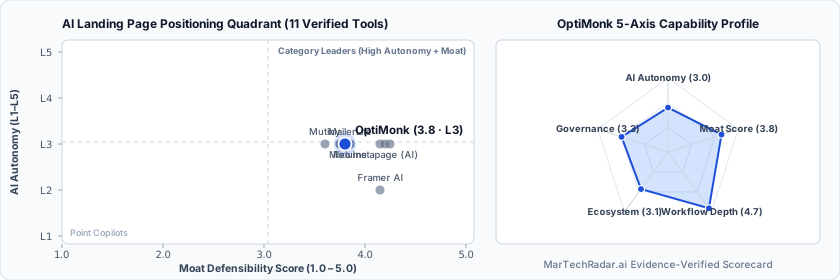
OptiMonk is a Web SaaS tool for AI Landing Page (Landing Page Builders & Autonomous CRO) in Lifecycle & CDP. Pricing: From $19/mo. Best suited to DTC / eCommerce. Editor ratings: AI autonomy L3 (conditional automation); moat score 3.8/5.0 (Proprietary moat). Fact-checked by Anna Xia on Oct 12, 2026.
Autonomous conversion rate optimization platform and on-site overlay generator powered by agentic design mechanics and MCP integrations.
OptiMonk buyer fit verdict: when to choose vs. when to walk away
Choose OptiMonk if (Best Fit)
- Target ICP & Stack Fit: You operate as DTC / eCommerce requiring a Web SaaS deployment for AI Landing Page.
- L3 Architecture & Defensibility: Defensibility stems from a mature behavioral event-triggering engine integrated with real-time DOM telemetry, coupled with programmatic Model Context Protocol (MCP) connectivity that exposes campaign generation directly to external developer workflows.
- Commercial Model Fit: Your procurement budget aligns with From $19/mo.
Walk away from OptiMonk if (Deal-Breakers)
- Walk away if your workflow requires uncapped enterprise volume on the From $19/mo entry plan without upgrading tiers.
- Walk away if your workflow cannot tolerate client-side script overhead: Injecting complex behavioral DOM observers and real-time cursor trajectory listeners introduces synthetic rendering delays, threatening Core Web Vitals such as Interaction to Next Paint (INP) if script execution is unthrottled.
- Walk away if LLM generative drift is a deal-breaker for your team: Relying on autonomous agent generation for front-end layouts can yield CSS collisions, erratic brand-token alignment, or inconsistent mobile viewport responsiveness requiring manual developer mediation.
OptiMonk key facts & scorecard
| Pricing | From $19/moVendor pricing page |
|---|---|
| Free plan | No / not disclosed |
| Delivery | Web SaaS |
| Audience | DTC / eCommerce |
| AI autonomy level | L3 · Conditional automationEditor-verified |
| Moat tier & score | 3.8 / 5.0 · Proprietary moatEditor-verified |
| Funding | Bootstrapped |
| Total funding | BootstrappedBacked by Founders |
| Founders | Csaba Zajdó, Nicole Mezei |
| Company size | 51-200 employees |
| Governance & docs | Privacy ↗ |
| Headquarters | Debrecen, Hajdú-Bihar |
| Founded | 2014 |
| Last verified |
OptiMonk pros & cons: strengths vs. operational limitations
Pros: core strengths & capabilities
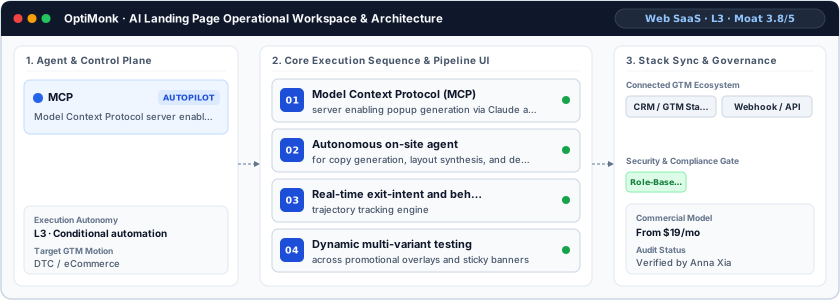
- Model Context Protocol (MCP): server enabling popup generation via Claude and Cursor
- Autonomous on-site agent: for copy generation, layout synthesis, and deployment
- Real-time exit-intent and behavioral: trajectory tracking engine
- Dynamic multi-variant testing: across promotional overlays and sticky banners
Cons: operational limitations & risks
- Client-Side Script Overhead: Injecting complex behavioral DOM observers and real-time cursor trajectory listeners introduces synthetic rendering delays, threatening Core Web Vitals such as Interaction to Next Paint (INP) if script execution is unthrottled.
- LLM Generative Drift: Relying on autonomous agent generation for front-end layouts can yield CSS collisions, erratic brand-token alignment, or inconsistent mobile viewport responsiveness requiring manual developer mediation.
- Traffic Tier Enforcement: The strict reliance on monthly pageview thresholds penalizes high-traffic, low-margin e-commerce stores whose visitor volume surges rapidly without generating commensurate conversion gains.
OptiMonk TCO & deal-breaker stress test
Simulate 12-month stepped TCO, hidden cost multipliers, contract lock-in exposure, and stack failure modes using only facts verified by Anna Xia on · Capture SHA 6f6b60fa.
OptiMonk aligns with your 5-seat / $800/mo profile. Review the walk-away triggers and contract levers below before deployment.
| Plan / Tier | Verified Rate | Scale Fit | Scope & Quota Notes |
|---|---|---|---|
| Essential | $19/mo | 1–2 seats | For stores finding their first wins. |
| Growth / Professional | $228/mo | 5 seats | 3,000 AI credits / month |
- Moat Score
- 3.8 / 5.0
- AI Autonomy
- L3
- Free Tier / Trial
- None disclosed
Triggered audit signals & failure modes
- Published Self-Serve Entry FloorVerified Pricing Ledger
OptiMonk publishes a transparent entry point (From $19/mo) for initial validation before committing.
- Tier Fit for 5-Seat Scale: Growth / Professional ($228/mo)Verified Tier Schedule
3,000 AI credits / month
- Primary Operational Bottleneck: Traffic Tier EnforcementAudit by Anna Xia
The strict reliance on monthly pageview thresholds penalizes high-traffic, low-margin e-commerce stores whose visitor volume surges rapidly without generating commensurate conversion gains.
Hidden TCO Multipliers & Quota Gates
- Annual Billing Headline vs. Monthly Premium: Headline entry rates reflect annual billing commitments (Save 25%); month-to-month flexibility carries a higher effective monthly rate or requires annual prepayment.
- Credit & Usage Burn Multiplier: Automated workflows consume metered credits/usage quotas; multi-step enrichment, voice minutes, or high-frequency agent runs can trigger mid-cycle top-up packs.
When to Walk Away & Negotiation Levers
- Walk away if your workflow requires uncapped enterprise volume on the From $19/mo entry plan without upgrading tiers.
- Walk away if your workflow cannot tolerate client-side script overhead: Injecting complex behavioral DOM observers and real-time cursor trajectory listeners introduces synthetic rendering delays, threatening Core Web Vitals such as Interaction to Next Paint (INP) if script execution is unthrottled.
- Walk away if LLM generative drift is a deal-breaker for your team: Relying on autonomous agent generation for front-end layouts can yield CSS collisions, erratic brand-token alignment, or inconsistent mobile viewport responsiveness requiring manual developer mediation.
- Validate exact quota thresholds (seats, credits, or API calls) included in OptiMonk's From $19/mo tier before converting from monthly to annual billing.
- Require a sandbox proof-of-concept testing client-side script overhead against your live CRM/data schema before annual sign-off.
Ask a custom procurement or TCO stress-test question about OptiMonk
Lower 5-seat floor (~$79/mo vs. $228 / mo)
Lower 5-seat floor (~$11/mo vs. $228 / mo)
OptiMonk key entities, modules & ecosystem stack
Model Context Protocol server enabling popup generation via Claude and Cursor
OptiMonk moat & subtrack positioning
Defensibility stems from a mature behavioral event-triggering engine integrated with real-time DOM telemetry, coupled with programmatic Model Context Protocol (MCP) connectivity that exposes campaign generation directly to external developer workflows.
Editorial review
Fact-checked by Anna Xia (Senior B2B GTM & Revenue Systems Analyst) on .
Background
OptiMonk operates as an autonomous on-site conversion rate optimization system designed to engineer, deploy, and refine behavioral engagement overlays without front-end design intervention. Established in 2014 and headquartered in Debrecen, Hajdú-Bihar, the platform caters to e-commerce merchants and growth marketing teams seeking to capture intent-driven revenue. Rather than functioning as a passive widget repository, OptiMonk positions its architecture as an agentic conversion runtime that directly translates prompt-based specifications into fully functional storefront interactions.
How OptiMonk works
Under the hood, the system coordinates an event-driven JavaScript client library with autonomous generative modules. The client SDK monitors cursor trajectories, scroll velocity, session duration, and cart state to trigger contextual overlays like exit-intent vouchers and notification bars. Recent infrastructural upgrades expose a Model Context Protocol (MCP) server interface, permitting external agentic workflows via tools like Claude and Cursor to autonomously generate markup, calibrate visual styling, author promotional copy, and push live campaign payloads directly to host domains at Level 3 autonomy.
Limitations
Operational considerations and platform boundaries include:
- Client-Side Script Overhead: Injecting complex behavioral DOM observers and real-time cursor trajectory listeners introduces synthetic rendering delays, threatening Core Web Vitals such as Interaction to Next Paint (INP) if script execution is unthrottled.
- LLM Generative Drift: Relying on autonomous agent generation for front-end layouts can yield CSS collisions, erratic brand-token alignment, or inconsistent mobile viewport responsiveness requiring manual developer mediation.
- Traffic Tier Enforcement: The strict reliance on monthly pageview thresholds penalizes high-traffic, low-margin e-commerce stores whose visitor volume surges rapidly without generating commensurate conversion gains.
OptiMonk pricing
The commercial licensing model combines traffic volume metrics with generative compute allocations. Entry-level access begins at $0 per month for basic evaluation supporting 10,000 pageviews, while the paid tier starts at $19 per month (or $228 billed annually) for up to 20,000 monthly pageviews and 3,000 AI credits across two domains. Higher operational tiers scale pricing linearly against monthly session bandwidth and synthetic generation quotas.
How OptiMonk compares
OptiMonk operates within a specialized conversion envelope distinct from broad canvas builders like Framer AI, Dora AI, and Instapage (AI). While Framer AI and Dora AI synthesize full-fidelity, multi-page spatial web architectures, OptiMonk focuses exclusively on behavioral overlay injection without demanding full-site DNS or CMS migrations. Against Instapage (AI), which centers on standalone post-click landing pages, OptiMonk excels as a lightweight dynamic layer directly tailored for mid-market DTC storefronts.
Direct competitors & market radar
Top algorithmic competitors based on category positioning, capability overlap, and ICP alignment.
Frequently asked questions about OptiMonk
How much does OptiMonk cost and what pricing tiers are available?
Published pricing summary for OptiMonk: From $19/mo. A permanent free plan is not disclosed for OptiMonk. Verified tier schedule: Essential ($19/mo for 1–2 seats); Growth / Professional ($228/mo for 5 seats). The commercial licensing model combines traffic volume metrics with generative compute allocations.
How does OptiMonk work and how autonomous is its AI architecture?
Autonomous conversion rate optimization platform and on-site overlay generator powered by agentic design mechanics and MCP integrations. Within AI Landing Page (Landing Page Builders & Autonomous CRO), MarTechRadar rates its execution architecture at L3 · Conditional automation with a verified Moat Score of 3.8 / 5.0 (Proprietary moat). Defensibility stems from a mature behavioral event-triggering engine integrated with real-time DOM telemetry, coupled with programmatic Model Context Protocol (MCP) connectivity that exposes campaign generation directly to external developer workflows. Corporate profile: Founded by Csaba Zajdó, Nicole Mezei, operating at 51-200 employees scale.
What are the main limitations of OptiMonk and when should buyers walk away?
Based on our editorial technical audit, key operational considerations and boundaries for OptiMonk include: (1) Client-Side Script Overhead: Injecting complex behavioral DOM observers and real-time cursor trajectory listeners introduces synthetic rendering delays, threatening Core Web Vitals such as Interaction to Next Paint (INP) if script execution is unthrottled. (2) LLM Generative Drift: Relying on autonomous agent generation for front-end layouts can yield CSS collisions, erratic brand-token alignment, or inconsistent mobile viewport responsiveness requiring manual developer mediation. (3) Traffic Tier Enforcement: The strict reliance on monthly pageview thresholds penalizes high-traffic, low-margin e-commerce stores whose visitor volume surges rapidly without generating commensurate conversion gains. Primary procurement walk-away rule: Walk away if your workflow requires uncapped enterprise volume on the From $19/mo entry plan without upgrading tiers.
What integrations, compliance certifications, and contract terms apply to OptiMonk?
Key TCO multiplier to watch: Annual Billing Headline vs. Monthly Premium (Headline entry rates reflect annual billing commitments (Save 25%); month-to-month flexibility carries a higher effective monthly rate or requires annual prepayment.) Before signing a contract, procurement teams should validate exact quota thresholds (seats, credits, or API calls) included in OptiMonk's From $19/mo tier before converting from monthly to annual billing.
What are the best OptiMonk alternatives and head-to-head competitors in 2026?
Top fact-checked alternatives to OptiMonk in AI Landing Page (Landing Page Builders & Autonomous CRO) include Instapage (AI) (From $79/mo), Dora AI (Custom / enterprise pricing), MailerLite (From $10.80/mo), Relume (From $12/mo). OptiMonk operates within a specialized conversion envelope distinct from broad canvas builders like Framer AI, Dora AI, and Instapage (AI).
Verified sources & evidence trail
- Official product domain: https://optimonk.com
- Commercial pricing verification: https://www.optimonk.com/pricing
- Verified corporate entity profiles (
sameAs): LinkedIn Company Profile · Crunchbase Entity Record - First-party governance & documentation links: Privacy
- Editorial audit sign-off: Fact-checked by Anna Xia on under the MarTechRadar Evidence-Ledger Protocol.