Sitekick Review (2026): AI Landing Page Pricing, Limits & Alternatives
Bottom line
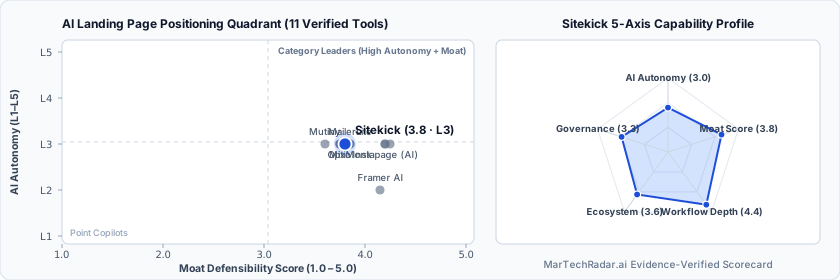
Sitekick is a Web SaaS tool for AI Landing Page (Landing Page Builders & Autonomous CRO) in Lifecycle & CDP. Pricing: Custom / enterprise pricing. Best suited to B2B SaaS and Creators / Solo. Editor ratings: AI autonomy L3 (conditional automation); moat score 3.8/5.0 (Proprietary moat). Fact-checked by Jagmeet Sine on Oct 12, 2026.
AI-powered landing page and website generator creating conversion-optimized layouts and copy from natural language prompts in minutes.
Sitekick buyer fit verdict: when to choose vs. when to walk away
Choose Sitekick if (Best Fit)
- Target ICP & Stack Fit: You operate as B2B SaaS and Creators / Solo requiring a Web SaaS deployment for AI Landing Page, with verified ecosystem connectivity for Salesforce.
- L3 Architecture & Defensibility: Sitekick maintains a modest defensibility profile reliant on prompt-to-layout template mapping and multilingual generation pipelines, but faces displacement risks from design-system builders embedding native generative workflows.
- Commercial Model Fit: Your procurement budget aligns with Custom / enterprise pricing.
Walk away from Sitekick if (Deal-Breakers)
- Walk away if you require transparent self-serve monthly billing or your budget ceiling is under $1,000/mo (Sitekick requires sales-gated custom quoting).
- Walk away if your workflow cannot tolerate component modularity constraints: The templated generation system restricts deep structural customization, preventing teams from implementing proprietary frontend frameworks, intricate dynamic widgets, or bespoke reactive JavaScript components.
- Walk away if deep CRM and martech integration gaps is a deal-breaker for your team: Data capture forms rely on standard webhooks and basic email handoffs, lacking native bidirectional synchronization with enterprise attribution pipelines, complex marketing automation databases, or multi-stage lead routing logic.
Sitekick key facts & scorecard
| Pricing | Custom / enterprise pricing |
|---|---|
| Free plan | No / not disclosed |
| Delivery | Web SaaS |
| Audience | B2B SaaS, Creators / Solo |
| AI autonomy level | L3 · Conditional automationEditor-verified |
| Moat tier & score | 3.8 / 5.0 · Proprietary moatEditor-verified |
| Funding | Bootstrapped |
| Total funding | BootstrappedBacked by Founders |
| Founders | Victor Metelskiy |
| Company size | 2-10 employees |
| Ecosystem integrations | Salesforce |
| Governance & docs | Privacy ↗ |
| Headquarters | United States |
| Founded | 2022 |
| Last verified |
Sitekick pros & cons: strengths vs. operational limitations
Pros: core strengths & capabilities
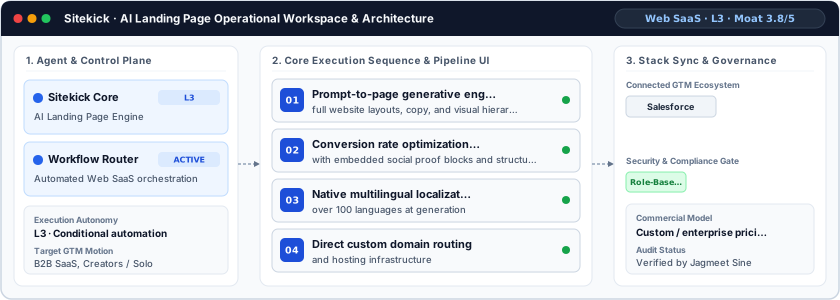
- Prompt-to-page generative engine synthesizing: full website layouts, copy, and visual hierarchies
- Conversion rate optimization wireframes: with embedded social proof blocks and structured CTA placements
- Native multilingual localization supporting: over 100 languages at generation
- Direct custom domain routing: and hosting infrastructure
Cons: operational limitations & risks
- Component Modularity Constraints: The templated generation system restricts deep structural customization, preventing teams from implementing proprietary frontend frameworks, intricate dynamic widgets, or bespoke reactive JavaScript components.
- Deep CRM and MarTech Integration Gaps: Data capture forms rely on standard webhooks and basic email handoffs, lacking native bidirectional synchronization with enterprise attribution pipelines, complex marketing automation databases, or multi-stage lead routing logic.
- Autonomous CRO Experimentation Limits: While the tool automates initial page synthesis, it lacks continuous multi-armed bandit testing or real-time traffic-based copy permutation engines, requiring manual intervention to execute iterative split tests.
Sitekick TCO & deal-breaker stress test
Simulate 12-month stepped TCO, hidden cost multipliers, contract lock-in exposure, and stack failure modes using only facts verified by Jagmeet Sine on · Capture SHA 88d7d514.
Sitekick triggers high-severity friction under your 5-seat / $800/mo constraints. Benchmark the verified subtrack alternatives below before committing.
| Plan / Tier | Verified Rate | Scale Fit | Scope & Quota Notes |
|---|---|---|---|
| Enterprise / Custom | Custom quote | 15–50+ seats (Enterprise SLA) | Sales-negotiated annual contract for custom volume, SSO/RBAC governance, and dedicated SLA. |
- Moat Score
- 3.8 / 5.0
- AI Autonomy
- L3
- Free Tier / Trial
- None disclosed
Triggered audit signals & failure modes
- Opaque Enterprise Quoting vs. SMB/Mid-Market BudgetVerified Pricing Ledger
Sitekick does not disclose a public self-serve floor (Custom / enterprise pricing). Buyers with a $800/mo cap face high sales-qualification friction.
- Sales-Gated Contract TermsFact-checked by Jagmeet Sine
Sitekick provides commercial access via a software-as-a-service model, offering a trial period alongside custom enterprise pricing available on request through direct sales channels.
- Primary Operational Bottleneck: Component Modularity ConstraintsAudit by Jagmeet Sine
The templated generation system restricts deep structural customization, preventing teams from implementing proprietary frontend frameworks, intricate dynamic widgets, or bespoke reactive JavaScript components.
Hidden TCO Multipliers & Quota Gates
- Component Modularity Constraints: The templated generation system restricts deep structural customization, preventing teams from implementing proprietary frontend frameworks, intricate dynamic widgets, or bespoke reactive JavaScript components.
- Deep CRM and MarTech Integration Gaps: Data capture forms rely on standard webhooks and basic email handoffs, lacking native bidirectional synchronization with enterprise attribution pipelines, complex marketing automation databases, or multi-stage lead routing logic.
When to Walk Away & Negotiation Levers
- Walk away if you require transparent self-serve monthly billing or your budget ceiling is under $1,000/mo (Sitekick requires sales-gated custom quoting).
- Walk away if your workflow cannot tolerate component modularity constraints: The templated generation system restricts deep structural customization, preventing teams from implementing proprietary frontend frameworks, intricate dynamic widgets, or bespoke reactive JavaScript components.
- Walk away if deep CRM and martech integration gaps is a deal-breaker for your team: Data capture forms rely on standard webhooks and basic email handoffs, lacking native bidirectional synchronization with enterprise attribution pipelines, complex marketing automation databases, or multi-stage lead routing logic.
- Demand a 30- to 60-day paid pilot opt-out clause in the Sitekick order form before signing a 12-month enterprise commitment.
- Require a sandbox proof-of-concept testing component modularity constraints against your live CRM/data schema before annual sign-off.
Ask a custom procurement or TCO stress-test question about Sitekick
Free / open entry ($0 floor vs. Custom / enterprise pricing) · Transparent self-serve entry without mandatory annual lock-in
Lower 5-seat floor (~$12/mo vs. Custom Quote) · Transparent self-serve entry without mandatory annual lock-in
Sitekick key entities, modules & ecosystem stack
Sitekick moat & subtrack positioning
Sitekick maintains a modest defensibility profile reliant on prompt-to-layout template mapping and multilingual generation pipelines, but faces displacement risks from design-system builders embedding native generative workflows.
Editorial review
Fact-checked by Jagmeet Sine (Senior MarTech Infrastructure & Agentic Workflow Architect) on .
Background
For growth marketing teams and non-technical founders tasked with rapidly validating offers, Sitekick serves as an automated landing page synthesis platform. Headquartered in the United States and founded in 2022, the company designs its software for performance advertisers, digital agencies, and entrepreneurial operators seeking to compress deployment timelines from days into minutes without dedicated engineering teams.
How Sitekick works
Sitekick executes site generation via a structured prompt-parsing pipeline. Users input basic business parameters, including core value propositions, target audiences, and primary calls to action. The platform’s generation engine routes these directives into pre-constructed structural frameworks calibrated for conversion rate optimization. Rather than generating random free-form code, the platform populates modular interface blocks with context-aware copywriting, responsive layout hierarchies, visual assets, and multilingual translations spanning more than one hundred languages. Generated outputs are subsequently exposed through an inline visual editor for manual styling adjustments, custom domain configuration, and instant asset hosting.
Limitations
Operational considerations and platform boundaries include:
- Component Modularity Constraints: The templated generation system restricts deep structural customization, preventing teams from implementing proprietary frontend frameworks, intricate dynamic widgets, or bespoke reactive JavaScript components.
- Deep CRM and MarTech Integration Gaps: Data capture forms rely on standard webhooks and basic email handoffs, lacking native bidirectional synchronization with enterprise attribution pipelines, complex marketing automation databases, or multi-stage lead routing logic.
- Autonomous CRO Experimentation Limits: While the tool automates initial page synthesis, it lacks continuous multi-armed bandit testing or real-time traffic-based copy permutation engines, requiring manual intervention to execute iterative split tests.
Sitekick pricing
Sitekick provides commercial access via a software-as-a-service model, offering a trial period alongside custom enterprise pricing available on request through direct sales channels. Enterprise quotes scale according to workspace seat counts, active domain allocations, and total monthly generated page volume without published upfront list tiers.
How Sitekick compares
In the generative web creation ecosystem, Sitekick focuses strictly on speed-to-market and direct conversion layouts, diverging from competitors like Framer AI, which emphasizes bespoke design control and advanced vector animation pipelines. Dora AI targets three-dimensional spatial animations requiring specialized digital design expertise, whereas Instapage AI targets sophisticated enterprise performance teams requiring multivariate split-testing infrastructure and direct Salesforce-grade attribution engines. Sitekick remains best aligned with lean operational teams, direct-response advertisers, and small agencies needing functional, copy-complete campaign pages without custom frontend overhead.
Frequently asked questions about Sitekick
How much does Sitekick cost and does it require a custom enterprise quote?
Published pricing summary for Sitekick: Custom / enterprise pricing. A permanent free plan is not disclosed for Sitekick. Sitekick provides commercial access via a software-as-a-service model, offering a trial period alongside custom enterprise pricing available on request through direct sales channels.
How does Sitekick work and how autonomous is its AI architecture?
AI-powered landing page and website generator creating conversion-optimized layouts and copy from natural language prompts in minutes. Within AI Landing Page (Landing Page Builders & Autonomous CRO), MarTechRadar rates its execution architecture at L3 · Conditional automation with a verified Moat Score of 3.8 / 5.0 (Proprietary moat). Sitekick maintains a modest defensibility profile reliant on prompt-to-layout template mapping and multilingual generation pipelines, but faces displacement risks from design-system builders embedding native generative workflows. Corporate profile: Founded by Victor Metelskiy, operating at 2-10 employees scale.
What are the main limitations of Sitekick and when should buyers walk away?
Based on our editorial technical audit, key operational considerations and boundaries for Sitekick include: (1) Component Modularity Constraints: The templated generation system restricts deep structural customization, preventing teams from implementing proprietary frontend frameworks, intricate dynamic widgets, or bespoke reactive JavaScript components. (2) Deep CRM and MarTech Integration Gaps: Data capture forms rely on standard webhooks and basic email handoffs, lacking native bidirectional synchronization with enterprise attribution pipelines, complex marketing automation databases, or multi-stage lead routing logic. (3) Autonomous CRO Experimentation Limits: While the tool automates initial page synthesis, it lacks continuous multi-armed bandit testing or real-time traffic-based copy permutation engines, requiring manual intervention to execute iterative split tests. Primary procurement walk-away rule: Walk away if you require transparent self-serve monthly billing or your budget ceiling is under $1,000/mo (Sitekick requires sales-gated custom quoting).
What integrations, compliance certifications, and contract terms apply to Sitekick?
Verified ecosystem and stack integrations include Salesforce. Key TCO multiplier to watch: Component Modularity Constraints (The templated generation system restricts deep structural customization, preventing teams from implementing proprietary frontend frameworks, intricate dynamic widgets, or bespoke reactive JavaScript components.) Before signing a contract, procurement teams should demand a 30- to 60-day paid pilot opt-out clause in the Sitekick order form before signing a 12-month enterprise commitment.
What are the best Sitekick alternatives and head-to-head competitors in 2026?
Top fact-checked alternatives to Sitekick in AI Landing Page (Landing Page Builders & Autonomous CRO) include OptiMonk (From $19/mo), Relume (From $12/mo), Replo (Custom / enterprise pricing), Yieldify (Custom / enterprise pricing). In the generative web creation ecosystem, Sitekick focuses strictly on speed-to-market and direct conversion layouts, diverging from competitors like Framer AI, which emphasizes bespoke design control and advanced vector animation pipelines.
Verified sources & evidence trail
- Official product domain: https://www.sitekick.ai
- Commercial pricing verification: Verified against official vendor pricing policy (Custom / enterprise pricing)
- Verified corporate entity profiles (
sameAs): LinkedIn Company Profile · Crunchbase Entity Record - First-party governance & documentation links: Privacy
- Editorial audit sign-off: Fact-checked by Jagmeet Sine on under the MarTechRadar Evidence-Ledger Protocol.