Pecan AI Review (2026): Predictive AI Pricing, Limits & Alternatives
Bottom line
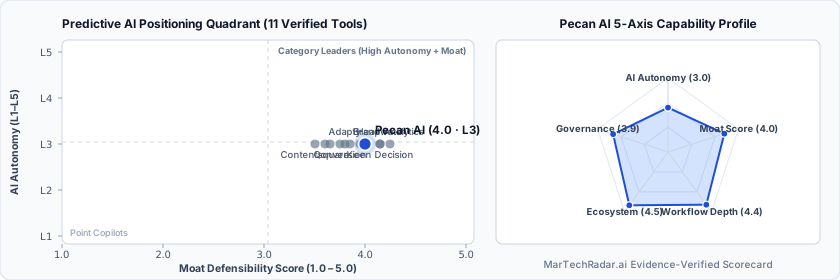
Pecan AI is a Web SaaS tool for Predictive AI (Predictive LTV, Churn & Customer Analytics) in Analytics & Attribution. Pricing: Custom / enterprise pricing. Best suited to B2B SaaS and Marketing Agencies. Editor ratings: AI autonomy L3 (conditional automation); moat score 4.0/5.0 (Proprietary moat). Fact-checked by Anna Xia on Oct 7, 2026.
Automated predictive analytics platform generating tabular machine learning models for customer churn, lifetime value forecasting, and demand planning.
Pecan AI buyer fit verdict: when to choose vs. when to walk away
Choose Pecan AI if (Best Fit)
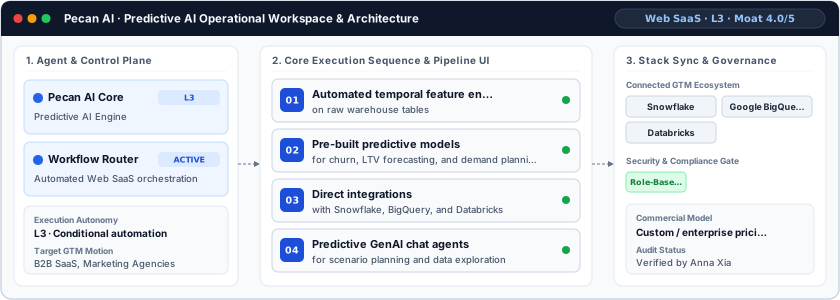
- Target ICP & Stack Fit: You operate as B2B SaaS and Marketing Agencies requiring a Web SaaS deployment for Predictive AI, with verified ecosystem connectivity for Snowflake, Google BigQuery, Databricks.
- L3 Architecture & Defensibility: Pecan AI establishes defensibility via proprietary automated temporal feature engineering that transforms raw relational data into machine-learning-ready tensors without manual data science overhead, backed by substantial capital.
- Commercial Model Fit: Your procurement budget aligns with Custom / enterprise pricing.
Walk away from Pecan AI if (Deal-Breakers)
- Walk away if you require transparent self-serve monthly billing or your budget ceiling is under $1,000/mo (Pecan AI requires sales-gated custom quoting).
- Walk away if your workflow cannot tolerate schema sensitivity: Pecan relies on consistent relational schemas; structural changes in source tables or silent warehouse data type modifications will cause pipeline ingestion failures.
- Walk away if sparse event latency is a deal-breaker for your team: The temporal feature store requires dense transactional velocity, producing unstable predictions when deployed on low-volume enterprise accounts or long-cycle conversion funnels.
Pecan AI key facts & scorecard
| Pricing | Custom / enterprise pricingVendor pricing page |
|---|---|
| Free plan | No / not disclosed |
| Delivery | Web SaaS |
| Audience | B2B SaaS, Marketing Agencies |
| AI autonomy level | L3 · Conditional automationEditor-verified |
| Moat tier & score | 4.0 / 5.0 · Proprietary moatEditor-verified |
| Funding | Series C+ |
| Total funding | $116MBacked by Insight Partners, Notable Capital, Vintage Investment Partners, Google Ventures, S Capital |
| Founders | Noam Brezis, Zohar Bronfman |
| Company size | 51-200 employees |
| Ecosystem integrations | Snowflake, Google BigQuery, Databricks |
| Governance & docs | Privacy ↗ |
| Headquarters | Tel Aviv, Israel |
| Founded | 2018 |
| Last verified |
Pecan AI pros & cons: strengths vs. operational limitations
Pros: core strengths & capabilities
- Automated temporal feature engineering: on raw warehouse tables
- Pre-built predictive models: for churn, LTV forecasting, and demand planning
- Direct integrations: with Snowflake, BigQuery, and Databricks
- Predictive GenAI chat agents: for scenario planning and data exploration
Cons: operational limitations & risks
- Schema Sensitivity: Pecan relies on consistent relational schemas; structural changes in source tables or silent warehouse data type modifications will cause pipeline ingestion failures.
- Sparse Event Latency: The temporal feature store requires dense transactional velocity, producing unstable predictions when deployed on low-volume enterprise accounts or long-cycle conversion funnels.
- Black-Box Feature Explanations: While the platform surfaces top SHAP-style model drivers, deep diagnostic debugging of complex temporal cross-features remains constrained compared to custom notebook code.
Pecan AI TCO & deal-breaker stress test
Simulate 12-month stepped TCO, hidden cost multipliers, contract lock-in exposure, and stack failure modes using only facts verified by Anna Xia on · Capture SHA 58f571f3.
Pecan AI triggers high-severity friction under your 5-seat / $800/mo constraints. Benchmark the verified subtrack alternatives below before committing.
| Plan / Tier | Verified Rate | Scale Fit | Scope & Quota Notes |
|---|---|---|---|
| Enterprise / Custom | Custom quote | 15–50+ seats (Enterprise SLA) | Sales-negotiated annual contract for custom volume, SSO/RBAC governance, and dedicated SLA. |
- Moat Score
- 4.0 / 5.0
- AI Autonomy
- L3
- Free Tier / Trial
- None disclosed
Triggered audit signals & failure modes
- Opaque Enterprise Quoting vs. SMB/Mid-Market BudgetVerified Pricing Ledger
Pecan AI does not disclose a public self-serve floor (Custom / enterprise pricing). Buyers with a $800/mo cap face high sales-qualification friction.
- Sales-Gated Contract TermsFact-checked by Anna Xia
Pecan AI structures its licensing around modular subscription tiers denoted as Starter, Team, and Business, which scale based on the volume of processed database rows, active prediction model batches, and support levels.
- Primary Operational Bottleneck: Schema SensitivityAudit by Anna Xia
Pecan relies on consistent relational schemas; structural changes in source tables or silent warehouse data type modifications will cause pipeline ingestion failures.
Hidden TCO Multipliers & Quota Gates
- Enterprise Governance & Add-On Gating: Advanced capabilities such as Single Sign-On (SSO), custom role permissions, or specialized analytics modules are gated behind upper tiers or paid add-ons.
- Schema Sensitivity: Pecan relies on consistent relational schemas; structural changes in source tables or silent warehouse data type modifications will cause pipeline ingestion failures.
- Sparse Event Latency: The temporal feature store requires dense transactional velocity, producing unstable predictions when deployed on low-volume enterprise accounts or long-cycle conversion funnels.
When to Walk Away & Negotiation Levers
- Walk away if you require transparent self-serve monthly billing or your budget ceiling is under $1,000/mo (Pecan AI requires sales-gated custom quoting).
- Walk away if your workflow cannot tolerate schema sensitivity: Pecan relies on consistent relational schemas; structural changes in source tables or silent warehouse data type modifications will cause pipeline ingestion failures.
- Walk away if sparse event latency is a deal-breaker for your team: The temporal feature store requires dense transactional velocity, producing unstable predictions when deployed on low-volume enterprise accounts or long-cycle conversion funnels.
- Demand a 30- to 60-day paid pilot opt-out clause in the Pecan AI order form before signing a 12-month enterprise commitment.
- Require a sandbox proof-of-concept testing schema sensitivity against your live CRM/data schema before annual sign-off.
Ask a custom procurement or TCO stress-test question about Pecan AI
Transparent self-serve entry without mandatory annual lock-in
Offers a free tier (Free plan · $0/mo · Enterprise plan) · Transparent self-serve entry without mandatory annual lock-in
Pecan AI key entities, modules & ecosystem stack
Pecan AI moat & subtrack positioning
Pecan AI establishes defensibility via proprietary automated temporal feature engineering that transforms raw relational data into machine-learning-ready tensors without manual data science overhead, backed by substantial capital.
Editorial review
Fact-checked by Anna Xia (Senior B2B GTM & Revenue Systems Analyst) on .
Background
Architected to bypass the manual feature engineering bottleneck inherent in tabular machine learning, Pecan AI was founded in 2018 in Tel Aviv, Israel, and has accumulated $116M in total venture funding. The platform provides automated predictive analytics specifically targeted at performance marketing leaders, revenue operations specialists, and retention managers seeking forward-looking customer metrics without staffing dedicated data science units.
How Pecan AI works
Pecan AI operates by connecting directly to modern data repositories including Snowflake, Google BigQuery, and Databricks. Its ingestion engine queries raw relational events and transactional tables, then deploys automated temporal feature engineering to synthesize historical aggregations, velocity trends, and recency indicators. The internal AutoML system evaluates multiple gradient-boosted decision tree configurations and regression models, scoring predictive accuracy through rigorous backtesting. The platform functions at Level 3 autonomy, autonomously training and serving inference pipelines while outputting propensity scores and lifetime value calculations back to downstream operational platforms via automated export jobs.
Limitations
Operational considerations and platform boundaries include:
- Schema Sensitivity: Pecan relies on consistent relational schemas; structural changes in source tables or silent warehouse data type modifications will cause pipeline ingestion failures.
- Sparse Event Latency: The temporal feature store requires dense transactional velocity, producing unstable predictions when deployed on low-volume enterprise accounts or long-cycle conversion funnels.
- Black-Box Feature Explanations: While the platform surfaces top SHAP-style model drivers, deep diagnostic debugging of complex temporal cross-features remains constrained compared to custom notebook code.
Pecan AI pricing
Pecan AI structures its licensing around modular subscription tiers denoted as Starter, Team, and Business, which scale based on the volume of processed database rows, active prediction model batches, and support levels. Commercial pricing is available on request through tailored enterprise sales quotes based on organizational scale and seats, with agreements structured as annual software licenses encompassing implementation services and enablement.
How Pecan AI compares
Within customer analytics, Pecan AI addresses forward-looking tabular modeling, separating itself from event-stream and behavioral trackers. While Contentsquare and Heap Analytics capture granular digital experience interactions and retrospective funnel drop-offs, Pecan executes predictive churn scoring and lifetime value regression on consolidated warehouse data. Unlike Brandwatch, which focuses on external brand sentiment and social listening data, Pecan models internal transactional records. The platform fits mid-market and enterprise direct-to-consumer organizations possessing structured warehouse data but lacking internal machine learning bandwidth.
Direct competitors & market radar
Top algorithmic competitors based on category positioning, capability overlap, and ICP alignment.
Frequently asked questions about Pecan AI
How much does Pecan AI cost and does it require a custom enterprise quote?
Published pricing summary for Pecan AI: Custom / enterprise pricing. A permanent free plan is not disclosed for Pecan AI. Pecan AI structures its licensing around modular subscription tiers denoted as Starter, Team, and Business, which scale based on the volume of processed database rows, active prediction model batches, and support levels.
How does Pecan AI work and how autonomous is its AI architecture?
Automated predictive analytics platform generating tabular machine learning models for customer churn, lifetime value forecasting, and demand planning. Within Predictive AI (Predictive LTV, Churn & Customer Analytics), MarTechRadar rates its execution architecture at L3 · Conditional automation with a verified Moat Score of 4.0 / 5.0 (Proprietary moat). Pecan AI establishes defensibility via proprietary automated temporal feature engineering that transforms raw relational data into machine-learning-ready tensors without manual data science overhead, backed by substantial capital. Corporate profile: Founded by Noam Brezis, Zohar Bronfman, operating at 51-200 employees scale.
What are the main limitations of Pecan AI and when should buyers walk away?
Based on our editorial technical audit, key operational considerations and boundaries for Pecan AI include: (1) Schema Sensitivity: Pecan relies on consistent relational schemas; structural changes in source tables or silent warehouse data type modifications will cause pipeline ingestion failures. (2) Sparse Event Latency: The temporal feature store requires dense transactional velocity, producing unstable predictions when deployed on low-volume enterprise accounts or long-cycle conversion funnels. (3) Black-Box Feature Explanations: While the platform surfaces top SHAP-style model drivers, deep diagnostic debugging of complex temporal cross-features remains constrained compared to custom notebook code. Primary procurement walk-away rule: Walk away if you require transparent self-serve monthly billing or your budget ceiling is under $1,000/mo (Pecan AI requires sales-gated custom quoting).
What integrations, compliance certifications, and contract terms apply to Pecan AI?
Verified ecosystem and stack integrations include Snowflake, Google BigQuery, Databricks. Key TCO multiplier to watch: Enterprise Governance & Add-On Gating (Advanced capabilities such as Single Sign-On (SSO), custom role permissions, or specialized analytics modules are gated behind upper tiers or paid add-ons.) Before signing a contract, procurement teams should demand a 30- to 60-day paid pilot opt-out clause in the Pecan AI order form before signing a 12-month enterprise commitment.
What are the best Pecan AI alternatives and head-to-head competitors in 2026?
Top fact-checked alternatives to Pecan AI in Predictive AI (Predictive LTV, Churn & Customer Analytics) include Contentsquare (€39–€79/mo), QuadSci (Custom / enterprise pricing), Brandwatch (Custom / enterprise pricing), Heap Analytics (Custom / enterprise pricing). Within customer analytics, Pecan AI addresses forward-looking tabular modeling, separating itself from event-stream and behavioral trackers.
Verified sources & evidence trail
- Official product domain: https://pecan.ai
- Commercial pricing verification: https://www.pecan.ai/pricing/
- Verified corporate entity profiles (
sameAs): LinkedIn Company Profile · Crunchbase Entity Record - First-party governance & documentation links: Privacy
- Editorial audit sign-off: Fact-checked by Anna Xia on under the MarTechRadar Evidence-Ledger Protocol.