BrightEdge Generative Parser Review (2026): GEO Pricing, Limits & Alternatives
Bottom line
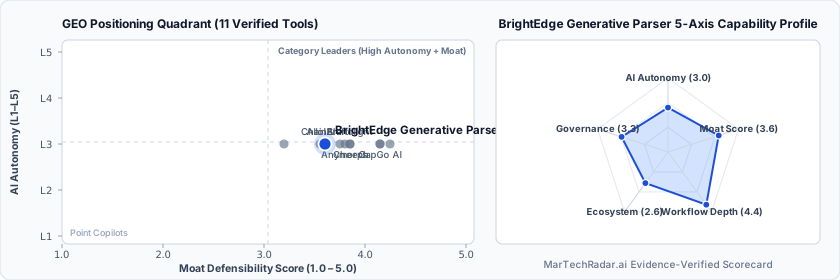
BrightEdge Generative Parser is a Web SaaS tool for GEO (GEO Brand Tracking & LLM Rank Tracking) in GEO & AI SEO. Pricing: Custom / enterprise pricing. Best suited to DTC / eCommerce and Enterprise Brands. Editor ratings: AI autonomy L3 (conditional automation); moat score 3.6/5.0 (Proprietary moat). Fact-checked by Jiacky Lee on Oct 15, 2026.
Enterprise generative engine optimization tracking platform monitoring brand visibility, pixel displacement, and citations across Google AI Overviews.
BrightEdge Generative Parser buyer fit verdict: when to choose vs. when to walk away
Choose BrightEdge Generative Parser if (Best Fit)
- Target ICP & Stack Fit: You operate as DTC / eCommerce and Enterprise Brands requiring a Web SaaS deployment for GEO.
- L3 Architecture & Defensibility: BrightEdge leverages substantial historical SERP corpus data and high-throughput DOM parsing infrastructure to measure generative AI answer presence, pixel displacement, and synthetic citation equity.
- Commercial Model Fit: Your procurement budget aligns with Custom / enterprise pricing.
Walk away from BrightEdge Generative Parser if (Deal-Breakers)
- Walk away if you require transparent self-serve monthly billing or your budget ceiling is under $1,000/mo (BrightEdge Generative Parser requires sales-gated custom quoting).
- Walk away if your workflow cannot tolerate nondeterministic response drift: Model outputs from conversational engines drift across sequential queries, creating attribution discrepancies when identical prompt variants yield divergent citation arrays.
- Walk away if dom mutation fragility is a deal-breaker for your team: Unannounced interface experiments by major search providers break client-side layout parsers, requiring rapid scraper schema updates to prevent data extraction dropouts.
BrightEdge Generative Parser key facts & scorecard
| Pricing | Custom / enterprise pricing |
|---|---|
| Free plan | No / not disclosed |
| Delivery | Web SaaS |
| Audience | DTC / eCommerce, Enterprise Brands |
| AI autonomy level | L3 · Conditional automationEditor-verified |
| Moat tier & score | 3.6 / 5.0 · Proprietary moatEditor-verified |
| Funding | Venture-backed |
| Governance & docs | Trust & Security ↗ · Privacy ↗ |
| Headquarters | United States |
| Founded | 2007 |
| Last verified |
BrightEdge Generative Parser pros & cons: strengths vs. operational limitations
Pros: core strengths & capabilities
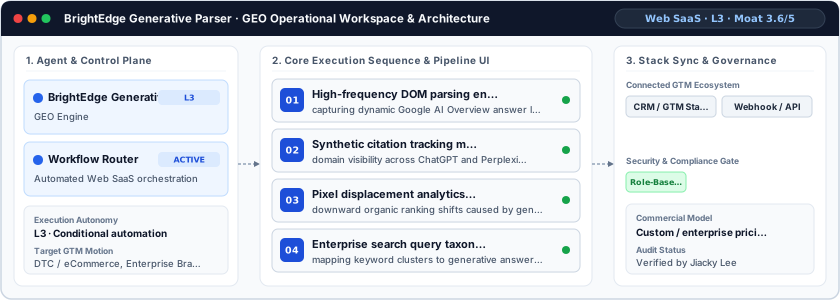
- High-frequency DOM parsing engine: capturing dynamic Google AI Overview answer layouts
- Synthetic citation tracking measuring: domain visibility across ChatGPT and Perplexity answer graphs
- Pixel displacement analytics calculating: downward organic ranking shifts caused by generative answer boxes
- Enterprise search query taxonomy: mapping keyword clusters to generative answer trigger rates
Cons: operational limitations & risks
- Nondeterministic Response Drift: Model outputs from conversational engines drift across sequential queries, creating attribution discrepancies when identical prompt variants yield divergent citation arrays.
- DOM Mutation Fragility: Unannounced interface experiments by major search providers break client-side layout parsers, requiring rapid scraper schema updates to prevent data extraction dropouts.
- Attribution Latency Gap: Batch crawling cadences for broad enterprise keyword sets create measurement delays compared to instant generative SERP updates executed during live query events.
BrightEdge Generative Parser TCO & deal-breaker stress test
Simulate 12-month stepped TCO, hidden cost multipliers, contract lock-in exposure, and stack failure modes using only facts verified by Jiacky Lee on · Capture SHA be766bb7.
BrightEdge Generative Parser triggers high-severity friction under your 5-seat / $800/mo constraints. Benchmark the verified subtrack alternatives below before committing.
| Plan / Tier | Verified Rate | Scale Fit | Scope & Quota Notes |
|---|---|---|---|
| Enterprise / Custom | Custom quote | 15–50+ seats (Enterprise SLA) | Sales-negotiated annual contract for custom volume, SSO/RBAC governance, and dedicated SLA. |
- Moat Score
- 3.6 / 5.0
- AI Autonomy
- L3
- Free Tier / Trial
- None disclosed
Triggered audit signals & failure modes
- Opaque Enterprise Quoting vs. SMB/Mid-Market BudgetVerified Pricing Ledger
BrightEdge Generative Parser does not disclose a public self-serve floor (Custom / enterprise pricing). Buyers with a $800/mo cap face high sales-qualification friction.
- Sales-Gated Contract TermsFact-checked by Jiacky Lee
BrightEdge delivers the Generative Parser under an enterprise software-as-a-service licensing structure. Commercial pricing is available on request through tailored enterprise sales quotes based on organizational scale and seats.
- Primary Operational Bottleneck: Nondeterministic Response DriftAudit by Jiacky Lee
Model outputs from conversational engines drift across sequential queries, creating attribution discrepancies when identical prompt variants yield divergent citation arrays.
Hidden TCO Multipliers & Quota Gates
- Nondeterministic Response Drift: Model outputs from conversational engines drift across sequential queries, creating attribution discrepancies when identical prompt variants yield divergent citation arrays.
- DOM Mutation Fragility: Unannounced interface experiments by major search providers break client-side layout parsers, requiring rapid scraper schema updates to prevent data extraction dropouts.
When to Walk Away & Negotiation Levers
- Walk away if you require transparent self-serve monthly billing or your budget ceiling is under $1,000/mo (BrightEdge Generative Parser requires sales-gated custom quoting).
- Walk away if your workflow cannot tolerate nondeterministic response drift: Model outputs from conversational engines drift across sequential queries, creating attribution discrepancies when identical prompt variants yield divergent citation arrays.
- Walk away if dom mutation fragility is a deal-breaker for your team: Unannounced interface experiments by major search providers break client-side layout parsers, requiring rapid scraper schema updates to prevent data extraction dropouts.
- Demand a 30- to 60-day paid pilot opt-out clause in the BrightEdge Generative Parser order form before signing a 12-month enterprise commitment.
- Require a sandbox proof-of-concept testing nondeterministic response drift against your live CRM/data schema before annual sign-off.
Ask a custom procurement or TCO stress-test question about BrightEdge Generative Parser
Lower 5-seat floor (~$148/mo vs. Custom Quote) · Transparent self-serve entry without mandatory annual lock-in
Lower 5-seat floor (~$24/mo vs. Custom Quote) · Transparent self-serve entry without mandatory annual lock-in
BrightEdge Generative Parser moat & subtrack positioning
BrightEdge leverages substantial historical SERP corpus data and high-throughput DOM parsing infrastructure to measure generative AI answer presence, pixel displacement, and synthetic citation equity.
Editorial review
Fact-checked by Jiacky Lee (Managing Editor, AI Autonomy & Moat Methodology) on .
Background
Headquartered in the United States, BrightEdge launched the Generative Parser to solve generative engine optimization and answer engine visibility tracking for enterprise organic search directors. As generative responses replace static blue links across modern search interfaces, digital marketing leaders face unprecedented attribution blind spots. The platform captures structural visibility shifts across search surfaces, functioning as an enterprise rank tracking engine purpose-built for corporate teams defending search share against conversational discovery environments.
How BrightEdge Generative Parser works
At an architectural level, the Generative Parser deploys automated headless browser agents across distributed geographic proxies to ingest search engine result pages. The engine analyzes dynamic DOM trees to identify synthetic answer insertions, parsing structured citation cards, pixel depth offsets, and source attribution blocks across Google AI Overviews, Perplexity, and ChatGPT. Operating with Level 3 conditional autonomy, the platform categorizes query intent, calculates generative presence frequencies, and alerts teams when high-value organic positions are pushed below the fold by synthetic summaries.
Limitations
Operational considerations and platform boundaries include:
- Nondeterministic Response Drift: Model outputs from conversational engines drift across sequential queries, creating attribution discrepancies when identical prompt variants yield divergent citation arrays.
- DOM Mutation Fragility: Unannounced interface experiments by major search providers break client-side layout parsers, requiring rapid scraper schema updates to prevent data extraction dropouts.
- Attribution Latency Gap: Batch crawling cadences for broad enterprise keyword sets create measurement delays compared to instant generative SERP updates executed during live query events.
BrightEdge Generative Parser pricing
BrightEdge delivers the Generative Parser under an enterprise software-as-a-service licensing structure. Commercial pricing is available on request through tailored enterprise sales quotes based on organizational scale and seats. Contracts reflect aggregate tracked keyword volumes, ingestion frequencies, proxy routing allocations, and enterprise account governance requirements rather than self-service usage tiers.
How BrightEdge Generative Parser compares
Within the generative engine tracking sector, BrightEdge competes against specialized platforms such as Anymorph, AthenaHQ, and Brandlight. While Anymorph and AthenaHQ focus primarily on conversational prompt simulation and direct LLM brand sentiment audits, BrightEdge integrates generative tracking directly into classic organic search rank and pixel displacement workflows. Brandlight emphasizes agile synthetic share-of-voice indexing, whereas BrightEdge remains tailored for legacy enterprise organizations requiring rigorous query taxonomy management across omnichannel discovery platforms.
Direct competitors & market radar
Top algorithmic competitors based on category positioning, capability overlap, and ICP alignment.
Frequently asked questions about BrightEdge Generative Parser
How much does BrightEdge Generative Parser cost and does it require a custom enterprise quote?
Published pricing summary for BrightEdge Generative Parser: Custom / enterprise pricing. A permanent free plan is not disclosed for BrightEdge Generative Parser. BrightEdge delivers the Generative Parser under an enterprise software-as-a-service licensing structure. Commercial pricing is available on request through tailored enterprise sales quotes based on organizational scale and seats.
How does BrightEdge Generative Parser work and how autonomous is its AI architecture?
Enterprise generative engine optimization tracking platform monitoring brand visibility, pixel displacement, and citations across Google AI Overviews. Within GEO (GEO Brand Tracking & LLM Rank Tracking), MarTechRadar rates its execution architecture at L3 · Conditional automation with a verified Moat Score of 3.6 / 5.0 (Proprietary moat). BrightEdge leverages substantial historical SERP corpus data and high-throughput DOM parsing infrastructure to measure generative AI answer presence, pixel displacement, and synthetic citation equity.
What are the main limitations of BrightEdge Generative Parser and when should buyers walk away?
Based on our editorial technical audit, key operational considerations and boundaries for BrightEdge Generative Parser include: (1) Nondeterministic Response Drift: Model outputs from conversational engines drift across sequential queries, creating attribution discrepancies when identical prompt variants yield divergent citation arrays. (2) DOM Mutation Fragility: Unannounced interface experiments by major search providers break client-side layout parsers, requiring rapid scraper schema updates to prevent data extraction dropouts. (3) Attribution Latency Gap: Batch crawling cadences for broad enterprise keyword sets create measurement delays compared to instant generative SERP updates executed during live query events. Primary procurement walk-away rule: Walk away if you require transparent self-serve monthly billing or your budget ceiling is under $1,000/mo (BrightEdge Generative Parser requires sales-gated custom quoting).
What integrations, compliance certifications, and contract terms apply to BrightEdge Generative Parser?
First-party governance and developer endpoints verified on domain include: Trust/Security (https://www.brightedge.com/trust). Key TCO multiplier to watch: Nondeterministic Response Drift (Model outputs from conversational engines drift across sequential queries, creating attribution discrepancies when identical prompt variants yield divergent citation arrays.) Before signing a contract, procurement teams should demand a 30- to 60-day paid pilot opt-out clause in the BrightEdge Generative Parser order form before signing a 12-month enterprise commitment.
What are the best BrightEdge Generative Parser alternatives and head-to-head competitors in 2026?
Top fact-checked alternatives to BrightEdge Generative Parser in GEO (GEO Brand Tracking & LLM Rank Tracking) include Profound (Custom / enterprise pricing), Quattr (Custom / enterprise pricing), Passionfruit (Custom / enterprise pricing), Mega (From $148/mo). Within the generative engine tracking sector, BrightEdge competes against specialized platforms such as Anymorph, AthenaHQ, and Brandlight.
Verified sources & evidence trail
- Official product domain: https://brightedge.com
- Commercial pricing verification: Verified against official vendor pricing policy (Custom / enterprise pricing)
- First-party governance & documentation links: Trust & Security · Privacy
- Editorial audit sign-off: Fact-checked by Jiacky Lee on under the MarTechRadar Evidence-Ledger Protocol.