Cardboard Review (2026): AI Video Editor Pricing, Limits & Alternatives
Bottom line
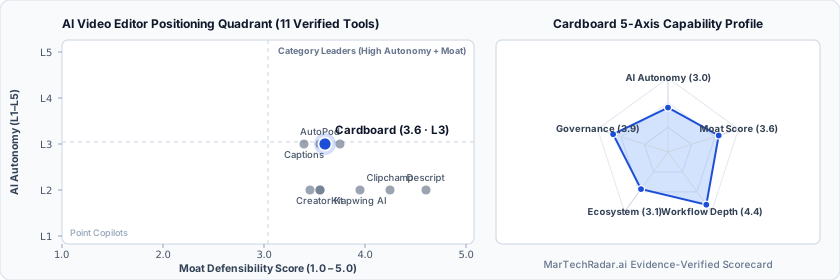
Cardboard is a Web SaaS tool for AI Video Editor (AI Video Repurposing & Shorts Editing) in Visual & Creative Media. Pricing: From $5/mo. Best suited to B2B SaaS and Marketing & Growth Teams. Editor ratings: AI autonomy L3 (conditional automation); moat score 3.6/5.0 (Proprietary moat). Fact-checked by Tim Fenolz on Oct 16, 2026.
Agentic browser and macOS video editor that reasons over raw footage to assemble launch videos, UGC ads, case studies, and shorts in minutes.
Cardboard buyer fit verdict: when to choose vs. when to walk away
Choose Cardboard if (Best Fit)
- Target ICP & Stack Fit: You operate as B2B SaaS and Marketing & Growth Teams requiring a Web SaaS deployment for AI Video Editor.
- L3 Architecture & Defensibility: Combining multimodal LLM footage reasoning with a native browser and macOS timeline editor lets growth teams go from raw video assets to editable multi-variant cuts in minutes.
- Commercial Model Fit: Your procurement budget aligns with From $5/mo.
Walk away from Cardboard if (Deal-Breakers)
- Walk away if your workflow requires uncapped enterprise volume on the From $5/mo entry plan without upgrading tiers.
- Walk away if your workflow cannot tolerate heavy 4k multi-cam rendering latency: While browser and lightweight Mac workflows excel at short-form marketing cuts, processing multi-hour 4K raw camera deliverables introduces indexing latency and bandwidth bottlenecks compared to local workstation suites.
- Walk away if generative b-roll credit consumption is a deal-breaker for your team: Iterating heavily with embedded third-party video generation models (such as Kling 2.5 or Hailuo) rapidly consumes monthly generative credits on entry plans, creating a cost trade-off for high-volume creative testing.
Cardboard key facts & scorecard
| Pricing | From $5/moVendor pricing page |
|---|---|
| Free plan | No / not disclosed |
| Delivery | Web SaaS |
| Audience | B2B SaaS, Marketing & Growth Teams |
| AI autonomy level | L3 · Conditional automationEditor-verified |
| Moat tier & score | 3.6 / 5.0 · Proprietary moatEditor-verified |
| Funding | Pre-seed |
| Total funding | $500K |
| Founders | Ishan Sharma, Saksham Aggarwal |
| Company size | 2-10 employees |
| Governance & docs | System Status ↗ · Changelog ↗ · Terms ↗ · Privacy ↗ |
| Headquarters | San Francisco, California |
| Founded | 2025 |
| Last verified |
Cardboard pros & cons: strengths vs. operational limitations
Pros: core strengths & capabilities
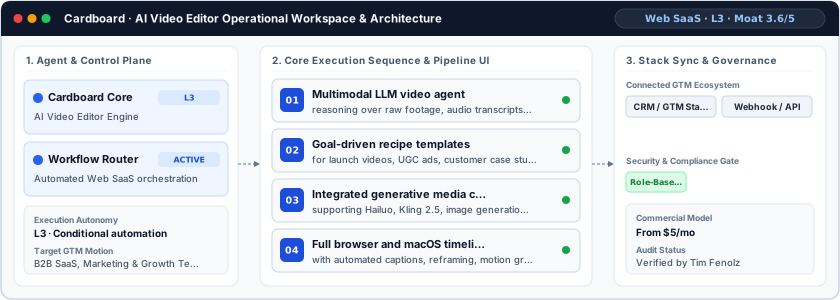
- Multimodal LLM video agent: reasoning over raw footage, audio transcripts, and visual b-roll
- Goal-driven recipe templates: for launch videos, UGC ads, customer case studies, and podcast clips
- Integrated generative media credits: supporting Hailuo, Kling 2.5, image generation, and AI music
- Full browser and macOS timeline editor: with automated captions, reframing, motion graphics, and NLE exports
Cons: operational limitations & risks
- Heavy 4K Multi-Cam Rendering Latency: While browser and lightweight Mac workflows excel at short-form marketing cuts, processing multi-hour 4K raw camera deliverables introduces indexing latency and bandwidth bottlenecks compared to local workstation suites.
- Generative B-Roll Credit Consumption: Iterating heavily with embedded third-party video generation models (such as Kling 2.5 or Hailuo) rapidly consumes monthly generative credits on entry plans, creating a cost trade-off for high-volume creative testing.
- Bespoke Keyframe Precision Boundary: Motion designers requiring granular Bezier curve graph editing or complex 3D compositing struggle with autonomous recipe abstractions, facing a creative control learning curve.
Cardboard TCO & deal-breaker stress test
Simulate 12-month stepped TCO, hidden cost multipliers, contract lock-in exposure, and stack failure modes using only facts verified by Tim Fenolz on · Capture SHA a9a686e9.
Cardboard aligns with your 5-seat / $800/mo profile. Review the walk-away triggers and contract levers below before deployment.
| Plan / Tier | Verified Rate | Scale Fit | Scope & Quota Notes |
|---|---|---|---|
| Lite | $5/mo | 1–2 seats | Free on Mac App |
| Free | $8/mo | 5 seats | Generative AI not included |
| Starter | $9/mo | 15 seats | Then $40 - $29/month |
- Moat Score
- 3.6 / 5.0
- AI Autonomy
- L3
- Free Tier / Trial
- None disclosed
Triggered audit signals & failure modes
- Published Self-Serve Entry FloorVerified Pricing Ledger
Cardboard publishes a transparent entry point (From $5/mo) for initial validation before committing.
- Tier Fit for 5-Seat Scale: Free ($8/mo)Verified Tier Schedule
Generative AI not included
- Primary Operational Bottleneck: Generative B-Roll Credit ConsumptionAudit by Tim Fenolz
Iterating heavily with embedded third-party video generation models (such as Kling 2.5 or Hailuo) rapidly consumes monthly generative credits on entry plans, creating a cost trade-off for high-volume creative testing.
Hidden TCO Multipliers & Quota Gates
- Annual Billing Headline vs. Monthly Premium: Headline entry rates reflect annual billing commitments (Save up to 61%); month-to-month flexibility carries a higher effective monthly rate or requires annual prepayment.
- Credit & Usage Burn Multiplier: Automated workflows consume metered credits/usage quotas; multi-step enrichment, voice minutes, or high-frequency agent runs can trigger mid-cycle top-up packs.
When to Walk Away & Negotiation Levers
- Walk away if your workflow requires uncapped enterprise volume on the From $5/mo entry plan without upgrading tiers.
- Walk away if your workflow cannot tolerate heavy 4k multi-cam rendering latency: While browser and lightweight Mac workflows excel at short-form marketing cuts, processing multi-hour 4K raw camera deliverables introduces indexing latency and bandwidth bottlenecks compared to local workstation suites.
- Walk away if generative b-roll credit consumption is a deal-breaker for your team: Iterating heavily with embedded third-party video generation models (such as Kling 2.5 or Hailuo) rapidly consumes monthly generative credits on entry plans, creating a cost trade-off for high-volume creative testing.
- Validate exact quota thresholds (seats, credits, or API calls) included in Cardboard's From $5/mo tier before converting from monthly to annual billing.
- Require a sandbox proof-of-concept testing heavy 4k multi-cam rendering latency against your live CRM/data schema before annual sign-off.
Ask a custom procurement or TCO stress-test question about Cardboard
Fits within $800/mo budget (From $12/mo)
Fits within $800/mo budget (From $14/mo)
Cardboard moat & subtrack positioning
Combining multimodal LLM footage reasoning with a native browser and macOS timeline editor lets growth teams go from raw video assets to editable multi-variant cuts in minutes.
Editorial review
Fact-checked by Tim Fenolz (Lead AdTech, Programmatic & Attribution Analyst) on .
Background
Founded in 2025 by Saksham Aggarwal and Ishan Sharma and headquartered in San Francisco, California, Cardboard (cardboard.ai) is an agentic video editor built for growth marketing teams, startup founders, and high-output creators across browser and macOS environments. Operating with a team of 2 to 10 employees and backed by $500K in Pre-Seed funding from Y Combinator (W26), the company eliminates multi-week agency post-production cycles by letting marketers drop in raw footage alongside a concrete campaign goal—such as generating three 30-second ad hooks or turning a customer interview into a polished case study—and receive an editable first cut in minutes.
How Cardboard works
Cardboard operates at Level 3 autonomy by pairing multimodal large language model footage comprehension with a hardware-accelerated web and native Mac timeline engine. When a user uploads raw talking-head takes, screen recordings, or product clips, the agentic pipeline indexes both spoken dialogue and visual frames to identify high-conviction soundbites, remove filler pauses, and align b-roll transitions. Users can invoke specialized production recipes—including Launch Videos, UGC Ads, Explainers, Product Demos, and Keyframed Portals—while orchestrating third-party generative models (such as Kling 2.5 and Hailuo), automated motion graphics, AI background music, and multi-aspect reframing before exporting finished renders or NLE project files.
Limitations
Operational limitations and technical trade-offs include:
- Heavy 4K Multi-Cam Rendering Latency: While browser and lightweight Mac workflows excel at short-form marketing cuts, processing multi-hour 4K raw camera deliverables introduces indexing latency and bandwidth bottlenecks compared to local workstation suites.
- Generative B-Roll Credit Consumption: Iterating heavily with embedded third-party video generation models (such as Kling 2.5 or Hailuo) rapidly consumes monthly generative credits on entry plans, creating a cost trade-off for high-volume creative testing.
- Bespoke Keyframe Precision Boundary: Motion designers requiring granular Bezier curve graph editing or complex 3D compositing struggle with autonomous recipe abstractions, facing a creative control learning curve.
Cardboard pricing
Cardboard offers tiered monthly and annual subscriptions alongside a free macOS app entry point. Paid plans include Lite ($5 for the first month, then $8 to $10/mo for standard editing, captions, and reframing), Starter ($9 for the first month, then $29 to $40/mo adding 400 generative credits, NLE exports, and stock footage), and higher-volume tiers scaling from $59 and $89/mo up to $175 and $250/mo for teams requiring larger generative credit pools.
How Cardboard compares
Within the AI Video Repurposing & Shorts Editing category, Cardboard competes against AI video editing alternatives such as Kestroll, Palmier, and Descript. Versus transcript-only editors like Descript or clip-only repurposers like OpusClip, Cardboard differentiates itself by combining multimodal visual footage reasoning with production recipes for launch videos, UGC ads, and customer case studies. Growth marketing teams and B2B SaaS storytellers choose Cardboard for rapid first cuts, whereas Hollywood colorists remain on DaVinci Resolve.
Frequently asked questions about Cardboard
How much does Cardboard cost and what pricing tiers are available?
Published pricing summary for Cardboard: From $5/mo. A permanent free plan is not disclosed for Cardboard. Verified tier schedule: Lite ($5/mo for 1–2 seats); Free ($8/mo for 5 seats); Starter ($9/mo for 15 seats). Cardboard offers tiered monthly and annual subscriptions alongside a free macOS app entry point.
How does Cardboard work and how autonomous is its AI architecture?
Agentic browser and macOS video editor that reasons over raw footage to assemble launch videos, UGC ads, case studies, and shorts in minutes. Within AI Video Editor (AI Video Repurposing & Shorts Editing), MarTechRadar rates its execution architecture at L3 · Conditional automation with a verified Moat Score of 3.6 / 5.0 (Proprietary moat). Combining multimodal LLM footage reasoning with a native browser and macOS timeline editor lets growth teams go from raw video assets to editable multi-variant cuts in minutes. Corporate profile: Founded by Ishan Sharma, Saksham Aggarwal, operating at 2-10 employees scale.
What are the main limitations of Cardboard and when should buyers walk away?
Based on our editorial technical audit, key operational considerations and boundaries for Cardboard include: (1) Heavy 4K Multi-Cam Rendering Latency: While browser and lightweight Mac workflows excel at short-form marketing cuts, processing multi-hour 4K raw camera deliverables introduces indexing latency and bandwidth bottlenecks compared to local workstation suites. (2) Generative B-Roll Credit Consumption: Iterating heavily with embedded third-party video generation models (such as Kling 2.5 or Hailuo) rapidly consumes monthly generative credits on entry plans, creating a cost trade-off for high-volume creative testing. (3) Bespoke Keyframe Precision Boundary: Motion designers requiring granular Bezier curve graph editing or complex 3D compositing struggle with autonomous recipe abstractions, facing a creative control learning curve. Primary procurement walk-away rule: Walk away if your workflow requires uncapped enterprise volume on the From $5/mo entry plan without upgrading tiers.
What integrations, compliance certifications, and contract terms apply to Cardboard?
First-party governance and developer endpoints verified on domain include: Status (https://status.cardboard.ai). Key TCO multiplier to watch: Annual Billing Headline vs. Monthly Premium (Headline entry rates reflect annual billing commitments (Save up to 61%); month-to-month flexibility carries a higher effective monthly rate or requires annual prepayment.) Before signing a contract, procurement teams should validate exact quota thresholds (seats, credits, or API calls) included in Cardboard's From $5/mo tier before converting from monthly to annual billing.
What are the best Cardboard alternatives and head-to-head competitors in 2026?
Top fact-checked alternatives to Cardboard in AI Video Editor (AI Video Repurposing & Shorts Editing) include Palmier (Free plan · $0/mo), Kestroll (Pricing not disclosed), Klap (From $14/mo), Submagic (From $12/mo). Within the AI Video Repurposing & Shorts Editing category, Cardboard competes against AI video editing alternatives such as Kestroll, Palmier, and Descript.
Verified sources & evidence trail
- Official product domain: https://cardboard.ai
- Commercial pricing verification: https://www.cardboard.ai/pricing
- Verified corporate entity profiles (
sameAs): LinkedIn Company Profile · Crunchbase Entity Record - First-party governance & documentation links: System Status · Changelog · Terms · Privacy
- Editorial audit sign-off: Fact-checked by Tim Fenolz on under the MarTechRadar Evidence-Ledger Protocol.