Descript Review (2026): AI Video Editor Pricing, Limits & Alternatives
Bottom line
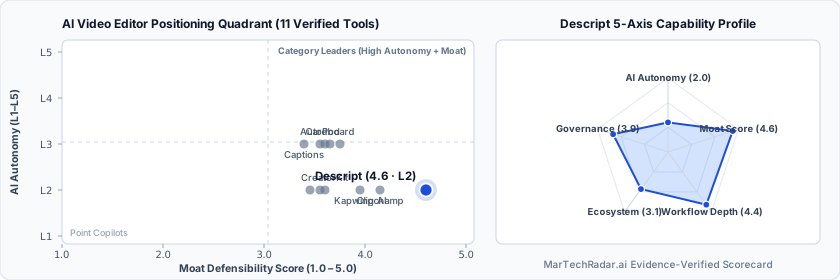
Descript is a Web SaaS tool for AI Video Editor (AI Video Repurposing & Shorts Editing) in Visual & Creative Media. Pricing: Free plan · $16–$65/mo · Enterprise plan. Best suited to B2B SaaS and Creators / Solo. Editor ratings: AI autonomy L2 (workflow copilot); moat score 4.6/5.0 (Proprietary moat (category leader)). Fact-checked by Anna Xia on Oct 4, 2026.
Descript is an AI-powered multimedia editing platform that unifies audio and video editing into a text-document workflow with automatic transcription.
Descript buyer fit verdict: when to choose vs. when to walk away
Choose Descript if (Best Fit)
- Target ICP & Stack Fit: You operate as B2B SaaS and Creators / Solo requiring a Web SaaS deployment for AI Video Editor.
- L2 Architecture & Defensibility: Descript's technical defensibility rests on its proprietary document-to-timeline synchronization engine and custom neural voice cloning models, reinforced by early investment and technical collaboration with the OpenAI Startup Fund.
- Commercial Model Fit: Your procurement budget aligns with Free plan · $16–$65/mo · Enterprise plan and want a self-serve free tier for zero-cost initial validation.
Walk away from Descript if (Deal-Breakers)
- Walk away if your workflow requires uncapped enterprise volume on the Free plan · $16–$65/mo · Enterprise plan entry plan without upgrading tiers.
- Walk away if your workflow cannot tolerate phonetic alignment drift: Complex multi-speaker overlap or non-standard regional dialects can desynchronize transcript timestamps from underlying video frames, requiring manual timeline micro-adjustments.
- Walk away if high-bitrate export latency is a deal-breaker for your team: Cloud rendering queues experience processing latency when compiling multi-cam compositions or heavy 4K timelines, constraining synchronous real-time review cycles.
Descript key facts & scorecard
| Pricing | Free plan · $16–$65/mo · Enterprise planVendor pricing page |
|---|---|
| Free plan | Yes |
| Delivery | Web SaaS |
| Audience | B2B SaaS, Creators / Solo |
| AI autonomy level | L2 · Workflow copilotEditor-verified |
| Moat tier & score | 4.6 / 5.0 · Proprietary moat (category leader)Editor-verified |
| Funding | Series C+ |
| Total funding | $100.0MBacked by OpenAI Startup Fund, Andreessen Horowitz |
| Founders | Andrew Mason |
| Company size | 51-200 employees |
| Governance & docs | Trust & Security ↗ · System Status ↗ · Changelog ↗ · Terms ↗ · Privacy ↗ |
| Headquarters | San Francisco, United States |
| Founded | 2017 |
| Last verified |
Descript pros & cons: strengths vs. operational limitations
Pros: core strengths & capabilities
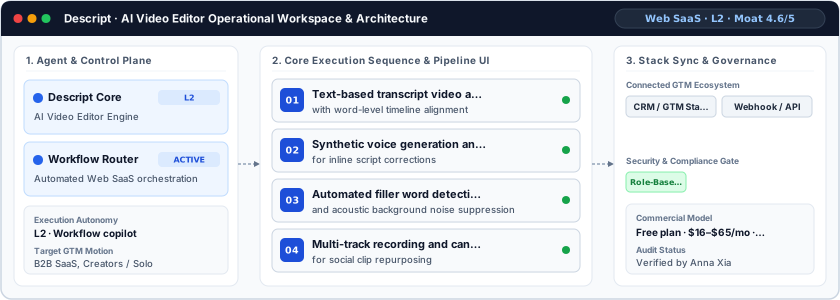
- Text-based transcript video and audio editing: with word-level timeline alignment
- Synthetic voice generation and voice cloning: for inline script corrections
- Automated filler word detection: and acoustic background noise suppression
- Multi-track recording and canvas layouts: for social clip repurposing
Cons: operational limitations & risks
- Phonetic Alignment Drift: Complex multi-speaker overlap or non-standard regional dialects can desynchronize transcript timestamps from underlying video frames, requiring manual timeline micro-adjustments.
- High-Bitrate Export Latency: Cloud rendering queues experience processing latency when compiling multi-cam compositions or heavy 4K timelines, constraining synchronous real-time review cycles.
- Advanced Color Correction Ceilings: The editing canvas lacks node-based color grading, color look-up table management, and precision sub-frame masking needed for broadcast-grade post-production specifications.
Descript TCO & deal-breaker stress test
Simulate 12-month stepped TCO, hidden cost multipliers, contract lock-in exposure, and stack failure modes using only facts verified by Anna Xia on · Capture SHA f7d4247f.
Descript aligns with your 5-seat / $800/mo profile. Review the walk-away triggers and contract levers below before deployment.
| Plan / Tier | Verified Rate | Scale Fit | Scope & Quota Notes |
|---|---|---|---|
| Free / Sandbox | $0 | 1–2 seats (Evaluation) | Entry free tier with capped usage or feature quotas for initial workflow testing. |
| Entry / Starter | $16/mo | 1–2 seats | Elevate your projects, watermark-free |
| Business | $65/mo | 5 seats | Scale to a team of 5 (billed separately) |
| Enterprise / Custom | Custom quote | 15–50+ seats (Enterprise SLA) | Sales-negotiated annual contract for custom volume, SSO/RBAC governance, and dedicated SLA. |
- Moat Score
- 4.6 / 5.0
- AI Autonomy
- L2
- Free Tier / Trial
- Free plan
Triggered audit signals & failure modes
- Published Self-Serve Entry FloorVerified Pricing Ledger
Descript publishes a transparent entry point (Free plan · $16–$65/mo · Enterprise plan) with a free tier for initial validation before committing.
- Tier Fit for 5-Seat Scale: Business ($65/mo)Verified Tier Schedule
Scale to a team of 5 (billed separately)
- Primary Operational Bottleneck: Phonetic Alignment DriftAudit by Anna Xia
Complex multi-speaker overlap or non-standard regional dialects can desynchronize transcript timestamps from underlying video frames, requiring manual timeline micro-adjustments.
Hidden TCO Multipliers & Quota Gates
- Credit & Usage Burn Multiplier: Automated workflows consume metered credits/usage quotas; multi-step enrichment, voice minutes, or high-frequency agent runs can trigger mid-cycle top-up packs.
- Enterprise Governance & Add-On Gating: Advanced capabilities such as Single Sign-On (SSO), custom role permissions, or specialized analytics modules are gated behind upper tiers or paid add-ons.
When to Walk Away & Negotiation Levers
- Walk away if your workflow requires uncapped enterprise volume on the Free plan · $16–$65/mo · Enterprise plan entry plan without upgrading tiers.
- Walk away if your workflow cannot tolerate phonetic alignment drift: Complex multi-speaker overlap or non-standard regional dialects can desynchronize transcript timestamps from underlying video frames, requiring manual timeline micro-adjustments.
- Walk away if high-bitrate export latency is a deal-breaker for your team: Cloud rendering queues experience processing latency when compiling multi-cam compositions or heavy 4K timelines, constraining synchronous real-time review cycles.
- Validate exact quota thresholds (seats, credits, or API calls) included in Descript's Free plan · $16–$65/mo · Enterprise plan tier before converting from monthly to annual billing.
- Require a sandbox proof-of-concept testing phonetic alignment drift against your live CRM/data schema before annual sign-off.
Ask a custom procurement or TCO stress-test question about Descript
Lower 5-seat floor (~$10/mo vs. $65 / mo)
Lower 5-seat floor (~$16/mo vs. $65 / mo)
Descript moat & subtrack positioning
Descript's technical defensibility rests on its proprietary document-to-timeline synchronization engine and custom neural voice cloning models, reinforced by early investment and technical collaboration with the OpenAI Startup Fund.
Editorial review
Fact-checked by Anna Xia (Senior B2B GTM & Revenue Systems Analyst) on .
Background
Architectured around a transcript-first processing paradigm, Descript replaces traditional non-linear timecode editors with document-based media manipulation. Headquartered in San Francisco, United States, and founded in 2017, the company has secured $100.0M in venture funding to rebuild audiovisual production workflows. Target buyers encompass B2B product marketing managers, corporate communications teams, and media repurposing specialists who require rapid narrative editing without dedicated non-linear editing overhead.
How Descript works
The platform functions by processing ingested audio and video files through an automated speech-to-text pipeline, synchronizing words directly to underlying AV timeline clips. Editing text strings automatically truncates or resequences corresponding media samples. Integrated voice synthesis pipelines generate inline voice cloning for script corrections, while machine learning models identify acoustic anomalies, purge filler words, and isolate speech signals via automated spectral gating without requiring manual sound-board configuration.
Limitations
Operational considerations and platform boundaries include:
- Phonetic Alignment Drift: Complex multi-speaker overlap or non-standard regional dialects can desynchronize transcript timestamps from underlying video frames, requiring manual timeline micro-adjustments.
- High-Bitrate Export Latency: Cloud rendering queues experience processing latency when compiling multi-cam compositions or heavy 4K timelines, constraining synchronous real-time review cycles.
- Advanced Color Correction Ceilings: The editing canvas lacks node-based color grading, color look-up table management, and precision sub-frame masking needed for broadcast-grade post-production specifications.
Descript pricing
Descript operates a tiered SaaS model combining fixed seat licensing with compute limits. Beyond its foundational free tier, self-serve paid tiers range from $16 to $65 per person monthly, differing by monthly transcription allocation hours, export resolutions, and access to advanced synthetic voice generation features. Enterprise deployments require custom contracts covering consolidated billing, SSO, and administrative permission governance.
How Descript compares
Relative to browser-based collaborative editors like Kapwing AI, Descript provides superior text-linked audio precision but trades off lightweight browser agility for native client installations. Compared to programmatic shorts-generation tools like Munch and Kite, Descript focuses on fine-grained editorial revision rather than fully autonomous metric-driven clip extraction. It serves organizations seeking editorial narrative control through document interfaces over pure autonomous snippet creation.
Direct competitors & market radar
Top algorithmic competitors based on category positioning, capability overlap, and ICP alignment.
Frequently asked questions about Descript
How much does Descript cost and what pricing tiers are available?
Published pricing summary for Descript: Free plan · $16–$65/mo · Enterprise plan. Descript includes a free tier or sandbox entry point. Verified tier schedule: Free / Sandbox ($0 for 1–2 seats (Evaluation)); Entry / Starter ($16/mo for 1–2 seats); Business ($65/mo for 5 seats); Enterprise / Custom (Custom quote for 15–50+ seats (Enterprise SLA)). Descript operates a tiered SaaS model combining fixed seat licensing with compute limits.
How does Descript work and how autonomous is its AI architecture?
Descript is an AI-powered multimedia editing platform that unifies audio and video editing into a text-document workflow with automatic transcription. Within AI Video Editor (AI Video Repurposing & Shorts Editing), MarTechRadar rates its execution architecture at L2 · Workflow copilot with a verified Moat Score of 4.6 / 5.0 (Proprietary moat (category leader)). Descript's technical defensibility rests on its proprietary document-to-timeline synchronization engine and custom neural voice cloning models, reinforced by early investment and technical collaboration with the OpenAI Startup Fund. Corporate profile: Founded by Andrew Mason, operating at 51-200 employees scale.
What are the main limitations of Descript and when should buyers walk away?
Based on our editorial technical audit, key operational considerations and boundaries for Descript include: (1) Phonetic Alignment Drift: Complex multi-speaker overlap or non-standard regional dialects can desynchronize transcript timestamps from underlying video frames, requiring manual timeline micro-adjustments. (2) High-Bitrate Export Latency: Cloud rendering queues experience processing latency when compiling multi-cam compositions or heavy 4K timelines, constraining synchronous real-time review cycles. (3) Advanced Color Correction Ceilings: The editing canvas lacks node-based color grading, color look-up table management, and precision sub-frame masking needed for broadcast-grade post-production specifications. Primary procurement walk-away rule: Walk away if your workflow requires uncapped enterprise volume on the Free plan · $16–$65/mo · Enterprise plan entry plan without upgrading tiers.
What integrations, compliance certifications, and contract terms apply to Descript?
First-party governance and developer endpoints verified on domain include: Trust/Security (https://www.descript.com/security), Status (https://status.descript.com). Key TCO multiplier to watch: Credit & Usage Burn Multiplier (Automated workflows consume metered credits/usage quotas; multi-step enrichment, voice minutes, or high-frequency agent runs can trigger mid-cycle top-up packs.) Before signing a contract, procurement teams should validate exact quota thresholds (seats, credits, or API calls) included in Descript's Free plan · $16–$65/mo · Enterprise plan tier before converting from monthly to annual billing.
What are the best Descript alternatives and head-to-head competitors in 2026?
Top fact-checked alternatives to Descript in AI Video Editor (AI Video Repurposing & Shorts Editing) include Munch ($38–$398/mo), Kite (From $40/mo), Kapwing AI (Free plan · $16–$50/mo), Pictory (From $25/mo). Relative to browser-based collaborative editors like Kapwing AI, Descript provides superior text-linked audio precision but trades off lightweight browser agility for native client installations.
Verified sources & evidence trail
- Official product domain: https://descript.com
- Commercial pricing verification: https://www.descript.com/pricing
- Verified corporate entity profiles (
sameAs): LinkedIn Company Profile · Crunchbase Entity Record - First-party governance & documentation links: Trust & Security · System Status · Changelog · Terms · Privacy
- Editorial audit sign-off: Fact-checked by Anna Xia on under the MarTechRadar Evidence-Ledger Protocol.